
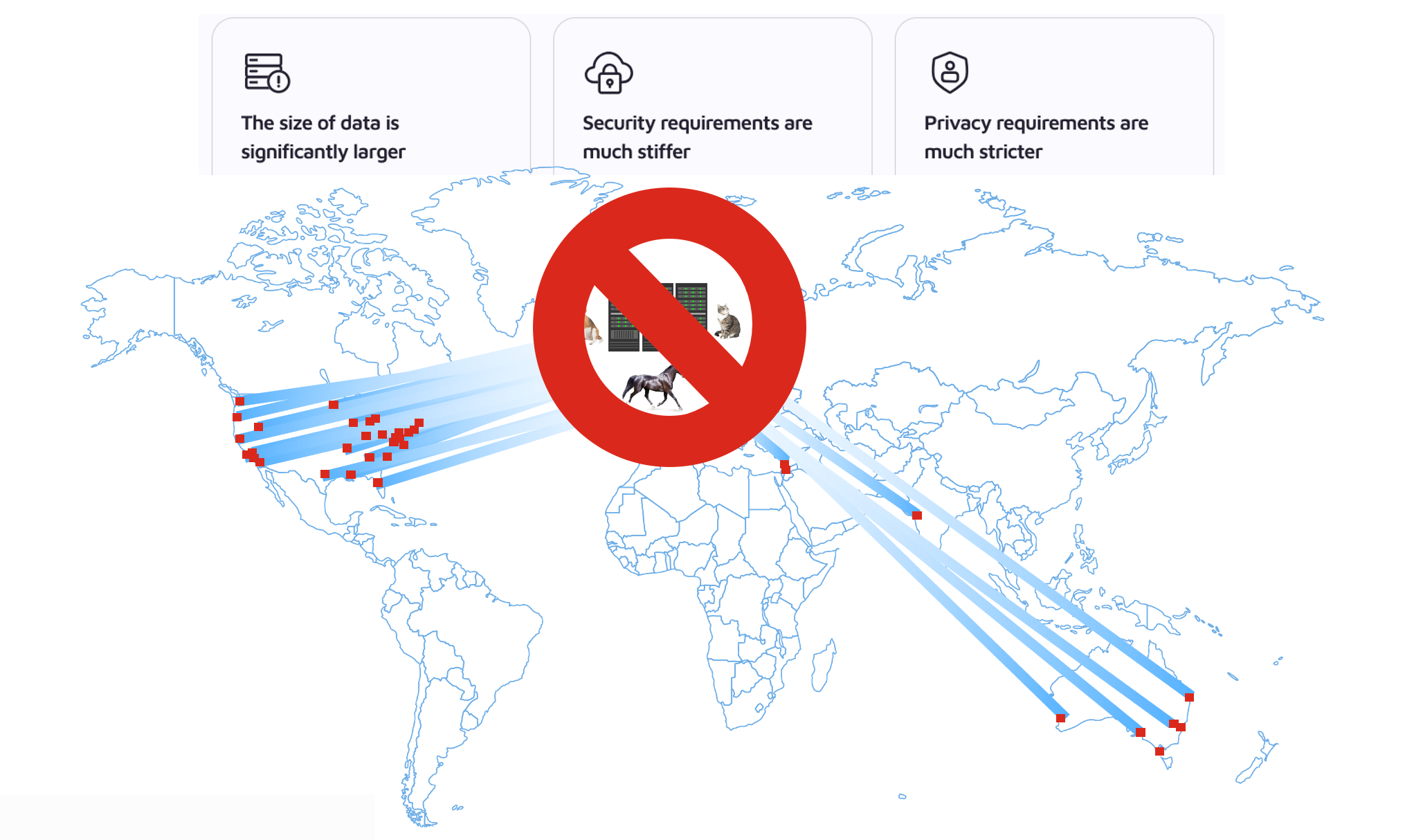
Artificial intelligence (AI) agents, not building more medical schools, hold the key to eliminating healthcare inequality locally and globally. Consumer AI applications have made dramatic progress over the last decade based on deep learning technology, the availability of large quantities of diverse data and a centralized architecture approach. Unfortunately, the centralized AI cloud infrastructure will not work for AI applications in medicine.
As we’ve seen in the previous post, even in adult medicine most of the data comes from 3 states and 2 countries. But it’s not that the data is not there. It’s just most of it is digital exhaust. In pediatric cardiology, the 500 children’s hospitals in the world produce about 6,000,000 TB of cardiac echo data per year. That’s 100,000x the amount of data available in the centralized NIH Imaging Data Commons. Imagine the accuracy that could be achieved in diagnosing every pediatric cardiology condition locally, while making this data globally available to train AI agents.
The question is: couldn’t we simply repeat ImageNet and aggregate the data in some central site? Let’s start by choosing a location – a data center in Ireland. There are at least five challenges.
1. Centralized architectures are not network preserving
Your first consideration will be the network cost to move the cardiac echo data from Gertrude’s Children’s in Kenya, HCM in Brazil or Nemours in the US to Ireland. Some locations will have more and less reliable network connections. And as everyone familiar with today’s cloud service providers, there will be another network cost to transfer data from the central site to any other location.
2. Centralized architectures are not application-friendly.
Aggregation of data in a centralized architecture, repository, or data commons inherently requires that the data be organized. Anytime a database is created, along with it comes a schema, or a designated way to organize the data. Unfortunately, a schema perfectly designed for one application might be nearly impossible to use for another application. Years of building enterprise software have taught us this harsh lesson.
3. Centralized architectures are not real-time.
To understand why real-time access to accurate AI-generated learning is important, simply imagine if an autonomous car needed a central server to decide what to do at every turn and crossing sign, to recognize and avoid a pedestrian. The latency between requesting a decision and retrieving it from a centralized architecture, based in Ireland, is unacceptable: at 15 miles per hour, the vehicle would cover 22 feet every second. The same challenge applies to any real-time pediatric application where every second counts.
4. Centralized architectures are not privacy-preserving.
Let us assume we agree to aggregate all pediatric echocardiographic data from around the world in Ireland. How would we preserve privacy for a patient in California whose data is sent to Ireland? How would we control who could access that data? And how might we set limits on which data is shared? Someone in Ireland with no connection to the patient may have access not only to a patient’s pediatric echo data, but their personally identifying information as well.
These questions bring to the forefront an important consideration of data sharing and privacy known as “Purpose Limitation”. In a world where we increasingly expect specified data to be used only with our permission, by certain people and for clearly defined purposes, accumulating data in a centralized architecture offers the opposite, with no stated purpose other than keeping the data for the future does nothing to preserve privacy.
5. Centralized architectures can violate data residency/sovereignty
Organizations sometimes require that their data is stored in a specific location or region within the country. Sovereignty takes data control a step further by subjecting data to the laws of the country in which it resides. More simply, in our example, many jurisdictions would veto the storage of healthcare data in Ireland.
While the centralized architectures have powered the development of many consumer AI applications to date, there are multiple reasons why this is not the right approach for the training and deployment of AI applications for use in pediatric healthcare. Centralized architectures are simply not application friendly, not network preserving, not real-time, and not privacy preserving. What we really need for healthcare and life sciences is a privacy-preserving, global, real-time distributed AI cloud infrastructure.
No posts
Comments
Nothing yet. Say the first thing.
Sign in to join the conversation.