

For a time it was England’s most famous story. 1170: King Henry II wonders if anyone might rid him of the turbulent priest Thomas Becket. Four knights hear his musing and slay Becket in Canterbury Cathedral. Phenomenal outrage ensues: Henry makes a penitential walk to the cathedral, and so, across the following centuries, have pilgrims from all over the world.
In the 14th century, those pilgrims became the subject of England’s most famous author. Geoffrey Chaucer’s The Canterbury Tales narrated a band of pilgrims narrating a selection of stories with a little less piety and a little more bawd. “Erses” flew out of windows, “farts” flew out of those, and stumbling into the wrong bed was always occasion for a night of “merry fits” with the incumbent.
Those glories lasted some time. But Becket’s shrine got smashed up six Henries later, and Chaucer lost some of his public once English stopped being middle. Lately, though, the nation’s young are finding themselves newly drawn to the religious; in fact, we hear of a religious revival. No one quite knows why. This was one of the many questions I had time to ponder as I walked the five days and 160km from Southwark to Canterbury last week.
The first cathedral I fell for was Durham. The Wear forms a near-loop around a wooded escarpment and on the high plateau shines what Harold Evans, editor of the Northern Echo before the Times, called “the most dramatic and exciting architectural site in the world”. Later, I got into other cathedrals, such as Salisbury, which has Britain’s tallest spire and an original copy of the Magna Carta. Each trip I made further justified the opinion of Paul Johnson, editor of this magazine from 1965 to 1970: that the cathedrals of north-west Europe in general, and of England in particular, were “the noblest of human artefacts”.
As it turns out, I’m not the only young cathedrophile. When I started posting cathedral reviews online, others gathered. It seemed time to propose a pilgrimage. And the destination – the destiny – could have only ever been Canterbury.
Some of my readers had been already. They told me to look out for oasts, the white chimney tips used for the special drying of hops, and said the “little old ladies” in the churches along the way would prepare treats if we “let them know” we were coming. Sadly, no contact information for the little old ladies was provided.
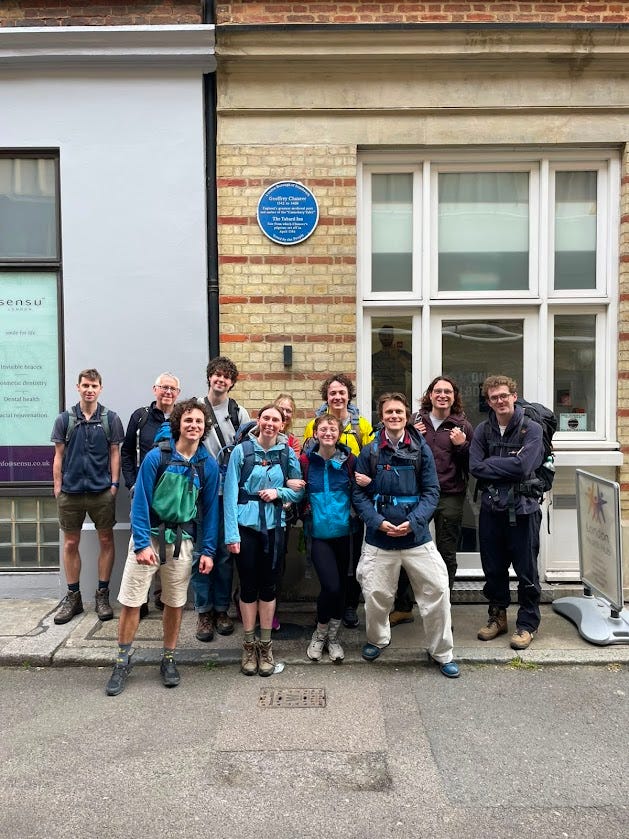
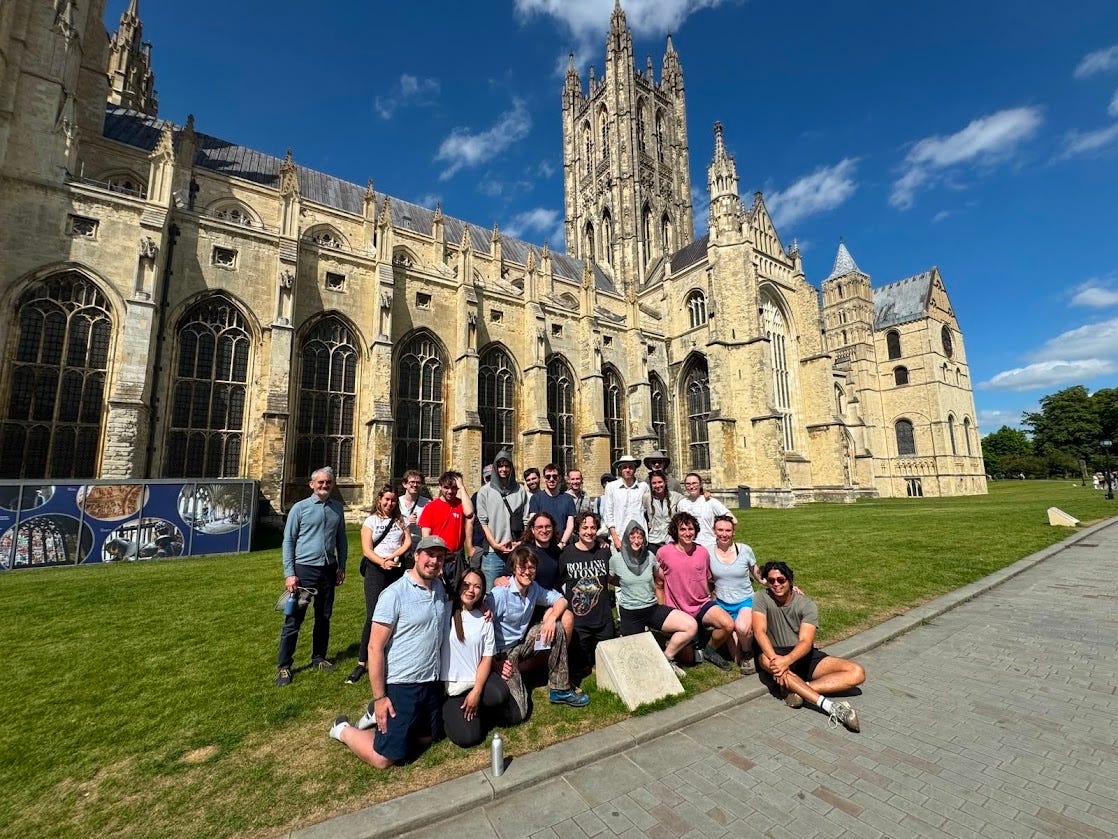
It was from the Tabard Inn that Chaucer’s happy band embarked in 1387, and it was from the bin in an alley where the Tabard Inn used to be that we set off. Minus a few dog-ate-my-pilgrim’s-passporters who dropped out the night before, there were 11 of us that morning, and our number rose to 28 in the course of the trip, just one short of Chaucer’s original count.
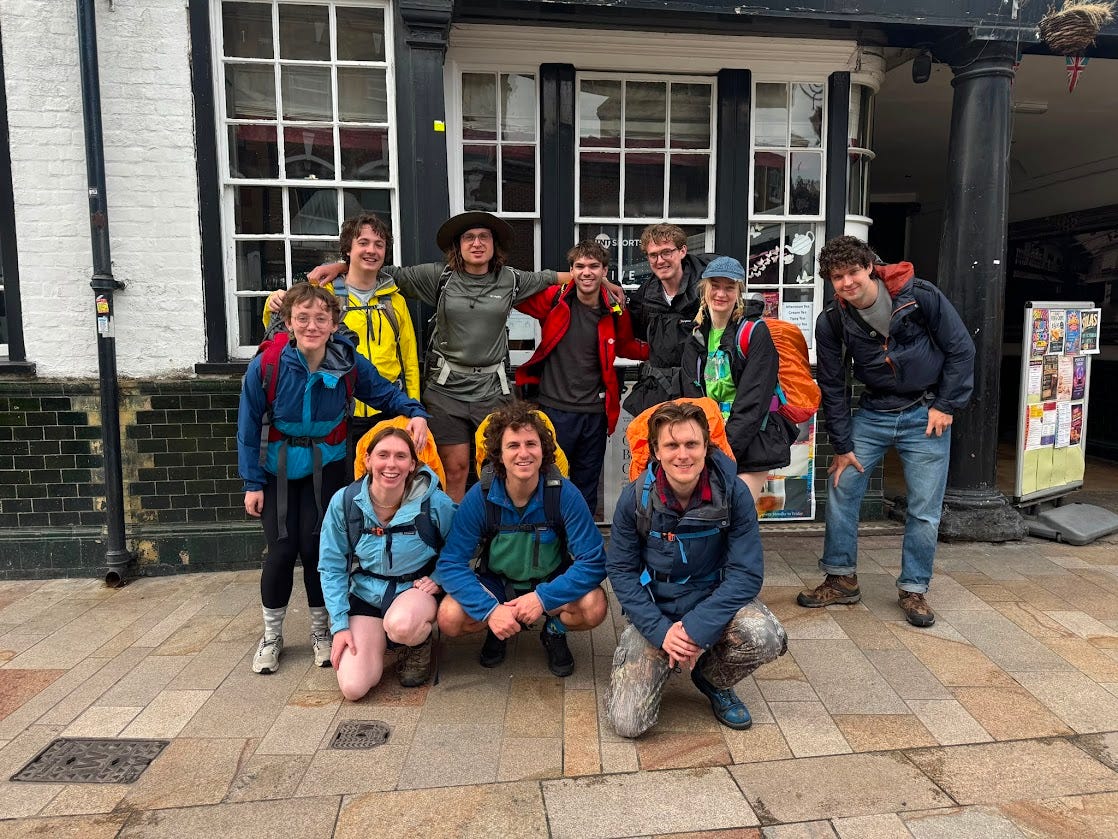
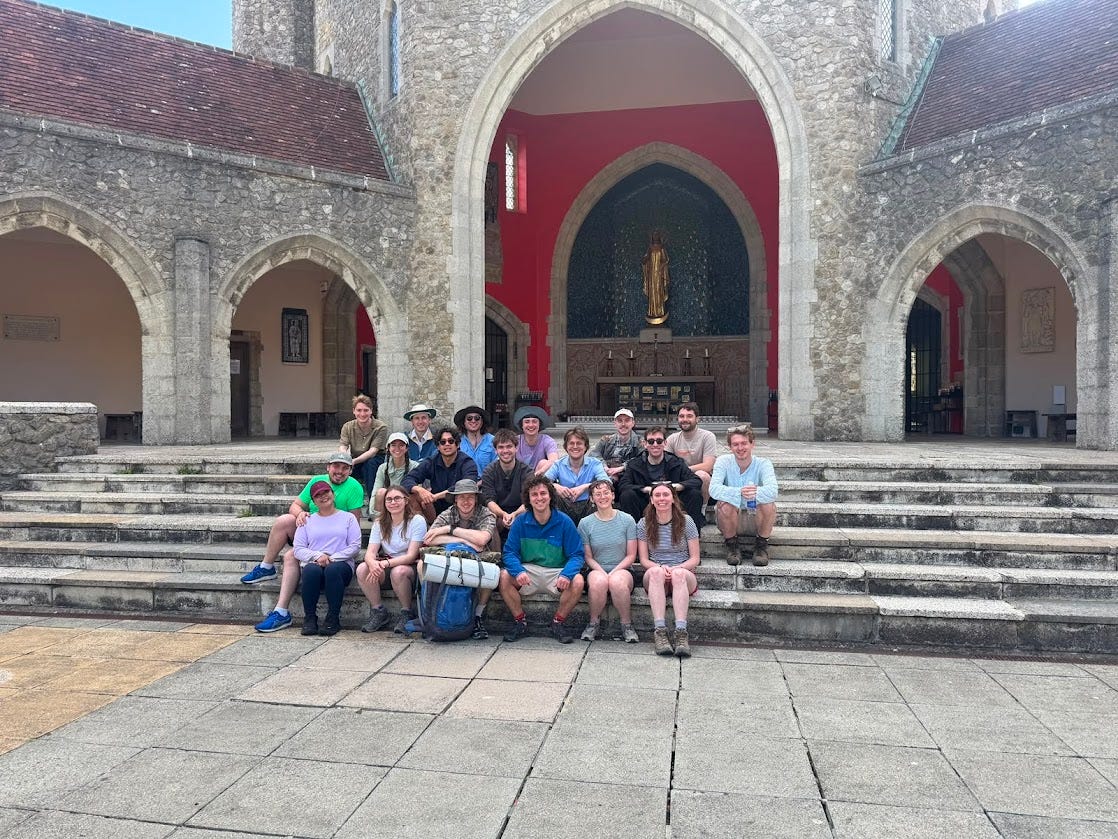
We were mostly in our mid-to-late twenties, though that didn’t deter constant shouts of: “Are you doing Duke of Edinburgh?” from drivers passing by. Only once did an actual D of E group ask us, and then as we neared one said, quite dispiritingly, “oh”. We displayed mixed professions and very mixed preparations. There were students and doctors and coders and consultants. Certain pilgrims sported professional-hiking calves, while others wore Charles Tyrwhitt shirts and Doc Martens.
It was a long walk through liminal outer London, where shopping trolleys sink into beach mud, wild ponies run in the shadow of estuary infrastructure, and huge landfills are grown over into grassy islands. By evening, we were all merry in Dartford’s Royal Victoria and Bull Inn, having broken at last into lovely Kent, restoring ourselves with classic pub meals. (One of our fellow pilgrims committed to “English peasant food only”, but soon resigned the gimmick after discovering that potatoes are “New World”.)
We felt proud of our 38km and 50,000 steps. The distance felt impressive until one pilgrim headed home: we cockily enquired how late into the night his train back to London would take him. He answered: “Oh, are you sure you want to know? Thirty minutes.” That measure remained pretty devastating throughout our pilgrimage. In our first three days our time back to London progressed from 30 to 40 to 45 minutes. In the last two, we reached a faster train line and our return time actually decreased. Passing trains awed us. “That looks fast,” we mouthed, “and smooth.”
On foot, the days were long, and demanded some resourcefulness even beyond that shown by Chaucer’s crew. In his day the inns were so numerous that you never had to worry about room or board. After a blistering 34.2km, our second night was spent in a field – and not our intended one. I cede my right to slumber peacefully in an English field to no man but to every sheep, and our plot had been occupied by baaing invaders.
Luckily a nearby meadow of damp long grass welcomed us. Most of us slept in “bivvy bags” purchased from goarmy.co.uk, an army surplus store that sometimes delivers your goods covered in mud. We baggers envied the one pilgrim in a tent, but he faced his own challenges; having forgotten most of his kit, he was choosing whether his one towel would be pillow, mattress or blanket. I was in crisis too: the socks I had bought that promised to endure substantial mileage – as denoted by the “100m” sewn into them – turned out simply to say, the other way round, “wool”. From the next field, the sheep laughed cruelly.
But it was all justified as we awakened to a broad, pure morning. We then reached more classical pilgrim pathways – soft old holloways and gorgeous ridges. We rested at the Aylesford Priory, a 13th-century monastery dissolved by Henry VIII, now home to six cassocked worshippers. The gardens were alive with rabbits and geese, we ate in a 12th-century dining hall, and the centrepiece of the site was a fabulous outdoor stone piazza chapel. Our jolly gaggle didn’t quite gel with the order’s… well, order: dinner was at exactly 7pm, or you weren’t getting any.
The Tudor pub in the village passed the test of a good old pub: you couldn’t get through the door without stooping. We sat in the evening sun on the outdoor terrace and waved in the weekend pilgrims as they arrived across the stone bridge over the river. Somehow, despite being almost 100km from London, locals still answered the information that we had set off from the capital with: “What, this morning then?”
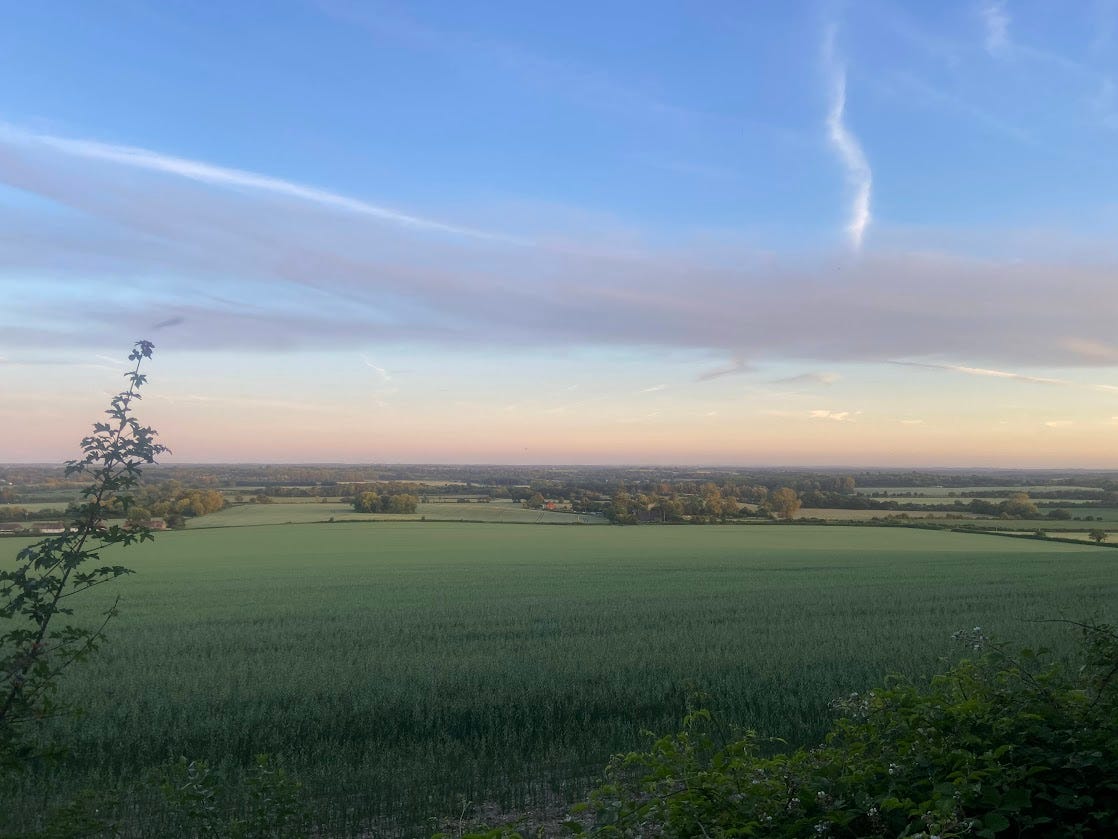
Saturday was the hardest day of all, long and hot and weary. But the walk took us through beautiful valleys, forests, orchards, vineyards and hop fields, and all of it was “blest by suns of home”. As we neared the end of the day, it was hard not to be quite overcome. Once, as we climbed through a field of cool blue wheat, the sun began to go down, and it just didn’t feel possible to look back and hold the gaze of the country: it was somehow too heartbreaking.
Friends, parents and loved ones joined us for the final leg the next morning. It wasn’t a great time for the path to become hilly, but our hearts soared as the cathedral finally shimmered into view. Drivers honked their horns at us, welcoming us in. The cathedral staff looked at the stamps on our pilgrim’s passports and let us in for free, happy to welcome the largest and youngest group they had yet seen. We made our weary, ecstatic entry.
The masters can do the talking here. As Johnson said, our cathedrals are the noblest of human artefacts, and as Simon Jenkins said, “Canterbury is the story of the English cathedral, complete unto itself.” We left and went home, as Chaucer might have put it, “with full glad heart”. Anyone for Durham to Lindisfarne?
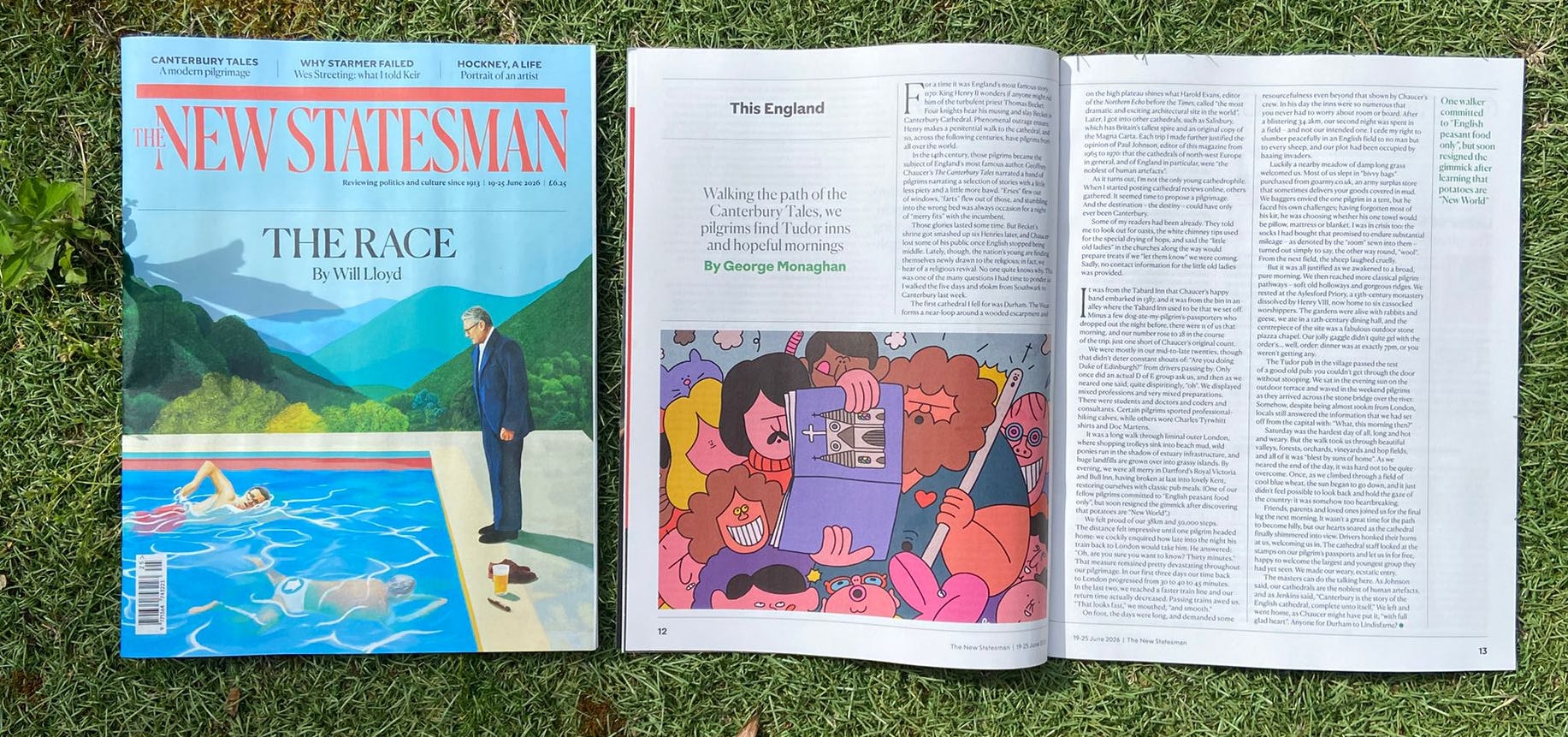
The above ran in this week’s New Statesman. I got back Sunday, drafted Monday, and implemented the edits Tuesday morning. I felt proud to appear in such a beautiful issue, which featured cover art honouring David Hockney and a dazzling Will Lloyd cover story.
Canterbury takes the highest open position in our cathedral rankings, which is second. It was made by the epic approach. Inside, the most ravishing element was the murder site, which hummed with dark gravity. You could look up, and see the dark stained glass windows, as the dying Becket must have seen them, slanted and vespertine, less admitting than forbidding the outside light.
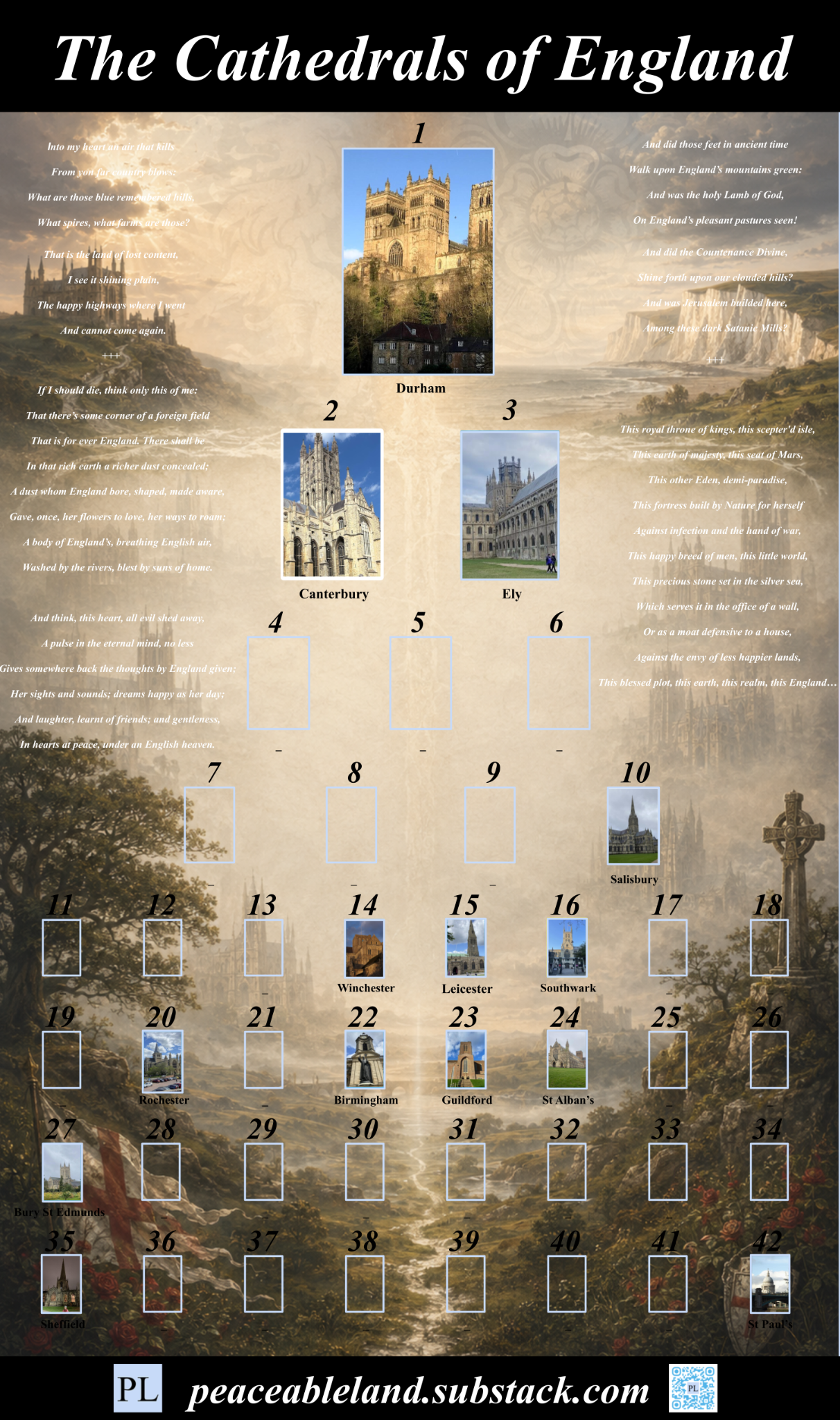
Heading to the tube the next day, all those poems in that chart seemed fair cause for tears, especially, to the lower left, Rupert Brooke’s “The Soldier”. Our journey made memories that will last forever and passed as a five-day spell of aching bliss. Thank you Sam, Beth, Bertie, Paul, Alex, Cosmo, Paul, Josh, Raph, Tristan, Nick, Alex, John, Ethan, Josh, Roselle, Harry, Sam, Bernhard, Tom, Mia, Andy, Maya, Lily, Mum, Dad, and Uncle Niall for coming. If you have ever enjoyed PL, please try the writings of the following pilgrims:
Paul George’s Forgotten History Matters
Joshua Gaskell’s The Rest is Literature
John Phipps’s Paintings!
Harry Thomas’s Skellig Michael
Sam Summers Sweet Airs
If of interest, I reviewed a new novel, High and Low by Amanda Craig. The review begins:
The state of the nation is that the nation’s in a state. But we know that. That’s the news. That’s the high street. That’s the wallet. Raising our present lot to state-of-the-nation art – explanatory and instructive in all the ways we like – requires a technique beyond mere reporting and a talent beyond mere noticing. Amanda Craig’s new novel High and Low is a fresh attempt to make meaning of our mess and, all told, an enjoyable one.
Thanks so much as ever folks. I hope you have a nice weekend and that your team flourishes in the World Cup – at least until it is slain by England. Some photos of our trip below.
All my best
GM

No posts
Comments
Nothing yet. Say the first thing.
Sign in to join the conversation.