

With any luck, folks, as you receive this me and about thirty other pilgrims are closing in on Canterbury Cathedral at the end of our ninety mile walk. That will have been hard but rewarding, just like it was last weekend to read the model text, Geoffrey Chaucer’s 14th-century masterwork, The Canterbury Tales. As people seemed quite impressed, I thought I’d write a little about reading difficult stuff. The first rule is not to leave it so late that you end up in Decathlon, grappling with an inflatable camping mattress in one hand and with The Pardoner’s Tale in the other.
A blog I loved years ago was “The 100 Greatest Books Challenge”. It now looks worryingly defunct, but I used to take lots of suggestions from that page, and from the lists the author made, one of which was about the ten most difficult books to read. So far as I can tell from that, and from my own reading, difficult reads are usually old, long, or complicated. Chaucer was all three: old, long, and complex. But there are ways through all those difficulties.
With old shit like Chaucer or Shakespeare, get hold of a version with ready annotations. That means on the same page in paper copies, and clickable on Kindle. After that, just trust that a few key words will unlock most of the meaning. Once you have your anons (“soon”) and your wots (“know”) down it actually comes fairly fluently.
With long books just divide the pagecount by thirty and read that much everyday. Sometimes, like in Moby Dick or The Brothers Karamazov, there is a monomaniacal character from whom you can borrow an obsessive frenzy, but otherwise the simple maths is enough. Even thousand pagers fall in a month like this.
With complicated shit I’ve found it best to read chapter summaries before. I did that with Ulysses and Gravity’s Rainbow. It helps you to find meaning when adrift. With the Canterbury Tales, I may or may not have had ChatGPT brief me on the contents before each chapter…
But the truest and deepest advice of all is William Faulkner on Ulysses. Approach it “as the illiterate Baptist preacher approaches the Old Testament – with faith.” Most of the time, these hard old tomes have survived for a reason, and contain at least some treasure. Then the Shakespeares and Joyces and Tolstoys and Melvilles and so on come to feel essential to all of the life that follows your reading them.
Chaucer has left me with a simple rude cheer since I read it. I suppose the name for it lies somewhere in the field of bawdiness, revelry, ribald, pleasance, swiving, pagan, mirth and so on. As it’s so remote, locating it in cultural-linguistic history would be hard. But it is easy – and merry – to feel.
Hopefully that mirth has reached Canterbury, rather than blistering and bursting along the way. I can’t wait to see it. Simon Jenkins starts his chapter: “Canterbury is England’s premier cathedral. It is also the nation’s most exhilarating gothic building. From Bell Harry Tower to Becket’s martyrdom, from the ghosts of Chaucer’s pilgrims to the Norman crypt capitals, it forms an incomparable collection of medieval art.”
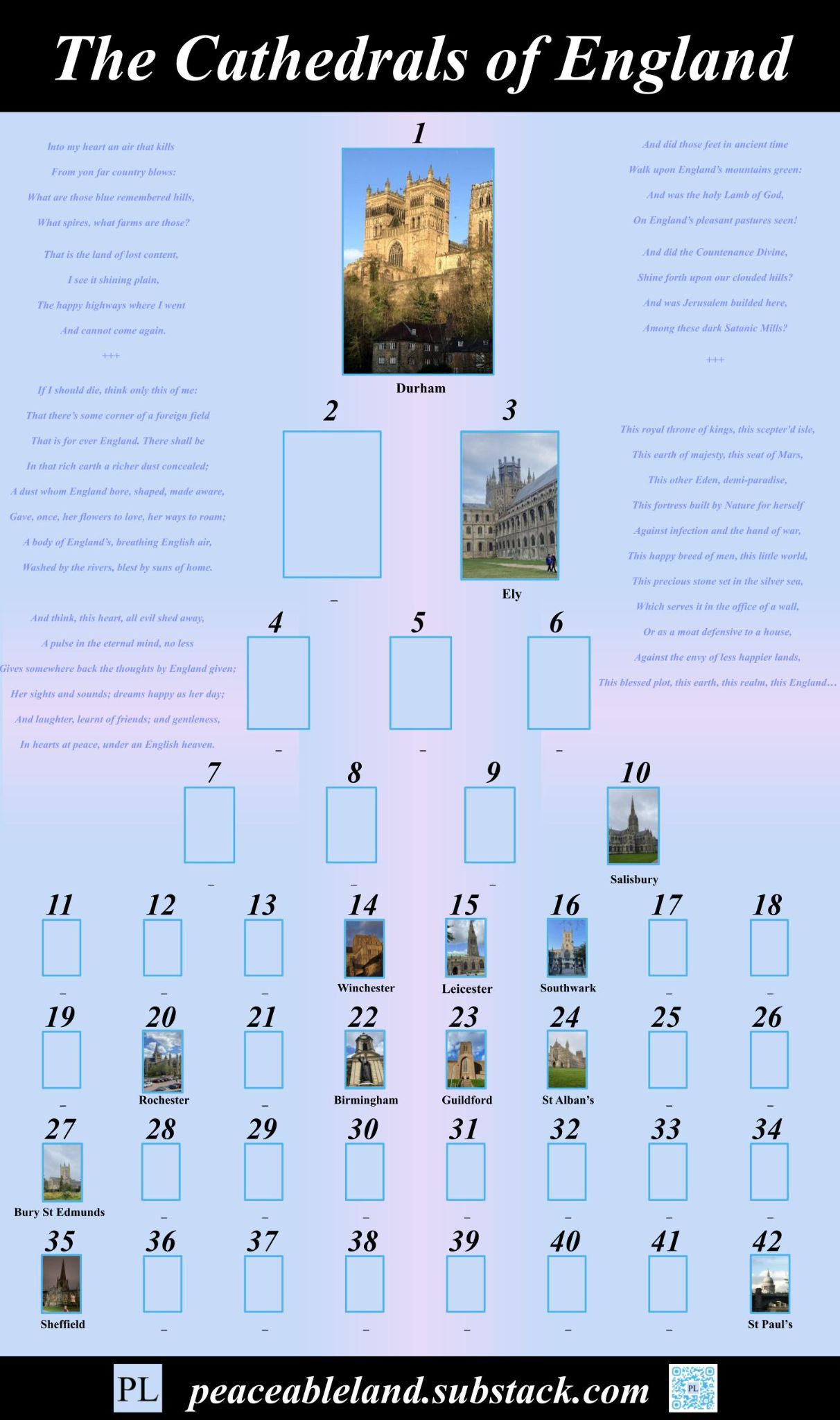
I’ll try to write the trip up for next Sunday. Here, as a reminder, are the present cathedral rankings:
I hope you have a merry weekend.
All my best
GM
No posts
Comments
Nothing yet. Say the first thing.
Sign in to join the conversation.