
Despite my career in medicine, I’ve always fashioned myself more of a historian. In fact, every astrologer who's ever looked at my chart (not at my urging, but at the request of others) always says the same thing: I should have been a teacher, and I have a particular mark, apparently often seen in mentally incompetent people, that makes others want to take care of them.
I accept these attributes because I know they are true.
Back when we had supermarkets, my mother and grandmother would buy certain encyclopedia-type works which came out at the rate of one volume per week. These were American Heritage-type books, history-of-civilization-type stuff. After school I would languish on my bed, head hanging over the edge, book on floor, reading until my mother threatened to come upstairs and kill me unless I came down for dinner. Often midway through, the stores would lose interest in the series, so I was often left with incomplete libraries; a Funk and Wagnalls that ended with L/M, a world history series that deprived me of all the late good stuff, like WW2.
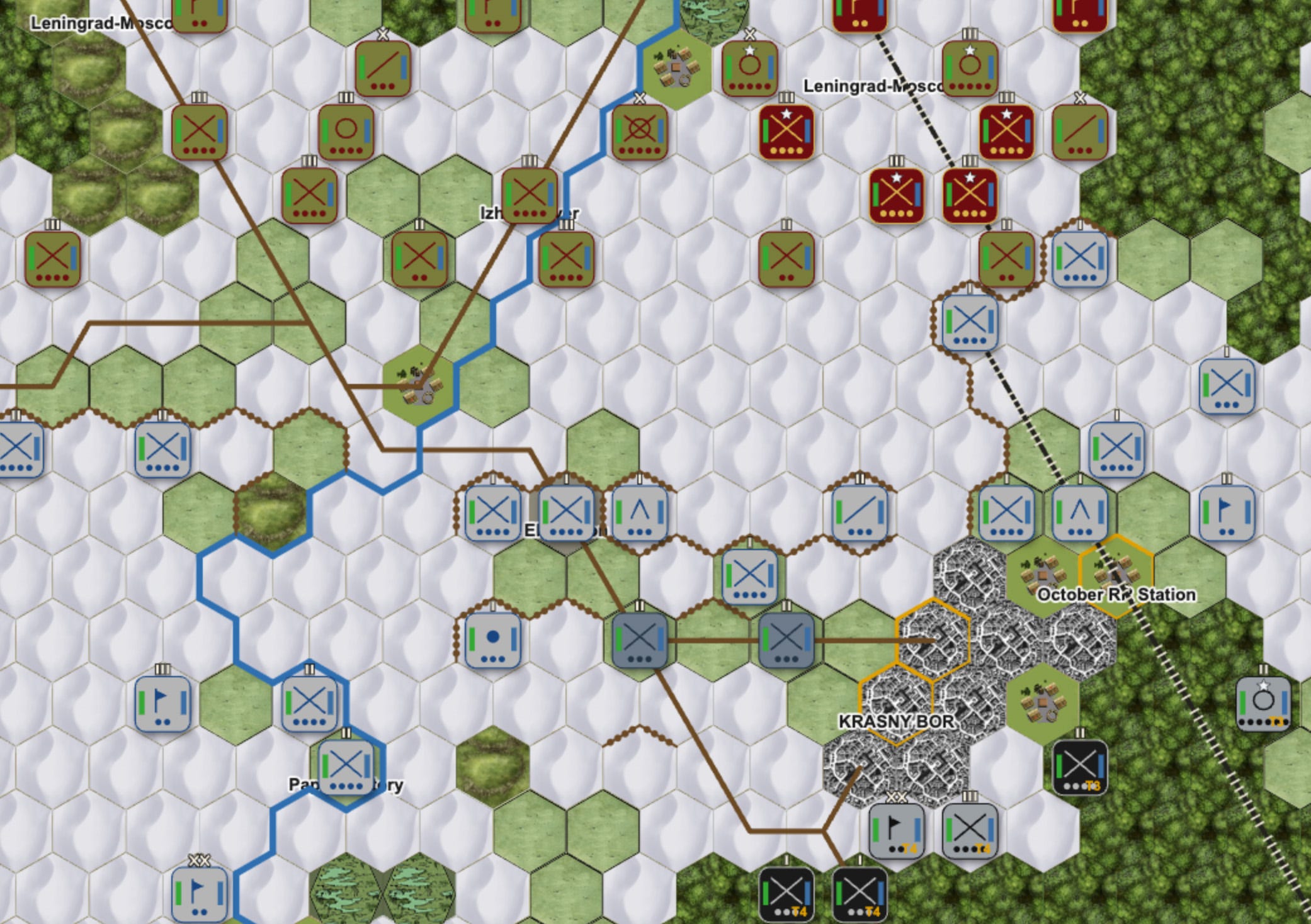
Not surprisingly, I was soon attracted to board games, particularly the military/ strategy type stuff. It’s kind of a guy thing, although my most nefarious opponent was actually the girl across the street, who could probably have gotten the German army into Moscow in 1941 if they'd given her the chance. These were clumsy cardboard games and required manual dexterity and an awful lot of dice rolls, so I was ecstatic when computers came along and relieved my childhood baloney fingers of any more execrable tile stacking.
The height of the popularity of these games was certainly the late to mid-1990s, just as computers were evolving from the text-based DOS to the then-amazing Windows 95. With names like ‘Panzer General,’ ‘Steel Panthers’ and the ‘Operational Art of War, ’ they provided hours of entertainment and joy, even if their AI at the time was a bit on the simple side. These games usually were run on ‘boards’ comprised of many hex-shaped ‘tiles’ that had various terrain features such as forest, towns, roads, and rivers, each having its pros and cons for the particular unit (infantry, armor, cavalry, etc) that you proposed moving into it with. These games actually have refused to die, and even though they have long been relegated to the historical pile known as ‘abandonware’ and their fostering companies long extinct, these games are still played on emulators and other tools that allow them to come back to life.
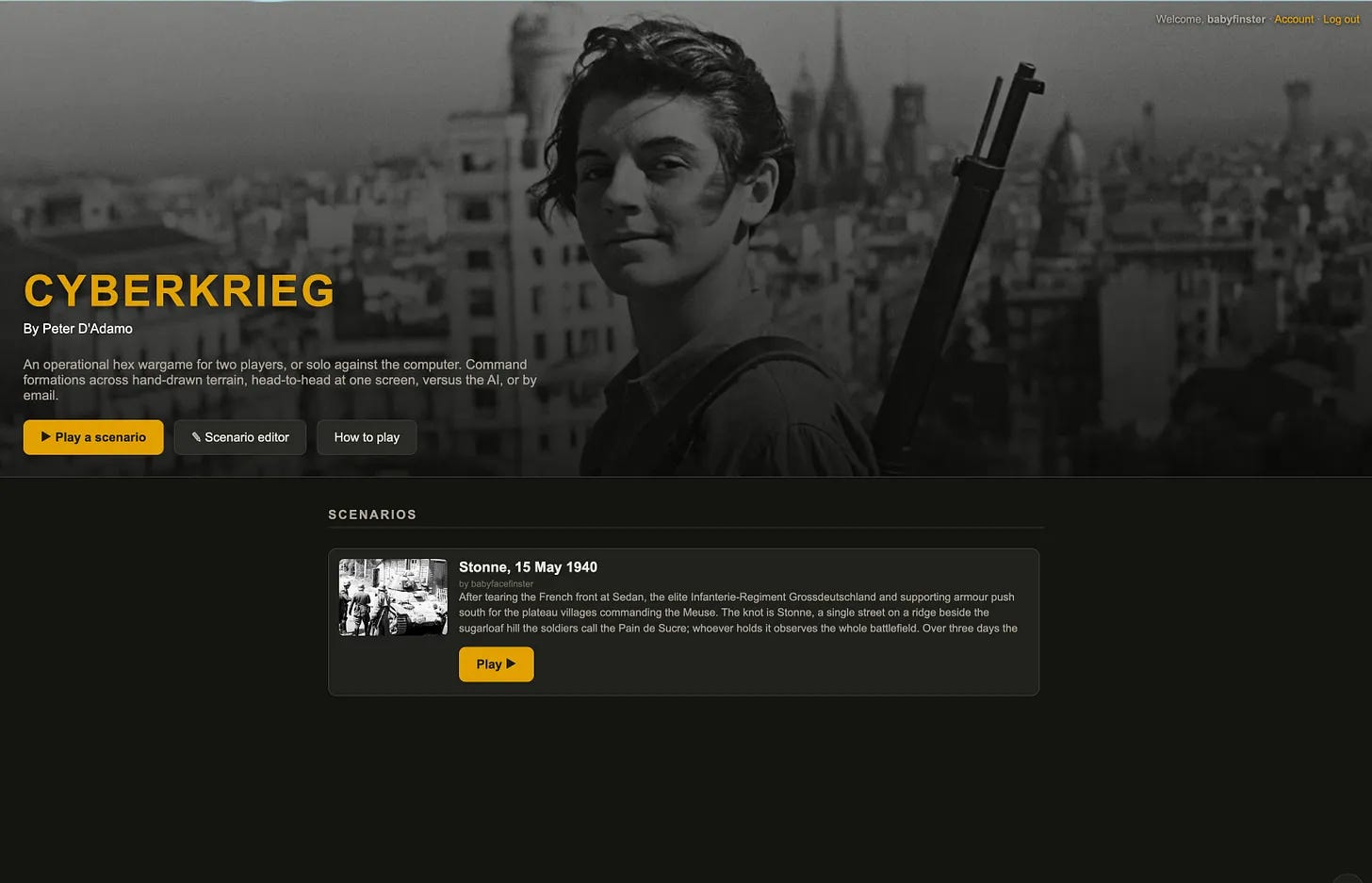
I haven’t played strategy games in over two decades, but one of the things I most enjoyed about them was the ability to build scenarios that I or others could enjoy. It also gave me the opportunity to deep-dive into the history of these events and try to design asymmetric gambits that were fun and challenging to play. Most other scenario designers typically went for the high-ticket battles: Normandy, North Africa, the Pacific. I enjoyed exploring the ones few people have ever heard of: Nomonhan (Japan versus Soviets in Mongolia, 1939); French colonial struggles against the Viet Minh in the 1950s, such as the battle of Dien Bien Phu, and my personal favorite, the last stand of the Spanish Blue Division (Division Azul) against the Soviets on the Eastern Front in 1943, a scenario I originally made over 20 years ago that was widely downloaded and enjoyed, so much in fact that the game manufacturer included in subsequent editions of the game, conveniently forgeting to reimburse me for it.
I’ve written about using Claude Code and Claude Cowork to help build new pieces of software that in years past would have taken months, if not years, to complete. These include my well-known SWAMI and Opus23 medical platforms, and a learning management system for clinicians. Lately I’ve been using Claude to spelunk my businesses (very helpful at finding errors in spreadsheets) but not very much fun.
Just returning from a short trip to the UK aboard the Queen Mary 2 left me quite averse to doing any number crunching, so I wondered where I could find one of these old great games and amuse myself for a few hours. Easier said than done. Most can’t run on modern machines, or if they do, the images are tiny (were the pixels bigger back then), or they run so fast you can’t keep up with them. So I decided to make one using my newfound Claude skills. Forty-eight hours later, I had Cyberkrieg.
There’s a particular madness that arrives when you decide to build a wargame in a browser. A proper one, with hexes, fog of war, supply lines, and a combat results table where a two-letter code like “EX” or “DE” quietly means something catastrophic just happened to somebody’s favorite battalion.
OCD me had to hand-render each terrain tile in Photoshop. I’ll spare you the evening I lost to the width and color of the hex borders.
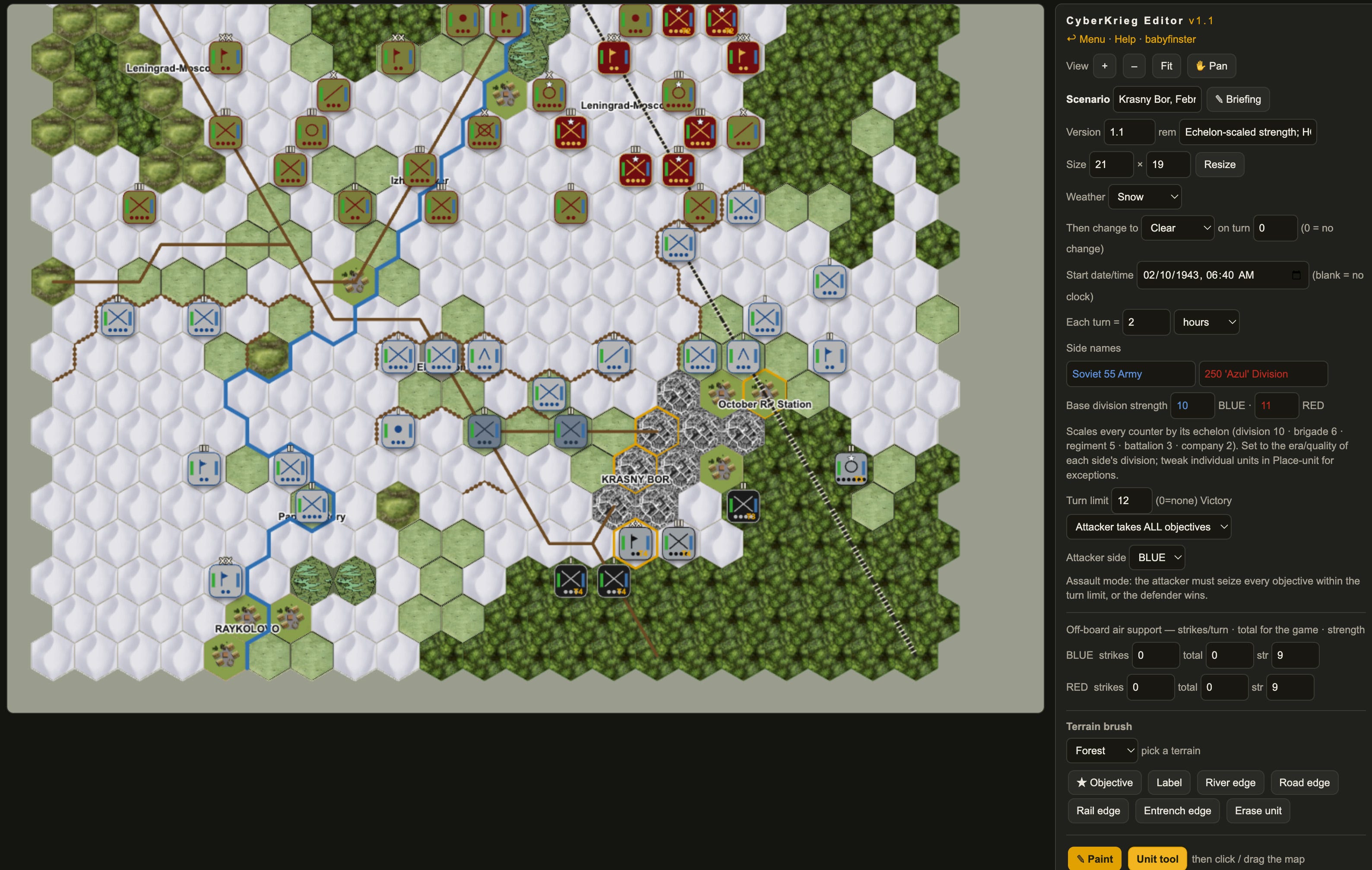
Cyberkrieg is an operational-tactical hex game that runs on a canvas — you pan and zoom across a map of painted terrain tiles (plain, forest, hills, marsh, mountain, the works), push little NATO-style unit counters around, and try to break the other guy before the turn clock runs out. There are infantry, armor, mechanized, recon, artillery, anti-tank, anti-air, and HQs. Units can be elite. They can be paratroopers or marines, each with their own little hand-drawn insignia. There’s weather. There are entrenchments drawn as beaded wire, roads that thread hex to hex, rivers along the edges. There’s command and supply, so a unit cut off from its HQ starts to wilt. And, because I apparently hate sleep, there’s play-by-email, so you and a friend can fight a campaign one turn at a time across a week.
But that was just the overture. The real work was regenerating my magnum opus scenario from the 1990s: the Battle of Krasny Bor, February 1943, the climax of the Spanish Blue Division’s time on the Eastern Front.
The Blue Division (actually the 250th Infantry Division of the Wehrmacht) was a gift of Francisco Franco to Adolf Hitler for Germany’s assistance in the Spanish Civil War. The division was mostly comprised of vehement anti-communist Falange (fascists), many of whom lost family members in the Civil War; however, there were also loyalists who were using it as a sort of get-out-of-jail-free card. Some argue that they were the price Franco paid Hitler to keep Spain out of World War 2.
And, unlike most other Axis minor powers, the Spanish actually fought quite well. However, they had a distinctly unmilitary bearing, typically walking slouched, head forward, cigarettes dangling from their mouths, hands in pockets, all of which drove the more spit-and-polish Germans into apoplexy. Unlike their allies, they were also not antisemitic; in fact, many had Jewish or Gypsy girlfriends. Areas under the division's control were known to be about as tolerant as you could expect in a very intolerant place during a very intolerant war.
On that cold February morning, four Soviet rifle divisions, 800 guns, and a swarm of tanks smashed into the equivalent of five Spanish battalions in −25°C cold. The Spanish took something like 75% casualties and were pushed only a few kilometers before the line held on the Izhora. It is the exact kind of lopsided, doomed, magnificent stand that wargames exist to let you re-fight. A Thermopylae-like, famous last-stand kinda thing.
That’s the thing about a solo project like this. The big stuff, the combat engine, the map editor, the scenario format, gets built in long focused stretches you barely remember. But the texture of it, the feel, gets argued into existence one fussy little decision at a time. A hairline here. A shade of sage there. A tank that refuses to die on schedule.
None of this is finished. I still need to watch the AI actually play it out over twelve turns, and I’ve a stack of scenarios waiting for the new strength-and-command system. But the engine underneath finally does the thing I care about most: it doesn’t just look like the battle. It weighs like it.
Cyberkrieg is an online game, which means you play it from your browser. Once I get enough testing done to ensure that a jack-in-the-box doesn’t come out of the screen and punch someone in the face, I’ll release the URL address, and if interested, you can try it.
Comments
Nothing yet. Say the first thing.
Sign in to join the conversation.