
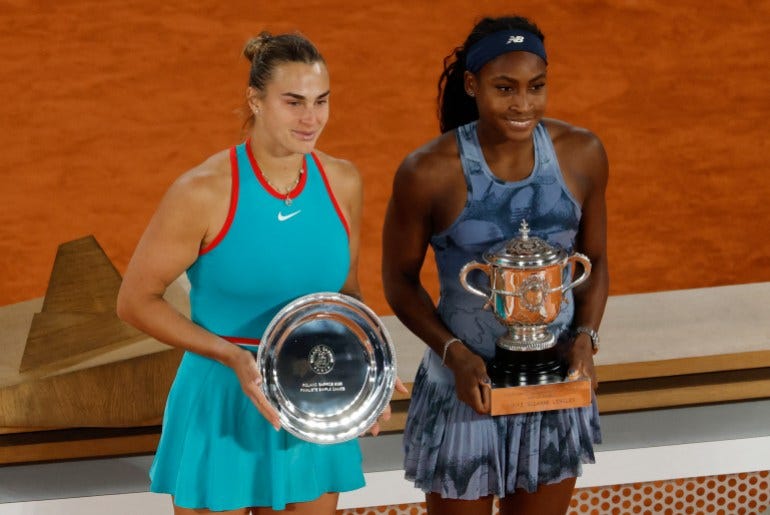
Whether you’re an avid tennis fan or an occasional highlight-watcher, chances are you’ve come across the contentious post-final Roland Garros press interview where Aryna Sabalenka—ranked number 1 by the WTA—made many fiery claims about why she lost the French Tennis Open. One of these claims was the high number of unforced errors she made while playing the formidable Coco Gauff (ranked number 2). She claims that Gauff won the RG, not because of her performance, but rather, due to the number of avoidable mistakes made by Sabalenka during the match.
Before we get into what this means, I want to state that everything I write is in defense of Sabalenka, not because I favour her over Gauff—personally, I was rooting for the latter—, but because I want to give her the benefit of the doubt. It may have been an error to lay these claims on an international stage, but it is an error that can be justified by the fact that she was recovering from playing numerous tough games over a two-week span, was up against a strong opponent in Gauff set in unexpectedly tough conditions, and ultimately, emotions ran high when she lost one of the most pressurised, exhausting, and highly-anticipated matches of the year. Although it might have seemed like a deliberate attack on Gauff, I believe that Sabalenka’s erroneous reaction, at least in part, may have been out of her own control in that moment.
This brings me to what this piece is about: the unforced error, a statistic that supposedly earned Gauff her championship point, and one that is among the most highly debated in the world of tennis.
What is an unforced error? Unforced errors (UE’s) are a common statistic in most racket sports. It is an error made when the ability to have kept the ball in play was entirely in the hands of the player, and the point lost was not influenced by the opponent. To put it simply,
“Unforced errors are shots that a player should have made but didn’t.” - Jeff Sackman on Heavy Topspin
This is not to be confused with a ‘forced error’, where a player is ‘forced’ into losing the point because of a tactful, strategic play by the opponent.
In the case of the forced error, the point is earned by the opponent, while in the unforced error, it is yielded by the player due to a mistake. UE’s highlight a gap between the player’s skill and their ability to perform consistently under pressure when playing for a point.
Let’s say the opponent hits a powerful shot in an offensive position that forces the player to run wide and hit the ball into the net. It is a shot that typically would not be made by the average professional tennis athlete. This is considered to be a forced error. On the other hand, if the opponent is hitting a neutral shot that is not visibly in the offensive, and the player has relatively more time and space to make the shot, but still hits the ball in the net or out, it is considered to be an unforced error—a result of the player’s own mistake.
There are 3 kinds of unforced errors: when the ball hits the net, when the ball goes long, or when the ball goes wide.
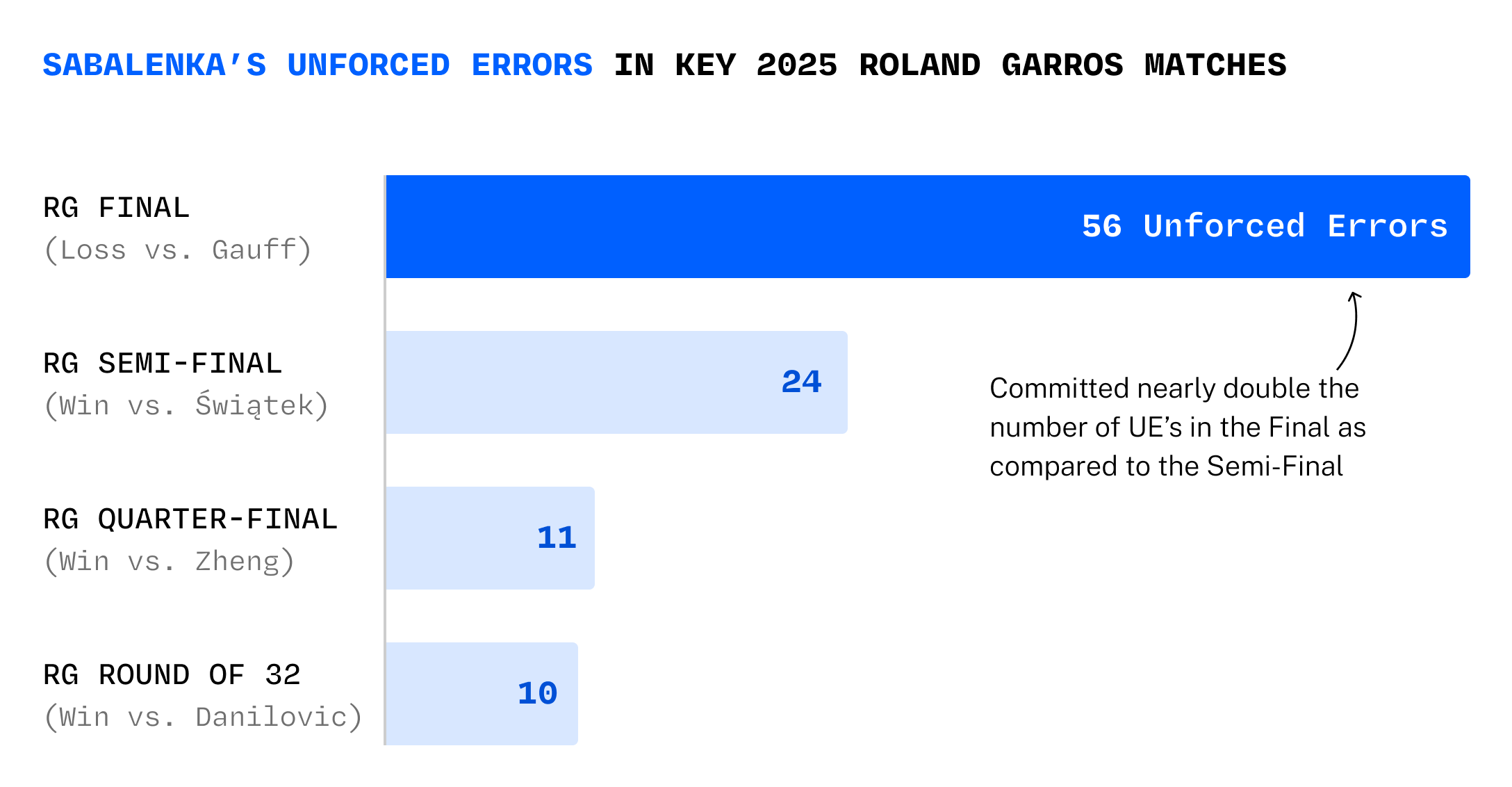
While it is true that on paper, Sabalenka did make many more UE’s in the RG final as compared to her previous matches (see image below), is the error itself a useful frame of reference for determining who was the better player in the match, versus who got lucky? What do the sport stats we so often quote in conversation really mean and what makes them reliable indicators? Are they always powerful instruments to measure an athlete’s performance?
To many sport critics, the answer to the last question in the context of UE’s is no.
“Errors in a tennis match are matters of opinion,” says Craig O’Shannessy for the NYT. “Next to nothing happens in a match without some form of pressure. There is always something forcing or influencing shot selection. ”
And…
“No stroke in tennis is unaffected by the situation or the opponent; you could say the serve should be, but even then, what about the pressure of the occasion, the score, the moment, the opponent or their quality of return?” - Simon Cambers for Tennis Majors
It also begs the questions: are players ever fully in control of a point lost due to an unforced error? Wouldn’t it depend on the player’s position on court, their level of tiredness, wind speed, height of the ball, direction, spin, and much more? Also, would an UE in a Sabalenka-Gauff pair-up be an UE in a Świątek-Anisimova pair-up?
Another critical factor to consider is that the scorers of unforced errors are people, and opinions about whether an error is forced or unforced varies from person-to-person. There is no standard algorithm one can follow to judge an unforced error and it leaves plenty of room for grey area interpretations. In the case of the RG final, Aryna did make many unforced errors, but when I was looking for a confirmation on how many, the number varied across sources. On Tennis Abstract, Sabalenka made 56 UE’s. According to the NYT, she made 70 (which is what most articles agree with). Perhaps there is a case is to be made for discrepancies in data across platforms, or maybe the unforced error in itself is a highly subjective metric. Wimbledon itself is proven to have historically been more generous when scoring unforced errors as compared to other tennis championships.
To many sport critics, the unforced error may not be the best indicator of whether one player is better than the other in a professional match. Aryna claiming that her loss in the RG final was due to her own UE’s took away from Coco’s grit and cleverly placed shots. It gave the media the impression that she lost, not because Coco was the better player, but because Aryna made preventable mistakes. However, to her credit, Aryna also stated in her interview that Coco handled the conditions better—which is true—and that she was the better player on that day—also true. While it was unsportswoman-like for Aryna to have implied that her own mistakes led to Coco’s win, her unforced errors were not the only reason she lost that final.
To read more about why forced errors are much better measures of a player’s performance than unforced errors, check out this article by Craig O’Shannessy.
Visit this link to see the complete final between Gauff and Sabalenka.
No posts
Comments
Nothing yet. Say the first thing.
Sign in to join the conversation.