
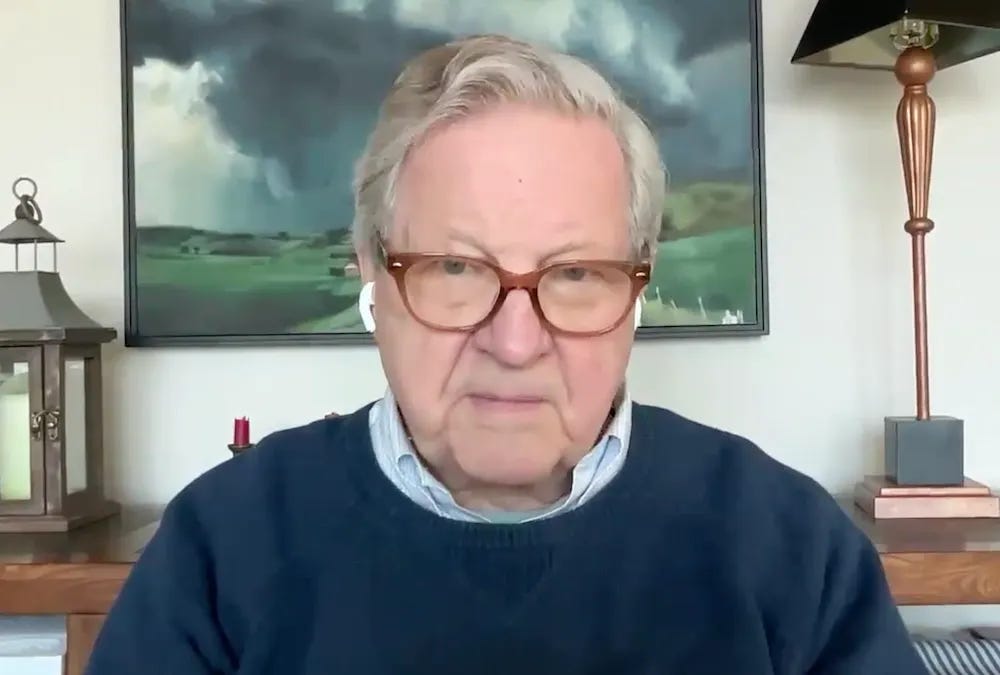
I like Lloyd Axworthy. From the days of my youth until he retired in 2000, the Winnipeg Liberal MP and minister of various portfolios in the Pierre Trudeau and Jean Chrétien governments always came to Parliament ready to scrap. A low-key lunch I had with him in Winnipeg a few years ago was as pleasant a political chat as I can remember. And I interviewed Axworthy a year ago because he’s emerged as a persistent critic of Mark Carney from the left, a flank that’s looking like a persistent vulnerability for the newish Liberal prime minister.
But I was surprised at his essay the other day, written with Michael Michalak Manulak1 lamenting the end of Canadian participation in UN peacekeeping missions.
The news hook for the Axworthy-Manulak essay was the news that Canada will end its deployments to Congo, South Sudan, Kosovo and Cyprus. This means 50 to 60 Canadian Armed Forces personnel will be reassigned.
“A quiet funeral for what remained of Canada’s identity as a peace-minded middle power,” Axworthy and Manulak called it.
“The decline is staggering. In the early 1990s, Canada was the largest contributor to UN peacekeeping, with over 3,300 personnel deployed. By 2019, that was down to roughly 150. Today, it’s in the low dozens.”
Yikes. What happened? “Our military brass have modelled defence priorities on U.S. doctrine for two decades: combat over peacekeeping, deterrence over diplomacy. Stephen Harper and then-[Chief of Defence Staff] Rick Hillier began gutting our peacekeeping capacity, presiding instead over a failed mission in Afghanistan.”
The rest is opinions, which are fair enough. “Parliament should be debating this,” Axworthy and Manulak conclude. “Right now, it isn’t.” Also fair: It’s August. Parliament isn’t debating anything.
But I’m surprised that, having traced a decline from “the early 1990s” to “today,” Axworthy pins so much blame on Stephen Harper (specifically) and Mark Carney (implied by grumbling).
On the road from “over 3,300 personnel deployed” to the low dozens, one prime minister did more than 90% of the cutting. Far, far, far more than Harper, Carney, Paul Martin or Justin Trudeau. His name was Jean Chrétien. For four years, Lloyd Axworthy was his foreign minister.
Don’t worry, I’m not here to make assertions about either man’s character. I think it’s almost always handy to understand why things happen. Let’s get to it.
In November 1990, near the end of Brian Mulroney’s years in office, the world was between the fall of the Berlin Wall and the failed Moscow coup attempt of 1991, and Canada had 1,002 troops deployed in UN peacekeeping operations. The number soon rocketed upward, not because Canada changed its mind about things, but because the world changed. The sullen certainties of the Cold War gave way to new possibility and grave new risk. The UN established 16 new peacekeeping missions from 1989 to 1993, as many as in the previous 40 years. Several ended very badly, in places like Mogadishu (“Operation Restore Hope”), Rwanda and Srebrenica. In response to these horrors, total UN peacekeeping deployments worldwide declined from 75,000 to about 12,000.
Canada’s contribution fell even faster than the global total: by April 2002, with Chrétien still the prime minister, Canada had a total of 281 soldiers and civilian police deployed for UN peace ops worldwide. This is partly because Canada was busy: the “failed mission in Afghanistan” that Axworthy bizarrely hangs on Harper began in 2001. Canada would get deeper into Afghanistan partly to stay on the right side of the Americans after declining to get involved in the Iraq invasion, a story one of Axworthy’s successors, the late Bill Graham, told ably in his underrated book The Call of the World.
To recap: Canada had a lot of peacekeepers overseas in 1993, not because it had particularly reached some summit of virtue, but because the world was trying a UN peacekeeping surge to see whether it could help tackle a Pandora’s box of new local threats. When the demons won, as they usually do in Pandora’s box stories, UN peacekeeping declined sharply. Canada’s contributions declined faster, especially under Chrétien, who reduced Canada’s total UN deployment by more than 90%. Those levels fell further under Paul Martin, Harper, and (apart from a timid one-year deployment of some evac helicopters in Mali) Trudeau.
That’s the trend, one that Axworthy saw close-up when he was the steward of Canada’s foreign policy while Chrétien was putting almost all of Canada’s peacekeeping contribution in mothballs. But I’m also left wondering what he means by “Canada’s identity as a peace-minded middle power.”
Has anyone in any other country ever remarked on Canada’s “identity” as a peace-minded middle power? Because Canada seems to be getting its “identity” on the cheap.
Let’s move past historic trends and look at the current state of peacekeeping. The UN’s own dashboard page shows that at the end of April Canada had 26 personnel in active peacekeeping deployment. Stipulate that that’s a low number. Say, for the sake of restoring Canada’s identity, we increased it tenfold, to 260 soldiers and police deployed worldwide. About where Chrétien left it. That would still put Canada a lot lower than Spain (693), Italy (754), Morocco (1,330), Indonesia (1,955) or the current top quartet of Nepal, India, Bangladesh and Rwanda, each with more than 4,000 personnel deployed for peace ops.
(Why do developing countries go in so big on peacekeeping? For many reasons, but partly, I learn, because the work is reimbursed generously by the UN. So much so that a single deployment can make the soldier’s family markedly better off for a long time after he comes home. There’s a whole conversation to be had about Canada’s financial contribution to UN peacekeeping, which is five times its share of UN member states’ population.)
It’s a bit precious to discern a Canadian “identity” in peacekeeping when Canada has, for instance, a dozen people deployed in the Democratic Republic of Congo and Bangladesh has 130 times as many. In Cyprus it’s one Canadian to over 200 each for Argentina, Britain and Slovakia.
To complain that Canada is going from several dozen to two dozen peacekeepers is mere theatre, unless the suggestion is that Canada should contribute many hundreds or thousands of soldiers for open-ended deployments. But be careful: the current generation of peacekeeping missions isn’t tidy or trouble-free. UN missions in Central African Republic have sustained 234 fatalities, in South Sudan 161, in Congo 311. NATO and NORAD, which get an airy wave of the hand from Axworthy and his co-author, grind up fewer Canadian lives than this other work might, because while deterrence may not be high-minded it has worked so far.
I have no interest in arguing that UN peacekeeping work is somehow unworthy. It’s serious work that, in my limited experience (the high days of Canadian peacekeeping work came before my time as a reporter), its practitioners treat seriously. But before you laud it as somehow morally superior to the work Canadian soldiers are doing and have planned, have an eye to what you’d be getting into. The UN peacekeeping missions in which Canadian participation is going from slim to slimmer aren’t just dangerous, as documented above, they’re not obviously effective. In Congo, the Security Council recently noted a “rapidly deteriorating security and humanitarian crisis.” In South Sudan, “warnings of famine and collapse.” In Cyprus, “lack of progress,” which on the scale of things isn’t so bad. (Recall that in Cyprus, the end of peacekeeping means that precisely one Canadian staff officer won’t be replaced when their current rotation ends.)
I’m a little reluctant to get into debates about peacekeeping because there is so much vibe attached to such discussions. For some, peacekeeping is risible because its practitioners don’t have robust rules of engagement, and because they get their mandate from the United Nations, which is (shudder) globalist. For others, peacekeeping is inherently noble because it has the word “peace” in it, and the Americans don’t like it. I suspect very few readers will engage with any specific argument I’ve made here.
I guess what I’m saying is that cherry-picking “the early 90s” as some sort of golden era, when it was a chaotic era that ended in chaos very quickly, is not serious political science. Pining for a greater role in missions that have steadily cost human lives while struggling to do demonstrable good for the societies where they work isn’t impressive resource management. And bad-mouthing the effort of any Canadian government that would seek to dissuade Russia, China and, on some days, the United States from acting on their basest hegemonic impulses isn’t showing any higher allegiance to the cause of peace.
My mistake was to reproduce the name of Axworthy’s co-author as Axworthy wrote it. I’m told the co-author’s real last name is Manulak.
No posts
Comments
Nothing yet. Say the first thing.
Sign in to join the conversation.