
Two things have always been true about human life.
There is a manmade ocean of cruelty, domination, and extraction, built and maintained by people who profit from its persistence. Patriarchy, racism, ableism, authoritarianism, heterosexism, etc... The forms shift. The underlying grammar of cruelty and domination persists.
And there is an equally ancient human capacity for love, solidarity, creativity, compassion, empathy, and care. Families, schools, gardens, friendships, congregations, common spaces and shared resources.
Both things are locked in an ancient tug of war. And this tug of war didn’t start with Trump, and it will not end with him.
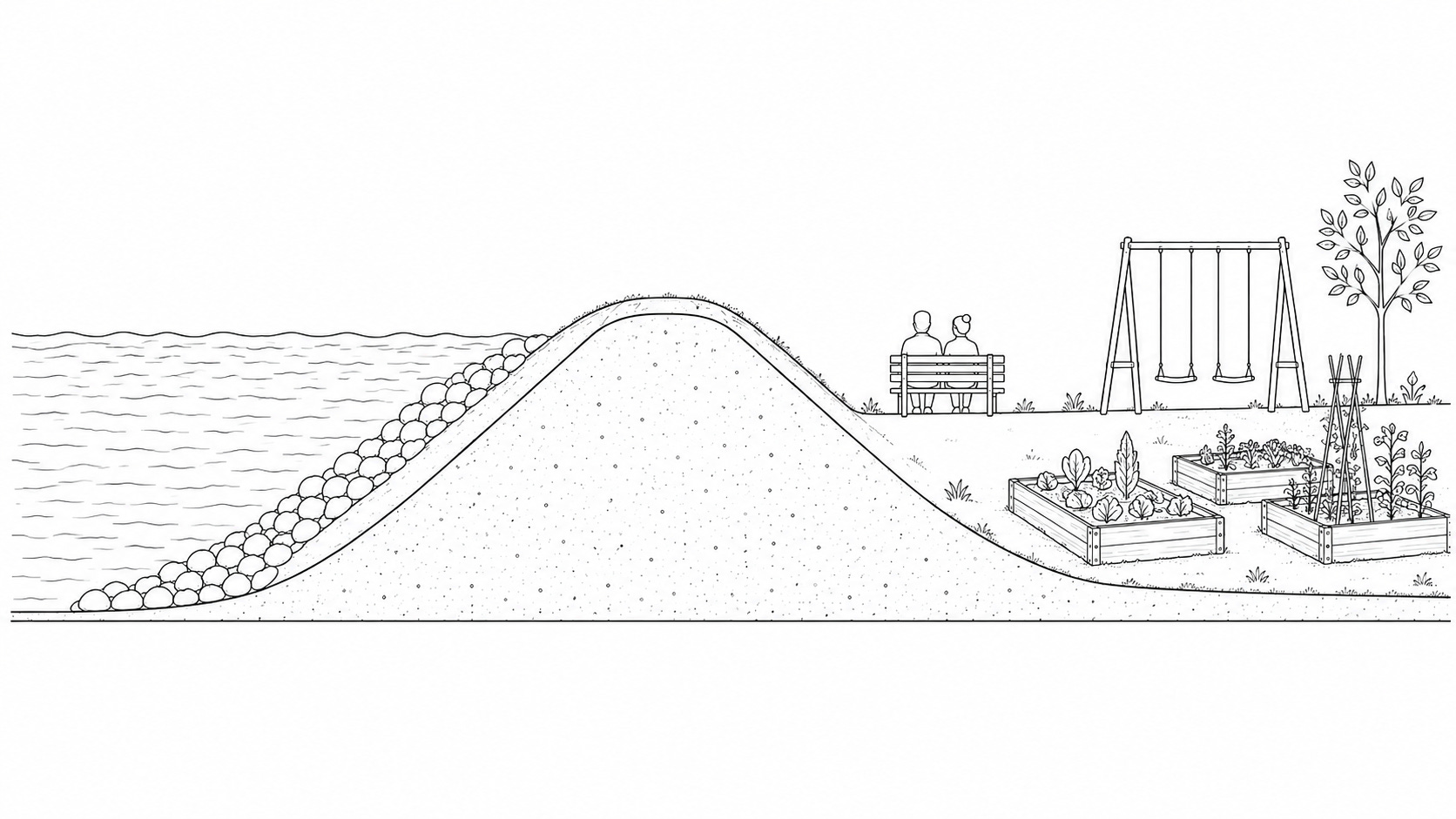
Inside that condition, people build dikes. A dike is everything we raise to hold the cruelty back: laws, courts, unions, a free press, advocacy and watchdog groups, safety nets. A dike doesn’t defeat the ocean. Oceans can’t be defeated. A dike holds, and it holds only because people maintain it across generations, at hundreds of vulnerable points, every day, because the water is always pressing.
Behind the dike lies the floodplain: the protected ground where the actual living happens. Schools, libraries, playgrounds, and neighborhoods. Dinner tables covered in potluck dishes. Gardens. Coffee while the sun comes up. Music, theater, poetry, and dance. Elders living with dignity. Kids who get to be kids. None of it is naturally safe. It stays safe because the dike holds. And the dike holds because people continuously maintain and fortify it.
In 2005, New Orleans drowned when its levees breached. Those levees failed from neglect: budgets cut, repairs deferred for years. What is happening in this country now under Trumpism is worse than neglect. The people who benefit most from the deep grammar of enclosure, extraction, cruelty and domination are going after the democracy-protecting dikes directly, defunding and dismantling them. Tearing down safety nets, defunding vital public services, attacking civil rights legal frameworks, attacking truth itself.
Finish line thinking is what I call the mindset that political struggle is temporary and wins are final. It’s rooted in a story about how political change works: the hero or the rebels fight against the odds, the villain falls, life settles down, and the people who fought enjoy the new normal. It has moved generations of people to fight for what matters, and there is nothing wrong with wanting resolution. For many of us, it’s the foundation our whole engagement was built on.
But finish line thinking can also fail us in a lot of situations. Ground is won and then lost. A villain is removed and another one rises. When the finish line keeps receding, the mindset leaves you stranded.
Ultimately, this mindset offers no way to make sense of the work that comes beyond the next election or policy victory. Finish line thinking is built for sprints. But most social justice and democracy struggles are marathons that span generations.
Finish line thinking also decides what counts as real action, favoring dramatic gestures that promise quick victory over the slow, unglamorous work that durable social change requires.
Learning to see finish line thinking pays off quickly. A bad headline stops being a verdict on whether everything is lost. Over the years, it protects your capacity to stay. The movements that outlast authoritarians are made of people who can keep tending the dike without an ending in sight.
We must give up the fantasy ending where threats to hard-won victories just go away forever and the victories become permanent without needing defense or maintenance.
What you get is a story with room for everything the finish line story couldn’t hold. A defeat becomes a breach to repair. A victory becomes a stretch of dike that still needs tending. And the work gets its dignity back: holding a dike in a storm is honorable, even if your section of the dike succumbs and needs rebuilding.
The goal of much of my work is to help people make the process of participating in the ancient tug of war yours. You re-examine the wins you thought were permanent. You name what the old finish line story promised you. You practice creating times to rest your eyes on what the dike protects and not just on the ocean of cruelty smashing against the dike. And you find your stretch of dike and the people working beside you. Knowing where to stand and what to focus your energy on helps avoid catastrophizing and being overwhelmed by the enormity of the ocean of cruelty.
“Freedom is never really won. You earn it and win it in every generation. That is what we have not taught young people, or older ones for that matter. You do not finally win a state of freedom that is protected forever. It doesn’t work that way.”
- Coretta Scott King
I’ve devoted two chapters to building these skills in my new book, Survive Authoritarian Harm. You’ll use these practices when a defeat feels final, and when a victory tempts you to put the maintenance work down. And these practices remind us of the oldest rules of a tug of war: never let go of the rope, and pull together. Learn more about the book below.
In solidarity,
Paul
Remember: Stay human. Stay strategic. Shape tomorrow.
You’re overwhelmed. That’s not a flaw. It’s Trump’s plan.
Losing hours to doomscrolling. Breaking at small things. Withdrawing from people you love. Feeling ashamed you can’t handle this better, and wondering why everyone else seems to be managing better.
They’re not. And your overwhelm isn’t personal failure — it’s an accurate response to a coordinated assault.
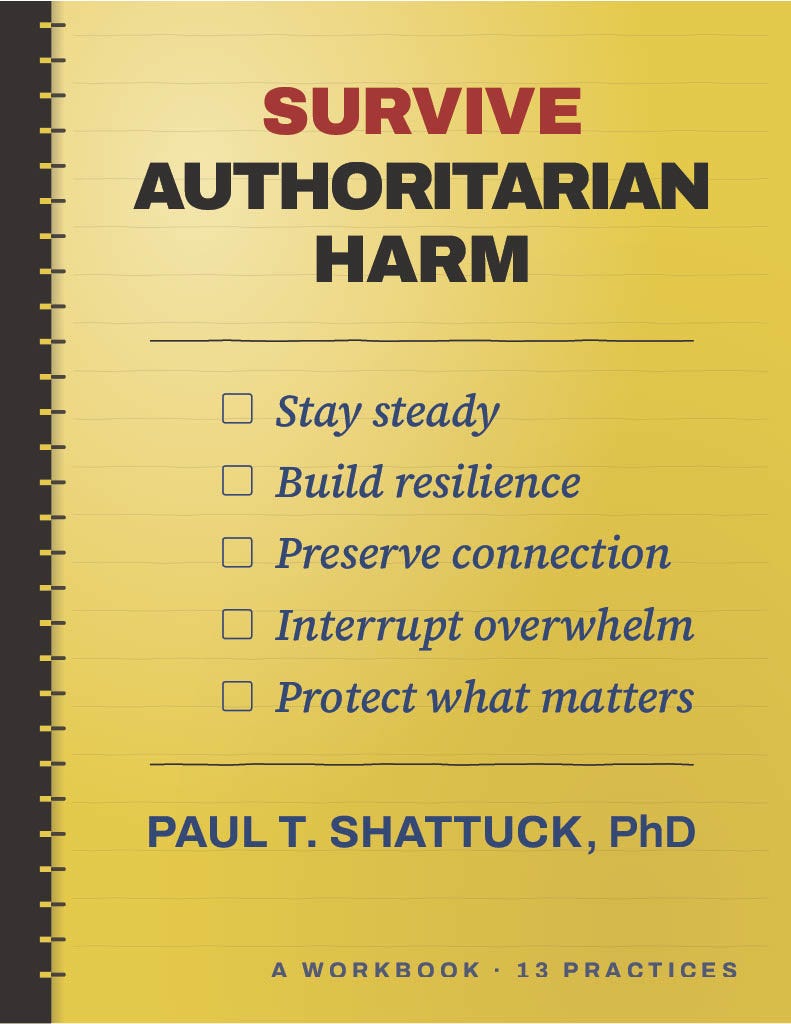
This book delivers practical tools to interrupt overwhelm while building endurance and defiance under authoritarian assault.
Flood the zone. Manufacture crisis. Weaponize shame. Exhaust everyone who might resist. The strategy is public: Bannon named it, and Trump’s own people describe the goal as traumatizing opponents. Your capacity to think, act, and stay connected is exactly what they’re trying to drain — because people who can still think and still connect can still resist.
Stress apps and wellness advice weren’t built for this. They treat systemic harm as something you fix privately by working on yourself.
Thirteen practices across four sections — checklists, self-assessments, conceptual frameworks, menus of concrete moves, and prompts you write in. Built to be used mid-chaos, imperfectly, one page at a time.
Recognition (Practices 1–4). See clearly what the assault is doing to you. Spot your overwhelm patterns early, map your triggers, learn to read your accumulated load before something small tips you over, and name the three reactive states this pressure produces: collapsed overwhelm, numb cynicism, scattered activism. Naming the pattern replaces blaming yourself.
Rescue (Practices 5–7). First aid for when you’re in it right now: a shame interrupt, emergency circuit breakers matched to what’s happening in your body, and a dedicated doomscroll rescue. The goal isn’t perfect composure. It’s stopping the freefall fast enough to find one next move.
Resilience (Practices 8–9). Get from “I stopped the spiral” to “I can function effectively again.” Three pathways back to steadiness, plus a connection practice: who steadies you, who you can tell the truth to, and how to navigate the rooms where honesty is risky. Not abstract calm — operational capacity: steady enough to think, choose, and act from your values instead of from panic.
Building (Practices 10–13). New in this edition. Inventory what this assault has cost you — in your body, your relationships, your paycheck — and decide what to rebuild and what to protect. Catch the finish-line thinking that burns people out. Build a foundation that holds for years. Then write your own declaration: what you’re still in this for, and what you refuse to accept.
Plus a Quick Reference Card for days you can’t think straight, and “Try This With Others” prompts in every practice.
Start anywhere — if you’re spiraling right now, go straight to the Emergency Interrupt. Return repeatedly; the workbook meets you where you are, not the other way around. Use it imperfectly: one move, one question, one breath counts. Some weeks you’ll need it daily. Some weeks you won’t need it at all. That’s how it’s designed.
In December 2024 my employer told me to delete a post supporting federal workers Trump had targeted. I refused. They fired me. What came next was everything in this workbook: the paralysis, the shame spiral, the fear that visits my house directly. I’m married to an immigrant, and some days we’re afraid to go to the grocery store because of ICE activity where we live MAGA thugs routinely harass and intimidate us in our town. I went looking for tools built for this and found stress apps and self-care lists. None of that matched what we were experiencing. So I built what was missing.
I’m Paul Shattuck, MSW, PhD: social worker, researcher, forty years an organizer, with contemplative and recovery practices nearly as old. None of it exempts me. I work these practices myself and sharpen them with the readers of my blog, Stay Human — Shape Tomorrow, which has nearly 13,000 subscribers across 95 countries — including readers living under repressive governments in places like Iran and Venezuela. People inside the hardest conditions find these tools worth their attention.
A PDF, delivered instantly — over 100 pages, made to print at home or read on any device, yours to write in for years.
A 100+ page write-in workbook. 13 practices. Pay what you want: $24 minimum, $65 recommended value.
Recognition
1. Recognizing Your Overwhelm Patterns — a quick-scan checklist to catch overwhelm before it takes your day.
2. Direct Trigger Mapping — trace what activates you and whether your responses lead to action or paralysis.
3. Building Threshold Awareness — read your accumulated load before something small breaks you.
4. Recognizing Reactive States — name the three reactive states and catch them in real time.
Rescue
5. Shame Interrupt: Self-Grace Under Assault — break the shame cycle before it isolates you.
6. Emergency Interrupt Protocol — circuit breakers matched to how you’re stuck: frozen, flooded, locked up, withdrawing.
7. Doomscroll Rescue — understand why you can’t stop scrolling, then pick the off-ramp that fits.
Resilience
8. Pathways to Steadiness — three routes back to functioning: anchor in values, guard your capacity, build discernment.
9. Cultivating Supportive Connection — map who steadies you; plan for the spaces where honesty costs too much.
Building
10. Map the Harms, Pick Priorities — inventory what’s been taken, then sort it: let go, rebuild, protect.
11. The Weak Foundation: Finish Line Thinking — spot the mindset that burns people out, before it decides your next move.
12. Cultivating a Foundation That Holds — the dike you tend, the floodplain you protect, the shift you show up for.
13. Building Endurance and Defiance Skills — take stock of what you’ve already built, strengthen what’s next, write your declaration.
No posts
Comments
Nothing yet. Say the first thing.
Sign in to join the conversation.