
I would never publish what follows if my father were alive. He would be too ashamed to see it in print. But it’s my story too.
Summer, 1970. I’m counting the stairs outside a building that my father has never entered. It’s on the other side of the large university campus where he works. He is supposed to attend a meeting there tomorrow and needs recon. So I scout ahead and see how close he can park his car to that building. The grand main entry is at the top of 30 granite steps, classic campus gothic design. I check the side doors. I find the one with no steps, then track down a janitor and ask if it stays unlocked. Then I walk back across campus to give Dad my report: he’s not going to be able to make it to that conference room. It’s on an upper floor and the building has no elevator. He needs to call and get them to relocate the meeting elsewhere.
He swears – “Fuckin’ stairs!!” – and slams his crutch down on his desk. I take a few steps back.
I’m 7.
My father got polio on the same day as one of his brothers and one of his sisters. His sister ran a fever for a week and recovered. His brother spent a few weeks in the hospital and came out with a slight limp. My father spent the better part of a year in the hospital, in and out of an iron lung, and nearly died more than once. They told him he would be in a wheelchair the rest of his life.
Before the virus he was a jock. Football, amateur boxing, the college swim team, a champion golfer. He did not accept the wheelchair prognosis. After two years of physical therapy, he wore a steel brace the length of his leg and could walk a city block using two crutches.
He and my mom joined the Catholic Worker movement, a socialist Catholic group founded by Dorothy Day. After getting married, they volunteered a year in a Catholic Worker settlement house. Then they got assigned to Nova Scotia for two years where they helped organize fishermen into a co-op.
Dad then went to grad school in his 30’s and became a sociology professor. Criminology and community development were his main focus. After the riots of the late sixties he worked on community redevelopment in the South Bronx and Newark and helped pioneer the community development corporation movement. He built stay-in-school programs for kids the system had already written off. He ran for the local school board and served two terms as its president. He taught courses on environmentalism before the first Earth Day.
Dad loved helping people and believed deeply in the power of community to transform lives.
Dad also drank himself into a stupor most nights. He was one of the loneliest people I have ever known.
The university put his office in the basement for years before an elevator eventually got installed.
His department lived on the fourth floor of a gothic brick and stone building with a grand staircase out front. His colleagues walked up those stairs to their offices every morning. My father entered through a back emergency exit next to the boiler room, because that was the one door with no steps, and that is where they gave him his office.
Dad worked summers and I often went to work with him. I got him articles and books from the library. And I shuttled documents up and down to the department’s main office.
And I scouted recon. When he had a meeting in a building he didn’t know, I walked the route first and came back with a report. Which door. How many steps.
I thought every kid did this.
Late 1990’s. I’m in graduate school in Madison, Wisconsin. Studying sociology in my 30s after a career in community organizing. This apple did not fall far from the tree.
My father and brother fly out to visit. His walking has shrunk to about twenty feet by now. Then he needs a place to sit. A wheelchair is still not open for discussion. Stubborn old man.
I rent him a battery-powered scooter. He looks at it scornfully, the way he looks at most offers of help.
Then he gets on.
Within an hour he’s racing two and three blocks ahead of us down State Street, zooming back with reports. There’s a restaurant on the next corner with a level entrance. The bookstore has a ramp around the side. He’s found a kid-friendly place to eat dinner and already made a reservation.
He is the one doing recon for me now while I push a stroller.
I saw my father laugh more that weekend than I have in my entire life. He tells us he feels like a fighter pilot. I buy him some cheap aviator sunglasses. He makes airplane strafing noises while he scoots along. He grew up worshipping an older brother who fought in WW II. I grew up watching war movies with my dad. For three days in Madison, he gets to pretend he’s flying missions against the Nazis.
We offer to buy him a scooter when he gets home to Brooklyn. His face closes. The apartment is too small, he says. His girlfriend wouldn’t like it. And it probably wouldn’t fit in the ancient elevator. The subject is finished.
The scooter goes back to the rental place on Monday. Dad puts his dreams back in long-term storage.
Some nights he fell on the way to the bathroom after drinking too much. It was always a big deal because it was very hard for him to get back up even when he was sober. I would hear him crash and curse as he stumbled and fell. I’d find him on the floor.
More often than not, I just held him while he cried. Sometimes I had to get towels for a makeshift diaper when he couldn’t hold his pee any longer. The falling was the trigger to cry about everything the polio had taken. A grown man leaking piss and self-pity onto a 7-year old boy in pajamas. I remember waiting for the crying to be over so I could help him up. He was a big man - 6’ 5”, 250 lbs.
Nobody ever mentioned it in the morning.
Every stairway on that campus had an architect. The buildings had trustees who approved the plans, administrators who assigned the offices. When they declined to build a way in, the cost of that decision got transferred to folks like my father. And Dad paid it in shame.
I write a lot about how shame like this is a bill for hardship that’s been delivered by oppressive systems to the wrong address. A lot of us end up feeling shame for our hardships that are not our fault. We are conditioned to believe the hardship and the solution belong to us. Who does that benefit? People in power who profit from enclosure and extraction.
My father taught the right answer to that question for a living. His entire field, his whole career, was moving blame off individuals and onto the arrangements that produced their suffering. The disability rights movement did the same thing. It said the problem was never the leg that wouldn’t move. The problem was the people who profited from buildings without ramps and fought every law that would have required one. He knew all this.
He could not redirect the blame and shame for himself. A socialist who spent a lifetime teaching others to fight systemic harms, he blamed himself for every minute of his hardship.
In mining, overburden is the material that lies above something worth money. Wikipedia defines it as “the rock, soil, and ecosystem that lies above a coal seam or ore body.” The industry also calls it waste or spoil. It doesn’t matter what the material is. A forest, a mountainside, a town. If it stands between the machine and the seam, it gets stripped and piled somewhere out of the way.
The Trump regime runs on the same accounting. Medicaid is overburden. Special education is overburden. The agencies that enforce civil rights law are overburden. A century of hard-won protections stands between the regime and the wealth it intends to extract, and strip mining the shit out of democracy is a justifiable cost so long as they reach the seam.
In July 2025, Congress passed and Trump signed the bill they named Big and Beautiful. It delivered record-setting tax cuts for billionaires and corporations. And it cuts roughly a trillion dollars from Medicaid over ten years. The budget office projects more than ten million people will lose coverage. Medicaid is what pays for home care aides, wheelchairs, the therapists who work with disabled kids, the costs for most nursing homes. The senators who voted for it said the country couldn’t afford all that while also delivering the tax breaks to rich campaign donors.
The same government looked the other way when Trump chose a war with Iran. The Pentagon admits to thirty billion so far. A Harvard budget economist who correctly forecasted the cost of Iraq projects this one will pass a trillion before it’s paid off.
They found a trillion for the war. They could not find it for the ramp or the poor kids.
“Too expensive” is the oldest sentence in this extraction game. They said it about child labor laws and workplace safety rules. They said it about curb cuts and lifts on public buses. They said it about the ADA, which business lobbies fought for years as a burden America could not bear. Those assholes never went away. They waited patiently and invested steadily in candidates that can be bought.
Trump’s demolition of disability supports and infrastructure does more than take services away. It reinstalls the old blame delivery system, the one that sends the shame bill for the missing ramp to the person at the bottom of the stairs.
Every service they strip still has to happen. Somebody’s family becomes the aide, the elevator, the ride to the hospital. People with no family or close friends are shit out of luck. A new generation of kids will grow up doing recon.
He hid it when he got sick. In his eighties, living on a small fixed pension with no savings. He was terrified of medical debt. So he stopped going to doctors and told no one. I lived halfway across the country and we talked every week. He never let on.
His partner called me on a weekday evening. My father couldn’t get out of bed and wasn’t making sense. I called 911. The ambulance crew arrived and then refused to take him. The elevator in his building was broken, he lived on the sixth floor, and he was a large man. I worked the phones from St. Louis until I found a volunteer fire company in the next borough willing to come carry him down.
“Talk to me,” a guy says when he answers the phone. I explain the situation. He tells me to hold on and covers the phone so he can shout to guys in the next room. “Yo Tony! Vito! This guy’s pops needs to get to the hospital. But he’s six floors up and no elevator. And he’s fat. Whaddya say?” Comes back on the phone and says, “Yeah, we’ll get your pops to the hospital. What’s the address?”
I flew out the next morning. He went into a coma two days later. He died while I held his hand and caressed his head. My phone was on the bedside table playing his favorite music.
I was his executor. He had about twenty thousand dollars to his name. It took me eighteen months to untangle and settle his hospital bills. No omnibus bill. Every provider who touched him billed separately. Radiology, catheterization, labs, etc., etc. I have three graduate degrees. I was teaching health policy to graduate students at the time. It was overwhelming.
The ambulance company that refused to carry him billed us $1,800. Medicare paid it.
The volunteer firefighters sent a card. “This one’s on us. Your pops was cracking jokes and making us laugh when we carried him out. So sorry for your loss.”
In solidarity,
Paul
Remember: Stay human. Stay strategic. Shape tomorrow.
Please support this work and help me reach more people. Paid subscribers make this work possible. Upgrade here if you’re able. Or consider buying me a coffee or leaving a tip on Ko-fi.
The disability policy gains during my lifetime were real. I watched them arrive. Curb cuts, ramps, elevators, disability laws with teeth. And I’ve devoted most of the past 30 years to advocating for better supports for people with developmental disabilities and their families.
What I’m watching now is how fast they come apart under focused attack. It took three generations of organizing to build them and it is taking a season to demolish them. The gains were real. The permanence wasn’t.
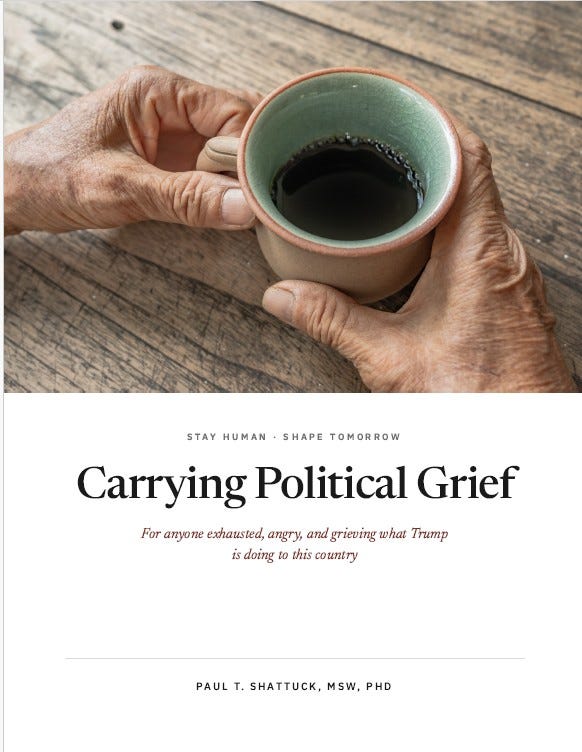
I wrote a short book about what it does to a person to watch that happen, and how to keep going while it does. It’s called Carrying Political Grief and it’s for anyone exhausted, angry, and grieving what Trump is doing to this country
The book is pay what you want, and a few chapters are free to preview. Check it out here.
No posts
Comments
Nothing yet. Say the first thing.
Sign in to join the conversation.