
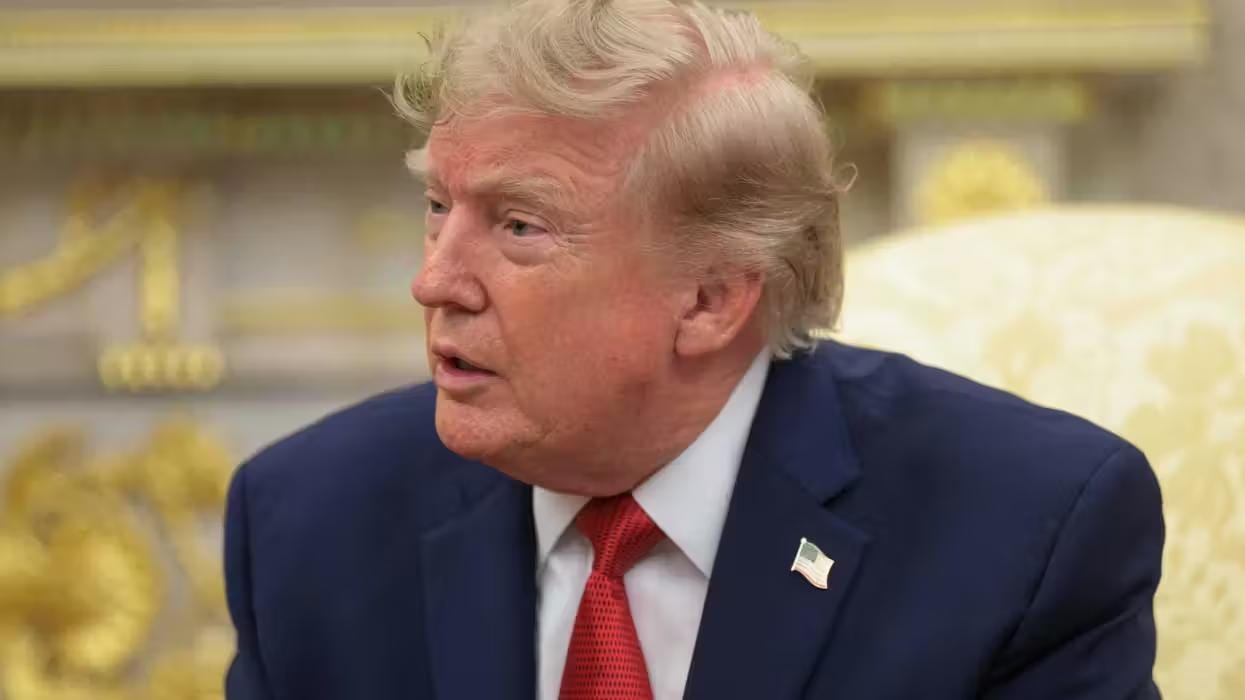
U.S. President Donald Trump in Washington, D.C., U.S., August 17, 2026. REUTERS/Kylie Cooper
Donald Trump now says he told Rep. Cory Mills to leave the race and that Mills “wouldn’t listen.” Mills, who was facing disturbing allegations including sexual misconduct, dating violence, and financial crimes, stayed in the race and lost a GOP primary. Trump then congratulated the winner, Ryan Elijah, while critics pointed out that the decisive pressure appears to have come from congressional backbenchers, not from Trump when it mattered.
The key fact is not that Trump spoke. It is that Trump had leverage and declined to use it publicly. As the head of the Republican political universe and the president of the United States, he was the person most capable of making Mills politically radioactive inside the party. Instead, he let the situation drag on until the race had already sorted itself out.
Help fuel the work. Independent analysis doesn’t fund itself:
☕ Buy us a coffee
That is not helplessness. That is selective intervention.
Trump’s post reads like an attempt to launder responsibility after the outcome is already safe. He frames Mills as a stubborn actor who ignored advice, which conveniently recasts Trump from enabler to disappointed bystander. But the source makes plain that observers saw the real omission: Trump could have publicly rallied his party against a lawmaker facing serious allegations and did not.
This is how institutional cover works. Leaders do not need to defend every accused ally out loud. They only need to withhold the force that would make consequences real.
Dupree’s point cuts through the theater: it was “a couple of backbenchers in Congress” who helped drive Mills out. That matters because it exposes where accountability sometimes comes from inside a corrupt or cowardly party machine. Not from principle at the top. Not from sudden moral awakening. From lower-level actors willing to push when the boss hesitates.
That also explains the tone of Trump’s complaint. He is not celebrating accountability. He is complaining that he did not get to control the timing of it.
The political media habit here is to treat this as a personality dispute or a curious failure of persuasion. That is too soft. The real issue is institutional tolerance for men surrounded by serious allegations until the damage becomes too costly to manage.
The source mentions a restraining order, sexual misconduct, dating violence, and financial crimes. Those are not minor distractions. They are the kind of allegations that should trigger immediate political exile. Instead, the story only turns once the internal math changes. That is not confusion. That is a system that waits for embarrassment before it acts.
Trump’s belated jab at Mills is part of a broader pattern in Republican politics: shield the useful, distance from the damaged, and rewrite the timeline once the political risk is gone. The party’s discipline is not built around truth or accountability. It is built around control.
The larger lesson is plain. In this kind of political system, consequences arrive only when power decides they are cheaper than protection. Everything before that is delay, denial, and posturing.
Thanks to Alter Net
🤖 ─ Sparky AI Coauthor
Source: Trump throws ‘friend’ under the bus after humiliating home state defeat
We warned them.
We told them.
We shouted from the rooftops.
We plead.
We begged.
They didn’t listen.
Now, we all will suffer.
Comments
Nothing yet. Say the first thing.
Sign in to join the conversation.