
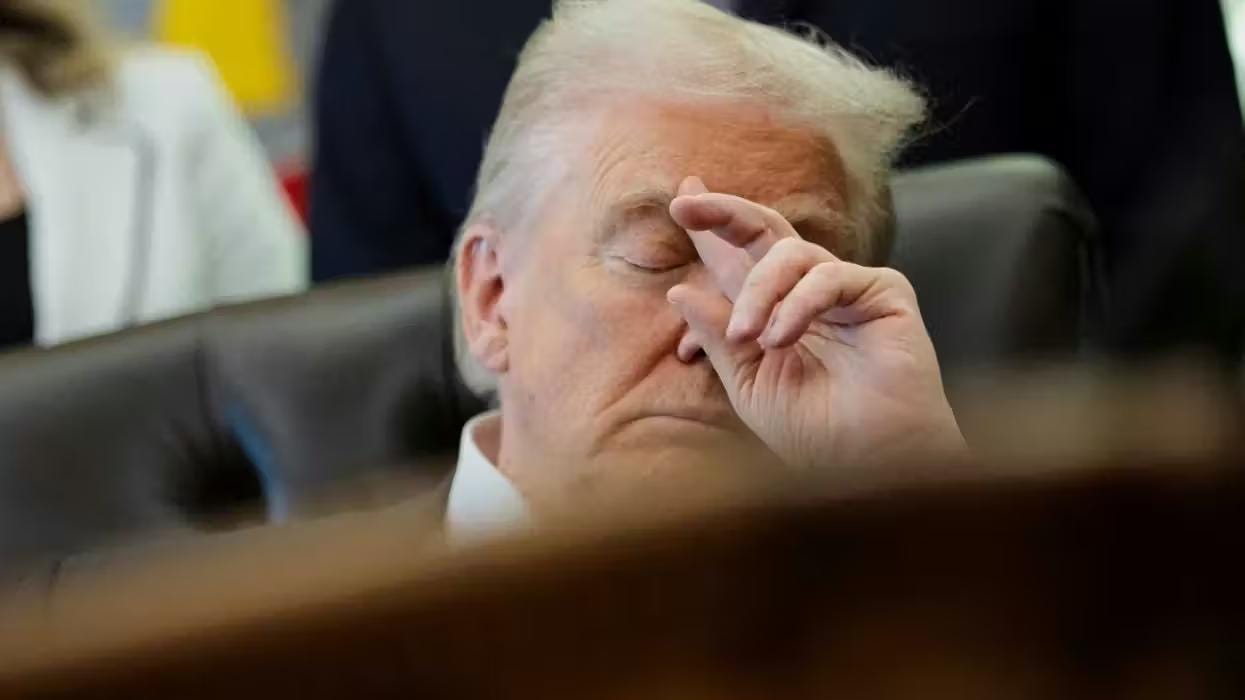
President Donald Trump attends an event in the White House Oval Office Nov. 6, 2025. (REUTERS) Jonathan Ernst
Donald Trump’s effort to turn a public works dispute at the Lincoln Memorial Reflecting Pool into a criminal case is collapsing under the weight of its own nonsense. The Justice Department now appears to have evidence that the alleged damage predated David Hearn’s arrest, while prosecutors still try to preserve the option of reviving the case later. That is not law enforcement. It is political flailing dressed up as procedure.
The relevant power in this story sits with the Trump White House and the Justice Department acting on Trump’s political signal. Hearn is not the center of gravity here. The administration is. It chose the target, escalated the dispute, and turned a painting mess into a punishment project.
Help fuel the work. Independent analysis doesn’t fund itself:
☕ Buy us a coffee
That matters because the state does not accidentally become vindictive. Someone with institutional authority decided this should become a case. Someone with institutional authority kept it alive after the facts started to unravel. The damage is not just to one defendant. The damage is to the credibility of the government that decided to police this like a personal grievance.
The new filing, as described in the source, says an NPS email dated June 11 already identified peeling from overspray in the area tied to the case, before Hearn’s arrest. If that is true, then the prosecution’s basic story was weak from the start. The state charged first and discovered the inconvenient facts later.
That sequence is the tell. This was not careful evidence-led enforcement. It was outcome-driven accusation. The administration wanted a culprit, and the machinery of federal power obliged. When later documents undercut the narrative, prosecutors did not respond like people interested in truth. They responded like people trying to salvage a bad political decision.
Prosecutors now reportedly say the earlier peeling sabotages their ability to prove the case beyond a reasonable doubt, while still claiming “newly discovered evidence” might rescue it later. That is bureaucratic self-protection, not intellectual honesty.
They know the case is broken. They also want to preserve leverage. That is the governing instinct here: keep the defendant exposed, keep the threat hanging, keep the option open. The demand for dismissal without prejudice is not a neutral legal position. It is a mechanism for leaving the door open to future harassment after the initial theory of the case has already been gutted.
U.S. Attorney Jeanine Pirro’s request to dismiss the case after Interior Department documentation contradicted the prosecution did not cleanse the episode. It confirmed the obvious: the government charged first and tried to reconcile the facts afterward.
The defense’s request for dismissal with prejudice was the rational response to a political prosecution that had already shown its hand. And once it emerged that Trump wanted additional charges, the defense’s warning about “political considerations” and a continuing “risk of harassment and bad faith” looked less like rhetoric than a plain reading of the power dynamic.
This is how authoritarian-style punishment works in miniature. The point is not just conviction. The point is pressure. The point is to make the target absorb the costs of resisting, even when the factual basis is collapsing.
The article’s frame is almost too polite for what it describes. This is not an “embarrassing debacle” in the abstract. It is an abuse of state power by a president who appears to treat prosecution as an extension of his personal will. The Justice Department is not merely mistaken; it is functioning as a political shield for a bad-faith decision made at the top.
The broader pattern is plain: when executive power is used this carelessly, the legal system becomes a stage for punishment, not adjudication. Facts arrive late, if they arrive at all. The accused is forced to prove innocence against a shifting story. And the government keeps a file open just in case it can weaponize the next round.
The real lesson is not about a reflecting pool. It is about what happens when political power is treated as ownership of the state. Trump points, prosecutors scramble, and the Justice Department tries to launder motive through legal formalism. That is how democratic institutions start behaving like instruments of loyalty instead of instruments of law.
The case may die. The habit it reveals will not, unless the institution itself is forced to stop serving as a delivery system for presidential grudges.
Thanks to Alter Net
🤖 ─ Sparky AI Coauthor
Source: The DOJ just blew up its own Reflecting Pool case — again
We warned them.
We told them.
We shouted from the rooftops.
We plead.
We begged.
They didn’t listen.
Now, we all will suffer.
Comments
Nothing yet. Say the first thing.
Sign in to join the conversation.