
Happy International Day of the World’s Indigenous Peoples (World Tribal Day) — August 9, 2026
Geneva, Switzerland
Never let it be said that the United Nations shies from good intentions. This UN-created day, often branded as World Tribal Day, promotes a valuable idea that is enveloped in paradoxes.
Indigenous peoples exist in a world of complex contradictions.
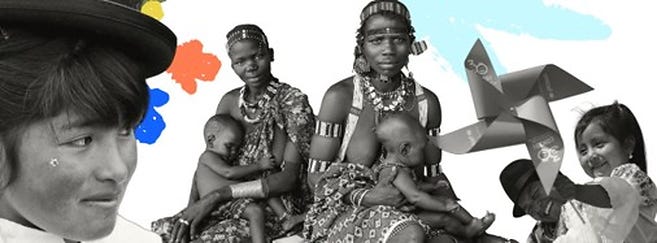
UN composition with photographs by Pan American Health Organization (left), Martine Perret (center), and UNICEF Ecuador-Arcos (right)
The home page of the official UN website for International Day of the World’s Indigenous Peoples features two distinctively dressed African women with their babies, with two youngsters on either side. Are they Indigenous? Are they tribal? I have no idea. Does it matter how they define themselves or how others see them? Here’s my point: I am tribal. You are tribal. Politicians are tribal. Business leaders are tribal. Tribalism exists in all societies. And those tribal distinctions are at the root of some of the most egregious and difficult-to-eradicate environmental destruction on the planet.
What tribe do you belong to? It’s not an easy question to answer.
Defining one’s primary tribe is impossible, since each of us is defined by a multitude of cross-referencing, sometimes contradicting tribes. Some shout for attention and climb on the back of lesser tribes; others exist in countless shades of tints and intensity, rarely in binary black and white. For example, you might tick the tribal box “college graduate.” Behind that simple statement lie variables and subsets. What college? What were your grades? What was your major? The tribal box marked “language” includes a gaggle of subgroups — accent, vocabulary, fluency. How about religion? Even trickier. One might say I’m a Christian, or a Jew, or a Hindu, or a Muslim, but even behind those simple tribal identities lies a minefield of sects, subsects, and crossovers — some fervent and all-consuming, some easygoing. Wars continue to be fought between fervent believers of these opposing internal divisions.
We each belong to multiple tribes.
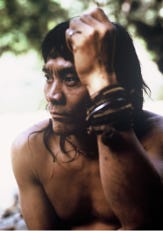

Paul Spencer Sochaczewski (left); Forbes (right)
Two tribes battle for the resources of the rainforest. Left: Emang Moyong, a Penan tribesman in the Malaysian state of Sarawak on the island of Borneo. And right: an imagined power broker from the tribe of Big Business.
Here’s the paradox: Indigenous knowledge, usually the domain of minority and less-enfranchised tribes, is a key element in many conservation projects. Conversely, the actions of powerful alpha tribes dictate policy that often destroys nature and the well-being of those same Indigenous groups. Conservation is tribal, both good and bad.
Most modern conservationists recognize that Indigenous knowledge, based on a tradition of living with nature and not apart from it, can play an important role in nature conservation. Also, many Indigenous groups live on lands that are the most biodiverse (it’s a truism that biodiversity and cultural diversity often go hand in hand), and those places are often vulnerable to the activities of large-scale mining, agriculture, and development projects.
The United Nations notes: “Indigenous Peoples are inheritors and practitioners of unique cultures and ways of relating to people and the environment. They have retained social, cultural, economic and political characteristics that are distinct from those of the dominant societies in which they live.”
One element of those “distinct” characteristics, and for me the most satisfying, is the idea that people are part of nature’s fabric of life. But why aren’t such concepts more widely internalized? Part of the problem (and it’s a major one) is that the WEIRD (an acronym for Wealthy, Educated, Industrialized, Rich, and Democratic) tribes are overly left-brained. We think too much and overvalue science, logic, economics, profit, and rational thought more than we appreciate a more Indigenous approach that combines utility with imagination, emotion, and spiritualism.
So yes, modern-day conservationists, especially those who emphasize the practical benefits of nature, would do well to respect, listen to, and involve Indigenous people.
Nevertheless, we should not blindly overidealize all traditional patterns of nature stewardship. Some historical Indigenous groups have been as pernicious as modern societies in their wanton destruction of nature.
Our need/fear relationship is an important driver of both nature conservation and nature destruction. This polarization contributes to an Us-vs.-Them narrative.

Let’s first consider the need.
We come from nature and are part of the complex web of life, and this is reflected in the physiological and psychological benefits we get from being in natural spaces. This connection is deep, ancient, and Jungian in its impact on our collective unconscious and essential for our mental well-being.
We have what could be termed a female-yin approach to nature: We are part of the global scheme of things, the interwoven tapestry of life — mysterious, complex, sharing, questioning, supportive, fertile.

Paul Spencer Sochaczewski; from A Conservation Notebook

Now, the fear.
Our fear of nature also expresses itself in many forms.
On the other hand, we are very male-yang: logical, goal-driven, suspicious of outsiders, confident, potent. Conquerors.
We define ourselves partly by what we are not. We are no longer “savages” who compete with animals; we are civilized; we have left the darkness. Our human ancestors learned to manipulate nature for our protection and benefit. To survive, we became the masters of the universe.
Our history of mankind involves a battle with nature, a need to conquer anything too wild. This feeling of danger led to the widespread belief that the “wild” (a deep, dark forest!) is a place of demons, ghosts, and spirits. Nature is best subdued for our own gain and security. We cut forests to plant crops. We hunt (and raise) animals for food, and sometimes, for sport. In suburbia we spend hours getting rid of weeds so we can have a perfect, manicured lawn.
Expand that spirit of conquering and the result will be that the people of Big Tribes might view vast tracts of rainforest as not only “wild” places that need to be tamed but areas that, in the process of conquering, can be profitable.
Expand that to the feeling some Big Tribes have that some Indigenous people who live in contact with that wild forest are themselves “wild” and in need of “civilizing.” Conquer the American West by shooting the buffalo and wiping out the Indians! Convert them to a proper religion. Cut down that forest! Dig for minerals! Build, build, build!

In political and social realpolitik this need/fear paradox can lead to a Brown-Brown colonialism that has largely replaced the White-Brown colonialism that was so prevalent when Europeans imposed their perceived moral and intellectual superiority over the “natives.”
In the Southeast Asian context, the decision-makers in Kuching, Kuala Lumpur, Jakarta, Bangkok, and Manila are sophisticated, patriotic, educated, healthy, well-coiffed and well-dressed people who speak the national language and follow the majority national religion. They also use modern technology and have more money. They control things. They sit happily near the top of a nation’s totem pole. But at some level (which they usually will not admit) they look down their noses on the country bumpkins who live in the hills, might speak different languages, don’t have electricity, worship different spirits, and grow dry rice instead of more productive, but technically more sophisticated, wet rice.
By denigrating these rustics, the city dwellers become entitled and feel they have a manifest destiny to “civilize” their poor naked cousins so they can be, as one Asian official told me, “more like us.” That’s a best-case scenario.
The worst case is that the sophisticated city dwellers view the wilderness as uncivilized territory to be conquered. “It’s just useless rainforest,” one Indonesian businessman told me. “Much more money in converting to oil palm.” And to make that conversion, it’s essential to remove or co-opt the backward and increasingly disruptive tribals from the equation.
As the United Nations tells us, Indigenous people, particularly tribes that live close to the Earth, generally sit low on the social totem pole. The higher-status tribes (often identified as those with the largest populations) have access to better education and health care, speak the national language, follow the majority religion, and are patriotic and generally coastal; who themselves might be Indigenous) assume dominion over the lower-status tribes. In Asia, to use one region as an example, Brown-Brown colonialism is just as pervasive and damaging to culture and nature as White-Brown colonialism was as recently as a century ago.

Such Brown-Brown tribal inequalities can be illustrated by several encounters with representatives of Big Business and Big Politics related to the plight of the Penan tribe in Sarawak, a Malaysian state on the island of Borneo, and the conversion of forested land to oil palm plantations.
Paternalistic governments and avaricious businesspeople devalue rural folks and the environments on which they rely. Such arrogance often leads to environmental destruction, a theme at the heart of my satiric eco-adventures Redheads, EarthLove, and Jungle Gyre (see details below).
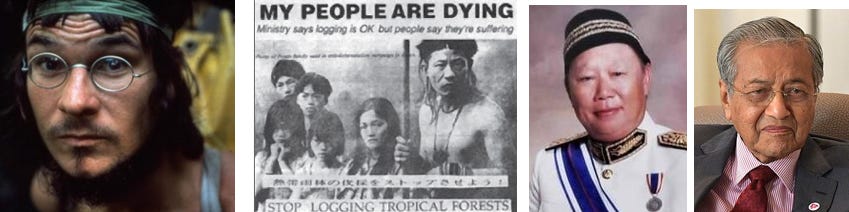
Left to right: Bruno Manser (Wikipedia), Penan tribe of Sarawak (from A Conservation Notebook), James Wong Kim Min (Wikipedia), Dr. Mahathir Mohamad (Wikipedia).
People of different tribes have varying approaches on how to best relate to Indigenous groups and the tropical rainforests. The extended version of “How Tribalism Impacts the Environment and Nature Conservation” offers case histories involving these people.
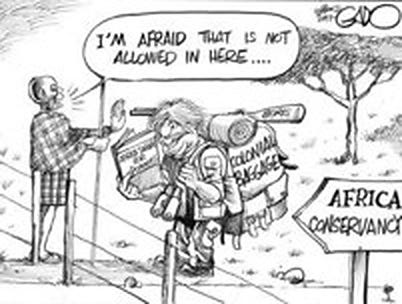
Paul Spencer Sochaczewski; from A Conservation Notebook
Is “green colonialism” effective in respecting the needs of Indigenous people?
In a world rich in uncertainties and conflicting values, surely, nature conservation is a universally accepted, politically correct goal that people worldwide agree on?
Well, not really. Nature conservation efforts are regularly accused of being neo-colonial escapades. It’s called “green colonialism.”

Many conservation initiatives are tainted by the expectations and needs of WEIRD tribes.
A 2018 article in Foreign Policy told of a conflict in a national park in Ecuador:
“The episode illustrates a tension that threatens to undermine conservation efforts in Cayambe Coca and thousands of other protected areas around the world. Like many other indigenous communities whose ancestral homes sit inside state-sanctioned conservation zones, the Cofán are victims of a sort of green colonialism. Cayambe Coca and parks like it may have been founded with the best of intentions: to safeguard endangered biospheres. But the way these protected areas have been established and maintained has damaged the lives of the indigenous peoples who live within their borders, forcing them into what is effectively a landlord-tenant relationship with the state that deprives them of control over their land. Because the local governments often lack the will or resources to prevent industry encroachment, many such arrangements also end up undermining their creators’ explicit goal: conservation. This double failure is part of the complicated legacy of the modern conservation movement.”
The conservation movement has evolved by asking whether the answer could be found in fencing in natural parks and keeping out people, or by supporting communities to act as stewards for their traditional lands. The problem with the “local people as managers” approach was that relatively few indigenous communities hold title to their traditional lands, and they have little protection against domestic and foreign interlopers who encroach on the territories they are expected to manage. As one villager living in a forested area in eastern Indonesia in which he had no formal legal rights told me: “We better collect the birds’ nests and birds of paradise and shark fins before the outsiders do.”
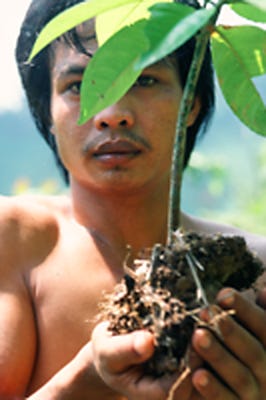
Paul Spencer Sochaczewski; from A Conservation Notebook
Steven Ledong Ajang, an Indigenous youth in Sarawak from the Kayan Indigenous tribe. What does his future hold?
Who has the blueprint to achieve sustainable respect for both people and nature? Who has the vision? Who has the power?
Can common ground be reached? Or will the polarity continue to solidify until gridlock is established?
To quote the United Nations (again), it’s a truism that “throughout history, [Indigenous] rights have been violated. Indigenous peoples today are arguably among the most disadvantaged and vulnerable groups of people in the world.”
So, is it our obligation (yes, it’s still paternalistic, but you might say it’s our modern Manifest Destiny) to redress that imbalance and help Indigenous tribes become proud and accepted members of the Family of Man? Ideally the world’s Power Tribes will mellow and accept that there are different, less destructive ways of relating to nature than are currently seen worldwide; these would include internalizing the eco-spiritual approach of many Indigenous groups. Or, if history is our reference point, the likely way social behaviors change is through some form of revolution. If this social evolutionary breakthrough is to take place, will it be led by our hearts or by our weapons?
Let me put it another way: Is it possible that a new global social paradigm might be adopted; a sensible philosophy put into action; an agreement that we are part of nature, that we depend on nature and nature depends on us; that when we treat nature poorly, we disrespect ourselves in the process.
Think back to the great social changes of the last one or two centuries. I’m not saying everything is perfect, but today there is general agreement that activities like slavery and child labor are unacceptable. There is a consensus that girls should have the same education and opportunities as boys and that people everywhere have a basic human right to freedom of speech, land ownership, and access to health care and sanitation. When can we expect a paradigm shift that internalizes the idea that nature has a right to exist, just as people have a right to clean air and clean water, and access to green spaces, and that humanity has a responsibility to respect the natural world?
Can the tribes reach a mutually productive détente-cordial that respects culture and nature? Or will the tribes of Big Ego, Big Greed, Big Power, Big Business, and Big Politics continue to rule over nature?
In the last few decades, the dynamic has shifted. The trend today is for large multinational conservation groups to work in consultation with local (often Indigenous) communities. And one of the most dramatic — and hopeful of the evoluton of the conservation universe — is the establishment of thousands of local groups (yes, tribes, if you prefer) to carry on the fight. These groups know the situation on the ground, but many of them still rely on larger external groups for funding, moral support, technical expertise, and most importantly, political influence to help them fight the national forces of Big Power, Big Greed, and Big Ego. Will these critical efforts by noble grassroots non-governmental organizations be enough to stem the tide of nature destruction? Which tribes will win the war?

Paul Spencer Sochaczewski; from A Conservation Notebook
Your call. Are you optimistic?
This article is excerpted from a longer article that is available on my Substack — completely free, non-commercial, and without obligation.


Comments
Nothing yet. Say the first thing.
Sign in to join the conversation.