
GENEVA, Switzerland
Make your writing dance.
Can you dance?
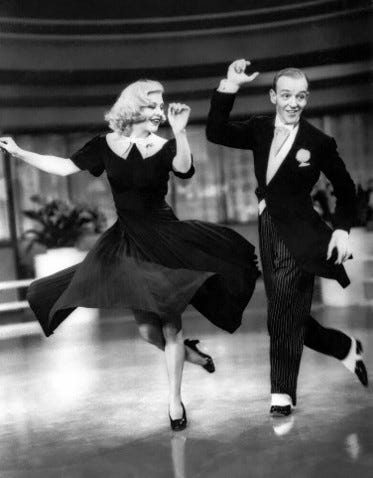
Let me rephrase that. Can you swirl and twirl and dip and prance like Fred Astaire and Ginger Rogers?
This article celebrates the world premiere of Swing Time, a film that features their signature choreography at its most elegant.
And elegance rarely occurs in writing. You’ll know it when you read it; when the words leap off the page, jitterbug, and break into song; when you rise from your chair and call to your partner, “Hey, you gotta read this.”
And you’ll know it when you write it. It’s when everything comes together. It will feel like a fleeting runner’s high, the satisfaction of a clean golf stroke, or a high note sung perfectly. Reward yourself with a contented “yes” (maybe even a “huzzah!”) and a metaphorical pat on the back.
The basic recipe is to write clearly and concisely, using correct grammar and vocabulary. This seeming simplicity is, in itself, noble. (Note: Even a single sloppy error — for example using an apostrophe to make a plural noun — is a sin, as egregious as if Fred had stomped on Ginger’s ankle and dropped her during a twirl.)
Just write clearly and honestly — you’ll have my admiration and thanks.
Then incorporate some of the advice in these Substack posts and in Share Your Journey — “just say no” like the Nancy Reagan Principle instructs, write in scenes like Little Red Riding Hood, cut fluff like Michelangelo sculpts, relate to the hero’s journey, focus on the Story of One, and start with a bang.
Then add pixie dust.
Cold fact: Some people have a natural ability to sing, dance, paint, write music, and understand how a carburetor works.
More cold water: Some people will never achieve elegance in writing. You may have to accept that “good” is just fine; good is a peak few people scale. (You might recall the scene in the play/film Amadeus in which composer Antonio Salieri realizes his limitations. Salieri is competent. Mozart is, well, he’s Mozart.)
Nevertheless, don’t despair if you can’t write like Abraham Lincoln, paint like Andrew Wyeth, or touch the soul like Giacomo Puccini. Here are a few tips to help your writing sing, even if it might remain a little off-key:
The Rhythm Method
Read this aloud:
This sentence has five words. Here are five more words. Five-word sentences are fine. But several together become monotonous. Listen to what is happening. The writing is getting boring. The sound of it drones. It’s like a stuck record. The ear demands some variety. Now listen. I vary the sentence length, and I create music. Music. The writing sings. It has a pleasant rhythm, a lilt, a harmony. I use short sentences. And I use sentences of medium length. And sometimes when I am certain the reader is rested, I will engage him with a sentence of considerable length, a sentence that burns with energy and builds with all the impetus of a crescendo, the roll of the drums, the crash of the cymbals — sounds that say listen to this; it is important.
So write with a combination of short, medium, and long sentences. Create a sound that pleases the reader’s ear. Don’t just write words. Write music.
— Gary Provost, 100 Ways to Improve Your Writing
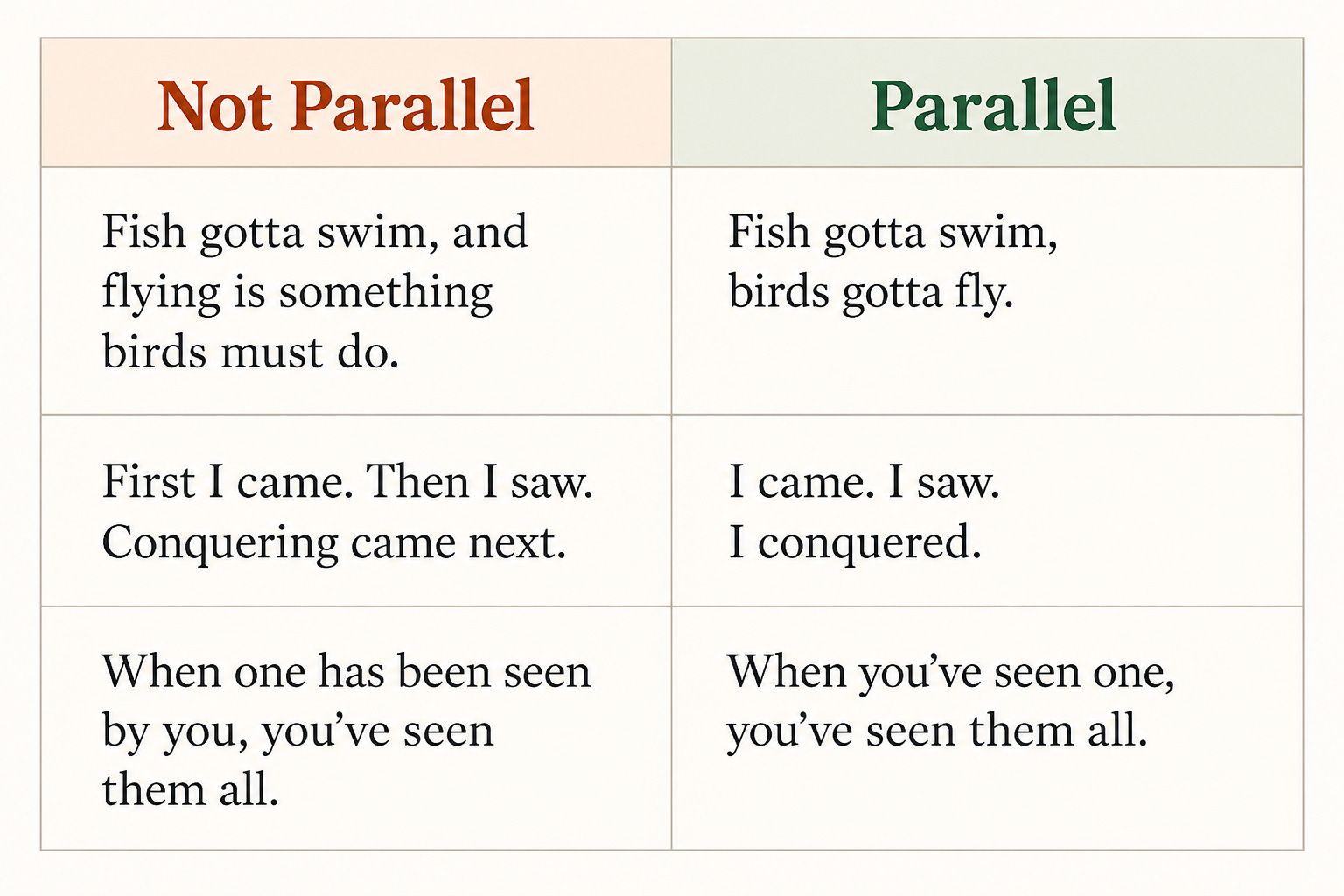
Parallel Structure
More music, again by Gary Provost, the best writing teacher I’ve had.
Triple Whammy — the Rule of Three
For some reason, we like examples to come in sets of threes. This common phenomenon is as impossible to figure out as the reason why aerobics instructors worldwide use a count of eight.
Consider: Snap, crackle, and pop. Three gifts of the magi: gold, frankincense, and myrrh. Three Stooges, Musketeers, and Tenors. Thomas Jefferson’s three inalienable rights: life, liberty, and the pursuit of happiness. The use of “so” three times by Winston Churchill: “Never in the field of human conflict was so much owed by so many to so few.” Richard III’s desperate plea: “A horse, a horse, my kingdom for a horse!” Martin Luther King’s triple freedom: “Free at last! Free at last! Thank God Almighty, we are free at last!”
Diana Darling uses a multitude of threes:
Bali then was a richly growing swarm in the world, humming with the after clash of cymbals [1] and gongs [2] and slow soprano hand bells [3]. It was a scented place. There was the perfume of mangoes [1] and dung [2] and frangipani [3], and the subtler scents of molds [1], hot wax on cloth [2], and woodsmoke on the skin of lovers [3]. Bali was a shimmering world suspended between heaven and hell, and its people were operatic in their art [1], ferocious in war [2], and tender to their superiors [3].
— Diana Darling, The Painted Alphabet
“It seemed like a nice neighborhood to have bad habits in.”
— Raymond Chandler, The Big Sleep
“Both parties deprecated war; but one of them would make war rather than let the nation survive; and the other would accept war rather than let it perish. And the war came ...”
— Abraham Lincoln, Second Inaugural Address
“I did, however, want to hear Jesse Jackson speak. He is the only living American politician with a mastery of classical rhetoric. Assonance, alliteration, litotes, pleonasm, parallelism, exclamation, climax and epigram — to listen to Jesse Jackson is to hear everything mankind has learned about public speaking since Demosthenes. Thus Jackson, the advocate for people who believe themselves to be excluded from Western culture, was the only 1988 presidential candidate to exhibit any of it.”
— P.J. O’Rourke, Parliament of Whores
Lynne Truss, who wrote joyfully about incorrect punctuation in Eats, Shoots & Leaves, enhances her prose (which leaps, clicks its heels in joy, and smiles at the reader) by quoting other elegant writers. Here’s how she illustrates a point with a quote from James Thurber:
“[James] Thurber was once asked why he used a comma in the sentence ‘After dinner, the men went into the living-room?’ His answer was probably one of the loveliest things ever said about punctuation. ‘This particular comma,’ Thurber explained, ‘was [his editor, Harold] Ross’s way of giving the men time to push back their chairs and stand up.’”
Watch how this sentence gains precision and power just by using evocative verbs and strong nouns:
A person enters a space.
A man enters a space.
A man enters a church.
A priest enters a church.
A priest limps into a church.
A pope limps into a church.
A pope staggers into a church.
A pope staggers into a cathedral.
A pope staggers into St. Peter’s.
Pope Benedict XVI staggers into St. Peter’s.
Pope Benedict XVI crawls into St. Peter’s.
Finally, elegant writing is like charisma. You can’t fake it. Please don’t try to force it; you’ll look ridiculous. If elegance doesn’t show up on a particular day, be very happy with good.
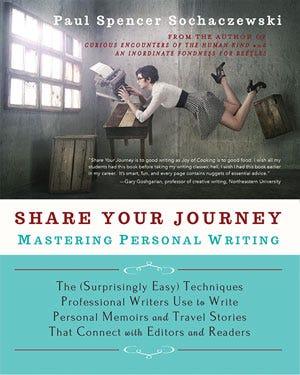
Share Your Journey contains a long chapter on elegance, with many more tips, examples (good and bad), and suggestions to help you write prose that soars.
Comments
Nothing yet. Say the first thing.
Sign in to join the conversation.