
For a long time, I’ve seen teams trying to connect absolutely everything to OKRs.
Every bug fix.
Every support task.
Every infrastructure improvement.
Every operational activity.
And honestly? That usually creates confusion instead of clarity.
The reality is more nuanced — and much more interesting.
Not every output from a team has the same purpose.
Some outputs are meant to create change.
Others are meant to sustain continuity.
Both matter.
The mistake is treating them as if they were the same thing.
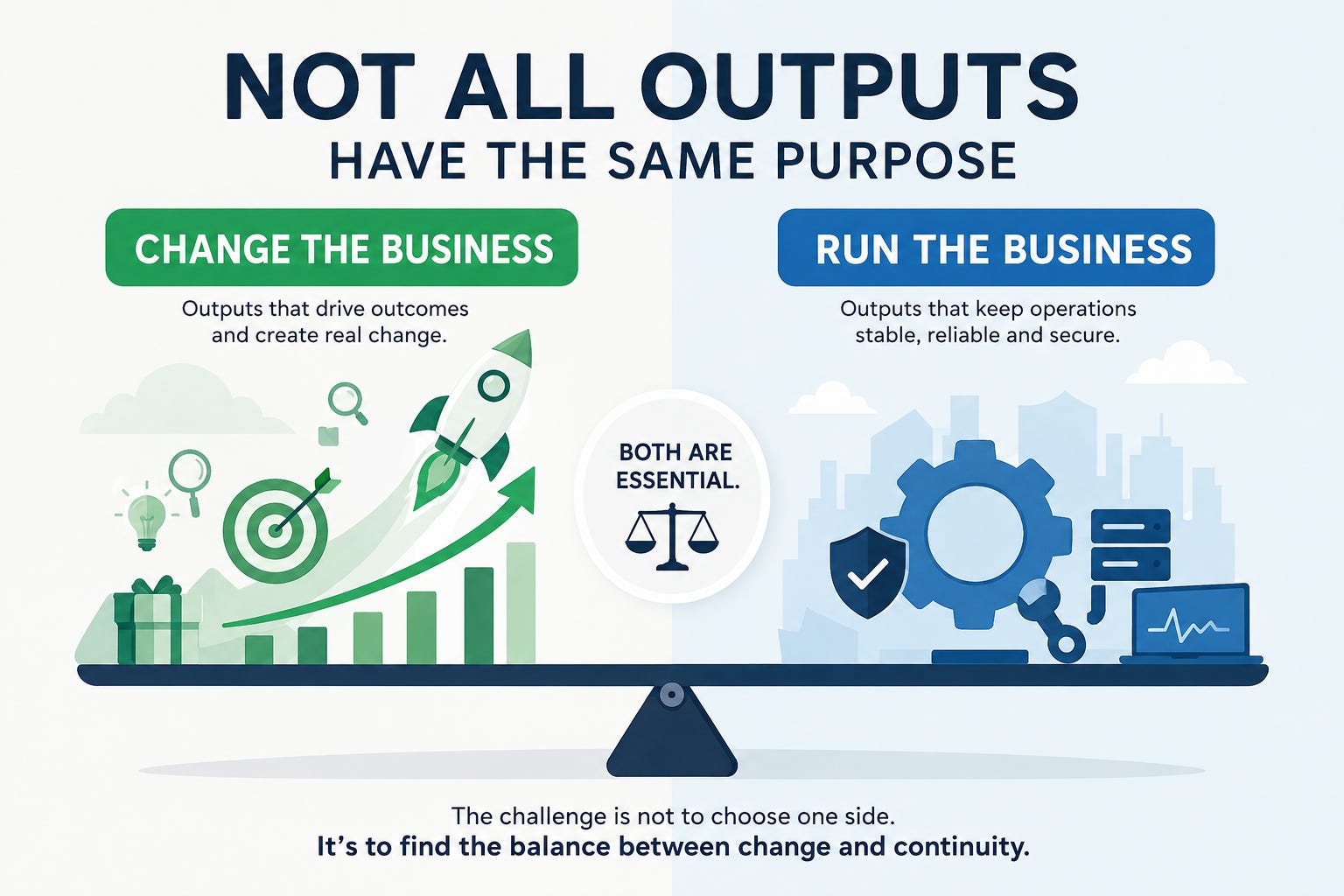
This is the type of work most people naturally associate with OKRs.
Teams are trying to move something important.
They are experimenting. Learning. Creating new capabilities. Testing hypotheses. Launching improvements.
Typical outputs here include:
MVPs
Discovery activities
New features
Process redesigns
Product experiments
New customer journeys
Innovation initiatives
These outputs are not valuable by themselves.
Their value comes from the impact they generate.
That’s why, in this context:
Outputs → influence Key Results → which indicate progress toward Outcomes
The output is the intervention.
The Outcome is the real-world change.
For example:
A team launches a new onboarding flow.
That’s an output.
But the business only changes if customer behavior changes:
Higher activation
Better conversion
Faster adoption
Lower churn
This is where Team OKRs shine.
They help teams focus not only on delivering something, but on understanding whether that delivery actually created meaningful impact.
I wrote recently about the difference between KPIs and outcomes, and how many teams get trapped measuring activity instead of progress. This idea builds directly on that reflection.
Now let’s talk about another type of work — equally essential.
The work that keeps the business alive.
This includes things like:
Bug fixing
Customer support
Security
Compliance
Infrastructure
Maintenance
Reliability
Monitoring
Data operations
Operational improvements
These outputs are not necessarily trying to create transformation.
They exist to maintain operational health.
In this case:
Outputs → help sustain healthy operational KPIs
And that’s perfectly fine.
A support team resolving incidents quickly may not be “changing the business,” but they are preventing customer dissatisfaction.
An infrastructure team improving reliability may not have a flashy OKR, but they are protecting revenue and trust.
A compliance team may not generate visible growth, but they are reducing operational risk.
This work matters enormously.
The problem starts when organizations force these activities into artificial OKRs just because “every team must have OKRs.”
That usually creates bureaucratic goals nobody truly believes in.
I discussed this in another post: Not Every Team Needs a Team OKR: When to Say No.
This is where many organizations get stuck.
They mix together:
KPIs
KRs
operational metrics
strategic outcomes
routine activities
transformational initiatives
And suddenly everything becomes an “OKR.”
But there’s a critical distinction:
KPIs answer:
“Are we keeping the business healthy?”
KRs answer:
“Are we making meaningful progress toward a desired outcome?”
Both are valuable.
But they serve different purposes.
Trying to force operational KPIs into strategic OKRs often dilutes focus and creates frustration.
One mental model I often use with teams is this:
Focus:
Learning
Innovation
Strategic movement
New value creation
Flow:
Outputs → KRs → Outcomes
Focus:
Stability
Reliability
Operational excellence
Continuity
Flow:
Outputs → KPIs → Operational health
Neither side is “better.”
Organizations need both.
In fact, healthy companies constantly balance these two dimensions.
Too much focus on change without operational discipline creates chaos.
Too much focus on operations without change creates stagnation.
The challenge is balance.
One very common trap is when leadership pushes OKRs everywhere without considering the nature of the work.
The intention is usually good:
“We want alignment.”
But the result often becomes:
OKR theater
artificial Key Results
meaningless metrics
teams gaming numbers
low engagement
Sometimes the best thing an operational team can do is maintain excellent KPIs consistently.
That is already highly valuable.
Not every team needs to reinvent itself every quarter.
And not every output needs to connect directly to a KR.
When teams understand whether they are primarily:
changing the business
orrunning the business
…several things improve immediately:
Better clarity
Better prioritization
Better conversations
Better expectations
Better alignment between leadership and teams
Most importantly, teams stop feeling guilty for doing operational work.
Keeping systems stable, customers supported, and operations healthy is not “less strategic.”
It is foundational.
Without operational stability, sustainable growth becomes impossible.
The goal is not choosing one side.
The goal is learning how to balance change and continuity at the same time.
—Paulo
🔗 https://caroli.org/en/
💼 https://www.linkedin.com/in/paulocaroli
📘 https://caroli.org/en/livro/team-okr/
How does your organization balance “change the business” and “run the business”? I’d love to hear the tensions and tradeoffs you’ve seen in practice.
No posts
Comments
Nothing yet. Say the first thing.
Sign in to join the conversation.