
What do politics, religion, and AI have in common?
They can all send a conversation thermonuclear.
I’ve seen seasoned boards at loggerheads and committed parent communities deeply divided by the AI discussion.
I’ve seen members of the same staffroom who had been jovial colleagues for a decade suddenly locked in a bitter dispute over this new technology.
What does this tell us about Artificial Intelligence?
Discussing AI isn’t easy.
And here’s my big idea for this essay, and the central reason we struggle to discuss AI:
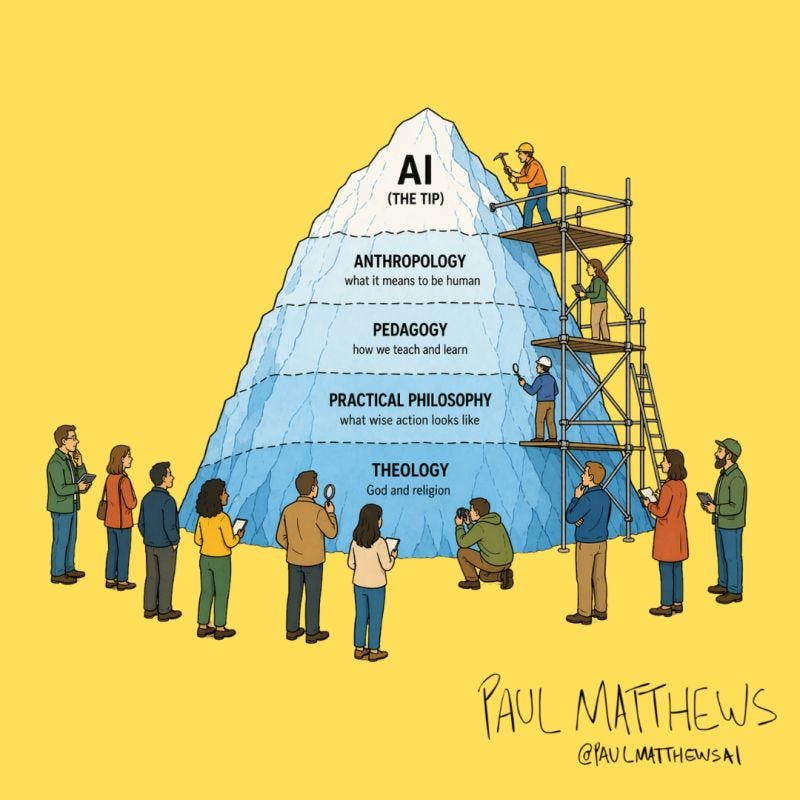
The AI discussion isn’t primarily about tech. In fact, the technology is only the tip of the iceberg.
Putting AI in the ‘technology’ bucket is an easy mistake to make.
After all, in late 2022, when we first used tools like ChatGPT, we found them on a website while we were using a laptop. The tools produced text on a computer screen and were created by big technology companies.
When we think of AI we might think of phrases like
token use
data security
neural networks
machine learning
enterprise licenses
pre- and post-training
All that to say, it’s easy to assume that a conversation about integrating AI into a school community is primarily technological.
But just as 90% of the iceberg is below the waterline, 90% of the conversation is about more than technology.
The reason our AI conversations can be so complex is they draw upon the most important questions we face as a human race:
What is a human being?
What does a good life look like?
What is the purpose of education?
Does life have an ultimate purpose?
What does good teaching and learning look like?
Is there a God? And what might this mean for us as humans?
Even a passing glance will reveal that these are the big questions of life.
And these are precisely the questions that we are drawing upon as we seek to discuss how we use artificial intelligence wisely within a school community.
For example, say I believe that education is primarily about the formation of a person. And suppose I have a colleague who thinks that education is primarily about equipping a young person for the workforce. We’re going to have wildly different opinions about AI, not because of our understanding of the technology, but because of answers to questions that sit well below the waterline.
(and if the Titanic taught us anything - it’s not the stuff above the waterline you gotta worry about)
You see this principle at play in my latest book, Wise AI.
When considering using AI well, the first things we need to sort out are the why (purpose), and our values and principles. Only once these are clear will habits and tools actually work together to improve the shape of our work and life.


This brings me back to my big idea: discussing AI isn’t mainly - or even mostly - about technology.
The AI iceberg floats in an ocean of deeply human questions.
Here are some rapid-fire applications of this AI-iceberg idea for your school community.
Have the discussion. AI is the biggest technology disruption the world has ever known. It’s causing known and unknown changes to our students, teachers, and school communities. If we aren’t having the discussion we only set ourselves up to fail.
Realise the scope of the discussion. Don’t make the mistake of putting the AI discussion in the same category as moving from Google to Microsoft or changing Learning Management Systems. Be prepared to talk about theology, philosophy, anthropology, and pedagogy.
Lean into your school’s purpose and vision. Schools are great at outlining big, guiding principles - vision, mission, values, learner attributes etc. They don’t necessarily need to be ‘reimagined’ for the AI world, but they do need to be leaned on. In much of my work with schools I’ve seen that the ideas that got a school this far are often sufficient to carry the it into the future with purpose and clarity.
Get help with the process. Change is tricky and there’s every chance you would benefit from some outside help navigating the AI iceberg. If that sounds like a good idea, why not get in touch with me? You can contact me here - I’d love to hear from you.

At the beginning of this essay I noted that I’ve seen discussions about AI detonate conversations, friendships, and board meetings.
But let me say this: I’ve also seen the opposite.
I’ve seen schools move through these discussions with clarity, purpose, space, and healthy outcomes. It is possible for these discussions to be a genuinely edifying experience for staff, students, and the school community.
And the first step towards this is to realise what kind of discussion we’re actually having when we talk about AI.
Because just as 90% of the iceberg is under water, 90% of the AI conversation is not about technology.
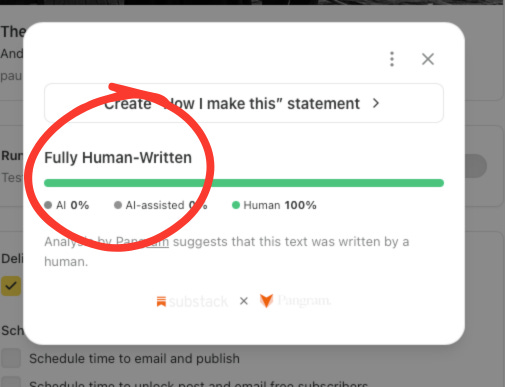
P.S. Have you noticed that Substack has just introduced an AI detector to the platform? Stupid idea. Those things don’t work. This essay got (rightly) flagged as 100% human and I got the distinct feeling I passed a test that I should not have had to sit. Oh well.

No posts
Comments
Nothing yet. Say the first thing.
Sign in to join the conversation.