
Hey friend,
This week has been a wild one.
First week of the school holidays. Swimming lessons every day. Lost (and found, and lost, and found…) goggles every day.
And still no baby. Come on man!
Hopefully soon.
My sons have been staying with the in-laws for a few nights (we were pretty sure the baby was coming so sent them off as a preemptive strike). With our new-found (but short-lived?) mobility, we managed to go and see the Odyssey - brilliant! - and get out for a coffee or two.
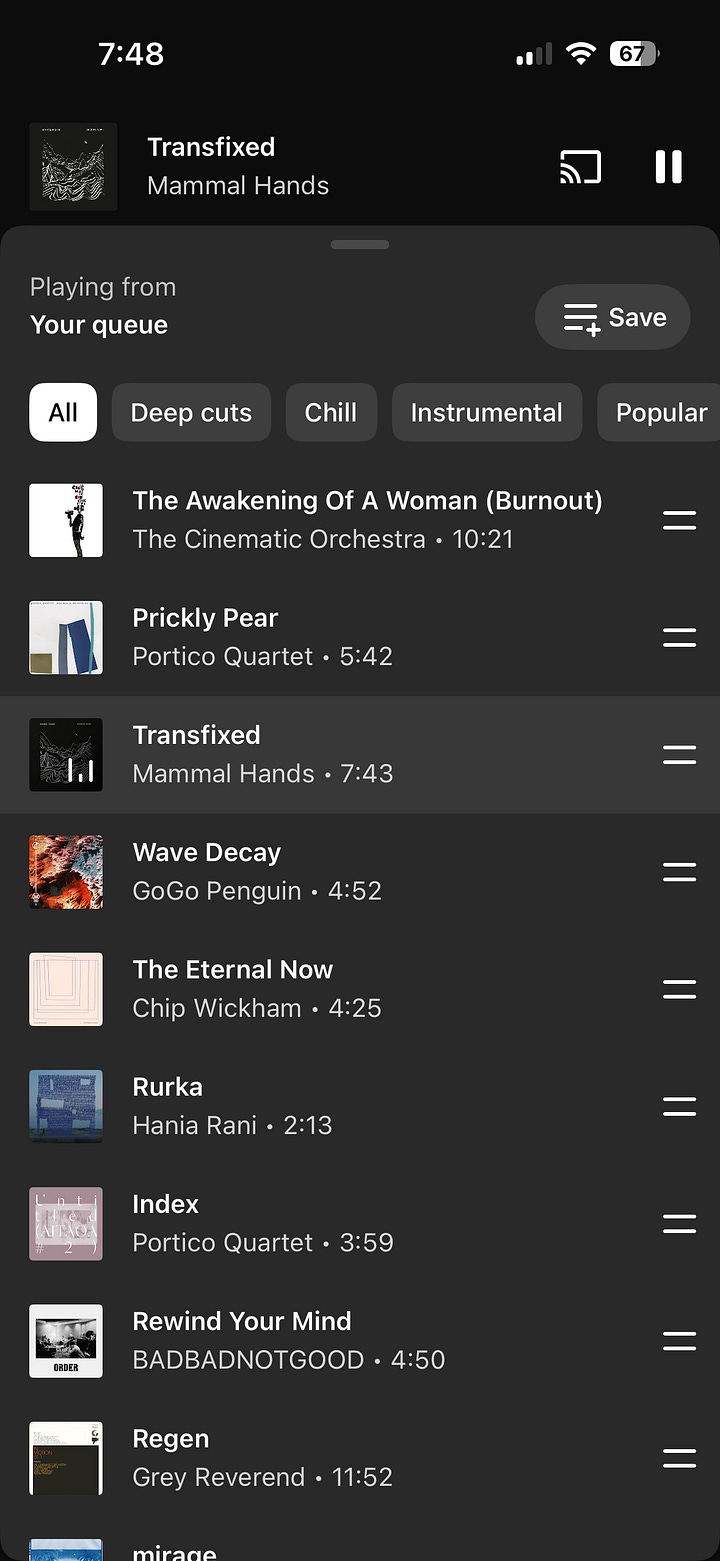
I’ve also rediscovered my love for instrumental progressive jazz. Playlist below. Let me know if you try it.
Anyway - over the last few weeks we’ve been thinking about a formation-forward vision for education. This is more important than ever in an AI world.
Let me know if you find it useful!




AI misuse has a gravitational pull amongst our students.
I can feel it in the classroom. Many of our students have an ever-burning yet unconsumed desire for the path of least resistance, and that path now leads through a chatbot. While there’s been much said about how we adjust our tasks in light of the AI reality, I want to go deeper.
Before we look at design, we must look at desire.
What do our students actually want from their education?
If they desire completion, then AI misuse is the obvious choice. It’s fast, it’s frictionless, and it produces something that looks like work. But if we cast a deeper desire, a desire for formation, AI misuse becomes illogical. It may help you with task completion, but it doesn’t help you with personal formation.
You can’t outsource becoming someone.
That’s the argument I’ve been making for the last few weeks. Today I want to show you what it looks like on the ground.
A quick word on my context.
I’m deeply invested in AI and formation on two fronts. Through my consulting practice, I work with schools. Through my classroom practice, I work in a school. Both shape my thinking, but they’re different kinds of knowing.
These notes are from my practice in a school. I’m the Head of HASS and Christian Studies in a Christian secondary school, so you’ll see that context permeating the examples I give below.
And if you want to work together to navigate AI in your school, let’s chat :)

Having a clear vision is crucial.
Articulating a subject-specific vision forces us to specify what we’re on about and what we hope for.
I want my students to come away knowing exactly what kind of formation we’re after. When they graduate my course at the end of the year, having been shaped into the sort of person I hoped they’d become, I don’t want that to be a surprise to them. I want them to know we were aiming at that all along.
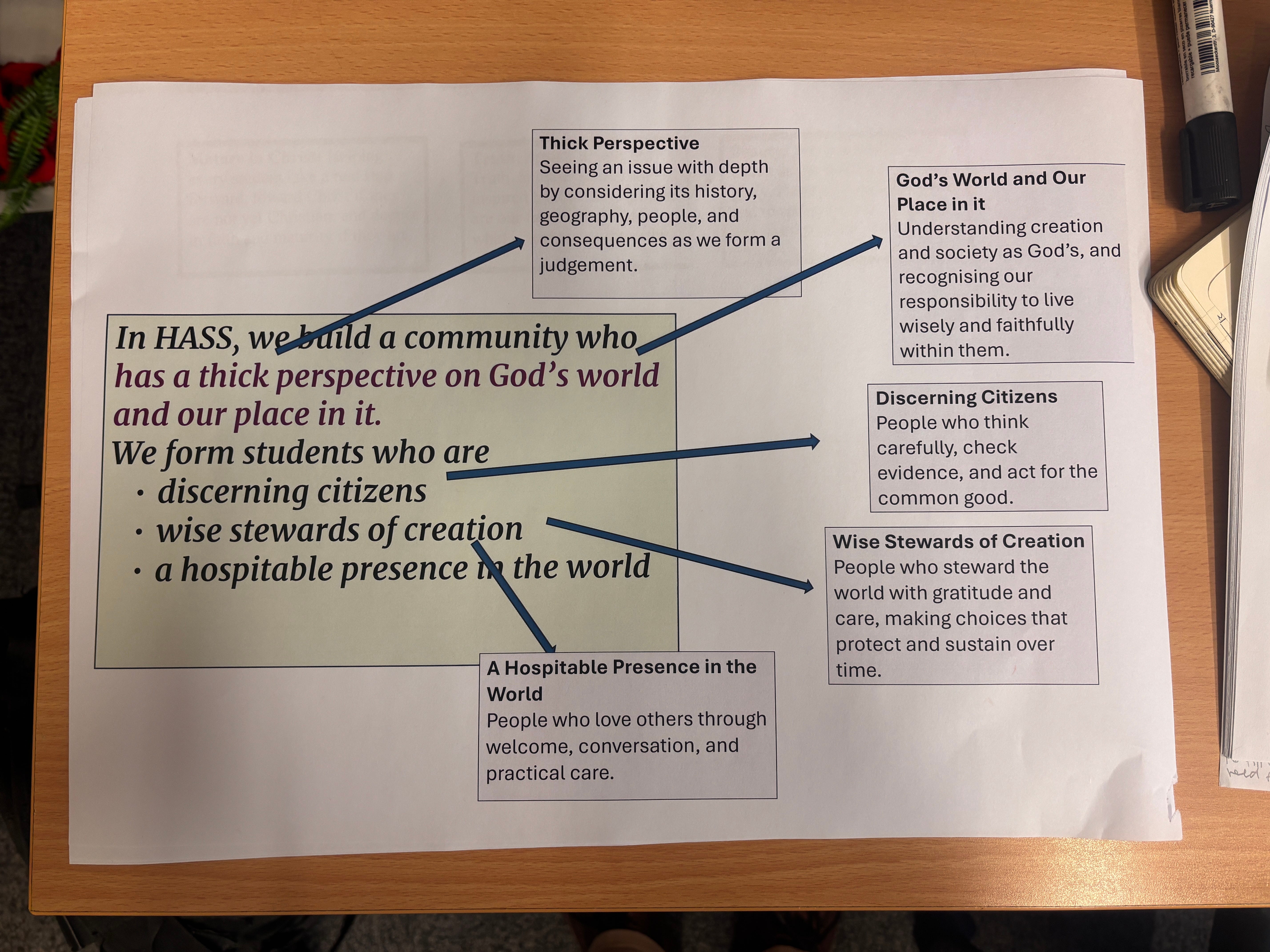
Part of this is launching the year with a clear articulation of the vision. On day one, I show my students what we believe and what we’re about. Not just what we’ll cover. Who we hope to become.
Below is the handout I give my students. Yes - it’s pretty noisy - but I’m a writer, not a graphic designer. Cut me some slack!
Here’s the catch, though.
If the vision is launched and then left alone, it won’t make a dent. A vision needs legs. It needs to move through the classroom and travel with us during our learning.
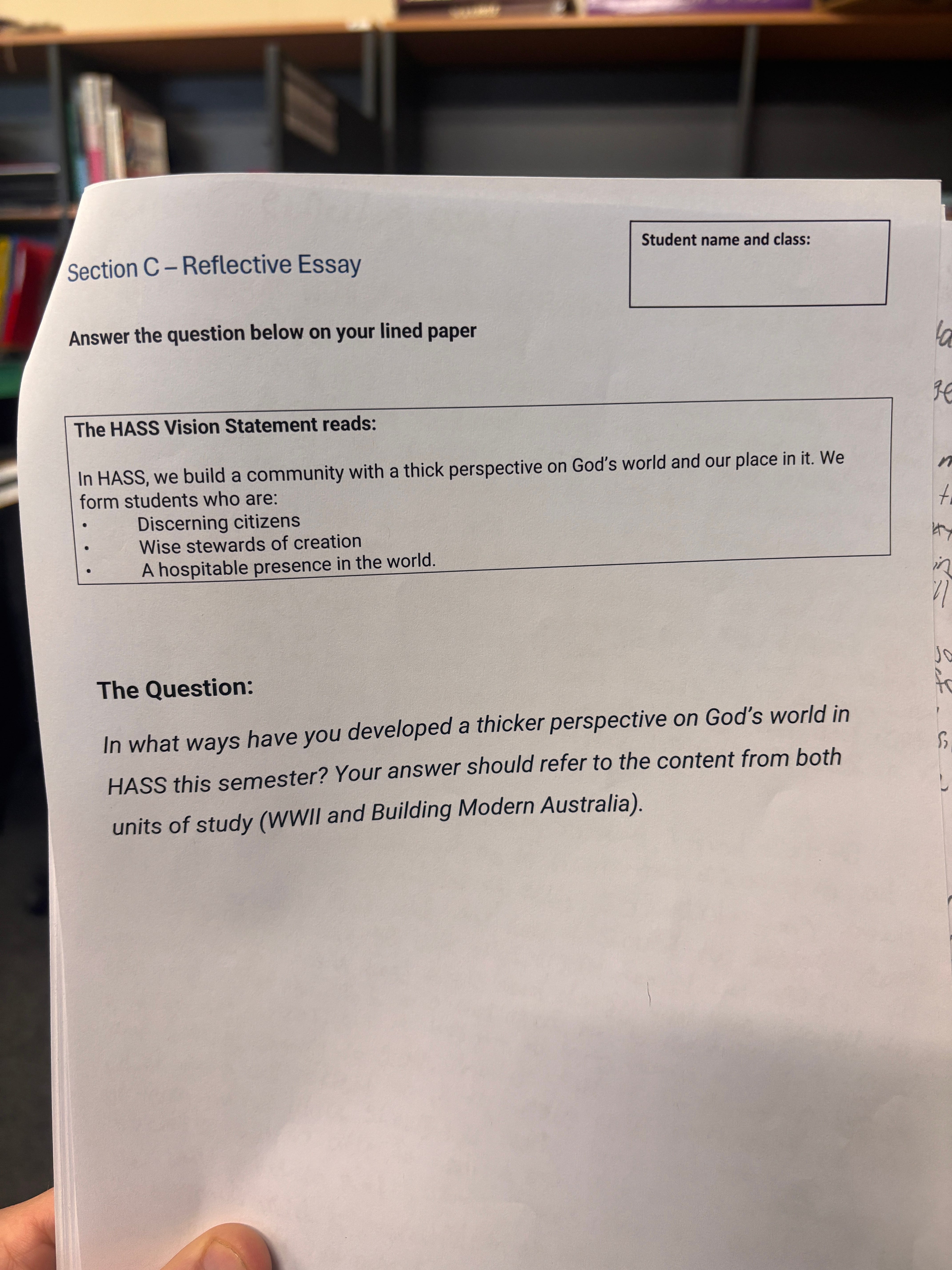
So this year, for the History mid-year exam, the essay response was a reflection on our HASS vision statement.
Students had the question in advance, which meant part of their academic preparation for the exam was reflecting on how they had been shaped and changed through our time together.
The responses were great.
Students weren’t just able to recall key historical moments. They could articulate how those moments had changed their perspective, and changed how they interact with the people around them, both socially and historically.
That’s what I’m talking about!
Language is the life-blood of the classroom.
Language is what compels, persuades, and articulates culture. And whether we notice it or not, our language is always communicating a vision for learning, expressed or implied.
One of the ways I deliberately harness this is by using the phrase formation goal in place of learning goal in our daily lessons. This could seem like linguistic sleight of hand. It’s not. It’s another way to make the main thing the main thing.
Another phrase I have on high rotation: “When you walk out that door in 80 minutes’ time, you’ll be able to...”
It’s simple, but it does a lot of work. It makes the goal clear and concrete, and it locates the progress within the student, not in a worksheet or a Google Doc. The lesson isn’t about producing answers on a sheet or words on a screen. The lesson is about producing a person.
Say it enough times and it begins to sink in.
For the last few weeks, I’ve argued that the fundamental issue with student AI misuse isn’t design but desire.
If students desire merely to complete the work, it will be hard to outmanoeuvre them with innovative design. But if students desire to learn, grow, struggle, and create, then AI misuse becomes not impossible, but illogical. Outsourcing their work would be acting against their own desires, because they have a formation goal.
So here’s a simple routine I use when I launch assessments to foster exactly that. Fifteen minutes, three steps:
Survey the task with the students. Explain it clearly. Give them a physical task sheet. Have them highlight and annotate as you go.
Students should leave this step very clear about what is required of them.
Have students consider the way they’ll complete the assessment. What’s the logical order of events? Research first. Form a hypothesis. Research more. Create an essay skeleton. Refine the hypothesis. Write a first draft. Edit. Peer review. Second draft. Submit.
Then schedule it. Time block the plan into the class time and homework time available.
Students should leave this step with a clear, actionable plan.
Have students consider what they want to stay with them as a result of this work. What should they know in perpetuity? What skill do they hope to refine and carry forward? Is there a disposition they’d like to cultivate?
At the beginning of the work, the student is answering the question: how do I hope this work will change me?
That question is the whole point. Asking students how they hope the work will change them deliberately frames the work as formation-forward, not completion-forward. A blessing and a necessity in a world with AI.
I’m absolutely sold on a formation-forward approach to education.
And these are just a few of the ideas that I implement to help my students catch the vision.
But it would be remiss of me to leave the impression that these pedagogical practices will leave all of your students spellbound by a formational vision for education and completely resistant to AI misuse. Of course not.
There will still be misuse.
We still need to talk about task design.
And we will do that next week (unless the baby comes!)
A formation-forward vision for learning is where we start, but not where we end.
There has never been an easier time for students to outsource or offload work.
Therefore, there has never been a better time to get clear on the value of the work we’re doing. And the value lies not in the production of work but in the production of a person. Education is about formation.
I’m convinced that a formation-forward vision for education is more important than ever, because it approaches the heart of the AI misuse problem: the heart. If students desire to charge through their work with minimum effort and maximum efficiency, clever task redesign will just leave them feeling like they’re being checkmated into busywork.
My hope is not to make AI misuse impossible by design but illogical by desire.
A desire to be deeply shaped by the work renders outsourcing counterproductive.
No posts
Comments
Nothing yet. Say the first thing.
Sign in to join the conversation.