
Following my two-part series, “Cancer Therapies That May Be Ineffective—or Harmful,” I received many thoughtful comments raising a fundamental question: Can we still trust the science and the medical literature?
It is a legitimate question. Scientific publications are not immune to bias, conflicts of interest, selective reporting, poor methodology, commercial influence, or, occasionally, outright misconduct. The COVID era made many of these problems impossible to ignore.
But recognizing the limitations of the scientific literature does not mean abandoning science. It means learning to evaluate the evidence more carefully and critically.
This is a complex and important subject. Here is my short response.
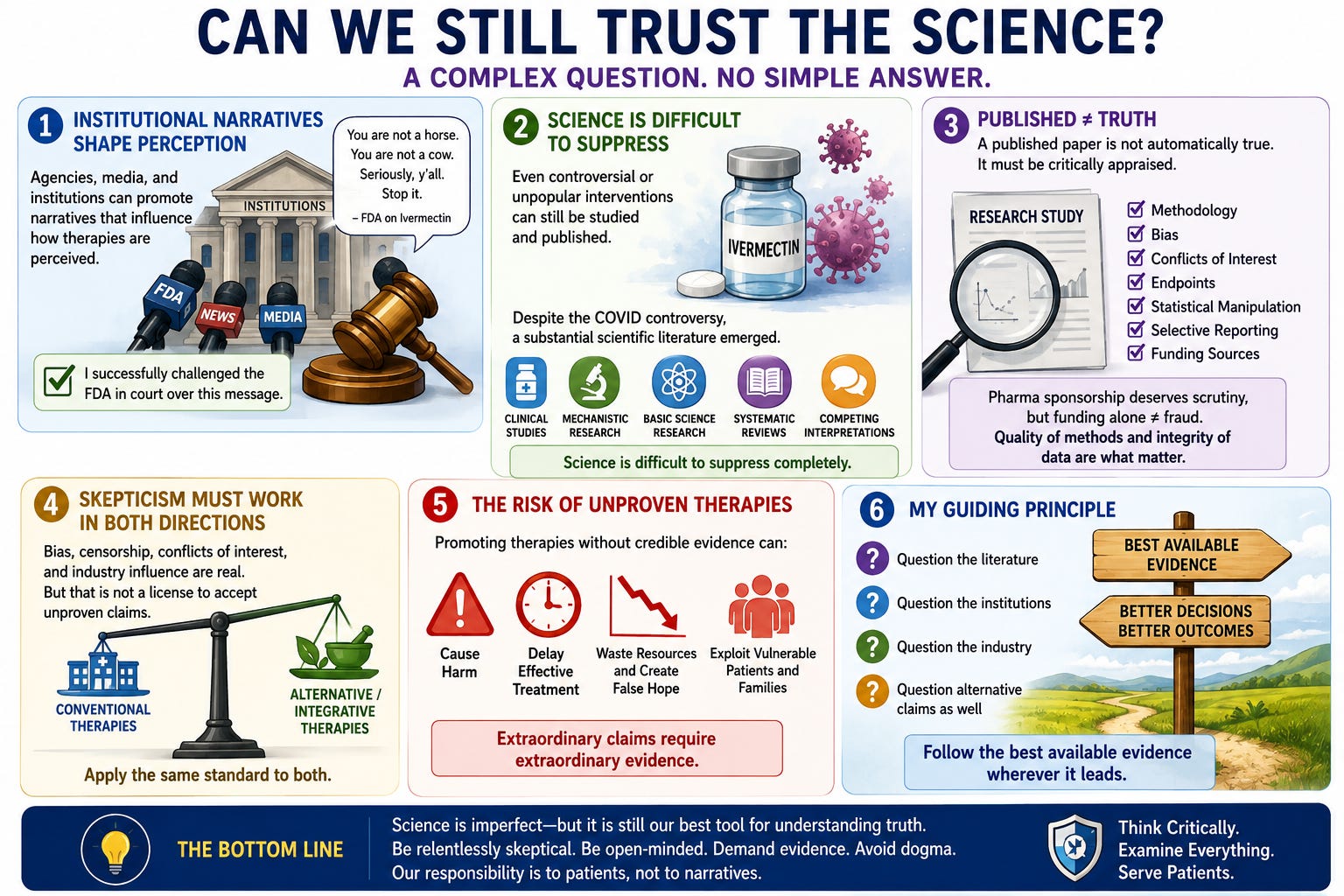
This is a complex question, and there is no simple answer. Having successfully challenged the FDA in court over its infamous “You are not a horse. You are not a cow. Seriously, y’all. Stop it.” messaging about ivermectin, I am well aware that institutional narratives can influence how particular therapies are perceived. Nevertheless, it remains possible to conduct and publish research on controversial or unpopular interventions.
Ivermectin is a good example. Despite the extraordinary controversy surrounding it during COVID, a substantial body of scientific literature emerged (over 100 clinical studies). Whatever conclusions one draws from that literature, the important point is that science is difficult to suppress completely. Clinical studies, mechanistic experiments, basic-science research, systematic reviews, and competing interpretations can still enter the scientific record.
COVID also taught us an important lesson: a published paper should not automatically be equated with scientific truth. Studies must be critically appraised for methodology, bias, conflicts of interest, choice of endpoints, statistical manipulation, selective reporting, and funding sources. Pharmaceutical sponsorship deserves particular scrutiny, but sponsorship alone does not establish that a study is fraudulent. The quality of the methods and the integrity of the data ultimately matter.
At the same time, legitimate concerns about bias, censorship, conflicts of interest, or pharmaceutical influence cannot become a justification for accepting therapies that lack credible supporting evidence. Skepticism must work in both directions. We should scrutinize conventional treatments rigorously, but we must apply the same standard to alternative and integrative therapies.
It can be dangerous to promote a cancer therapy as effective when meaningful evidence of benefit is absent, particularly when the intervention itself may cause harm or delay effective treatment. My position is therefore quite simple: question the literature, question the institutions, question industry, and question alternative claims as well. Then follow the best available evidence wherever it leads.
That is my short answer to what is, in reality, a very complicated issue.
Comments
Nothing yet. Say the first thing.
Sign in to join the conversation.