
What have we done? And why? Join me ‘On Earth As It Is’. Because only by understanding the past will we free ourselves from its tyranny.
‘Mr Mayor, I came here on a state visit and I get bombs thrown at me. It is outrageous. Now you may speak’ - Franz Ferdinand, after the first attempt on his life
Next Thursday: The uses of Franz Ferdinand, dead
RECKLESSNESS, PRIDE OR PIG-HEADEDNESS explained the Archduke Franz Ferdinand’s decision to persevere with a state visit to Sarajevo, the capital of Bosnia-Herzegovina, on St Vitus’ Day, 28 June 1914, the day Bosnian Serbs were celebrating the anniversary of the sacred Battle of Kosovo.
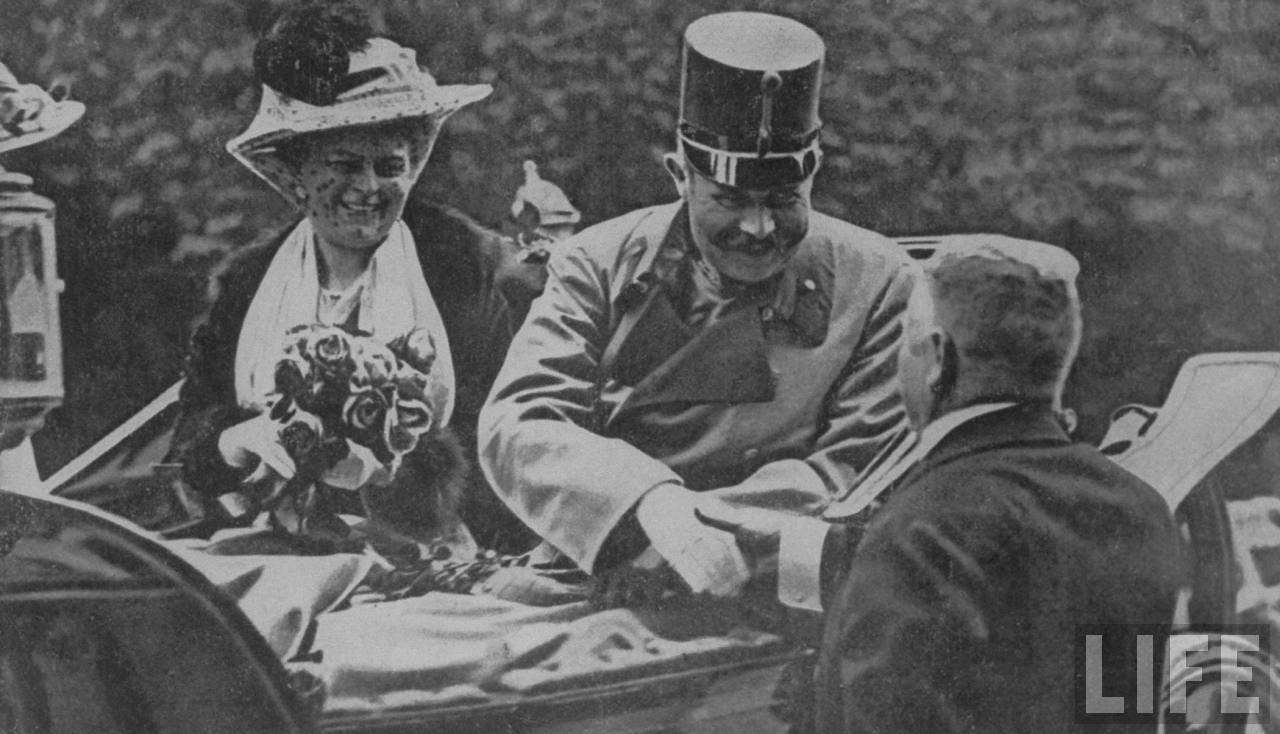
Probably, it was a combination of all three. Ferdinand, heir to the Austro-Hungarian throne, was a vain, impulsive man, of limited intelligence, given to unrealistic ideas about the future of the empire. He persuaded himself that the Bosnian Serbs would learn to enjoy living under Austrian occupation. On the contrary, they loathed the idea.
In 1914, then 50 years old, Franz Ferdinand believed the lie that his popularity exceeded the confines of his small circle of nodding courtiers, anxious for placement when he ascended the throne, many of whom he dismissed as ‘toadies’.
In fact, he was widely disliked, at court and by the Austrian elite. He had a tendency to fly at his detractors in bursts of violent rage. He had more than a touch of the Kaiser’s spoilt-brattishness (the two were friends).
‘When I am Commander-in-Chief,’ he once told the Austrian chief-of-staff, ‘I shall do as I will; if anyone does anything else I shall have them all shot.’
And yet, for a Habsburg, he was unusually reform-minded, even ‘liberal’: he encouraged the self-determination of the non-Serbian Slavs and the Hungarian minorities, to the fury of the Magyar elite. His strengths were probably administrative: he made sensible changes to the Austrian military.
And there was another, personal side. His tenderness to those he loved redeemed him. A happily married man – in a society where happy marriages were rare – he adored his children and doted on his wife Sophie, whom the Austrian court contemptuously dismissed as ‘common’. His family responded by offering him a warm and loving refuge from the coldness of the Viennese court.
—
It was a lovely summer’s day in Sarajevo. The archduke and duchess had completed their duties of the previous two days – he had inspected military manoeuvres, she had visited schools and orphanages – and they were now heading into town for a welcoming ceremony and formal celebration of their 14th wedding anniversary.
The Bosnian capital put on a strained show of loyalty to the visiting Habsburg heir. The dynasty’s black and yellow standard with the red eagle flew on the streets and draped the archduke’s motorcade.
The representatives of a dozen different minorities obediently turned out in their religious and military attire.
‘The very headgear,’ writes the historian Adam Hochschild, ‘reflected the crazy quilt of this ungainly empire that threatened to come apart at the seams: homburgs, yarmulkes, mitres, fezzes, turbans, plus cavalry helmets and brimmed military caps . . .’
—
The mood in the city was tense, and the authorities were on high-alert. The timing of the visit gravely offended the Bosnian Serb minority who detested the Austrian control of Bosnia.
Over the previous days, the governor of Bosnia, General Oskar Potiorek, had ignored clear warnings about violent groups of Bosnian Serbs. The Bosnian chief of police, Dr Edmund Gerde, alone seemed to realise the provocation of a state visit on St Vitus’ Day, and appealed to the town’s military committee to take extra precautions.
‘Don’t worry, these lesser breeds would not dare to do anything,’ replied the committee chairman, a ‘highly bred’ Austrian. As he minuted Gerde’s concerns, he added, scornfully, ‘You see phantoms everywhere.’
Security was extremely lax. Gerde’s requests for an additional cordon of soldiers to reinforce the police (he had only 120 men) had been ignored. The archduke’s itinerary was even published in the papers the day before.
—
Phantoms were everywhere. A seven-man Bosnian-Serb death squad had been assigned to assassinate Franz Ferdinand. Trained in Serbia, they had been smuggled across the border a few weeks earlier.
They answered to the Serbian ‘revolutionary’ network formed in 1911 called Ujedinjenje ili Smrt (Unification or Death), or ‘The Black Hand’ by its enemies.
The Black Hand dignified itself as a ‘nationalist movement’ with close connections to the Serbian revolutionary group Narodna Odbrana (National Defence), formed after Austria’s annexation of Bosnia-Herzegovina in 1908.
Narodna Odbrana’s initial purpose was to recruit and train militia for a possible war between Serbia and Austria. It evolved into a pan-Slavic cultural movement and ceded authority to the powerful inner circle of The Black Hand, who took over the dirty work of terrorising and assassinating Serbia’s enemies.
New members of The Black Hand were obliged to swear ‘before God, on my honor and my life, that I will execute all missions and commands without question. I swear before God, on my honor and on my life, that I will take all the secrets of this organization into my grave with me’.
—
The Black Hand’s commander was Colonel Dragutin Dimitrijević (code-named ‘Apis’), who presided over a ten-member Executive Committee based in Belgrade. Despite their links with the Serbian Government, neither the committee nor the government publicly approved the plot to kill the archduke. It was Dimitrijević’s personal project.
He planned the assassination and selected the assassins without the backing of the Serb authorities, who saw that it might lead to war with Austria.
Of course, Dimitrijević and the members of The Black Hand were not as ‘secret’ as they liked to portray themselves. Well known to the Serbian Government, Dimitrijević had served as head of the Serbian General Staff’s Intelligence Service and was closely connected with senior politicians.
He frequented fashionable Belgrade coffee shops, where he liked to hint at his secretive work. Other Black Hand members held important army and political posts and influenced government policy.
The Serbian government was well informed of Black Hand activities and Crown Prince Alexander was an enthusiastic financial supporter.
Yet their friendly relations had cooled by 1914. Serb prime minister Nikola Pašić had displeased The Black Hand – and especially Dimitrijević – by not acting aggressively enough in pushing the pan-Serbian cause. Even so, there is little doubt that the Serbian Government knew in advance of the murder plot to kill Franz Ferdinand, even if they didn’t actively support it.
—
So, Dimitrijević deserves closer examination. By June 1914, he was something of a legend in the grisly business of assassination, with a long history of violence on behalf of the Serbian state.
Cunning, cultured and articulate, he presented himself as a ‘gentleman killer’ quite unlike the rougher breed of Serbia’s past heroes. ‘He had the characteristics which cast a spell on men,’ one biographer wrote admiringly. He was a brilliant organiser, utterly ruthless and scrupulously loyal.
His chief flaw was that he laboured under the illusion that he had none. ‘Dimitriević was convinced that his own ideas were the right ones on all matters, events and circumstances,’ wrote Professor Stanojević. ‘He believed that his opinions and activities enjoyed the monopoly of patriotism. Hence anyone who did not agree with him could not in his eyes be either honourable or wise or a patriot.’
Apis was not politically astute. If he possessed a sharp military brain, his political ideas were ‘dim and confused’, actuated by little more than hatred of Austria-Hungary and the Ottoman Empire.
He recurs with Flashman-like frequency at earlier scenes of bloodshed spilt in the name of Serbia. In 1903, on behalf of the government, who disapproved of the dynastic plans of the then royal family, Dimitrijević led the assassination of King Alexander I and his wife, Queen Draga, the last of the Obrenović dynasty.
They were dispatched with customary overkill. Wrenched from their hiding place – the bedroom cupboard, or, some claim, a rudimentary ‘panic room’ – the 26-year-old king and his young wife were shot, mutilated, disembowelled and, lest any signs of life remained, thrown from a second-floor window of the palace onto piles of garden manure.
For his role in the assassinations, the parliament proclaimed Dimitrijević ‘the saviour of the Fatherland’.
Promoted to professor of Tactics at the Military Academy, Dimitrijević excelled at war games and planned several victories in the Balkan Wars of 1912–13. From 1911, he doubled as leader of The Black Hand and drew up a list of assassination targets.
He had planned to start at the top, with the murder of Emperor Franz Joseph – the grandeur of the target flattered Apis’s ambitions. This came to nothing, and in early 1914 Dimitrijević turned his attention to the heir to the Austrian throne.
—
Franz Ferdinand had made himself a prime target by promising concessions to the southern Balkan states still under Austro-Hungarian rule, such as Bosnia-Herzegovina and Croatia, which contained many Serbs.
This received little support at court, where Ferdinand incurred the wrath of the emperor, his uncle, and the anti-Slav movement. Nor did it appease the Serbs, who wanted the wholesale eviction of the Austrians, not piecemeal gestures.
Had it succeeded, Ferdinand’s plan would have frustrated Serbia’s hopes of unifying the Slavs into a single state, with its capital in Belgrade. Franz Ferdinand thus found himself caught between the Slav haters in Vienna and the Habsburg haters in Belgrade. The Balkans were no place for moderates and appeasers. Nor did he endear himself to the Hungarians: his anti-Magyar views enraged the Magyar elite. The heir to the throne was a marked man – on all sides of politics.
—
In early 1914, Dimitrijević and his henchmen selected the assassination squad: seven impoverished Bosnian youths, bound by their wretched provenance, revolutionary zeal and hatred of Austria-Hungary.
Three – Gavrilo Princip, Nedeljko Čabrinović and Trifko Grabež – were trained in bomb throwing and marksmanship, and were smuggled back into Bosnia a few weeks before St Vitus’ Day.
Of the seven assassins, Gavrilo (‘Gavro’) Princip was the leader and driving force – a quiet lad with a ruthless cast of mind that reflected Apis’s.
Born in 1894 into the impoverished Bosnian village of Obljaj, Princip’s unforgiving, unsanitary upbringing was depressingly typical of the Bosnian peasantry.
He was one of nine children, six of whom died at birth or in infancy, raised in a little hut with an earthen floor, furnished with chests, a stone bench and an open hearth, above which hung a few metal cauldrons.
His father, a farmer and postman, was an austere man of devout Orthodox inclination. His mother, a chronically hard-working woman, endured the wrath of God as stoically as she did another baby and the weather.
—
Princip was a keen student, who read quietly, absorbed a great deal and developed a keen sense of classroom justice. ‘[E]very blow he received he would return twofold,’ his mother was quoted as saying.
With the help of his 20-year-old brother, he enrolled in a commercial school in Sarajevo, but his interests strayed to student politics. He later attended Sarajevo High School, a seedbed of student radicalism. He wrote poems and lyrical vignettes, romantic and solipsistic. His general hatred for Bosnia’s Austrian overlords sharpened into a yearning for action.
This ‘emotional, solitary’ youth, Dr Martin Pappenheim, his prison medical officer, would later write, dreamt of the ‘union of the southern Slavs outside the framework of Austria’, to be achieved by revolution and assassination.
Expelled from school for laziness and student activism, Gavro left home and walked 300 kilometres to Belgrade, kissing the soil, he later claimed, at the Serbian border. There, he joined the company of self-exiled Bosnian Serbs, keen to avenge their little country.
—
The archduke’s motorcade made its way along Appel Quay. Franz Ferdinand and his wife sat in the third vehicle, a gleaming Graf and Stift open sports car, facing General Potiorek, the governor of Bosnia.
The leading automobile carried the mayor and chief of police; further dignitaries rode in the two other vehicles.
The archduke and his wife were foolishly visible. He sported a blue serge tunic, black trousers, white gloves, a brace of medals and peaked hat adorned with green peacock feathers, the ceremonial uniform of a general of the Hussars. The duchess wore a wide white hat, with an ostrich-feather veil, a dress of white silk, tied with a red sash, and an ermine stole.
The motorcade advanced towards the junction of three bridges, where the seven assassins were waiting: five (Danilo Ilić, Vijetko Popović, Mohamed Mehmedbašić, Nedeljko Čabrinović and Vaso Čubrilović) at the Cumuria Bridge, armed with a bomb and revolvers; Gavrilo Princip at the Latin Bridge, armed with a pistol; and Trifko Grabež at the third bridge. A ‘regular avenue of assassins’, the archbishop of Sarajevo later described it.
—
The archduke survived the first bridge. A bomb thrown by Čabrinović rolled off the hood and exploded against a back wheel of the oncoming car, slightly wounding Potiorek’s aide-de-camp, who was taken to hospital.
The other assassins lost their nerve and failed to shoot. Čabrinović tried to escape along the riverbed but was soon caught and arrested. He swallowed a cyanide pill, but it was old and merely induced vomiting.
Shaken, but determined to look unfazed, Franz Ferdinand ordered the motorcade to continue. No precautions were taken, and the car’s hood remained down. The vehicle sped off, too fast for the two remaining assassins to target it.
On arriving at the Town Hall Franz Ferdinand noticed the slight graze on the duchess’s neck, where the bomb’s detonator had struck her. This elicited a strange response from her husband: selfish indignation and bravado, rather than caution or protectiveness.
He dismissed a rushed exit under a security cordon, as advised, as a sign of weakness. Ferdinand made his hurt feelings known by interrupting, in high-blown tones, the mayor’s welcoming speech:
‘Mr Mayor, I came here on a state visit and I get bombs thrown at me. It is outrageous. Now you may speak.’ Dismayed silence met this bizarre interruption, and the official proceedings resumed.
Their Highnesses had displayed ‘the greatest coolness’, remarked Count Franz von Harrach, who travelled in the front seat of the archduke’s vehicle. After the bomb attack, Ferdinand told him (he recalled), ‘Today we shall get a few more bullets still . . .’
—
General Potiorek played down the risk of a second attack, while, at the same time, proposed amending the program. They should not visit the museum, as planned, he suggested, but return at speed along another route.
Ferdinand objected: he must first visit the slightly wounded man (Colonel Merizzi) in hospital – a perverse decision in the circumstances. That involved returning along the Appel Quay, the same route as published in the itinerary.
As they approached the Latin Bridge, where Princip lurked near Moritz Schiller’s delicatessen, the chauffeur of the lead car seemed to lose his head. He took a sharp right into the narrow Francis Joseph Street, the original route. The archduke’s car followed but had to stop when the driver of the leading car, realising his error, and with Potiorek shouting for them to return to the altered route, began reversing.
At this point, Princip lunged forward to the right-hand side of the open vehicle, where the archduke and the duchess sat exposed, and fired.
The first bullet struck Ferdinand in the jugular; the second hit his wife in the stomach.
Count Harrach witnessed the couple’s last moments alive: ‘Her Highness cried, “For God’s sake! What has happened to you?” Then she sank down from her seat with her face between the archduke’s knees . . . His Royal Highness cried: “Soferl, Soferl! Don’t die. Live for my children!” Thereupon I seized the Archduke by the coat-collar to prevent his head from sinking forwards and asked him, “Is Your Royal Highness in great pain?” To which he clearly replied: “It is nothing.” Now his expression changed and he repeated six or seven times: “It is nothing”, more and more losing consciousness.’
—
The royal couple were dead on arrival at the hospital. Princip was beaten to the ground before he could shoot himself or swallow his cyanide capsule, and carted off to the police station.
Judge Pfeffer observed, after interrogating Princip: ‘The young assassin, exhausted by beating, was unable to utter a word. He was undersized, emaciated, sallow, sharp-featured . . . his clear blue eyes, burning and piercing but serene, had nothing criminal or cruel in their expression. They spoke of innate intelligence . . . he regarded the Heir Apparent as the embodiment of the supreme power which exercised its terrible pressure on the Yugoslavs.’
Princip told the judge: ‘From the footboard, I aimed at the Archduke . . . I do not remember what I though . . . I know only that I fired twice or perhaps several times, without knowing whether I had hit or missed, because at that moment the crowd began to beat me.’
Borijove Jevtic, a leader of Narodna Odbrana who was arrested with Princip, shared a prison cell with the assassin. He recalls that, when Princip was awoken at night and told he would be taken to another prison, he appealed to the prison governor:
‘There is no need to carry me to another prison. My life is already ebbing away. I suggest that you nail me to a cross and burn me alive. My flaming body will be a torch to light my people on their path to freedom.’
At his trial, Princip showed no remorse. He maintained his silence about The Black Hand, saying only:
‘In trying to insinuate that someone else has instigated the assassination, one strays from the truth. The idea arose in our own minds, and we ourselves executed it. We have loved the people. I have nothing to say in my defence.’
Uncertain of whether Princip turned 20 before or after the crime, the court gave him the benefit of the doubt and he escaped the death penalty. He was sentenced to life imprisonment and would die in the hospital of Theresienstadt Prison in April 1918, of tuberculosis, a few months before the end of the war.
Princip lived to witness the war that his murder of Franz-Ferdinand was later said to have ‘caused’. The assassination did not ‘cause’ WWI any more than the flutter of butterfly wings. The Austro-Hungarian rulers, with Germany’s help, used the archduke’s death to manufacture a case for a European war, as we shall see.
Selected sources and further reading:
Albertini, Luigi, The Origins of the War of 1914 (3 vols), Enigma Press, New York 2005
Bethmann Hollweg, Theobald von, Reflections on the World War, (transl. by Young, George), Cornell University Library, New York, 1920
French Yellow Book, Chapter II, No. 8. M. Dumaine, French Ambassador at Vienna, to M. René Viviani, President of the Council, minister for foreign affairs, Vienna, 2 July 1914.
Geiss, Imanuel, July 1914 The Outbreak of the First World War: Selected Documents, Charles Scribner’s Sons, New York 1967
Hochschild, Adam, To End All Wars: A Story of Loyalty and Rebellion, 1914–1918, Mariner Books, Boston 2012
Hötzendorf, Conrad von, Aus meiner dienstzeit, 1906–1918, University of Michigan Library, Ann Arbor 1921
Keiger, John, Raymond Poincaré, Cambridge University Press, Cambridge 1997
Ludwig, Emil, July 1914, Putnam, London 1929
Ludwig, Emil, Wilhelm Hohenzollern: The Last of the Kaisers, AMS Press Inc, New York 1978
Margutti, Albert von, La Tragédie des Habsbourg, Bibl. Rhombus, Vienna 1923
Seton-Watson, Robert, Sarajevo: A Study in the Origins of the Great War, Hutchinson, London 1925
Smith, David James, One Morning in Sarajevo: 28 June 1914, Phoenix Press, London 2009
Sondhaus, Lawrence, Franz Conrad von Hötzendorf: Architect of the Apocalypse, Brill Academic Publishers, Leiden, Netherlands 2000
Sosnosky, Theodor von, Franz Ferdinand. Der Erzherzog-Thronfolger. Ein Lebensbild, Verlag Von R. Oldenbourg, Munich 1929
Strachan, Hew, The First World War: Volume I: To Arms, Oxford University Press, USA 2003
Sulzberger, Cyrus Leo, The Fall of Eagles, Crown Publishers, New York 1977
The World War I Document Archive, ‘The Assassination of Archduke Franz Ferdinand’: http://wwi.lib.byu.edu/index.php/The_Assassination_of_Archduke_Franz_Ferdinand
Comments
Nothing yet. Say the first thing.
Sign in to join the conversation.