
Ring’s first Super Bowl ad was supposed to be a triumph. Thirty seconds. A lost dog, a neighbourhood of cameras, an AI-powered happy ending. Jamie Siminoff — the founder who built the company in his garage — on screen with his own dog, Biscuit. Feel-good, human, wholesome. An $8–10 million slot in front of 127 million people. By the time the post-game show started, it was already a crisis.
Critics didn’t dispute that Search Party could find lost dogs. They asked the obvious follow-up: if it can identify a Labrador, what stops it from identifying a person? Senator Edward Markey issued a letter. The Electronic Frontier Foundation published a statement. Ring terminated its partnership with police surveillance firm Flock Safety within days — a partnership, it should be noted, that had nothing to do with the Search Party feature in the ad. The public connected dots that weren’t necessarily connected, and the brand paid for it.
It isn’t the first time a product ad built around a genuinely good capability ignited exactly the opposite reaction to the one intended. In May 2024, Apple released “Crush!” — a sixty-second spot to launch its thinnest-ever iPad Pro. You remember it - the one where a hydraulic press systematically destroys a piano, a trumpet, cameras, paint cans, and books. The iPad pops out the other side. The metaphor (everything that used to be creative can now fit inside this device) was internally coherent. Externally, it landed as Silicon Valley physically destroying the arts. Hugh Grant called it “the destruction of the human experience.” Apple’s VP of marketing communications, Tor Myhren, issued a public apology within 24 hours: “We missed the mark with this video, and we’re sorry.” The ad was pulled from its planned TV run.
Both incidents share the same anatomy: a product story built around genuine capability, a creative execution that failed to account for the cultural moment, and a crisis that erupted before the communications team had drafted a response. Apple moved fast and took the hit clean. Ring’s situation is both more complicated and more instructive — because what happens next is different now.
This week, Siminoff has been on CNN, NBC, ABC, CBS, and The New York Times — what the Times called an “explanation tour more than an apology tour.” He’s been consistent: participation is opt-in, users control their footage, privacy is built in. He also admitted he “didn’t expect the reaction.” Which raises a question we rarely ask in communications: when the product is genuinely good, do we still stress-test the narrative against the cultural temperature of the room?
But here’s the distinction that matters for the rest of this piece. Apple’s “Crush!” crisis happened in May 2024 — the same month Google launched AI Overviews to the public. Ring’s crisis is happening now, when AI-generated search answers are present in roughly 16% of all US desktop queries, when 800 million people a week use ChatGPT, and when the AI tools your customers, journalists, and stakeholders use have already formed a view of your brand — and continue to revise it independently of anything you publish. That’s a different game. And it requires a different approach.
The SEO mental model is simple: you produce content, Google ranks it, and users click through. Position is the game. You win by ranking higher than the story you don’t want them to find. Crisis communications built on that model has a well-worn shape: respond fast, earn coverage, let fresh content push the crisis story down the rankings. Four to twelve weeks, depending on severity, and your branded search normalises.
That model still applies, but it now runs in parallel with a different system that operates by different rules. And the two systems don’t produce the same answers.
AI search tools are not a single thing. There are at least two meaningfully different mechanisms at work, and understanding them is the precondition for doing anything useful about them.
The first is retrieval-based AI: Google AI Overviews, Perplexity, and Bing Copilot. These pull from live or near-live web indexes, synthesising answers from current sources rather than ranking them. In a crisis, this matters acutely: damaging coverage can surface in a synthesised AI answer almost as quickly as it appears on a major news site. There is no longer a grace window.
The second is parametric knowledge: the base model’s training data, fixed at a cutoff date. According to an analysis published in December 2025, approximately 60% of ChatGPT queries are answered from this parametric knowledge alone, with no live retrieval. BrightEdge’s research confirms this split: ChatGPT and Google AI Mode use fundamentally different architectures, and they increasingly diverge in which sources they draw from. A query that triggers live retrieval in Perplexity might be answered using fixed training data in the base model of ChatGPT. The user gets a different answer to the same prompt in a different tool, with no indication of why.
This is where the data becomes genuinely significant for crisis communications. Ahrefs analysed AI citation patterns across ChatGPT, Perplexity, and Copilot in August 2025 and found that only 12% of URLs cited by these tools rank in Google’s top ten organic results. More striking still: 80% of LLM citations don’t rank in Google’s top 100 at all for the original query. A separate Ahrefs study found that 28.3% of ChatGPT’s most-cited pages have zero organic visibility. Semrush’s analysis of ChatGPT Search behaviour found it primarily cites pages ranked at position 21 or lower about 90% of the time.
Ranking well is not the same as being cited well.
The two systems are running alongside each other but drawing from different pools — and your crisis comms strategy has to account for both, because the audience encountering your brand through an AI answer is navigating a completely different information surface than the one clicking through Google results.
“The Stability Gap Research” published by Ahrefs in November 2025 found that AI Overview content changes 70% of the time for the same query, and when it generates a new answer, 45.5% of citations are replaced with different ones. BrightEdge’s “Citation Volatility Research” found that rarely cited domains exhibit 70x more instability in AI outputs than frequently cited ones. Rand Fishkin at SparkToro published research in early 2026 showing that AI brand recommendations are so inconsistent that the same query, run multiple times, almost never produces the same list in the same order. This isn’t a bug. It’s structural, because these systems are probabilistic, not deterministic. The implication for crisis comms is that you cannot assume a corrected AI answer will hold. You have to continuously maintain the conditions that make correct answers more likely.
The sources AI tools cite are not the sources comms teams traditionally target. AirOps research from October 2025 found that brands are 6.5 times more likely to be cited through third-party sources than their own domain. Wikipedia leads AI citation volumes across ChatGPT (16.3%), Perplexity (12.5%), and Google AI Overviews (8.4%). Reddit appears in 5.5% of AI Overviews and accounts for 46.5% of Perplexity’s citations. YouTube is cited more frequently than most news publications. MuckRack’s research shows that 95% of AI citations come from earned media, with 49% of those from journalistic sources, specifically when users include recency signals like “latest” or “what’s new.”
None of this means traditional PR is irrelevant. As is very clear these days, it’s quite the opposite. It means the quality and structure of what ends up in the sources AI trusts has become more consequential than ever. But it does mean that the outlets a traditional media relations team prioritises and the sources an AI system draws from are not automatically the same list. And in a crisis, knowing the difference matters.
The key distinction is that “traditional” SEO crisis management is about displacing bad content by ranking good content above it. AI crisis management is about influencing what gets pulled into a synthesis you can’t see being built, from sources you don’t fully control, that update at unpredictable intervals, producing answers that may vary each time a user asks.
These are different problems. They require some of the same inputs like quality content, authoritative earned coverage, structured owned media, but deployed with a different logic and measured against different signals.
Most of what crisis comms teams have always done still applies. Speed matters. Accuracy matters. Third-party validation matters. Earned media still reigns. But the why behind each of those things has shifted in ways that require different actions — not a different philosophy.
The SEO-era model was: act fast, publish clearly, earn coverage, and let time and volume do the rest. It was a battle for position. Position was measurable. Recovery was predictable.
AI synthesis doesn’t rank your press statement above a critical investigation. It reads both, alongside your Wikipedia page, a Reddit thread, a civil liberties organisation’s statement, and a Senator’s press release, and generates a single blended answer that may accurately represent none of them. You’re no longer competing for position. You’re trying to influence what gets pulled into a synthesis you can’t see being built.
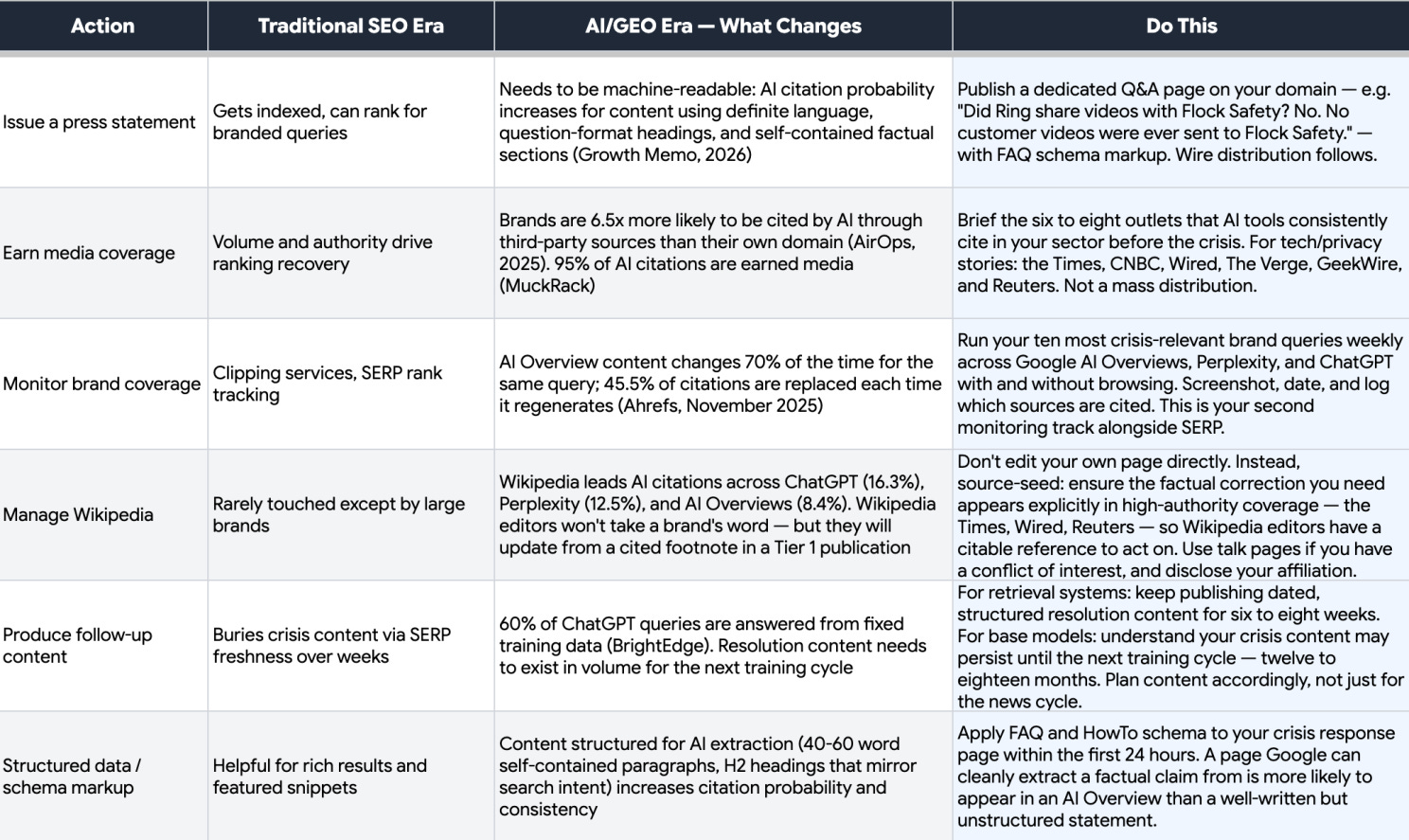
The step most teams skip entirely is the one that matters most before any of this becomes urgent: run an AI answer audit on your brand while things are quiet. Like the below:
“[BRAND] privacy concerns”
“Is [BRAND] safe?”
“Does [BRAND] share data with police?”
“[BRAND] controversy”
“[BRAND] lawsuit”
“[BRAND] security issue”
“[BRAND] data retention policy”
“What happened with [BRAND] and [ISSUE]?”
“[EXEC NAME] apology”
“[BRAND] response to [ISSUE].”
Query your brand name, your key products, and the obvious crisis scenarios across Google AI Overviews, Perplexity, and ChatGPT, with and without web browsing enabled. Screenshot and date every response. Note which sources are cited. This is your current AI reputation, and it almost certainly doesn’t match your SERP rankings. Tools like BrandRank.AI and Semrush‘s Enterprise AIO now track this continuously if manual testing isn’t sustainable. The point isn’t to fix everything you find — it’s to know what you’re walking into before someone else forces the conversation.
The human-readable version is what it’s always been. But it now also needs to be machine-readable, because retrieval systems are indexing it within hours. That means structured formatting: explicit factual corrections in Q&A form, not buried in paragraph three. FAQ schema markup on the response page. Named, dated, attributable facts. A wall of narrative prose is hard for AI systems to extract a citable claim from. Forty-five minutes of structural work at that moment can meaningfully affect what gets synthesised, which is an uncomfortable thing to think about when everything is on fire, so it’s worth having the template ready before you need it.
Here’s something that rarely comes up: AI doesn’t just synthesise facts, it synthesises sentiment.
If ten Reddit threads describe your brand as “creepy,” the synthesised answer will likely use the word “creepy,” even if every underlying fact is contested. Which means vocabulary matters as much as correction. Decide on three to five terms you want attached to your brand in the resolution — not dull corporate language, but language that directly counters the sentiment being amplified. If the AI is reaching for “surveillance,” your response content needs to repeatedly, plainly anchor on “opt-in participation,” “user-controlled footage,” and “on-device processing.” These aren’t just talking points for humans. They’re probabilistic inputs and enough of the right words, across enough of the right sources, shifts the vibe of the synthesised answer. Not because you’ve gamed anything, but because you’ve changed what the system has to work with.
Ring’s situation this week is a clean example. Search Party and the Flock Safety partnership are separate things, connected by category — cameras, law enforcement — rather than by function. An AI answering “Is Ring connected to police databases?” has enough signals in the environment to conflate the two without any individual source explicitly making that claim.
The practical answer is to include what you might call a negative constraints section in your official statement — language that explicitly rules out the false connection. Not “we take privacy seriously.” Something closer to: “Search Party does not connect to police databases. No customer footage is shared with law enforcement through this feature.” Simple, standalone sentences. These are easier for LLMs to parse than caveated prose, and they reduce the probability that your brand gets associated with a controversy it had nothing to do with.
AI Overviews typically draw from six to 14 sources per response, and the majority of those sources don’t rank in the top organic results at all. Volume of coverage matters less than the authority of coverage, which is a different discipline than blast distribution. Know which outlets AI tools consistently cite in your sector before the crisis arrives. For Ring this week, that list has been the Times, CNBC, GeekWire, CNN, and NBC. Shorter than a standard distribution, and deliberately briefed rather than sprayed.
Keep testing the AI answer weekly alongside your rank tracking — those two things may be telling completely different stories simultaneously, and often are. Ring is doing several things right; Siminoff’s interview tour is generating exactly the kind of fresh, attributed coverage that AI retrieval systems weigh more heavily. Apple moved faster but with less sustained follow-through. Their apology was clean, the ad was pulled, and the crisis moved on in traditional search. But “Crush!” remains the context in which many AI tools describe Apple’s relationship with creative professionals.
The comms profession has adapted to every new information environment it’s faced: rolling news, social media, the 24-hour cycle. AI search is the next one. We don’t have all the answers yet — and anyone who tells you they do is probably selling a subscription.
But knowing that position and citation are different games, and that your brand’s AI reputation requires active management rather than passive recovery, is a reasonable place to start.
In the age of AI search, you are no longer writing for the reader. You are writing for the reader’s researcher.
If you found this useful, please share it so others may benefit.
À bientôt!
No posts
Comments
Nothing yet. Say the first thing.
Sign in to join the conversation.