
Over recent decades, a new societal function system has been differentiating out of the health system — growing, as yet unrecognized, under the false flag of “mental health.” According to Luhmann’s theory of functional differentiation, modern society is a constellation of self-referentially closed, autopoietic function systems – societal domains specialized to fulfil key indispensable societal functions via professionalized and theoretically underpinned discourse practices: the economic system, the legal system, the political system, the system of the sciences, the education system, the health system etc. The roster of such systems is not a closed set. New systems can differentiate out from existing function systems, initially under borrowed semantics, before consolidating their own discourse-practice, profession, and reflection theory. The paper names such an emerging societal function system - the coaching system - and describes it via Luhmann’s analytical grid: its societal function (adapting and upgrading psychic functioning to evolving societal requirements), its lead distinction (self-conception/social expectation), its binary evaluative code (well adapted/maladapted) — incommensurable with the health system’s normal/pathological — and its historically variable programmes, which include the re-founded former “psychotherapy” approaches like the person-centered approach, cognitive-behavioral therapy, the psycho-dynamic approach, the systemic approach etc. The emergence thesis is grounded in a systematic critique of the analogical extension of the health system’s medical model to the world of speech-based counselling psychology and psychotherapy. That critique is situated genealogically: the anti-psychiatry movement of the 1960s and 1970s (Szasz, Goffman, Scheff, Laing, Basaglia, Canguilhem, Foucault, Deleuze and Guattari, Illich) had already destroyed the self-evidence of the medical model in the psychic domain, but failed for want of a constructive practice-paradigm and, more fundamentally, because an analytics of power could read the overextension of psychiatric jurisdiction only as social control; the present paper sublates that critique by supplying the society-theoretical frame in which the same misfit appears instead as the false-flag phase of an emerging function system. Conceptually, no naturalistic concept of mental disorder survives scrutiny (Szasz, Wakefield, Bolton) — and Wakefield’s harmful dysfunction analysis, the most rigorous on offer, both generates a systematic false-positives critique of the authoritative DSM (Diagnostic and Statistical Manual of Mental Disorders) from within and delimits, without naming it, a large domain of harmful non-dysfunction which is precisely the emerging system’s object, and where no underlying disease tier exists, the two-tier logical structure of symptom-and-illness collapses, rendering the concept of a “symptom” a category mistake — a conclusion reached independently, within quantitative psychopathology itself, by the network theory of mental disorder (Borsboom), whose formalism dissolves the latent disease entity while inconsistently retaining the code of the pathological. Empirically, psychiatric nosology lacks validity and biomarkers (Frances, Hyman), and outcome research favors the contextual over the medical model of psychotherapy (Frank, Wampold). Nor does pharmacological response restore the missing disease tier: following Moncrieff, the apparent vindication of the medical model by drug efficacy is shown to rest on an unargued disease-centered model of drug action, for which a drug-centered alternative is both historically prior and better supported — so that the medically warranted territory, real but narrow, has been expanded by the drugs themselves and stands in need of rollback. The developmental paradigm (Rogers, Seligman, Grant) supplies the positive alternative, and its categories are scale-invariant, extending seamlessly through systemic family practice to team coaching and organizational change management, whereas medical categories expire at the boundary of the individual. The medical model’s institutionalized expansion is further shown to be disempowering, embedding those who struggle to function in a sick role reinforced by benefit-certification circuits. A political-economy section then subjects that expansion to a libertarian analysis. Szasz’s own late verdict — that the question whether mental illnesses are diseases has been settled not by inquiry but by legislation and executive declaration — is read together with the recent British growth of mental health-related benefit claims, to expose a welfare ratchet: what such systems certify is non-adaptation, but they certify it under the code of the pathological, which names a status rather than a trajectory and therefore admits no exit. Diagnostic expansion is accordingly not an intellectual error awaiting better science but an equilibrium sustained by a professional, pharmaceutical and political interest structure, and by the administrative requirement that a nosology serving as an eligibility rule be uniform, stable and cheap to apply — a requirement that generates the very invalidity the empirical literature documents, and would regenerate it in any successor classification asked to do the same work. The remedy proposed is the decoupling of description from entitlement rather than the denial of suffering. The coaching system, by contrast, is already organized wholly through voluntary private provision, rightly so, since an object that is plural, historically specific and known only locally admits of no central specification; the rolling back of the false medical description and the rolling back of the state’s jurisdiction over ordinary difficulty in living are therefore two aspects of a single correction. The paper concludes that speech-based psychotherapy should be conceptually, terminologically, and institutionally assimilated to the coaching system — a residual medical domain being retained for conditions with robust organic grounding — and understands itself as a contribution to the emerging system’s own self-description.
After shifting from philosophy into architecture during the 1980s – without ever ceasing to read, absorb (and obliquely contribute to) philosophy – I was asked to design a psychiatric hospital. This motivated my first dive into the philosophical quicksand of mental illness and psychiatry, including the anti-psychiatry movement of the 1960s, and 1970s, reading a.o. Thomas Szasz’ “The Myth of Mental Illness”, Michel Foucault’s “Madness and Civilization” and “The Birth of the Clinic”, as well as Deleuze & Guattari’s “Anti-Oedipus”. This early philosophical interest coincided – in line with the authors cited – with my general radical, anti-capitalist outlook at that time. However, the gist of these critiques - locating the issue in societal and ideological rather than biological processes - stayed with me ever since.
During the first decade of our current century I got drawn into self-studying counselling psychology with all its diverse psycho-therapy approaches. At the time I was also intensely studying the system-theoretical sociology of Niklas Luhmann which at some points productively intersected with the systemic approach to psychotherapy. It was at that time when I first thought about the thesis put forward here, without however pushing it beyond some notes and fragments for a potential paper.
What brought me finally back to the topic and motivated me to expand my research is the fact that at ZHA - the architecture firm where I play a leading role – interest in issues of mental health has been spreading among our employees, both with respect to the mental health of our work force, as well as with respect to a potential contribution of architectural design to mental health. After having been drafted into our “Mental Health & Wellbeing” group, I took the initiative to further study, think through and articulate my (skeptical) intuitions about the increasingly prominent issue of “mental health” and its impact.
The contemporary field addressing psychological distress and dysfunction spans a spectrum from medically conceived psychiatry at one pole to life coaching and self-development at the other. Yet the spectrum metaphor conceals a categorical divide between two incompatible paradigms.
The first is the medical model. Its constitutive commitments are: (i) a notion of a healthy, normal state that is presumed to be biologically or psychologically given, historically stable, and largely independent of culture; (ii) discrete pathological syndromes that deviate from this state, ultimately grounded in physiological dysfunction; (iii) a distinction between surface symptoms and underlying disease, such that diagnosis identifies the disease behind the symptoms; and (iv) treatment conceived as intervention aimed at restoring the pre-morbid normal state. The lead distinction of the medical model is ‘therapy versus disease’. This applies only to individuals.
The second is the developmental or coaching model. Here there is no historically fixed normal state to be restored. The individual faces challenges — many of them historically unprecedented — and seeks to expand capacities, acquire coping strategies, revise self-interpretations, and adapt to evolving functional requirements. The relevant categories are not health and pathology but competence and incompetence, flourishing and stagnation, adaptive and maladaptive strategies. The practitioner is not a physician treating a disease but a coach, mentor, or dialogue partner facilitating self-transformation. Coaching is about growth and empowerment, the co-creation of an upgraded self-conception in the face of new demanding social role expectations. The lead distinction of the coaching model – made explicit and proposed here - is ‘self-conception versus social expectation’, or short ‘goal vs role’. This applies equally to persons, families and teams.
The thesis of this paper is that the medical model, wherever it structures speech-based psychotherapy, is a misleading analogy — conceptually incoherent, empirically unsupported, and practically distorting — and that all talk-based therapeutic practice should be re-founded on the coaching model. The medical model retains legitimacy only in a residual domain of conditions with demonstrated biological grounding, where it connects with pharmacological and neurological intervention rather than with speech.
The argument, however, does not terminate in a contrast of paradigms. Its ultimate destination, announced in the title, is society-theoretical: the paradigm contrast elaborated in the body of the paper will be formalized, in the terms of Luhmann’s theory of functional differentiation, as the observation of an emergent differentiation process. What confronts the health system across the divide is not merely an alternative model of practice but a new societal function system in formation — here named the coaching system — with its own societal function, lead distinction, task formula, binary code, programmes, profession, and nascent self-descriptions, which has been growing for decades under the false flag of mental health. The conceptual, empirical, historical, and institutional critiques developed in Sections 2 through 12 thus serve a double purpose: they dismantle the medical model’s claim to the territory of speech-based counselling practice, and they supply the grounds on which the emerging system can recognize itself. The paper is, in this sense, deliberately reflexive — a contribution to the self-description of the very system whose differentiation it describes.
My own first encounter with skepticism about psychiatry came through the literature of what has been called the anti-psychiatry movement of the 1960s and 1970s — above all Thomas Szasz’s The Myth of Mental Illness, Michel Foucault’s Madness and Civilization and The Birth of the Clinic, and Deleuze and Guattari’s Anti-Oedipus. This literature circulated far beyond the clinical disciplines; it belonged to the general theoretical culture of the period, and it deserves a chapter here both as intellectual genealogy and because its achievements and its failures jointly define the task the present paper takes up.
The movement was a genuinely international constellation. In the Anglophone world, alongside Szasz stood the sociologists: Erving Goffman’s Asylums (1961) analyzed the psychiatric hospital as a “total institution” and traced the “moral career of the mental patient” — the institutional production of the very passivity and degradation that was then read as symptomatic; Thomas Scheff’s Being Mentally Ill (1966) supplied the labeling theory according to which chronic “mental illness” is in large part a stabilized social role, entered through the ascription of the label — an analysis whose mechanism reappears, refined, in Hacking’s looping effects invoked throughout this paper. David Rosenhan’s pseudo-patient study (1973), in which sane confederates were admitted, diagnosed, and had their ordinary behavior recorded as pathology, delivered the empirical coup de théâtre. In Britain, R. D. Laing’s The Divided Self (1960) rendered schizophrenic experience intelligible as a strategy of a self under unbearable relational pressure, and — together with the family-interaction studies he conducted in the orbit of Bateson’s double-bind hypothesis — forms a direct historical bridge to the systemic tradition discussed in Section 11; his colleague David Cooper coined the very term “anti-psychiatry.” In Italy, Franco Basaglia’s democratic psychiatry translated the critique into institutional reform, culminating in Law 180 and the closure of the asylums. In France, the constellation was philosophical: behind Foucault stood his teacher Georges Canguilhem, whose Le normal et le pathologique (1943, 1966) had already dismantled the idea of a value-free, statistical norm of health — normality, Canguilhem argued, is established by the normative activity of life itself and, in the human case, by social norms — an argument that anticipates by decades the historicity thesis of Section 10 and strikes directly at the health system’s code as analyzed in Section 14. Foucault’s own Histoire de la folie (1961) reconstructed how “madness,” once an ambiguous presence with its own voice, was constituted as “mental illness” through the historically specific practices of confinement and the asylum, while Naissance de la clinique: Une archéologie du regard medical (1963) excavated the formation of the clinical gaze itself — the epistemic regime in which bodies became legible as cases of disease. Deleuze and Guattari’s Anti-Oedipus (1972), written out of Guattari’s practice at the La Borde clinic, attacked the psychoanalytic wing of the medical model at its conceptual root: the reduction of desire to the familial-Oedipal triangle and the therapeutic normalization it licensed. And adjacent to the movement proper, Ivan Illich’s Medical Nemesis (1975) generalized the critique to medicine as such, coining the analysis of iatrogenesis and of medicalization as the expropriation of ordinary human competences — the wider frame within which Conrad’s later sociology of medicalization stands.
The movement’s positive achievement was permanent: it destroyed the self-evidence of the medical model in the psychic domain. Nearly every argument developed systematically in this paper has an anti-psychiatric anticipation — Szasz anticipates the conceptual critique of Section 4, Canguilhem and Foucault the historicization of the normal/pathological code, Goffman and Scheff the sick-role and looping analyses of Section 15, Laing and the double-bind researchers the systemic re-description of the “identified patient” in Section 13.
Yet the movement failed, and the modes of its failure are instructive. First, it was almost wholly negative: a critique of psychiatric power without a constructive practice-paradigm to occupy the vacated territory. Where it did build alternatives, they were fragile heterotopias (Kingsley Hall, La Borde) or, in Basaglia’s case, a deinstitutionalization whose implementation — asylums closed faster than community structures were built — produced real casualties and handed the medical model its rehabilitating counter-narrative. Second, it was politically totalizing. Fused with the revolutionary currents of its decade, it read psychiatry as an apparatus of capitalist or bourgeois domination and was tempted into romanticizing madness itself — as existential truth-telling in the later Laing, as revolutionary desire in Anti-Oedipus. This overreach discredited the sober core of the critique and invited the rejoinder, pressed from the left by Peter Sedgwick in Psycho Politics (1982), that denying illness meant denying the reality of suffering and undermining the claim to care. Third, and most fundamentally from the standpoint of the present paper, the movement was theoretically confined to the analytics of power and domination. Observing the expansion of psychiatric jurisdiction, it could see only social control — repression, discipline, normalization. What it could not see, lacking a theory of societal differentiation, was that the very territory over which the health system was overextending its code was the growth zone of something new. The anti-psychiatrists correctly observed that the medical model did not fit the phenomena; they mistook the misfit for a scandal of domination when it was, in retrospect, the false-flag phase of an emergent function system. The constructive alternative they could not name was in fact assembling in their own decade, unnoticed by them, in humanistic psychology, the human potential movement, and the nascent practices of coaching and organizational development. The critique itself did not die with the movement. It was carried forward, on altered ground, by Frank Furedi’s *Therapy Culture* (2004), which turned from psychiatric coercion to therapeutic voluntarism — arguing that the therapeutic ethos had escaped the clinic altogether and become the dominant cultural script for interpreting ordinary experience. Furedi’s analysis is drawn upon substantially in Sections 15 and 16 below; it should be noted here that it reproduces the movement’s characteristic limitation, offering a powerful account of what has gone wrong and no constructive paradigm to put in its place, and that it bears against the thesis of this paper as well as for it — a difficulty taken up in Section 17. The present paper may accordingly be read as the sublation of anti-psychiatry: it preserves the critique, discards the totalizing politics of denunciation, and supplies what the movement constitutively lacked — a society-theoretical frame in which the observed crisis of the medical model appears not as the unmasking of an apparatus of power but as the birth of a system.
The medical model earned its authority in somatic medicine, where it rests on a genuine discovery: that behind clusters of symptoms lie identifiable pathophysiological processes — infections, lesions, metabolic derangements — whose causal structure is independent of culture and history. Tuberculosis is the same disease in twelfth-century Kyoto and twenty-first-century London. The distinction between symptom and disease, the logic of differential diagnosis, and the concept of restoring health all derive their sense from this underlying causal realism.
Psychiatry imported this apparatus wholesale. The Diagnostic and Statistical Manual of Mental Disorders (DSM) issued by the American Psychiatric Association (APA) presents itself as a nosology: a classification of disease entities identified via symptom criteria, with the implicit promise that these entities carve nature at its joints and will eventually be vindicated by biological findings. Clinical psychology and, crucially, speech-based psychotherapy inherited the same frame: the client presents symptoms, receives a diagnosis, and undergoes treatment whose success is measured as symptom remission — return to the normal state. The question is whether this transfer is legitimate. Three lines of argument suggest it is not.
The classical opening move is Thomas Szasz’s The Myth of Mental Illness (1961). Szasz argued that “mental illness” is a category error: illness in the literal sense requires bodily lesion or physiological dysfunction; where such dysfunction exists, we have neurological disease, not mental illness; where it does not, we have “problems in living” — conflicts, failures of adaptation, existential predicaments — misdescribed in medical vocabulary. Szasz’s political polemic should not obscure the enduring core of the argument: the concept of mental illness does double duty, borrowing the objectivity of somatic medicine while actually tracking socially and normatively defined deviance.
The most sophisticated attempt to rescue the disease concept is Jerome Wakefield’s harmful dysfunction analysis (Wakefield 1992a, 1992b), and because it is the most rigorous definition on offer it repays close statement. Disorder, on this account, requires two conditions, individually necessary and jointly sufficient. The first is dysfunction, and it is a factual, scientific component: the failure of an internal mechanism to perform a function for which it was naturally selected. “Function” is meant in the etiological sense — what the mechanism was selected for — so that dysfunction is neither statistical abnormality, nor departure from an ideal, nor social deviance. The second is harm, and it is a value component: the dysfunction must be judged harmful by the standards of the person’s culture. The exclusions generated by this pairing are the substance of the analysis. Dysfunction without harm is not disorder, as with a mild reading impairment in a preliterate society. Harm without dysfunction is likewise not disorder, and this exclusion covers a very large territory: grief, ignorance, illiteracy, unhappiness, criminality, and poor fit between a person and their circumstances are real predicaments that may well warrant help, but they are not pathologies.
The analysis is constructed to occupy ground between two positions Wakefield regards as untenable, and the two-front character of the argument should be registered, since it is what gives his later critique its force. Against Szasz and the constructionists, it insists that disorder is not merely a value judgment or a label affixed to deviance: there is a genuine factual component, grounded in evolutionary biology, and mental illness is therefore not a myth. Against Boorse’s biostatistical theory (Boorse 1977), which defines dysfunction as functioning below the species-typical level for a reference class, it insists that values are ineliminable — which is why the removal of homosexuality from the DSM counts, on Wakefield’s account, as a correct conceptual judgment rather than a political capitulation.
The analysis nonetheless makes the disorder concept hostage to two things psychiatry cannot deliver. The first is knowledge of the evolved functions of specific mental mechanisms, which remains largely speculative and contested; the factual component is thus liable to be undeterminable in precisely the cases where adjudication is needed. The second is a value-free criterion of harm, which does not exist — harm is relative to social expectations and to historically variable life-forms, so that the culture-indexed normativity the analysis was designed to constrain is readmitted through its second condition. A third objection, pressed by Lilienfeld and Marino (1995), holds that disorder is a Roschian prototype concept with irremediably fuzzy boundaries, and that the demand for necessary and sufficient conditions is itself a category error. Derek Bolton’s systematic examination - in his 2008 book What is Mental Disorder? - concludes that no naturalistic definition succeeds: the boundary between disorder and non-disorder is drawn by normative, culturally embedded judgments about distress and functioning. This is precisely what the medical model denies and the developmental model affirms.
What follows is the more telling because Wakefield turned his own analysis against psychiatric practice rather than deploying it in psychiatry’s defence. His position is that psychiatry possesses a valid concept and applies it invalidly: because DSM criteria are purely symptom-based, they cannot distinguish a genuine internal dysfunction from a normal, proportionate and often adaptive response to circumstances, and the systematic result is false positives. The programme is extensive and it is worth enumerating the domains in which he has pressed it. With Allan Horwitz, in The Loss of Sadness: How Psychiatry Transformed Normal Sorrow into Depressive Disorder (2007), he argues that the major depression criteria capture ordinary sadness following loss, that the bereavement exclusion was the sole and internally inconsistent acknowledgment of the problem, and that its removal in DSM-5 aggravated rather than remedied it. In All We Have to Fear: Psychiatry’s Transformation of Natural Anxieties into Mental Disorders (2012), the same analysis is applied across the anxiety disorders: normal and functional fear responses — of social evaluation, of heights, of separation, of danger — recoded as phobias and anxiety disorders, with shyness becoming social anxiety disorder. Elsewhere he has advanced the false-positives case for attention-deficit/hyperactivity disorder, where restlessness in age-inappropriate schooling regimes is read as pathology; for conduct disorder, where responses that are adaptive in harsh or dangerous environments are diagnosed as a disorder of the child; for adjustment disorder, whose criteria are effectively unable to exclude proportionate reaction to a stressor; for the progressive widening of post-traumatic stress disorder to encompass ordinary distressing experience; all critiqued as examples of questionable pathologization.
The significance of this for the present argument lies in its provenance. The false-positives literature does not come from critics who deny that mental disorders exist. It comes from the author of the most careful defence of their reality, using his own criterion, and it is on that account far harder to discount than the external critique — the same argumentative structure as the network turn examined in Section 6, where the latent disease entity is dissolved by a psychometrician who set out to model it. Peter Conrad’s sociology of medicalization (The Medicalization of Society, 2007) traces the same dynamic across domains: conditions of living are progressively redescribed as medical conditions, with profound consequences for self-understanding, agency, and the allocation of authority. Ian Hacking’s analysis of the “looping effects of human kinds” adds a further twist: psychiatric classifications do not merely describe; they transform the people classified, who reorganize their self-interpretation and behavior around the diagnosis — a causal circularity alien to somatic disease categories.
One further consequence of the harmful dysfunction analysis deserves emphasis, because it is a positive result and not merely a critical one, and because it has gone strikingly unexploited. Wakefield’s two conditions are indexed to different times. Dysfunction is fixed to the ancestral environment in which the mechanism was selected; harm is indexed to the standards of the present culture. It follows immediately that a mechanism operating exactly as designed, but producing suffering under conditions its design never anticipated, satisfies the harm condition and fails the dysfunction condition — and is therefore, on Wakefield’s own account, explicitly not a disorder. Evolutionary mismatch yields harmful non-dysfunction. Wakefield accepts this consequence and leaves the resulting category unnamed and institutionally unoccupied, since his concern is to police the boundary of the medical rather than to describe what lies beyond it. But the category so delimited is very large, and it is not empty: it holds the anxieties of a status-competitive and hyper-connected society, the demoralization of those whose acquired strategies have been overtaken by economic and technological change, the difficulties of sustaining intimate relations under conditions of unprecedented individual mobility, the mismatch between evolved attentional dispositions and the demands of prolonged sedentary abstraction. Suffering of this kind is real, often severe, and frequently remediable — but the remedy cannot be the restoration of a mechanism that has not failed. It can only be the reformation of the person’s strategies, capacities, and self-understanding in relation to what is now demanded of them. The most rigorous available definition of mental disorder thus leads us to, as a matter of its own logic, an extensive domain of genuine, addressable, non-pathological suffering for which it has no name and psychiatry no title. Naming that domain, and identifying the practice and the system that answer to it, is the task of the remainder of this paper.
The deepest grammar of the medical model is a two-tier structure in which the symptom is a sign and the disease is the underlying referent that the sign indicates. Fever is not the infection; it points to the infection. This structure carries the entire diagnostic logic — inference from surface manifestation to hidden cause — and the entire therapeutic hierarchy: genuine treatment targets the disease, while “merely symptomatic treatment” is, by definition, deficient. The concept of a symptom has no content outside this two-tier structure. A symptom is always a symptom of something else.
That structure is articulated, in medical usage, as an ordered sequence of three terms whose order is one of ascending etiological commitment. At its base stands the symptom: a single manifestation, classically one reported by the sufferer, its objective counterpart — available to the clinician’s inspection rather than the patient’s report — being the sign. Above it stands the syndrome: a cluster of symptoms and signs that reliably co-occur without any identified unifying cause. The syndrome is a descriptive and ultimately statistical entity, a pattern registered at the level of correlation; in disciplined scientific use the word is a candid confession of etiological ignorance, a placeholder marking the spot where an explanation is expected but has not arrived. At the summit stands the disease: a condition for which an underlying pathological process has been identified, a mechanism that explains why these manifestations cluster together and which confers upon the cluster a characteristic course and, in the ideal case, a definable lesion.
Much of the history of modern medicine consists of promotions along this sequence. Acquired immunodeficiency syndrome was a syndrome until the retrovirus was isolated; Down syndrome was a syndrome until the supernumerary chromosome was seen. The names survive their promotion — fossils of an earlier epistemic condition preserved in the nomenclature — but the status of the object changes entirely: what had been a correlation becomes a causal structure, and the manifestations, which had merely accompanied one another, become effects of a common cause and thereby symptoms in the full sense. The sequence matters because only its top rung licenses the semiotic operation on which clinical reasoning rests. A disease is what a symptom can be a symptom of.
Assessed against this sequence, the position of psychiatric nosology is not a matter of controversy but of definition. The categories of the DSM and of the mental and behavioral chapter of the World Health Organization’s International Classification of Diseases (ICD) are, without significant exception, syndromes: polythetic criteria sets assembled by committee from co-occurring complaints, with no identified pathophysiology, no validating biomarker, and — as their notorious heterogeneity attests - two patients bearing the same diagnosis being able to share almost no criteria. The objection to be pressed here is therefore not that psychiatry possesses poorly delineated diseases, which would be a remediable defect of a young science. It is that it possesses no diseases at all, but syndromes administered with the semantics of disease, the borrowed semantics performing the institutional work that only the missing third tier could legitimately perform.
In the domain of speech-based psychotherapy the profession has, in effect, admitted as much. Since DSM-III, psychiatric “disorders” are defined operationally as symptom clusters: the disorder is nothing over and above the presence of a specified number of criteria from a list. The sign points to itself. The resulting explanatory circularity has the structure of Molière’s virtus dormitiva: Why can he not concentrate? Because he has ADHD. How do we know he has ADHD? Because he cannot concentrate. Hyman’s diagnosis of “reification” names exactly this: constructs defined by symptoms are treated as diseases explaining those symptoms.
Strikingly, the leading quantitative framework in contemporary psychopathology research has drawn the same conclusion internally, and by an independent route. The network theory of mental disorders (Cramer et al. 2010; Borsboom & Cramer 2013; Borsboom 2017) rejects the latent-disease model outright: so-called symptoms are not passive indicators of a hidden common cause but directly and causally interact with one another — insomnia produces fatigue, fatigue impairs concentration, impaired concentration feeds worry, worry disrupts sleep. What the medical model calls a disorder is, on this account, a self-sustaining pattern among the phenomena themselves, with nothing behind them; and the vocabulary of “symptoms” survives in that literature as a fossil — a sign-term retained after the model has deleted its referent. Because this development supplies the strongest available corroboration of the present argument, and because its authors nonetheless decline the conclusion drawn here, it warrants separate treatment; the section that follows supplies it.
The developmental model dissolves the category mistake rather than perpetuating it. What medicine calls symptoms are, in the coaching frame, simply the problems themselves: behaviors, feelings, entrenched patterns, deficits of strategy or skill, assessed directly against the person’s goals and the functional demands of their situation — not read as signs of a hidden entity. Two consequences follow. First, the distinction between treating the disease and treating the symptom disappears; there is only working on the pattern, and change in the pattern is the whole of success — “symptomatic relief” loses its pejorative sense because there is nothing deeper that relief could have missed. Second, there is no determinate health state whose restoration the disappearance of symptoms would signify — only open-ended better and worse functioning relative to chosen ends and evolving demands. In Gilbert Ryle’s terms (Ryle 1949), applying the concept of a symptom where there is no illness/health polarity is a category mistake: it assigns a phenomenon to a logical type — the indexical sign of a disease — that has no application in the domain. The developmental model should accordingly retire the term altogether, speaking instead of patterns, habits, challenges, and strategies.
The most consequential corroboration of the foregoing argument comes not from the philosophical critics of the disease concept, whose commitments could always be dismissed as antecedent to their analysis, but from within quantitative psychopathology — from researchers in psychometrics whose motive was not to unseat the medical model but to model their data honestly. The network theory of mental disorder, developed by Denny Borsboom and collaborators over the past fifteen years, arrives at the collapse of the two-tier structure by way of measurement theory, and its arrival there is the more telling for being unintended.
The theory’s target is the latent variable model that has silently organized psychological measurement. On that model, symptoms are reflective indicators: manifest variables caused by an unobserved common cause, and independently once conditioned by this common cause. “Depression” is the hidden entity; insomnia, fatigue and anhedonia are its passive and in principle interchangeable traces; the sum score estimates the entity’s magnitude. This is not a statistical convention that merely happens to resemble the disease model. It is the disease model transposed into measurement-theoretic form — the third rung of the sequence set out above, reconstructed as a latent variable — and it inherits the medical model’s entire explanatory architecture, including the assumption of independence, which formally stipulates that the symptoms do not act upon one another.
Borsboom’s inversion consists in denying precisely that stipulation, on the straightforward ground that it is false. The couplings noted above — insomnia to fatigue, fatigue to impaired concentration, impaired concentration to failure at work, failure to rumination, rumination back to insomnia — are not correlations awaiting a common explanation but direct causal relations, evident to anyone who has lived through them and traceable in intensive longitudinal data. Once they are admitted the latent entity loses its office: there is nothing left for it to explain, since the clustering of the complaints is accounted for by their mutual influence. The disorder is not behind the phenomena. The disorder is the strongly connected cluster of phenomena.
From this inversion a substantial research programme follows, its formal apparatus borrowed from complex systems theory. Connectivity becomes the vulnerability parameter: a densely connected network, driven by an external adversity, can transit into a self-sustaining activated state that persists after the adversity has been withdrawn, whereas a weakly connected network relaxes to baseline. Disorder appears as an alternative stable state, an attractor exhibiting hysteresis, rather than as an illness. Comorbidity — arguably the DSM’s most damaging embarrassment, since diagnoses so regularly arrive in pairs — ceases to be the improbable co-occurrence of two diseases and becomes the ordinary behavior of a single network joined by bridge symptoms, insomnia linking the depressive to the anxious cluster. Early warning of transitions is sought in critical slowing down, the phenomenon by which a system near a tipping point recovers ever more sluggishly from small perturbations, imported directly from theoretical ecology (Scheffer et al. 2009). And intervention is redirected: one targets the most central node, or the bridge, breaking the loop that sustains the state, with no root pathology to be addressed, because there is none.
The significance for the present argument is difficult to overstate. What was claimed in the preceding section on conceptual grounds — that the two-tier logical structure has no lower storey in this domain, and that “symptom” is in consequence a category mistake — is here reached by a formal route, on the home ground of the opponent, using the opponent’s data and the opponent’s instruments. What survives of the term “symptom” in network psychometrics is merely the name of a node; and a node is not a symptom, since it signifies nothing beyond itself and points to no hidden referent. The medical model’s semantics has been evacuated from within.
More striking still is the intervention logic the programme generates, which is coaching logic in all but name. Its most advanced form is the idiographic network estimated from experience-sampling data on a single person, whose purpose is to identify this individual’s self-maintaining loop and to determine where it can be broken — an analysis of the pattern of a particular life under its particular conditions, without reference to a species norm and without any claim that the loop constitutes an aberration from a natural function. This is what a competent coach performs informally, and what the developmental/coaching paradigm defended below performs by design. The formalism recommends attending to the strategy that sustains the difficulty rather than to the deficit supposed to produce it.
Borsboom is nonetheless not an ally without remainder, and the point of resistance should be stated plainly rather than quietly annexed. He retains the code normal/pathological, and retains it deliberately: the attraction of network theory for a psychiatry in methodological crisis is precisely that it appears to save the reality of psychiatric objects without biological essentialism. The alternative stable state is offered as what “disorder” has meant all along, now specified dynamically instead of etiologically. Borsboom thus performs the demolition of the latent disease while blocking the inference drawn here from it.
The reply is that hysteresis is not pathology, and cannot become pathology by mathematics alone. A self-sustaining attractor is a formal property of a very wide class of configurations, many of them benign and some of them expressly desirable: an entrenched skill, a stable marriage, a productive professional identity, a durable organizational culture are all self-reinforcing states resistant to perturbation, and nothing in the formalism distinguishes them from the depressive loop. The distinction is imported from outside the model — from a judgment about how a person is faring against the functional requirements of a life that must be led in a particular society at a particular historical moment. That judgment is exactly what the code well adapted/maladapted articulates, and it articulates it without the surplus metaphysical claim that “pathological” carries over from its organic home. Once the latent disease has been dissolved, “pathological” adds to “maladapted and resistant to change” nothing except the borrowed authority of medicine.
Two further considerations confirm the reading. The first is scale invariance. The network formalism is wholly indifferent as to whether its nodes are the complaints of a psychic system or the interaction patterns of a social one; the same estimation procedures are applied to families, teams and organizations, where no one is tempted to speak of disease. A formalism that transfers without modification across the boundary between psychic and social systems — the boundary that medical categories cannot cross, as Section 12 will argue — is not a medical formalism, whatever the institutional setting of its development. The second consideration is reflexive. That a leading quantitative psychopathologist can dismantle the latent disease entity and yet retain the code of the pathological is exactly what the Luhmannian analysis of Section 14 would predict: the operations of the emerging system have run ahead of its self-description, and that self-description remains attached to the health system out of which the new system is differentiating. Network theory is, on the account given here, a document of the coaching system produced under the false flag of mental health.
Two caveats are owed to the programme, both acknowledged within its own literature and neither damaging to the use made of it here. Networks estimated from cross-sectional between-subjects data license no claim about within-person causal structure, an ergodicity failure pressed effectively by Fried and Cramer; centrality indices have proved unstable and network structures replicate poorly across samples (Bringmann et al. 2019); and the ontological thesis that the disorder is the network does not follow from the statistical model that motivates it, being a philosophical addition to it. But the argument advanced here requires only the negative claim — that the manifest phenomena are causally coupled to one another, and that no latent common cause is needed to explain their clustering — and that claim is not in serious dispute. The positive network ontology may stand or fall on its own evidence; the latent disease does not recover either way.
The conceptual critique is corroborated from within the citadel. Allen Frances, chair of the DSM-IV task force, publicly warned (Saving Normal, 2013) that DSM-5 would unleash further diagnostic inflation and that psychiatric diagnosis had lost contact with any defensible boundary between disorder and normal variation. More devastating still, Thomas Insel, then director of the U.S. National Institute of Mental Health, announced in 2013 that the NIMH would no longer organize its research around DSM categories, on the grounds that they lack validity: they are consensus constructs defined by symptom clusters, not entities validated by any laboratory measure, biomarker, or causal mechanism. Steven Hyman, Insel’s predecessor, has similarly described DSM categories as reified constructs that have impeded research.
After more than a century of biological psychiatry and decades of neuroimaging and genomics, no common mental “disorder” treated primarily by psychotherapy — depression, anxiety disorders, adjustment disorders, the personality disorders — possesses a diagnostic biomarker. The genetic findings that exist are massively polygenic, non-specific across diagnostic categories, and explain small fractions of variance. The chemical-imbalance account of depression, long the popular warrant for the disease model, has collapsed under review. This does not show that distress is unreal; it shows that the disease-entity structure imposed on it is an artifact of the imported medical template. The British Psychological Society’s Power Threat Meaning Framework (Johnstone & Boyle, 2018) draws the institutional conclusion: distress patterns are better understood as intelligible responses to adversity, threat, and meaning-contexts than as symptoms of internal disease.
The argument has so far proceeded on conceptual and diagnostic terrain, and a reader may by now have reserved a decisive objection. Whatever is said about missing biomarkers or dissolved latent entities, psychiatric drugs are prescribed to tens of millions of people and a great many of them report that they help. Surely wherever a chemical agent relieves a psychic condition, that condition has been shown to possess a chemical substrate, and the medical model is vindicated in exactly the territory that matters most. This inference must be blocked. It is the principal line of defense for the medical model and, more importantly, the principal engine of its expansion. That a residual territory of genuinely organic psychiatric conditions exists is conceded here and affirmed in Section 16. What is denied is that pharmacological response marks the boundary of that territory. The drugs have been, on the contrary, the instrument by which the boundary has been pushed far beyond its warrant.
The decisive analysis is Joanna Moncrieff’s, and it turns on a distinction between two accounts of what a psychoactive drug does. On the disease-centered model, the drug acts upon the physiological process that constitutes the disorder and corrects it, at least temporarily; the paradigm is insulin in diabetes, or an antibiotic against an infection. On the drug-centered model, the drug does what psychoactive substances have always done — it induces a characteristic altered state, of sedation, emotional blunting, indifference, activation or disinhibition — and that induced state may be experienced as relief without anything whatever having been corrected. Moncrieff’s historical point is that the drug-centered understanding is the older one, and was the understanding of the clinicians who introduced these compounds in the 1950s, who described what they observed in terms of the states the drugs produced rather than the diseases they reversed. The disease-centered model displaced it not through an accumulation of evidence but through a reframing, in which pharmacological agents came to be classified by the condition they were said to treat rather than by the effects they were known to produce.
The reframing is inscribed in the vocabulary itself. As Moncrieff observes, the very concept of an “antidepressant” is an inherently disease-centered notion, as the word itself declares: to name a drug for the condition it opposes is already to assert that a process exists which the drug reverses, and to imply that depression is produced by physiological mechanisms upon which drugs can act. The monoamine hypothesis, on her account, was formulated in order to underpin those assumptions rather than discovered independently and then applied to them — the proposal that the symptoms of depression arise from a deficiency of brain monoamines, serotonin and noradrenalin among them, and that antidepressant drugs exert their therapeutic action by increasing monoamine levels. The subsequent fate of that hypothesis should be decisive for anyone still inclined to regard the naming convention as innocent. The serotonin theory of depression has been abandoned by the research community that once propagated it, Moncrieff and colleagues’ 2022 umbrella review of the evidence finding no consistent support for it — while prescribing, legitimated for four decades by a theory the public was told was established fact, has continued to rise.
Beneath all of this lies a plain logical error, and it is worth naming, because it is the error already identified in Section 5 wearing a different costume. That a substance relieves a state licenses no inference whatever to the etiology of that state. Alcohol reliably relieves social anxiety, and no one has proposed an ethanol deficiency; beta-blockers relieve performance nerves; caffeine relieves fatigue; opiates relieve distress of every kind. The inference from therapeutic response to underlying pathology — the ex juvantibus fallacy — the practice of inferring what a condition is or is caused by from what relieves it. However, relief is massively multiply realizable. A drug may act far downstream of any cause, may induce a new state that offsets or masks the original one without correcting anything, or may work through expectancy.
The consequences of the reframing are visible in the prescribing record, and they are consequences of expansion rather than of discovery. Moncrieff notes that prescribing levels remained broadly constant from the 1960s to the late 1980s, a period in which the drugs were generally taken to give their best results in severe depression — the endogenous depression that was heir to the older categories of melancholia and involutional depression. With the arrival of the selective serotonin reuptake inhibitors, and under the influence of pharmaceutical promotion on an unprecedented scale, the situation changed dramatically: prescribing rates exploded and the drugs were extended to a far wider share of the population.
Antidepressants became standard for anxiety disorders, obsessive-compulsive disorder, bulimia, post-traumatic stress disorder, premenstrual syndrome, substance misuse and the personality disorders — sometimes justified on the ground that the person is depressed in addition to their other complaints, but increasingly recommended as the primary treatment for the other condition itself. What is significant is that this lateral extension is almost never accompanied by an explicit rationale. No drug-centered account is offered of what state the compound induces and why that state might prove useful in these various predicaments; and in the absence of any such account the disease-centered reading holds the field by default, conveying to the patient that some biological process is being reversed in each case. The cultural result is what Nikolas Rose called the neurochemical reshaping of personhood (Rose 2004): not merely a practice of treatment but a form of self-understanding, in which people come to interpret their own moods, capacities and failures as chemical facts about themselves.
That last point connects this section to the disempowerment dynamic examined in Section 15. The prescription is what makes the sick role materially real. A diagnosis can be doubted, resisted, or outgrown; a daily medication is a standing physical rehearsal of the proposition that one’s difficulty is an illness residing in one’s brain, and it anchors the certification circuits accordingly. The drugs are thus not merely accompanied by the medical model — they are its most effective instrument of transmission, and Hacking’s looping effects operate here with unusual force.
None of this entails that psychiatric drugs should be withdrawn, and the thesis defended here does not draw that conclusion. Two consequences follow instead, and both concern description rather than supply. The first is that the residual medical domain must be delimited by the criterion established in Section 5 — the identification of a pathological process — and not by responsiveness to a compound, which delimits nothing. The second, and the more interesting for the argument of this paper, is that a drug used under an honest drug-centered description ceases to be a treatment and becomes a technology of self-modification: a person elects to induce a state of reduced emotional reactivity, understanding what is induced and at what cost, in order to hold a life together while it is reorganized. Such a decision is not medical. It belongs to the same order as any other deliberate intervention in one’s own dispositions, and it falls under the code of the emerging system — well adapted or maladapted to the requirements one faces — rather than under normal and pathological. In the terms taken from Niklas Luhmann’s systems-theoretical sociology (further elaborated in section 14) psycho-pharmacology thus stands to the coaching system as a structurally coupled resource drawn upon by its programmes, and not as evidence that the system’s code is medical after all.
Again, the reframing of this whole domain as a domain for self-development via coaching does not exclude the parallel use of psycho-active drugs. Indeed, the withdrawal phenomena documented by Moncrieff and by Horowitz and Taylor — routinely misread as relapse, and thereby taken as further proof of an underlying disease requiring maintenance — make abrupt rollback a serious clinical hazard whatever one concludes about the model. The rollback proposed here is a rollback of the description and of the indications, not of care.
If speech-based psychotherapy were genuinely medical treatment, one would expect specificity: distinct disorders responding to distinct techniques targeting distinct pathological mechanisms, as antibiotics target bacteria. Sixty years of outcome research show the opposite.
Outcome equivalence across theoretical orientations is among the most replicated findings in psychotherapy research. The equivalence finding is among the most robust in the outcome literature. First anticipated by Saul Rosenzweig (1936), empirically substantiated by Luborsky and colleagues (1975), and confirmed in the meta-analyses of Wampold and colleagues (1997 and after), it holds that bona fide psychotherapies of radically different theoretical orientation produce approximately equivalent outcomes. Technique-specific ingredients account for a small fraction of outcome variance; the largest identifiable contributors are the so-called common factors: the quality of the alliance between client and practitioner, client expectancy and hope, practitioner empathy and allegiance, and the provision of a credible explanatory framework and ritual.
Jerome Frank’s classic Persuasion and Healing (Frank & Frank, 1991) interpreted these findings decades ago: psychotherapy is not a medical treatment but a socially sanctioned practice of remoralization — the restoration of morale, agency, and meaning in demoralized persons through a relationship with a credible helper, a shared explanatory myth, and structured procedures. Bruce Wampold’s The Great Psychotherapy Debate (Wampold & Imel, 2015) formalizes the opposition as one between the “medical model” of psychotherapy (specific treatments for specific disorders via specific mechanisms) and the “contextual model” (healing through relationship, expectation, and the enactment of adaptive change) — and concludes that the evidence overwhelmingly favors the contextual model.
The significance of this result for the present thesis can hardly be overstated: the leading empirical framework in psychotherapy science already rejects the medical model from within. What Wampold describes as the contextual model is, in all essentials, the coaching model: a collaborative relationship in which a person acquires new self-interpretations, expectations, and behavioral strategies. The vocabulary of diagnosis and treatment is a branding layer, retained for institutional reasons — reimbursement, professional licensure, the prestige of medicine — rather than because it describes the causal structure of the practice.
The alternative paradigm is not a speculative construction; it exists as a rich, partly suppressed tradition.
Humanistic psychology: Carl Rogers explicitly rejected the medical frame: his “client” (not patient) is not diseased but blocked in an inherent tendency toward growth; the practitioner provides conditions — empathy, congruence, unconditional positive regard — under which self-directed development resumes (On Becoming a Person, 1961). Abraham Maslow inverted the pathological gaze altogether, founding a psychology of health, self-actualization, and peak functioning. Both understood themselves as offering not treatment but facilitation of development.
Positive psychology: Martin Seligman’s programmatic founding of positive psychology (Seligman & Csikszentmihalyi, 2000) rested on the diagnosis that twentieth-century psychology had become a science of pathology and repair, neglecting strengths, virtues, and flourishing. The well-being constructs of this literature (PERMA, flow, character strengths) have no place in a disease framework: they define open-ended dimensions of development, not a fixed normal state. Health is the absence of disease, and the medical model’s telos is a baseline. In Positive Psychology the zero point is not the target. Flourishing lies well above the absence of distress — Seligman’s own formulation is that the absence of depression is not happiness. Peterson and Seligman’s Character Strengths and Virtues (2004) was designed explicitly as a counter-DSM — they described it as a manual of the sanities.
Coaching psychology: Anthony Grant, founder of the first university Coaching Psychology Unit (Sydney, 2000), developed an evidence-based coaching discipline for non-clinical populations: goal-directed, solution-focused, oriented to performance and well-being enhancement. Empirically, the active ingredients of effective coaching — alliance, goal-setting, expectancy, structured self-reflection — are the same common factors that carry psychotherapy outcomes. The continuity is not an embarrassment but a revelation: the practices were always the same kind of thing.
Philosophy as a way of life: Pierre Hadot’s reconstruction of ancient philosophy (Philosophy as a Way of Life, 1995) recovers the deep historical precedent: the Hellenistic schools — Stoic, Epicurean, Skeptic — offered structured regimes of self-examination, cognitive reframing, and behavioral exercise aimed at tranquility and flourishing. Modern cognitive therapy openly acknowledges its Stoic ancestry. But the Stoics did not conceive their practice as medicine in the literal sense (their medical metaphors were understood as metaphors); they conceived it as paideia — formation, cultivation, self-development. The talk-based therapies are the heirs of this tradition, not of Hippocrates.
The historicity of functional requirements:
The most important consideration is sociological. The medical model presupposes a historically stable normal psyche. But the demands placed on personality formation are themselves historical variables. Modern functionally differentiated society — with its dissolution of ascriptive roles, its requirement of continuous self-steering across separated life-spheres (polycontextural self-presentations, multiple peer groups, career, finance, intimacy, family) its acceleration of change, and now its digitally mediated attention economy — imposes psychic demands without precedent in the environments in which human psychology evolved and in which earlier generations were socialized.
We can further point to the increased complexity and dynamism of society over the last 40-50 years best and most relevantly described as post-fordist socio-economic restructuring: The convergence of computation and tele-communication delivered a technology induced societal transformation with momentous work & life-style implications, i.e. a new economy and society: the knowledge economy powering post-fordist network society. Fordism was based on repetitive mechanical mass production while Post-fordism is based on computationally empowered flexible specialisation and computationally empowered forms of communication. The technologies of Fordism were rigid without agile adaptivity and without the ability to quickly absorb and utilize innovations. In contrast, the new numerically controlled systems like robotic fabrication, 3D printing as well as the massive new field of software-as-a-service (SaaS) are capable of absorbing unlimited numbers of innovations. This in turn dynamizes business and business organisation and pulls workers away from assembly lines into R&D, marketing, finance etc. All work becomes innovative and project-like rather than routine (Schumacher 2025). Hierarchies flatten and become fluid and context dependent, stable occupational identities dissolve, the clear distinction between work and leisure becomes ambiguous etc. Continuous or frequent self-re-invention might be required, aesthetically expressed by cultural figures like Madonna. These phenomena present challenges to personality structure, self-perception, social self-sorting, to emotionally navigate the social field, and to general adaptive communicative functioning.
Much of what presents as “disorder” is better described as a mismatch between inherited dispositions or acquired coping strategies and novel functional requirements. Mismatch calls for adaptation, learning, and development — not for a restoration of a normal state that never existed as a historical constant. The developmental model builds this historicity into its foundations; the medical model must deny it.
Carl Rogers appeared in the previous section as one instance among several of the developmental tradition. He warrants separate treatment, for three reasons. His is the most fully elaborated attempt ever made to constitute a non-medical speech practice from inside the institutions of the health system; the conceptual apparatus he built for that purpose supplies, almost intact, the lead distinction that the next section will assign to the emerging Coaching System of society; and the trajectory of his own vocabulary is direct historical evidence for the differentiation thesis, since it records a practice repeatedly outgrowing the words available to name it.
The renaming sequence: Rogers named his approach three times. In Counseling and Psychotherapy (1942) it is non-directive therapy — a term defined purely by negation of the prevailing directive and interpretive models, and therefore still parasitic on them. In Client-Centered Therapy (1951) it becomes client-centered, replacing the patient of medicine with the client of a service relationship, a substitution whose significance Rogers made explicit. From the late 1960s, and definitively in A Way of Being (1980), it becomes person-centered, because by then the approach was being practiced with students, staff groups, community assemblies, and parties to political conflict, none of whom were strictly speaking clients. Three names in four decades is not terminological restlessness. It is what an emerging practice does when the semantics on offer belong to the system it is leaving: each renaming discards a borrowed term without yet being able to supply a native one. The vocabulary halted at person-centered precisely because the system it belonged to had not been identified.
Diagnosis rejected as a precondition: Rogers argued, from 1951 onward, that diagnostic evaluation is not merely unnecessary for effective therapeutic work but positively counterproductive, on the ground that it places the locus of evaluation in the practitioner and thereby reproduces in the relationship the very external judgment from which the client’s difficulty derives. The argument is not epistemic — not that psychiatric categories are unreliable, though he thought they were — but structural. In medicine the diagnosis is the operation that opens the treatment: nothing may be done until the condition is identified, because the intervention is selected by the identification. Rogers denied that speech-based work has this architecture at all. What follows is exactly the conclusion of Section 5: where nothing is identified beneath the presentation, the diagnostic gateway is not a scientific step but an administrative one.
Personality change as goal: The clearest statement is “The Necessary and Sufficient Conditions of Therapeutic Personality Change” (Rogers 1957). Rogers specified six conditions — psychological contact; client incongruence; practitioner congruence; unconditional positive regard; empathic understanding; and the client’s perception of the latter two — and then made the claim that gives the paper its title: no others are required. No diagnosis, no technique, no specialized knowledge of the client’s condition, and no differentiation by type of difficulty. The audacity of this is easy to miss at sixty years’ distance. A claim about the causal structure of the practice was advanced without any nosology whatever, and with the explicit assertion that the same conditions operate across whatever categories a nosology might supply. This is the transdiagnostic thesis stated at the origin, two decades before the meta-analytic literature of Section 9 arrived at it inductively. Wampold’s contextual model is, in substance, confirming Rogers’s hypothesis.
Self-concept and conditions of worth: The construct that carries Rogers’s mature theory is the self-concept: the organized configuration of self-perceptions available to awareness (Rogers 1959). Difficulty arises, on this account, from incongruence between the self-concept and the person’s own experience; and the mechanism generating that incongruence is what Rogers called conditions of worth — the valuations imposed by significant others and internalized as the terms on which the person may regard himself positively. The location of the trouble here deserves emphasis, because it is the whole argument of this paper in miniature. It is not in the organism. It is in the relation between a self-description and the expectations under which that self-description was formed. Rogers thus operated, without naming it as such, with a distinction between an internal reference — the person’s conception of himself, which is what the practice works on — and an external reference — the social expectations that press upon it, which the practice cannot alter and does not try to. That is the structure of a lead distinction, and the next section adopts it.
Rogers’s own resolution of the incongruence must, however, be corrected rather than inherited. He resolved it by appeal to the organismic valuing process and an inherent actualizing tendency: beneath the socially distorted self-concept lies a reliable natural directionality which the facilitative conditions permit to resume. This reintroduces, by the back door, precisely the figure that Sections 4 and 10 reject — a species-typical normal state, biologically underwritten and historically invariant, against which the acquired self-conception is measured and found deviant. The romantic naturalism is not incidental to Rogers; it is what licensed his optimism. The account developed here retains his distinction and discards its foundation. There is no organismic norm awaiting release. There are historically specific and rapidly changing social expectations, and self-conceptions that are more or less adequate to them; the work is developmental because the target moves, not because a buried nature is recovering itself. What Rogers naturalized, a society-theoretical account historicizes.
Two lesser qualifications belong here. The self-concept is not Rogers’s invention: the lineage runs through Snygg and Combs’s phenomenological field psychology (1949) and Lecky’s self-consistency theory (1945) back to James’s distinction between the I and the Me. Rogers’s contribution was to make it the operative construct of a practice rather than an item of theory. And the strict necessary-and-sufficient claim of 1957 has not survived intact; the subsequent literature supports the conditions as robustly facilitative — empathy and the alliance are among the best-attested outcome predictors in the field — rather than as jointly sufficient. Neither qualification touches the structural point, which concerns where the practice locates its object.
The extension beyond the clinic: The decisive evidence is what Rogers did with the framework once he had it. He applied it to teaching and institutional learning (Freedom to Learn, 1969), to intensive group work with strangers and with intact organizational teams (Carl Rogers on Encounter Groups, 1970), to administration and staff conflict, and in his final decade to intergroup and international conflict, including workshops with participants from divided societies (A Way of Being, 1980). No conceptual strain accompanied any of these moves; the same conditions were simply stated for a different unit. The previous section proposed scale-invariance as the test that separates the two paradigms, and observed that the medical model fails it constitutively, there being no diagnosis for a faculty or a firm. Rogers performed the extension himself, in public, across two decades, and the profession’s response was not to conclude that his framework was non-medical but to regard the extra-clinical work as a personal eccentricity of his later years.
The line of descent: The practices that took up this inheritance are, with few exceptions, the ones now called coaching. Thomas Gordon, Rogers’s collaborator, converted the conditions into trainable communication routines for parents, teachers, and managers. The human potential movement carried the group formats into organizational development. Motivational interviewing (Miller and Rollnick 2013) is explicitly Rogerian in derivation and is today as much a coaching instrument as a clinical one. The relational core of contemporary coach training — presence, non-judgmental listening, the client as the agent who holds the answers, the practitioner as facilitator rather than expert — is Rogers restated, frequently without attribution and often without awareness. The lineage from Rogers to present-day coaching is considerably more direct than the lineage from Rogers to present-day clinical psychology, which retained his outcome-research methods while discarding his theory.
Rogers as premature self-description: The proposal of this paper is therefore that Rogers should be read not as a precursor of coaching but as the first sustained attempt at a reflection theory for the coaching system, produced before the system had a name or a boundary and consequently forced to speak in a borrowed code. He published in the journals of clinical psychology; he submitted to outcome trials designed on the medical template; he kept the word therapy to the end. The distortions this produced are legible throughout the work — most of all in the naturalism just criticized, which is what a historicist thesis looks like when it must be advanced inside a system whose code presupposes a stable normal state.
The reception is more telling still. The discipline absorbed Rogers’s conditions under the heading of common — later nonspecific — factors: the residue that remains when the specific active ingredients have been subtracted, the background against which real treatment effects are to be measured. That is the characteristic optical error of polycontexturality, and Section 14 will generalize it. Observed under the code of the health system, the constitutive operation of another system cannot appear as constitutive of anything. It can only appear as what is left over.
The self-concept was not Rogers’s invention, and the qualification entered in the previous section deserves more than a subordinate clause. The lineage that produced it — running from William James through Prescott Lecky and through Snygg and Combs, with a decisive sociological detour through Cooley and Mead — is not antiquarian background. It is the strongest available evidence that the lead distinction – self-conception vs. social expectation - proposed in Section 14 is native to the field rather than imposed upon it from society theory. Each link in the chain contributes one element of the structure the coaching system requires, and each contributes it before there was any system to require it. What follows reconstructs the sequence with that end in view.
William James’ the I, the Me, and the plurality of social selves: The founding text is chapter ten of William James’s Principles of Psychology (1890), which divides the self into the self as knower and the self as known — the I and the Me. The I is the pure ego, the subject of experience, the stream of thought in the act of thinking. The Me is the empirical self: everything a person can call mine and hold before himself as an object. James’s treatment was deflationary about the first term and expansive about the second, and both moves matter here. He declined to posit a substantial soul or transcendental ego behind the stream; the I, on his account, is simply the passing thought, which appropriates its predecessors and thereby carries identity forward. Having so reduced the knower, he elaborated the known into three constituents: the material Me of body, possessions and family; the social Me of the recognition one receives from others; and the spiritual Me of inner dispositions, faculties and moral character.
Two consequences made a psychology of the self-concept possible, and the second is the one this paper depends upon. The first is that the Me, unlike the I, is an object — describable, measurable and alterable — so that a practice addressed to it becomes conceivable at all; one cannot work upon a transcendental ego, but one can work upon a self-description. The second is that the social Me places the external reference inside the self from the outset. James’s formulation is that a man has as many social selves as there are individuals who recognize him and carry an image of him in their minds, or, more practically, as many as there are distinct groups of persons about whose opinion he cares. The self, on the founding account of the tradition, is not a private interior subsequently exposed to social pressure. It is constituted in the first instance by the expectations of others, and it is plural because those expectations are plural and are addressed from differentiated quarters — an observation whose affinity with the theory of functional differentiation will be evident, and which will be taken up directly below.
James added one further element that the tradition has largely mislaid and that is worth recovering here: his account of self-esteem as a ratio of successes to pretensions, raisable either by multiplying attainments or by lowering claims. The formal structure of this is precisely that of the distinction argued for in Section 14. It is a relation between two movable terms rather than a property of the person; it has no normal value; it has no ceiling; and it can be improved from either end. James even drew the practical corollary, that the abandonment of a pretension is as much a relief as its fulfilment — which is to say that the reformation of a self-conception is a legitimate operation alongside the alteration of one’s circumstances. A concept of this shape cannot be assimilated to normal and pathological, for the sufficient reason that it specifies no state of the organism whatever.
The external reference becomes the social structure:
Charles Horton Cooley’s Human Nature and the Social Order (1902) supplied the mechanism James had left as an observation. His looking-glass self has three moments: we imagine our appearance to another, imagine their judgment of that appearance, and experience a self-feeling in consequence — pride or mortification. The self is thus assembled from imputed appraisals, and, crucially, from imagined ones, so that the operative external reference is not what others actually think but what the person takes them to expect.
George Herbert Mead’s Mind, Self and Society (1934) completed the sociologization. Mead took James’s Me and redefined it as the organized set of attitudes of others which the individual assumes toward himself, retaining the I as the unpredictable responding phase; the self arises in the dialogue between them. His decisive addition is the generalized other: the organized community or social group whose attitudes the individual takes over as a structured whole rather than person by person. With this the external reference ceases to be an aggregate of particular opinions and becomes a structure of expectation.
The importance of Mead for the present argument is that he is the bridge which a route running from Rogers directly to Luhmann leaves unbuilt. Luhmann’s elementary unit of social structure is the expectation, and social systems on his account consist in the reciprocal structuring of expectations and expectations of expectations. Mead’s generalized other is recognizably the same object approached from the side of the individual: the point at which social structure enters the self as the anticipated demand of an organized other. The external term of the lead distinction proposed in Section 14 is therefore not a borrowing from sociology imposed upon a psychological tradition. It is the term that tradition itself arrived at, in Mead, half a century before Luhmann gave it its systems-theoretical formulation. And Mead supplies in passing the psychological correlate of polycontexturality: where the generalized others multiply and their demands diverge — as they must in a society differentiated into incommensurable function systems — the labour of maintaining a self-conception under them ceases to be a transitional task of youth and becomes permanent.
Prescott Lecky’s consistency, entrenchment, and mechanism of resistance: Prescott Lecky’s Self-Consistency: A Theory of Personality (1945), published posthumously from lecture notes, is the least known of these sources and the most directly useful. Personality, for Lecky, is an organized system of values or ideas about oneself, and the master motive is the maintenance of its internal consistency. Experience which cannot be reconciled with the operative self-definition is not assimilated but resisted — not from incapacity, but because assimilation would fracture the system that makes experience intelligible. His clinical material consisted largely of students with entrenched academic failures whose difficulties dissolved when the self-definition sustaining them — that one is a poor speller, that one has no aptitude for mathematics — was revised.
Three things follow that this paper requires. Lecky supplies a mechanism of entrenchment which is in no way pathological: a stable maladaptive self-conception is the normal operation of a consistency-seeking system, not the malfunction of a mechanism, and it therefore falls squarely within the harmful non-dysfunction delimited in Section 4. He supplies, twelve years before Festinger, the dissonance principle in its self-referential form, and thereby a theory of why development is difficult which requires no reference to disease, deficit, or unconscious pathology. And he supplies, in 1945, an exact anticipation of what Hacking would later call looping: a classification received and accepted as a self-definition thereafter governs what its bearer can assimilate. The diagnostic labels criticized in Section 15 are, in Lecky’s terms, self-definitions issued with institutional authority — which is precisely why they are so durable, and why the durability is a consequence of the mechanism rather than evidence of an underlying condition.
The phenomenal field and the direction of enhancement: Donald Snygg and Arthur Combs’s Individual Behavior: A New Frame of Reference for Psychology (1949), which Rogers credited directly, made the decisive methodological move. Behaviour is determined not by the objective situation but by the phenomenal field: the individual’s perceptual world at the moment of acting. All behaviour is thus lawful and intelligible from the behaver’s own frame of reference, however unintelligible it appears from outside. Within that field lies the phenomenal self, the region experienced as “me,” and the single motive Snygg and Combs postulate is its preservation and enhancement.
Two elements of this are load-bearing. The first is the argument of Section 5 arrived at from the side of perception: conduct read from the actor’s own field is intelligible as construal, and requires no hidden entity of which it would be the sign. The observer who finds behaviour unintelligible has failed to reconstruct a field, not detected a pathology. The second is enhancement. Snygg and Combs’s motive is not the restoration of a state but a direction, open at the upper end — the same structure as flow, as the constructs of positive psychology discussed in Section 10, and as the code of the coaching system, none of which specify a terminus at which the work is complete.
What this lineage establishes: Four elements of the distinction proposed in Section 14 are thus already present, and present separately, before Rogers made the self-concept the operative construct of a practice. James supplies the internal term as an object susceptible of description and revision, together with the relational form — the ratio of success to pretension — in which no normal value can be specified. James, and then decisively Mead, supply the external term as social expectation structured by an organized other rather than as diffuse environmental pressure. Lecky supplies the dynamics: why self-conceptions persist, why they resist evidence, and why their revision is the operative form of change. Snygg and Combs supply the methodological stance, that the field must be reconstructed from within, and the open-ended direction of the work.
The pairing of these terms - self-conception and social expectation - is therefore not a construction of this paper. It is the settled result of a research tradition that ran for six decades, from 1890 to 1949, without once requiring the concept of disease, and which was assembled by figures who were not physicians and were not working within medicine. The practice of speech therapy built on these insights was subsequently absorbed into a health system that found no adequate and distinct code there capable of registering what it was for. The tradition did not fail. It arrived, complete in its essentials, as a nascent practice and potential function system that did not yet exist, and then waited three quarters of a century for the system to differentiate far enough to claim it.
Bateson’s metacommunication and the specification of the coaching operation:
One further contribution belongs to this prehistory, and it is of a different kind from the preceding four. James, Mead, Lecky, and Snygg and Combs supply the terms of the distinction and its dynamics; Gregory Bateson supplies a specification of the operation performed upon it. His communication theory rests on the observation that no message travels alone. Every communication carries, alongside its content, a frame indicating how the content is to be taken — a message about the message, standing at a higher level of abstraction than what it frames. Bateson called this metacommunication, and made the capacity to produce and recognize it the condition of ordinary competence: to be able to say not merely what one says, but what kind of thing one is saying, and on what terms one addresses the other.
The pathology of that capacity is what he and his Palo Alto collaborators described in 1956 as the double bind: an injunction; a second injunction contradicting the first at a higher level of abstraction; and — decisively — a prohibition on remarking the contradiction, with no exit from the field. The third ingredient is the one that matters here. What traps the person is not the contradiction, which could be resolved or refused if it could be addressed, but the impossibility of stepping out of the exchange far enough to name the pattern of which their own responses are a part. They can move within the frame; they cannot speak about it. Every available move is wrong, and the wrongness cannot be discussed.
Stated positively, this specifies what the practice reconstructed in this paper actually does. What a coach supplies is a position from which a pattern the client is inside can be named: not advice on which move to make within the frame, but the metacommunicative standpoint from which the frame itself becomes an object of comment and therefore of revision. In the terms now available, the operation is the restoration of metacommunicative capacity with respect to a self-conception under the expectations addressed to it — which is to say, precisely, the task formula of Section 14. This is not a metaphor imported from communication theory to decorate an account otherwise complete. It is a technical description, and it has three properties the paper requires. It presupposes no deficit, since the incapacity to comment on a frame from inside it is the ordinary condition of being inside one, not a malfunction. It is agency-conferring in the strict sense, since naming a frame is what returns a choice that was previously unavailable, and it is the client who then chooses. And it scales without modification: a team or an organization is likewise inside patterns it cannot name from within, which is why the intervention that answers to this description at the psychic level is recognizably the same intervention at the organizational level — Argyris and Schön’s double-loop learning, encountered in the next section, being Bateson’s own hierarchy of learning levels transposed to the firm.
A warning belongs with the inheritance. As an aetiology of schizophrenia the double-bind hypothesis failed: it was never confirmed and is not now defended, while what survived was the description of the communicative pattern and the interventions it generated. The asymmetry is exactly the one argued for throughout this paper — put in medical form, as a claim about the cause of a disease, the insight was false; put in developmental form, as a description of a relational pattern and of the work of naming it, it was productive and remains so. The cost of the medical form deserves recording, since a cause requires a locus, and the locus supplied was the family and above all the mother. The mother-blaming that disfigured this literature and injured a generation of families was not an incidental excess of its authors’ temperament; it was what happened when a communicational analysis was obliged to present itself as an aetiology, because an aetiology must identify something that has gone wrong in somebody. Bateson himself withdrew from the causal reading, and later from the covert and manipulative technique his collaborators built upon it — a therapeutic strategy that sits badly with the agency-conferring practice defended here.
A decisive test for any paradigm is its capacity for coherent extension. Here the asymmetry between the two models is total. The medical model is constitutively anchored to the individual organism: disease inheres in a body; diagnosis attaches to a person; health is a state of an organism. There is, and can be, no DSM or ICD entry for a family, a team, or a firm. The developmental model, by contrast, extends seamlessly to social systems — and the practices occupying that extended territory already exist, flourish, and have never for a moment been conceived as medicine.
The extension was in fact pioneered from within psychotherapy itself. The systemic family therapy movement relocated the unit of investigation and intervention from the individual psyche to the interaction system. Its foundational conceptual move is directly relevant to the argument of Section 5: the systemic therapists re-read the “symptom” of the so-called identified patient as a functional component of the family’s communication pattern — a move that dissolves the intra-individual disease entity at the very origin of the tradition. The child’s behavioral “disorder” turns out to be a stabilizing element of a parental conflict system; the “pathology” is a property of no one, because it is a pattern of the interaction. Tellingly, the medical-institutional apparatus could not follow this move: reimbursement and record-keeping regimes force systemic practitioners to this day to pin a DSM diagnosis on one individual even where the treatment unit is explicitly the family — a standing demonstration that the medical model breaks down at the first supra-individual threshold.
A parallel and even larger lineage developed wholly outside the mental-health ambit. Kurt Lewin’s group dynamics and action research (Lewin 1947) founded organizational development; Schein’s process consultation and organizational culture work (Schein 2010), Argyris and Schön’s organizational learning and double-loop learning (Argyris & Schön 1978), Senge’s learning organization (Senge 1990), and the contemporary practices of team coaching (Hawkins 2011) and corporate change management apply structured, dialogue-based intervention to teams and firms. Nobody has ever proposed that a corporation undergoing a change program is receiving treatment for a disease, that its dysfunctions are symptoms, or that the consultant restores it to a historically fixed state of organizational health — where the term “organizational health” occurs at all, it is confessedly metaphorical. The operative concepts are development, learning, capability-building, and adaptation to shifting environments and functional demands: coaching concepts through and through.
The underlying reason is that the developmental model’s categories are scale-invariant while the medical model’s are scale-bound. Patterns, communication routines, strategies, learning processes, and adaptation to evolving functional requirements are predicable of persons, dyads, families, teams, and organizations alike — these are, in systems-theoretical terms, distinct system levels facing their own environments and demands (von Bertalanffy 1968; Luhmann 1995). The medical model’s semantics is anchored in the organic system — disease is a category of the body. Speech-based intervention, by contrast, operates exclusively in the medium of communication: it can perturb and irritate psychic and social systems, prompting their own self-reorganization. This why one and the same dialogical practice-form can address a person, a family, or a firm — psychic and social systems are equally communication-addressable — and why such a practice could never literally treat a disease. Symptom, diagnosis, disease, and restored health, by contrast, lose their sense above the level of the organism, because their conceptual logic is parasitic on physiology. It follows that individual coaching, couples and family work, team coaching, and organizational change management form a single continuum: one connected set of developmental interventions differentiated only by the scale and type of the system addressed. The medical model fractures this continuum artificially — quarantining individual speech-based practice inside “mental health” while its methodological siblings, using the same dialogical, pattern-reframing, capability-building techniques, operate freely outside it. The seamlessness of the extension is itself evidence for the thesis: a discourse-practice that runs continuously from the person to the firm was never a branch of medicine at its individual pole.
The argument can now be raised to the level of society-theoretical formalization. Luhmann’s theory of society (Luhmann 1995; 2012–2013) holds that advanced modern society is functionally differentiated: organized neither as a hierarchy with a unified apex nor as a totality with a common rationality, but as a constellation of self-referentially closed, autopoietic social systems, each recognizable by, and operating according to, its own evaluative binary code — the legal system via legal/illegal, the economic system via payment/non-payment (profit/loss), the scientific system via true/false, the political system via government/opposition, the education system via pass/fail, the art system via original/conventional, the mass media via newsworthy/no news, and the health system via healthy/diseased (normal/pathological). Each system reproduces itself through communications structured by its own code; each generates its own distinctions, its own criteria of relevance and appropriateness, thereby policing its own boundaries, generating its own specific responses, and defines itself by its own canonic self-descriptions; and none can substitute for another. There is only one autopoietic function system – with exclusive and universal competency - for each societal exigency, serving the whole of society. The distinctness of the respective systems of distinction and evaluation implies discursive incommensurability. There can be no observation-position that synthesizes them into a unified whole. This irreducible multiplicity of incommensurable observational frames — polycontexturality — is the condition of modernity as such. There no longer any apex of society from which the whole of society can be controlled or planned, no focal point to which one could address once grievances about the development of society as w whole. The political system is only one specialized function systems among others participating in the evolution of society proceeding as the co-evolution of self-governing systems.
Crucially, the roster of function systems is not a closed list. Function systems are not designed; they differentiate out — historically, gradually, and initially under borrowed semantics — until they consolidate their own code, profession, organizational infrastructure, and reflection theory. The thesis proposed here is that precisely such a differentiation has been observable over recent decades: the emergence of a new, ever more widespread and distinctive societal function system, distinct from — indeed incommensurable with — the health system, though as yet without a generally accepted label, because it has been growing under the false flag of mental health. I propose to call it the coaching system. It displays all the marks of a consolidating function system: a distinct profession with its own training institutions and accreditation bodies; a distinctive professional practice spanning life coaching, executive and team coaching, and organizational consulting; a theoretical literature with dedicated journals and handbooks; and emerging attempts at comprehensive self-description, from evidence-based coaching psychology to competency frameworks. What the body of this paper has argued on conceptual and empirical grounds — that speech-based psychotherapy belongs to this practice-family and not to medicine — appears, at the societal level, as an incomplete differentiation process: an autopoietic system still partially entangled in the semantics, professional licensure, and financing circuits of the health system from which it is separating. One of the purposes of this paper is to push this separation forward.
Luhmann’s apparatus allows the contrast between the medical system and the coaching system to be stated with precision, in all its aspects and dimensions:
A function system is characterized by its societal function; by an ultra-stable, abstract, binary evaluative code; by historically variable programmes that concretize and operationalize the application of the code to cases; and by a lead distinction (Leitdifferenz) that orients its observations. Luhmann employs lead distinctions throughout his analyses of individual function systems but did not develop them into a general schema or comparative matrix. The systematization used here is my own, developed in Volume 1 of The Autopoiesis of Architecture (Schumacher 2011) in the course of specifying architecture as an autopoietic function system, and it is the instrument that makes the following comparison possible. In this book you can also find a complete comparative matrix juxtaposing all formalized function systems across all dimensions.
Three theses must be stated as premise of the comparative analysis: First, the lead distinction is the system’s re-entry of the difference between system and environment into the system itself; the form by which a system distinguishes what belongs to its own operations from what it must observe as environmental. Re-entry is Spencer-Brown’s term, taken over by Luhmann; the claim advanced here is that the lead distinction is the specific form re-entry takes at the level of a function system. Second, the distinction is accordingly ordered: the first term is always the internal, system reference, the second the external, environmental reference. Third — and this is what my own systematization added — a lead distinction so ordered yields the system’s task formula, the general description of its work, obtained by making the internal term operate upon the external one.
The pattern is visible across the established systems: Science: the lead distinction of theory (internal reference) versus evidence (external reference), is yielding the task formula of theorizing evidence, or equivalently of giving evidence for theories. Economy: price versus value, yielding the pricing of values. Politics: position versus issue, yielding the taking of positions on issues as the task formula. Architecture and design: form versus function, yielding the task formula of giving of form to functions. In each case the task formula is neither the function (which is the system’s contribution to society, identified and described by the sociologist with reference to the societal totality and its exigencies) nor the code (which is the binary by which the system evaluates its own operations), but the system’s account of what it does, generated from the two references it holds apart.
Applied to the case at hand, the health system’s lead distinction is therapy versus illness — therapy being the internal reference, the system’s own operation and illness the external reference, the environmental state it observes — yielding the task formula of treating illnesses (or healing diseases). For the emerging system analysed and formalized here – the coaching system - the corresponding distinction is self-conception (internal reference) versus social expectation (external reference), yielding the task formula of developing self-conceptions under evolving social expectations, which is to say guided self-development.
It also gives a positive name to the category that Section 4 found delimited but unoccupied by the most rigorous definition of disorder on offer. Wakefield’s harmful non-dysfunction — a psychic constitution working as designed, under conditions for which it was not designed — is, stated in the terms now available, a self-conception out of register with the expectations addressed to it. What his analysis can specify only negatively, as the residue left when the dysfunction condition fails and the harm condition holds, the lead distinction states positively and as the constitutive object of a system: not an absence of pathology but a determinate relation between two references, which the code well adapted/maladapted then evaluates and the task formula addresses. That the boundary-work of the most careful contemporary philosopher of psychiatric nosology should terminate in a vacancy exactly the shape of the coaching system’s object is, on the account given here, not a coincidence but a further symptom of the differentiation in progress.
Four considerations recommend this formulation over the looser pairing of challenge versus adaptation I had also considered. It is symmetrical in kind: both terms name structures rather than processes, as theory and evidence do, or form and function. More importantly, it is more specific, and indeed it is native to the field’s own vocabulary at both poles: the self-concept is the operative construct of the tradition reconstructed in Section 11 and remains central to coaching psychology, while expectation is the elementary unit of social structure in Luhmann’s own theory, which secures the external reference as genuinely social rather than as a vague environmental pressure. It generates the code directly, since being well adapted or maladapted just is the degree of fit between a self-conception and the expectations addressed to it. And it scales without modification, as Section 12 requires: teams, organizations, and families likewise operate with self-descriptions under environmental expectations, so that the extension from psychic to social systems is built into the lead distinction rather than added to it afterward.
What then is the distinctive societal function of the Coaching System in distinction to the health system? It is the adaptive upgrading of the members of society’s personality (family, team) structure and their productive psychological functioning with respect to the evolving societal requirements. Or to put it in another way: The societal function of the coaching system is to maintain the psychic preconditions of inclusion and productivity across a polycontextural society.
In a dynamic, complex, fast evolving society this becomes increasingly useful – if not necessary – for all members and intimate social units of society. Just as everybody is participating in the economy, is covered by the legal system, the educations system, health system, political system etc., so everybody can tap into and rely on the coaching system for dialogical self-development support. The coaching system as system of communications, as theory-led, discourse practice steering a professionalized service is becoming a genuine autopoietic function system with exclusive and universal competency and responsibility for the continuous adaptive upgrading of society’s personality structures. To be sure – and this is distinct from the psychiatric model – the provision of the dialogical self-development support is wholly voluntary.
The respective lead distinctions and task formulas have been formulated already above. With Luhmann we can also identify the characteristic elemental (communicative) operations of these function systems. In the political system these are political positionings and political decisions, in the sciences these are truth claims, in the education system these are instructions, in the health system these are medical diagnoses and interventions. In the coaching system the elemental communications are dialogical interpretation and steering. My formalization here proposes that the evaluative binary code of the coaching system is well ‘adapted vs. maladapted’, in contrast to ‘normal vs. pathological’ in the health system, including clinical psychiatry, or what legitimately remains of this domain. These codes apply to all cases within the ambit of the respective function system, and only to those cases. Only communications which refer to tis code are part of the respective function system. The code thereby functions as a demarcation criterion and boundary maintenance device delimiting the respective autopoietic function system. A communication that does not relate or can answer to the binary code does not belong to the respective domain.
The binary code, however, is rather abstract, and its application to concrete situations and cases requires what Luhmann terms programmes, conditioning the code application via specific criteria. These criteria evolve historically. The abstract code thereby establishes historical continuity for the identity of the system, across historically evolving programmes. For example, the code legal/illegal in the legal system is continuously re-programmed by new legislation, without thereby undermining the demarcation and identity of the legal system. Whether a communication is part of the legal system depends only on whether it raises or is relevant with respect to the question of legality. The programmes of the sciences conditioning the application of the binary code of the sciences – true/false – are the historically evolving scientific paradigms is each science. In the design disciplines the programmes are the prevalent styles. In the health system the equivalent programmes are the current medical doctrines (including the DSM), and in the coaching system we find the prevailing suite of counselling and coaching approaches, including re-founded former “psychotherapy” approaches: person-centred, cognitive-behavioural, psycho-dynamic counselling etc. Here belong also acceptance-and-commitment methods, positive-psychology interventions, motivational interviewing, goal-attainment frameworks, various systemic and team coaching formats.
Luhmann’s theory also points out that the modern function systems have evolved specialized communication media. This was necessary to make the isolation of the functional requisites addressed in the various function systems more acceptable, convincing and plausible, in order to achieve the artificial distillation of functional concerns, artificial in comparison to traditional societies where we the find the various aspects of social life – political, economic, legal, educational etc. - very much entangled and structured en bloc via a social hierarchy that used to cut across all these aspects. The development of special communicative media supported the crystallization of the functional differentiation into self-referentially closed function systems.
The medium of money facilitating the elemental operations of the economic system – economic exchanges – is the prime exemplar for a ‘specialized medium of communicative interchange’. Legitimate power is another such medium, that supports the differentiation of a political sphere and system. In the design disciplines it’s the medium of the drawing (now digital model). The specialized medium makes it possible that otherwise improbable communications become probable because it allows otherwise unacceptable communication offerings to become acceptable. The ubiquity of money makes it possible to consume in front of onlookers without sharing as they can also buy and consume. The rendered image of a design – a new palace – makes it possible to succeed with the proposal of a new, innovative design. The medium of legitimate power allows the continuation of non-reciprocal relations of instruction in firms, bureaucracies etc.
For the health system, the medium is the medical therapy. The test for a symbolically generalized medium is whether it renders acceptable a communication that would otherwise be refused. On that criterion therapy performs very well. Consider what the therapeutic frame licenses: cutting a person open, administering poisons calibrated to fall just short of lethal, complete disrobing before strangers, disclosure of information withheld from spouses, confinement against expressed wishes, the touching of every part of the body. Absent the frame, each is assault, sexual violation, or imprisonment. Inside it, they are routine and consented to by millions daily. The improbability being overcome is even larger than the improbability that anyone would part with goods for tokens, or obey an official.
For the Coaching System the evolved specialized medium is the protected dialogical session, formerly referred to as speech-based therapy. This framing medium unlocks the required but otherwise improbable opening up of very personal issues, vulnerabilities, weaknesses, desires, strategic goals etc. Two aspects of the medium - in contrast to the everyday communications with colleagues, partners, friends or family - support the required but improbable opening up: Non-reciprocity and de-consequentialization. Everyday intimacy requires mutual disclosure; coaching forbids it. The asymmetry removes the escalation that ordinarily makes disclosure risky. In intimate relations, disclosure creates obligation and exposure because the recipient persists in your world and will act on what they know. The coach is contractually temporary, structurally external, and paid. Payment is doing real work here: it converts what would otherwise be a gift creating reciprocal debt into a transaction that discharges itself. You disclose because it costs money and therefore costs nothing else.
Here is how the contrastive comparison can be summarized in matrix form:
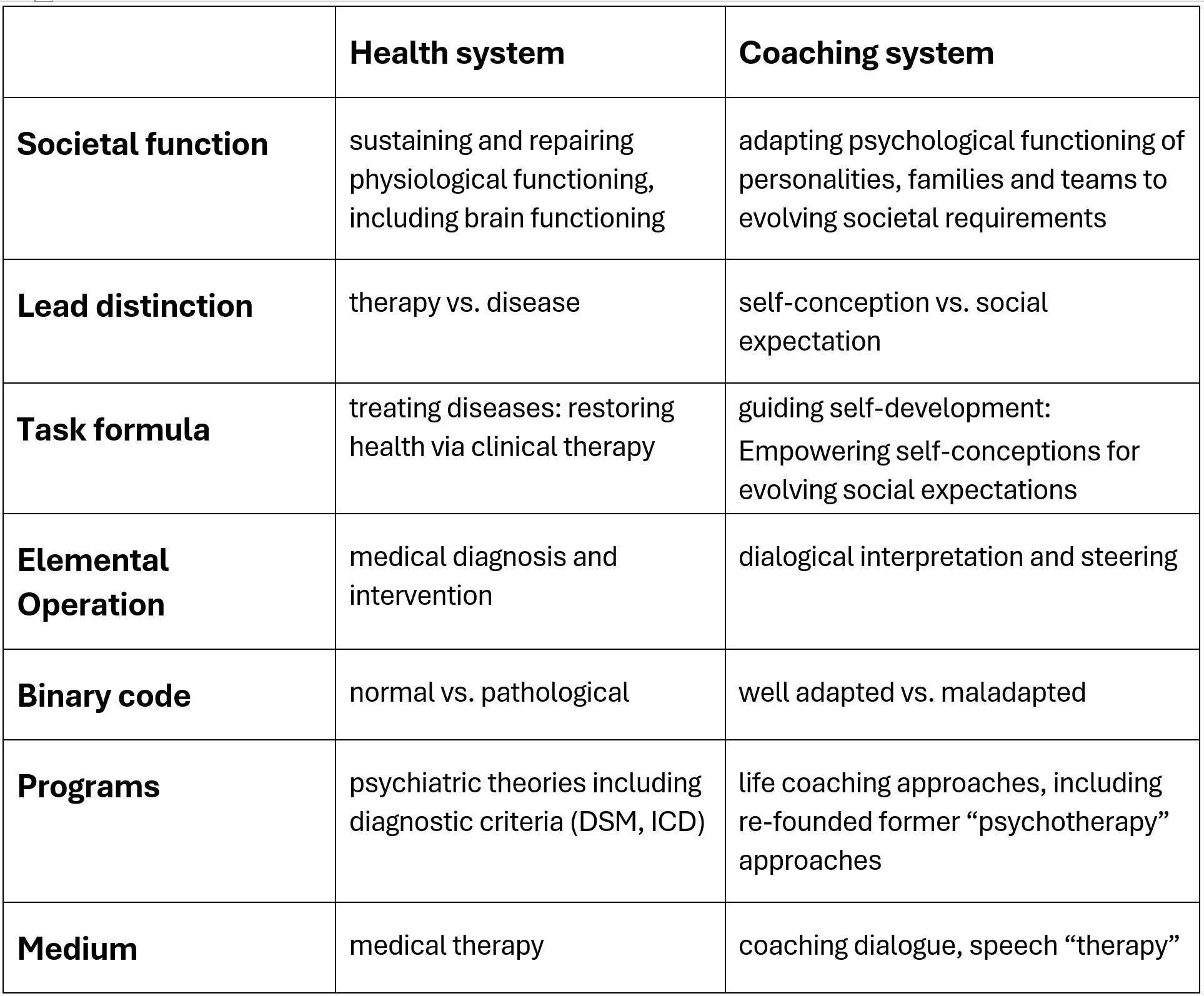
The grid makes several results of the preceding sections legible in a new register. First, the codes are genuinely incommensurable: normal/pathological presupposes a fixed reference state anchored in the organic substrate, whereas well adapted/maladapted is intrinsically relational and historical — adaptation is always adaptation to evolving demands, so the code builds the historicity argued in Section 10 into the system’s very constitution. There is no translation rule between the codes; a communication cannot be simultaneously processed as diagnosis and as coaching challenge without equivocation. Second, the distinction between ultra-stable code and variable programmes explains the observed structure of the field: coaching methodologies (programmes) can and will proliferate, compete, and turn over historically, while the code that unifies the system remains constant — exactly the pattern Section 9 revealed, in which programme-level differences wash out against the common practice-form. Third, polycontexturality explains the sterile mutual misrecognition between the systems: observed from within the health system’s code, coaching appears as unlicensed quasi-therapy or untreated pathology; observed from within the coaching system’s code, clinical practice appears as the pathologization of adaptation challenges. Neither observation refutes the other, and no super-observer adjudicates; the boundary can only be managed pragmatically, as Section 16 proposes, by assigning the organic substrate to the health system and the communication-addressable domain of psychic and social adaptation to the coaching system. Finally, the frictions documented in this paper — the diagnostic gateway, reimbursement coding, the forced individual diagnosis in systemic practice, the benefit-certification circuit — are recast as artifacts of incomplete differentiation: points where the emerging system is still forced to communicate in the borrowed code of the old. On this reading, the present paper’s proposal is not a utopian re-engineering of the therapy world but a contribution to the reflection theory of a function system whose differentiation is already far advanced: the self-description catching up with the evolution.
The expansion of the medical model is not merely a static conceptual error; it is a self-amplifying social dynamic — and its net effect on those it claims to serve is disempowering.
The past two decades have seen an unprecedented proliferation of diagnosed conditions and self-ascribed mental-health problems, especially among the young — a phenomenon widely described as a mental health epidemic. Nick Haslam’s analysis of “concept creep” (Haslam 2016) documents the systematic horizontal and vertical expansion of psychology’s harm-related concepts: trauma, abuse, addiction, and disorder now cover ever milder and more ordinary experiences. Foulkes and Andrews (2023) advance the “prevalence inflation hypothesis”: mental-health awareness campaigns, saturating schools, media, and workplaces with diagnostic vocabulary, lead people to interpret transient and milder forms of distress as symptoms of disorder — and this self-labelling can itself worsen outcomes, since interpreting one’s state as illness alters expectation, self-efficacy, and behavior. This is Hacking’s looping effect operating at population scale: the classification manufactures the classified.
The documentation of this expansion, however, long predates its recent naming. Frank Furedi’s Therapy Culture (2004) had already traced, over the preceding two decades, the semantic inflation of precisely the vocabulary Haslam would later systematize — trauma, stress, abuse, addiction, self-esteem — and had identified the mechanism as cultural rather than clinical. Furedi’s object is not therapy as a practice but the therapeutic ethos as a system of meaning: a script that has escaped the consulting room and now furnishes the terms in which schooling, employment, media and public policy interpret human experience. Its content is an anthropology. Vulnerability ceases to describe the circumstances in which some people find themselves and becomes an ontological attribute of humanity as such; everyone is at risk, everyone is potentially damaged, and resilience falls under suspicion, reread as denial or as the repression of feelings that ought to be processed. Ordinary passages of life — bereavement, divorce, examination pressure, redundancy, conflict at work — are recoded as traumatic events calling for professional attention.
The significance of this for the present argument lies in its reach. The sick role analyzed above requires a certification, and its effects are therefore confined to those who have obtained one. The diminished self that Furedi describes requires no diagnosis at all. It operates as a diffuse cultural expectation of fragility, transmitted through curricula, workplace policy and media vocabulary, and it shapes self-interpretation across the whole population, including those who will never present to any service. The disempowerment at issue in this section is accordingly not merely an artefact of administrative gatekeeping but a general condition, and the certification circuits described below intensify a disposition that is already culturally available. Furedi’s further claim completes the circle: an ethos that trains people to construe their experience through the lens of damage produces the fragility it undertakes to remedy — which is the prevalence-inflation hypothesis, arrived at by cultural-sociological argument two decades before it was formulated epidemiologically.
The disempowering mechanism was identified at the very origin of medical sociology. Talcott Parsons’ analysis of the “sick role” (Parsons 1951) showed that the social recognition of illness confers legitimate exemption from normal role obligations, but at a price: the sick person is defined as not responsible for their condition and as obligated to submit to professional treatment rather than to help themselves. This bargain is benign for pneumonia. Applied to problems of living, it is corrosive: the obligations from which the diagnosed person is exempted — work, study, social participation — are precisely the fields of challenge in which coping capacities, competence, and morale are built. The exemption removes the developmental gymnasium while the not-responsible clause externalizes the locus of control. The meta-analytic finding that biogenetic explanations of distress increase prognostic pessimism and reduce perceived agency (Kvaale, Haslam, & Gottdiener 2013) confirms the point at the level of individual psychology: to be told one has a disorder is to be told that self-directed change is not the relevant category.
The dynamic is then locked in by institutional incentives. Modern welfare states condition significant benefits — incapacity payments, disability allowances, educational accommodations, workplace adjustments, exemption from job-seeking requirements — on medically certified mental-health conditions. This creates an incentive gradient to seek, retain, and behaviorally express diagnosis. The resulting growth of mental-health-related disability claims across advanced economies is well documented (Autor & Duggan 2003; OECD 2012), with common mental disorders — precisely the conditions lacking biomarkers and constituting the natural territory of speech-based practice — driving the expansion. The point is not an accusation of malingering: incentive structures shape sincere self-interpretation, in exactly the looping manner Hacking describes. But the consequence is an incentive inversion that the medical model conceals because it treats diagnosis as the neutral recognition of a pre-existing fact: once income, status, accommodations, and identity attach to incapacity, recovery becomes economically and socially penalized. A system nominally devoted to restoring functioning institutionally rewards its absence.
The developmental model reverses the valence at every point. Its categories — capacities, strategies, progressive challenge, growth — are agency-conferring rather than agency-negating; its practitioner contract presupposes an active, responsible client rather than a patient; and no rents attach to incapacity within it. Whatever support arrangements a society chooses to fund, they should not be routed through a gateway that requires people who are struggling to function to first certify themselves, to the state and to themselves, as disordered.
The preceding section described the disempowerment produced by diagnostic expansion as if it were a cultural drift. It is not. It is the predictable output of an institutional structure, and the structure can be specified. This section accordingly shifts from the phenomenology of the sick role to the political economy that manufactures it, and adopts for that purpose the analytical resources of the classical liberal and libertarian tradition: the theory of professional jurisdiction, the public-choice account of concentrated benefits and dispersed costs, and Hayek’s argument concerning the limits of centralized knowledge. The claim to be established is that the medical model’s overextension is not merely an intellectual error that better science will correct, but an equilibrium sustained by the fiscal and legal architecture of the welfare state — and that no re-description of speech-based practice will survive contact with that architecture unless the architecture is itself addressed.
The most authoritative witness is Szasz himself, in the preface he wrote fifty years after the original publication of The Myth of Mental Illness. Its argument is not a restatement but a concession of defeat, and the terms of the defeat are instructive. In the 1950s, Szasz recalls, the notion that providing health care was a responsibility of the federal government had not yet entered American national consciousness; the distinctions between medical and mental hospitals, between voluntary and involuntary patients, and between private and public psychiatry were sharp. Since then those distinctions have blurred into nonexistence. Virtually all medical and mental health care is now regulated by the federal government and paid for, in whole or in part, out of public funds; scarcely any psychiatrist lives on fees collected directly from patients; and none is free to contract with a patient about the terms of the therapeutic relationship, since every person legally defined as a mental health professional now bears a statutory responsibility for preventing his patient from becoming dangerous to himself or others. Szasz’s conclusion is startling and, for the present argument, decisive: it made sense fifty years ago to assert that mental illnesses are not diseases, and it makes no sense to say so today. The question has not been answered; it has been removed from the domain of inquiry. Debate about what counts as mental illness has been superseded by legislation about the medicalization and demedicalization of behavior — old diseases such as homosexuality and hysteria disappearing, new ones such as gambling and smoking arriving as if to replace them.
The mechanism of that removal is worth documenting in the words of those who effected it, since the ontological question that Sections 4 through 8 have shown to be genuinely open was closed by executive declaration rather than by evidence. In 1999 President Clinton announced that mental illness “can be accurately diagnosed, successfully treated, just as physical illness.” His mental health adviser, Tipper Gore, described the belief that mental illness is not a physical disease as among the most damaging myths in circulation. Surgeon General David Satcher offered the analogy directly: things go wrong with the brain much as they go wrong with the heart, the kidneys and the liver. A White House fact sheet on myths and facts about mental illness asserted that research had proved mental illnesses to be “diagnosable disorders of the brain.” None of these statements was true when made; each was, in Szasz’s phrase, a false belief converted by political power and professional self-interest into a “lying fact.” What is significant for the present analysis is not the falsity but the mode of settlement. A contested scientific question was not adjudicated by the state; it was terminated by it. Where a nosology acquires the imprimatur of government, there ceases to be any legally valid nonmedical approach to the phenomena it covers, and the plurality of competing descriptions on which intellectual progress depends is foreclosed by statute.
That such a settlement occurred requires no conspiracy, only an interest structure, and the structure is transparent to public-choice analysis. Three parties gain from the expansion of the medical description and none from its contraction. The profession gains jurisdiction, reimbursement and the monopoly rents that attach to licensed expertise — the dynamic Andrew Abbott anatomized in his study of the system of professions, in which occupations compete for exclusive dominion over problem domains. The pharmaceutical industry gains the indication, as Section 8 has already shown. Politicians gain a means of converting social problems into treatable conditions and thereby of expanding what Szasz called the therapeutic state, since a population defined as ill is a population that requires provision. Against these concentrated and well-organized benefits stand costs that are diffuse: borne by taxpayers who cannot trace them, and by claimants whose loss — a life recategorized as an incapacity — registers as gain. Buchanan and Tullock described the general form of this asymmetry sixty years ago. Haslam’s concept creep and Hacking’s looping effects, invoked earlier in this paper, supply its microfoundations; the fiscal structure supplies its direction.
An account of interests explains supply, but not demand, and the demand side of this equilibrium is the harder problem: it must be explained why a population accepts, and actively seeks, a description of itself that the preceding section has shown to be disempowering. Furedi supplies the missing term. The therapeutic ethos, on his analysis, occupies a vacancy. As the older frameworks within which suffering was given meaning and standing — religious, communal, familial, and the solidarities of class and political affiliation — lost their interpretive authority, the therapeutic became the surviving idiom in which a person could make a claim about their own condition and expect it to be honored. It is thus a moral regime operating under the semantics of health, and its political adoption follows: self-esteem policy, emotional literacy in schools, wellbeing agendas, a state acquiring a novel basis of legitimacy through the provision of emotional recognition rather than material goods. This is a considerable refinement of the therapeutic state as Szasz conceived it. Szasz’s version is coercive, and coercion accounts well for the psychiatry of the asylum; it accounts poorly for a contemporary expansion that proceeds very largely by consent. Furedi’s version works through validation rather than compulsion, and it is validation, not force, that has driven the caseloads examined below. Furedi also identifies the collateral damage: the premise that difficulty requires professional handling does not supplement the informal relations — family, friendship, neighborhood, the older forms of mutual aid — through which people have historically coped, but displaces them, so that each extension of professional jurisdiction erodes the very resources that would render it unnecessary.
The distinctively liberal objection, however, is epistemic rather than merely political, and it is the more fundamental of the two. Hayek’s argument concerning the use of knowledge in society holds that the information relevant to a decision is dispersed among the parties to it and is largely unformalizable: local, tacit, and specific to particular circumstances of time and place. The difficulties that bring people to speech-based practice are of exactly this character. They are constituted by an individual’s history, capacities, commitments and situation, and they change as those change. A centralized nosology used as a criterion of legal entitlement cannot accommodate such particularity, and must not try: to function as an administrative instrument, a category must be uniform, stable, auditable by a stranger, and cheap to apply. This yields a conclusion sharper than the one reached in Section 7. The polythetic symptom checklist is not merely bad science that better science will replace; it is what a description of psychic difficulty necessarily becomes once it is conscripted to serve as an eligibility rule. The invalidity documented there is a systematic consequence of the administrative function, not an accident of committee procedure, and it will reappear in any successor nosology asked to do the same work.
The British experience of the last decade supplies the demonstration, and on a scale that makes the fiscal engine impossible to overlook. In England and Wales the number of working-age people claiming a disability or incapacity benefit has risen from about 2.8 million in 2019 — roughly one in thirteen — to some four million, or one in ten (Institute for Fiscal Studies 2025). The caseload for Personal Independence Payment alone passed four million in April 2026, having risen by more than a quarter of a million in twelve months, with over 1.5 million awards recording a mental health condition (Department for Work and Pensions 2026). Mental and behavioral disorders now account for around two in five recent disability benefit awards, up from under a third before the pandemic; and the age gradient is extraordinary, mental health being the primary condition for some sixty-nine per cent of new twenty-five-year-old claimants against roughly twenty-two per cent of new fifty-five-year-old claimants (Latimer, Pflanz & Waters 2024). A twenty-year-old today is about as likely to claim a health-related benefit as a thirty-nine-year-old was in 2019. Spending on working-age health-related benefits, which grew by some twenty billion pounds over the post-pandemic period, was projected before the 2025 reform proposals to reach beyond seventy billion by the end of the decade.
The fate of those reform proposals illustrates the ratchet with unusual clarity. The tightening of the Personal Independence Payment eligibility test announced in March 2025 was withdrawn under political pressure within months; the Office for Budget Responsibility subsequently raised its estimate of spending within the welfare cap for the end of the decade by some twelve billion pounds, attributing the revision largely to that reversal and to continued growth in disability caseloads. Expansions of a certified category prove permanent; contractions prove reversible. This is precisely what the interest structure described above predicts, and it is why the problem cannot be treated as one of administrative parameter setting. Each certified claimant acquires a defensible entitlement and a constituency; each proposed contraction is experienced, correctly, as the withdrawal of something already granted.
The analytically decisive observation, and the one that belongs distinctively to this paper rather than to the liberal tradition generally, is that what these systems certify is not disease at all. It is non-adaptation. The recorded condition on a million and a half claim forms is discharging the function of the distinction well adapted/maladapted while wearing the semantics of normal/pathological. The welfare state has, in other words, already begun to process the coaching system’s object; it merely does so through the health system’s code, and the mismatch explains the ratchet better than any account of fraud or fecklessness. The pathological is a status, not a trajectory. It admits no gradient — there is no being somewhat ill — and it supplies no exit condition short of cure, which for a syndrome without a disease can never arrive. Maladaptation, by contrast, is intrinsically relational and temporal: it names a mismatch between a person’s current strategies and their current circumstances, and it implies a path. A certification system built on the second code could not generate a permanent caseload, because the category it assigns is one that people are expected to leave. The rise documented above is thus not evidence that a sickness has spread through the young; it is evidence of what happens when a developmental predicament is registered under a code that has no term for development.
The remedy that follows is not the denial of suffering, it is the decoupling of description from entitlement — the severance of the diagnostic monopoly from the fiscal gate. So long as one officially sanctioned nosology is simultaneously a scientific classification, a licensing boundary, a condition of reimbursement and a passport to income, it will be corrupted in all four capacities at once, and the corruption will be invisible in each because it originates in the others. Under the plural arrangement defended in the present author’s work on discourse capitalism, competing schools of developmental practice would be evaluated by those they serve, and by open, critical, decentralized discourse on the evidence of what works, rather than by conformity to a centralized, administratively convenient list — and support for those who cannot presently maintain themselves would be organized on grounds of need and circumstance rather than on a certified ontological claim about their brains. That would restore precisely what Szasz identified as having been lost: the freedom of the parties to a helping relationship to determine its terms between themselves.
A further observation completes the political-economy picture, and it is one that the emergence thesis of Section 14 predicts. The coaching system, unlike the health system out of which it is differentiating, is organized almost wholly through private market provision. Life coaching, executive and team coaching, organizational development and change consultancy, mentoring, the self-development literature and its digital successors are contracted voluntarily, priced openly, and paid for by the client or by the client’s employer. They operate without a state licensing monopoly, without a compulsory nosology, without third-party reimbursement, and without any statutory power over the person seeking help. Accreditation exists in abundance, but it is issued by competing private bodies whose certificates are worth what the market judges them to be worth, rather than by an authority whose imprimatur is a condition of lawful practice. Where the health system’s professions are gatekeepers of entitlements, the coaching professions are suppliers of services, and the difference is visible in every feature of the transaction.
This is not a contingent feature of a young sector that will in due course mature into regulation. It is the institutional form appropriate to the system’s function, and for the reason given above. The health system can be publicly organized because its object — organic dysfunction — is comparatively universal, comparatively stable across time and culture, and comparatively legible to a central authority. The coaching system’s object is none of these things. Its function is the adaptation and upgrading of emotional and communicative functioning to evolving societal requirements; those requirements are plural, historically specific, fast-moving, and known in their detail only locally, to the person, family or organization facing them. No central body can specify in advance what counts as adaptive for a particular life, nor which practices will prove to serve it. That determination is precisely what a competitive discovery procedure exists to perform, and here it is performed as it is performed elsewhere — by clients who continue or discontinue, and by practitioners who prosper or do not. A publicly financed and licensed coaching system would be obliged to define its object administratively in order to disburse, and would thereby reproduce the very pathology this paper has traced: a checklist standing in for a judgment, and a status standing in for a trajectory. The market form is thus not incidental to the new system but constitutive of its capacity to perform its function at all.
From this follows a conclusion at once conceptual and political, and the two aspects are inseparable: to roll back the false medical model is to roll back the state. The territory at stake — the vast field of ordinary difficulty in living, of demoralization, of skills not yet acquired and strategies that have ceased to work — is at present held under a description that makes it a matter for licensed professions, public financing, statutory certification and the entitlements that follow from certification. Withdrawing that description does not leave the territory unattended. It returns the territory to voluntary provision, in which those who want help contract for it with those who offer it, on terms the parties set between themselves — which is exactly the freedom whose disappearance Szasz recorded. Every condition demedicalized is a jurisdiction returned from administration to exchange. The re-founding proposed in this paper is therefore not a merely a conceptual or terminological reform. It carries political implications. The accurate description and the free arrangement are two aspects of a single correction, since it is the medical description that licenses the administrative apparatus, and the administrative apparatus that preserves the medical description.
The thesis is not antipsychiatric in the Szaszian totalizing sense: a residual medical domain remains, and it is real. But its shape is not what the phrase “residual domain” ordinarily suggests, and getting the shape right matters more than lengthening the list. The domain must be delimited by the criterion established in Section 5 — the identification of a pathological process, a lesion, an infectious agent, a metabolic derangement, a deterministic mutation, an autoimmune target, which explains why the manifestations cluster and confers upon them a characteristic course. Three things that are frequently mistaken for that criterion are not it. A biological correlate is not it. Every mental state whatever has one, and learning to ride a bicycle or to speak a second language does leave organic traces in the wiring — measurably so, as the hippocampal differences found in London taxi drivers who have acquired the Knowledge attest. The point is not that such traces are hard to detect, which would make the distinction hostage to the progress of imaging. It is that they differ in kind: learning-induced change is the substrate performing the function it exists to perform, not failing at it. Plasticity is the medium in which experience is written; a lesion is damage to the medium. And a criterion that every psychic state satisfies has no discriminative power whatever — which also disposes of the frequently heard objection that psychotherapy alters the brain and is therefore a biological intervention. It does, and so do reading, conversation, apprenticeship, and instruction in mathematics, none of which is thereby medical. Severity is not it: severe grief is severe, not thereby organic, and some unambiguously organic conditions are mild. And heritability is not it — a point that deserves emphasis, since it is the objection most commonly raised against the argument of this paper.
Heritability is a population-variance statistic. It reports what fraction of the variation in a trait within a particular population under particular conditions covaries with genetic variation; it is not a claim about mechanism, and it identifies no pathological process. Divorce, religiosity, political affiliation, and years of education are all substantially heritable, and nobody proposes them as diseases. More decisively for the present argument, a highly heritable trait may be an entirely normal variant that happens to be maladaptive in a given environment — which is precisely the harmful non-dysfunction delimited in Section 4. High heritability is therefore fully compatible with, and offers no evidence against, assignment to the coaching system. The inference from “it runs in families” to “it is a disease” is a further instance of the pattern this paper has traced from the virtus dormitiva through the ex juvantibus fallacy: an observation converted into an aetiology it does not support.
Applying the criterion strictly yields a core that is smaller than customary lists suggest but entirely unambiguous, and it is worth setting out with the psychic manifestations attached, since it is by those manifestations that these conditions enter psychiatric jurisdiction in the first place. The neurodegenerative and structural conditions constitute the largest group: Alzheimer’s disease, with its amyloid plaques and neurofibrillary tangles, now detectable in life by cerebrospinal and positron-emission markers and increasingly by blood-based phosphorylated tau, presenting first as episodic memory failure and progressing through disorientation, word-finding loss, and frequently to agitation, suspicion, and frank persecutory delusion; vascular dementia, whose infarcts are visible on imaging and whose course is stepwise rather than gradual, with prominent apathy and emotional lability; frontotemporal dementia, including its monogenic forms in MAPT, GRN, and C9orf72, which characteristically presents not with memory loss at all but with disinhibition, loss of empathy, and social transgression — patients are misdiagnosed for years as having undergone a change of personality or a midlife crisis; dementia with Lewy bodies, distinguished by fluctuating cognition and recurrent, elaborately detailed visual hallucinations; and Creutzfeldt–Jakob disease, whose rapid dementia is preceded in many cases by weeks of anxiety, insomnia, and depression. To these belong brain tumours, stroke, and traumatic brain injury, in which frontal lesions produce disinhibition and apathy that are indistinguishable at the level of behaviour from character change.
Huntington’s disease is the paradigm case of the group and deserves separate statement. Its cause is a single expanded CAG repeat on chromosome 4, its transmission is autosomal dominant, its penetrance above the threshold repeat length is complete, and a test performed decades before onset will say with certainty who will develop it. Its psychiatric manifestations — irritability, apathy, depression, obsessionality, occasionally psychosis, and a rate of suicide many times that of the general population — commonly precede the chorea by years. Here every element the medical model requires is present: a determinate lesion, a mechanism, a course, and a diagnosis independent of the symptoms it explains. The two-tier semiotic structure examined in Section 5 is fully instantiated, and the irritability genuinely is a symptom, because there is something for it to be a symptom of.
Delirium constitutes a second group by itself. It presents as acute disturbance of attention and awareness, fluctuating over hours, with disorganized thinking and often vivid hallucination and terror, and it is secondary to an identifiable systemic cause — infection, hypoxia, metabolic derangement, drug toxicity, withdrawal. It resolves when the cause is treated. The logic is that of somatic medicine throughout, and the psychic manifestations are exactly the sort that would, in the absence of the identified cause, be classified as psychosis.
The infectious and immune group is small but of exceptional argumentative importance. Neurosyphilis, in its late parenchymal form historically known as general paresis of the insane, produced grandiose delusion, disinhibition, euphoria alternating with depression, and progressive dementia, and accounted at its height for a substantial fraction of asylum admissions in Europe and America. Anti-NMDA receptor encephalitis, described only in 2007, presents with acute psychosis, hallucination, disordered speech, catatonia, and bizarre behaviour, frequently in young women, and is routinely mistaken for a first episode of schizophrenia; an antibody assay establishes the diagnosis and immunotherapy resolves it. The metabolic, endocrine, and nutritional group is larger and clinically commonplace: hypothyroidism presenting as depression with psychomotor slowing, hyperthyroidism as anxiety and agitation, Cushing’s syndrome as depression and occasionally psychosis, B12 deficiency as confusion and mood change, hepatic encephalopathy as fluctuating confusion, Wilson’s disease as personality change and mood disturbance in an adolescent whose copper metabolism is deranged by a mutation in ATP7B, acute intermittent porphyria as episodic psychosis and anxiety, and Wernicke–Korsakoff syndrome as confabulation and dense anterograde amnesia consequent on thiamine deficiency and mammillary body lesions. Pellagra, before its cause was known, filled asylum wards with a dementia and psychosis produced by the want of niacin.
Two further groups complete the core. Genetic syndromes with characteristic behavioural phenotypes — Down syndrome, Fragile X arising from FMR1 expansion, 22q11.2 deletion syndrome, Rett syndrome from MECP2 mutation, Prader–Willi, Williams syndrome — present with intellectual disability accompanied in each case by a recognizable profile of social, emotional, and behavioural features. Intellectual disability of identified aetiology belongs here likewise: untreated phenylketonuria, congenital hypothyroidism, fetal alcohol syndrome, lead exposure, perinatal hypoxia. And a group of neurological conditions with psychiatric presentation: epilepsy, particularly of temporal-lobe origin, with its ictal fear, déjà vu, derealization, and post-ictal psychosis; and narcolepsy with cataplexy, which is among the cleanest cases in the whole of psychiatry, being caused by the loss of hypocretin-producing neurons, measurable directly in cerebrospinal fluid, associated with a specific HLA allele, and almost certainly autoimmune in origin, and which presents with hypnagogic hallucination and sleep paralysis that were for decades read as psychotic phenomena.
Beyond this core lies a substantial middle territory in which the biological evidence is real but incomplete, and honesty requires that it be described as such rather than assimilated to either side. Schizophrenia and the psychoses carry a heritability estimated near seventy per cent, several well-replicated copy-number variants, a plausible mechanism in complement-mediated synaptic pruning, and neurodevelopmental and structural abnormalities visible in aggregate; they also lack any diagnostic test, exhibit heterogeneity so extreme that the category is unlikely to name one thing, and show a social gradient in migration, urbanicity, and childhood adversity that is among the largest in the epidemiological literature. Bipolar disorder presents the strongest case of this group, with comparable heritability, a relatively distinct episodic course, and a specific pharmacological response, yet no biomarker. Autism is unambiguously neurodevelopmental and possesses a syndromic subgroup with identified genetic causes, but that subgroup sits within a spectrum whose milder reaches raise the boundary problem of Section 4 in acute form. Attention-deficit/hyperactivity disorder is highly heritable and yet diagnosed entirely by behavioural report, varies enormously in prevalence across jurisdictions, and displays a relative-age effect — children born just before a school entry cut-off are diagnosed markedly more often than classmates born just after — which is difficult to reconcile with any reading of the category as a discrete pathology. Tourette syndrome, obsessive-compulsive disorder, and anorexia nervosa occupy similar ground. The honest description of this territory is that its assignment is unresolved, that some of it will very likely resolve toward the medical domain as mechanisms are identified, and that the remainder will not.
Physiological Dysfunction Induced by Life Experience: Deprivation, Plasticity, and the Limits of the Concession
A question arises at this point which deserves separate treatment, because it appears to threaten the criterion and because the honest answer to it is not the one the argument of this paper might seem to require. Can purely social experience — not injury, not poison, not infection, but adversity of the kind that consists in what happens between people — induce genuine physiological dysfunction of the brain? The answer is yes, in one well-established class of cases, and the concession should be made without qualification before its limits are drawn.
The class is early developmental deprivation. The children raised in Romanian institutions under Ceausescu, followed by the English and Romanian Adoptees study and by the Bucharest Early Intervention Project, exhibit reduced total brain volume in both grey and white matter, altered white-matter organization, and atypical electroencephalographic activity, with deficits that persist into adulthood in those deprived beyond the first six months of life. The findings show a dose-response relation to the duration of deprivation and a sensitive period: children removed early, or placed in foster care before the second year, fare markedly better than those removed late. Nothing physical was done to these children and nothing toxic was administered. What was withheld was ordinary contingent human responsiveness, and its absence produced measurable structural consequence. The principle was established experimentally in the visual system by Hubel and Wiesel, whose occluded kittens failed to develop normal cortical organization: a developing system deprived of the input it is built to receive does not merely fail to learn, it fails to construct itself.
The mechanism, however, is precisely what preserves the criterion rather than dissolving it, and the distinction that does the work is Greenough’s, between experience-expectant and experience-dependent plasticity. Experience-expectant plasticity concerns those inputs the developing nervous system has evolved to anticipate and which are reliably present in any normal environment — patterned light, faces, contingent caregiver response — and upon whose arrival, within a window, it builds structure. Where the expected input does not arrive, the structure is not built, and the resulting deficit is a genuine failure of a mechanism to perform a function for which it was selected: harmful dysfunction in Wakefield’s exact sense, and therefore properly medical. Experience-dependent plasticity, by contrast, is the ordinary lifelong encoding of idiosyncratic information — the bicycle, the second language, the route through a city — and it is not the exception to normal function but its operation.
What follows is that the pathway by which social experience produces organic dysfunction is deprivation, not meaning. The institutionalized infant was not damaged by the construction she placed upon her circumstances, by a self-conception formed under them, or by the significance she attached to the absence of a caregiver. She was damaged by the absence of an input her developing brain required in order to build itself, which is structurally the same kind of fact as the absence of a nutrient, and belongs to the same class of explanation as rickets. The claim entered earlier in this paper therefore stands in the form that matters: no construal of an event, however sustained and however distressing, produces a lesion. What produces the lesion is the missing input, and the input is missing whatever the infant makes of it — which is why the effect is greatest precisely where the capacity to make anything of it is least developed.
The adult case is far weaker, and the difference is instructive. The reduced hippocampal volume observed in post-traumatic stress disorder, frequently cited as demonstrating that adversity damages the brain, was shown by Gilbertson and colleagues in a monozygotic twin design to be at least in part a pre-existing familial risk factor rather than a consequence of exposure. Volume reductions observed in depression substantially recover with remission. McEwen’s concept of allostatic load, often invoked in this connection, describes the cumulative cost of adaptation — a system operating as designed under sustained demand — and not the failure of a mechanism. This supplies a further discriminator of some general use: a change that reverses when circumstances change is a state of an adaptive system, not a lesion. Lesions do not remit when the environment improves. Where the adult brain is concerned, what the evidence overwhelmingly shows is plasticity within the operating range, which is to say the substrate doing its work, rather than damage to the substrate.
Incarceration, and particularly prolonged solitary confinement, occupies an intermediate position and should be described with care. Mechanistically it is the closest adult analogue to the developmental cases, since what it imposes is precisely deprivation — of social contact, of sensory variety, of contingent response — rather than injury; and there is animal evidence that isolation reduces dendritic complexity and hippocampal neurogenesis, together with a long-standing clinical literature on the syndrome of confusion, hallucination, and cognitive impairment that prolonged isolation produces. The human structural evidence, however, remains thin and confounded, and it would be an overstatement to place solitary confinement in the same evidential class as the Romanian cohorts. It is worth adding that this hardly matters for the practical question. The harm of prolonged isolation does not stand in need of neuroimaging confirmation, and the demand that it should is itself an instance of the confusion this paper opposes: it concedes in advance that suffering counts as real only where a lesion can be exhibited. A century of testimony establishes the harm; the scan would add nothing to the case, and its absence subtracts nothing from it.
A word is owed to the epigenetic literature, since it is the form in which the claim now most often circulates. Meaney’s demonstration that variation in maternal licking and grooming alters methylation of the glucocorticoid receptor gene in rat pups, and McGowan’s report of comparable differences in the post-mortem brains of suicide victims with histories of childhood abuse, are genuine findings and were rightly influential. They are also, in their human extension, of contested replicability and uncertain effect size, and they document altered regulation rather than identified pathology. The proper verdict is that this is a promising line of investigation whose results do not at present establish a pathological process, and which should not be cited as though it did.
The concession thus costs the argument nothing, for the reason established above: aetiology does not determine jurisdiction, the identification of a pathological process does. A structural deficit is a medical matter whether it arose from a stroke, a toxin, or the absence of a caregiver, and the question of how it arose belongs to epidemiology and to prevention rather than to nosology. But the deprivation cases do more than leave the thesis standing, and it is worth saying what they positively contribute. Where early deprivation has produced a genuine and irreversible structural deficit, medicine can offer remarkably little: there is no treatment that rebuilds what was not built, and the medical model, having correctly identified the pathology, reaches the end of its resources at once. What remains — and it is the whole of what such a person’s life requires — is the construction of a workable existence with an altered constitution, under expectations calibrated to constitutions that were built normally. That is not a residual task left over after medicine has finished. It is the task, and it falls entirely within the object of the emerging system. The cases that appear to press hardest against the dividing line are therefore the cases in which the two-jurisdiction analysis is most obviously correct.
Finally, a caution about the use to which this literature is now put. The proposition that trauma changes the brain has become a staple of popular therapeutic culture, and its rhetorical function there is precisely the one analyzed in Sections 15 and 16: it converts a predicament into an organic fact, and thereby secures for it the standing that only the medical description confers. The most widely read exponent of the claim addresses a general audience, and the neuroscientific warrant offered for it is considerably weaker than the confidence with which it is asserted. The point is not that people who have suffered gravely are not suffering, nor that their difficulties are imaginary. It is that the appeal to neural evidence is doing work of a different kind from the work it appears to do — it is claiming a status rather than establishing a mechanism, and the status it claims is the one this paper has argued to be, for most of those to whom it is offered, disempowering.
The decisive structural observation, however, concerns not the contents of the medical domain but its behaviour over time. Consider what happens to a condition when its organic basis is established. General paresis, once the greatest single cause of psychiatric institutionalization in the Western world, became neurosyphilis and passed to infectious medicine. Pellagra psychosis became a nutritional deficiency and passed to dietetics. Myxoedema madness became hypothyroidism and passed to endocrinology. Epilepsy, for centuries a paradigm of madness, became a disorder of cortical excitability and passed to neurology. Anti-NMDA receptor encephalitis was identified in 2007 and passed within a decade to neuroimmunology. Huntington’s disease is managed by neurologists and geneticists. In each case the transfer was complete, and in each case the condition ceased to be a mental illness in anything but a historical sense. The residual medical domain is therefore not a stable province of psychiatry at all. It is a transit zone — a holding domain - from which conditions leave for the somatic specialty appropriate to the mechanism, as soon as the mechanism is known.
Szasz drew the radical conclusion from this pattern, and it should be stated in its full strength rather than softened. If the discovery of an organic basis for a psychic disturbance is precisely what removes it from psychiatry and delivers it to the relevant branch of somatic medicine, then organic grounding cannot be what makes something a mental illness — it is what makes something cease to be one. The category “mental illness” is thereby defined, structurally and not merely contingently, as the class of psychic disturbances whose organic basis has not been established. Its membership is provisional by construction: every confirmed case is an ex-member. On this reading the set of mental illnesses proper is empty, and psychiatry is not a medical specialty defined by a class of diseases but a residual jurisdiction defined by an absence of explanation — a holding domain, which discharges its contents to genuine medicine at exactly the rate at which genuine medicine becomes able to receive them.
The present paper does not need the conclusion in that strength, and does not adopt it. Two qualifications separate the position defended here from the Szaszian one. The first is that the transit zone or holding domain is not empty at any given moment, and its occupants are not fictions. Conditions in transit are real, are severe, and require medical management now, before their mechanisms are fully specified; a person with an untreated first-episode psychosis is not helped by the observation that the category will one day be dissolved into several others. The second and more important qualification is that Szasz, having demonstrated that the medical description does not fit, had nothing to put in its place, which is the failure diagnosed in Section 3 and the reason his critique could be absorbed without effect. The argument of this paper differs precisely here. It accepts the transit-domain analysis, and adds what Szasz could not: that the vacated territory is not a void into which suffering disappears, but the operative domain of an emerging function system with its own function, its own code, and its own professionalized practice.
The two exits from the transit domain are therefore asymmetrical in a way that has gone unremarked. The first exit is well understood: a mechanism is discovered and the condition departs to neurology, endocrinology, or immunology. The second exit is the one this paper describes, and it is by far the larger. Where no mechanism is discovered because there is none to discover — where what presents is a self-conception out of register with the expectations addressed to it, an entrenched strategy that has ceased to serve, a mismatch between an evolved constitution and the demands of a historically novel environment — the condition departs not upward into somatic medicine but sideways, into the coaching system. Psychiatry has been holding both classes of case in the same waiting room and describing both with the same borrowed vocabulary. The distinction between the two exits is the operative content of the dividing line proposed here.
Two consequences follow that guard against misreading. The first is that the line divides descriptions and jurisdictions, not persons. A person with Huntington’s disease, with a first-episode psychosis, or with a traumatic brain injury still holds a self-conception under expectations that have been transformed by the diagnosis, and the developmental work of reconstituting a life around an altered constitution is not merely compatible with medical treatment but urgently required alongside it. The medical model addresses the pathology; it has never had anything to say about the adaptation, and the assumption that treating the first discharges the obligation to the second is one of the more damaging consequences of the conflation this paper opposes. The second consequence is that the boundary is historically mobile and will remain so, moving in both directions: mechanisms will be found for some conditions now in the middle territory, and other conditions now confidently claimed for medicine will be relinquished, as homosexuality, hysteria, and drapetomania were relinquished before them. A dividing line of this kind cannot be drawn once and recorded. It has to be redrawn continually, by the same criterion.
It should be conceded that this boundary is not the one Wakefield would draw, and the disagreement is worth stating rather than leaving for a reader to discover. His criterion admits as genuine disorders the dysfunctions of evolved psychological mechanisms whether or not any organic substrate has been identified, so his residual medical domain is appreciably wider than the one proposed here and he would resist the assignment of everything lacking demonstrable biological grounding to the coaching system. Two replies are available. The first is the epistemic objection already entered in Section 4: where the evolved function of the mechanism in question is not known, the claim that it has failed is not a finding but a conjecture, and a domain boundary cannot be drawn by conjecture. The second is that the disagreement is narrower in practice than in principle, since Wakefield’s own false-positives programme removes from the disorder category the great bulk of what speech-based practice actually addresses. What remains genuinely in dispute is a residue of putative dysfunctions without organic markers — a real disagreement, but one that leaves the main thesis of this paper standing.
The dividing criterion proposed here is accordingly twofold. Substantively, the medical domain comprises those conditions in which a pathological process has been identified — and the identification, as the transit-zone analysis shows, tends of itself to transfer the condition out of psychiatry to the specialty that owns the mechanism. Pragmatically and as a working rule for the enormous remainder: where the intervention is speech — interpretation, dialogue, reframing, exercise, practice — the practice is developmental, not medical, regardless of current labeling.
Speech acts on meaning, self-interpretation, and skill; it does not act on lesions. Conversely, where intervention is genuinely physiological and disease-grounding is demonstrable, the medical model applies, though, as Section 8 argued, disease-specificity must not be overclaimed for psychiatric drugs even there, and responsiveness to a compound establishes nothing about aetiology. The current arrangement, in which speech-based practices are administered under medical concepts across a territory from which medicine has already conceptually withdrawn, is a category confusion sustained by the institutional interests analyzed in Section 16.
It is claimed the medical model reduces stigma (“an illness like any other”). The empirical literature suggests the opposite: biogenetic explanations tend to increase perceived dangerousness, pessimism about change, and social distance, while decreasing perceived agency. The developmental frame — challenges, learning, growth — is intrinsically less stigmatizing and more agency-preserving.
Does the coaching frame trivialize severe distress? No: the developmental model does not deny suffering; it re-describes its structure. Demoralization, grief, anxiety, and entrenched maladaptive patterns are fully real and can be severe. The question is whether their remedy operates as disease-treatment or as guided re-formation. The evidence says the latter — and severe cases with biological grounding are precisely those assigned to the residual medical domain.
The medical frame secures insurance reimbursement and professional regulation. This is true and is the strongest practical obstacle — but it is an argument about financing arrangements, not about the nature of the practice. Indeed, the diagnostic gateway distorts practice (clients must be pathologized to be helped) and restricts a market in which coaching, mentoring, and self-development services could compete openly. The reform implication is institutional redesign, not perpetuation of a false ontology.
The “empirically supported treatments” movement brands specific manuals for specific diagnoses. But as Section 9 showed, the specificity claim is precisely what the outcome evidence undermines; what the trials demonstrate is that structured, credible, alliance-based developmental practices help — which the coaching model predicts.
Therapy culture under a new name: The most serious objection to the constructive thesis comes from the critique this paper has itself drawn upon. Frank Furedi’s indictment of the therapeutic ethos does not spare the human potential movement, the self-development literature, or coaching; he would read the coaching system not as an escape from therapy culture but as its consolidation under a more flattering name, and the scale-invariance celebrated in Section 12 as the colonization of the workplace and the family by an expertise with no title to be there. Three replies are available, and the third requires a concession. First, what Furedi indicts is an anthropology of damage and incapacity, and that anthropology is precisely what the code well adapted/maladapted negates: it attributes capacity and a trajectory where the therapeutic ethos attributes fragility and a status, so a practice conducted under it is not the practice he describes. Second, his institutional targets are compulsory and publicly financed emotional intervention — curricula, state wellbeing programmes, mandated workplace schemes — which is to say that the argument of Section 15 for voluntary contracting and against public organization of this domain is itself a Furedian argument. Third, and this cannot be dissolved by pointing at the code, he would still object that a market in self-development corrodes informal support and the ideal of the self-reliant adult. The answer is that a coaching relationship is constitutively oriented to its own dispensability — it builds capacity rather than provides maintenance, and its success is the client’s exit, which is the structural inverse of open-ended treatment. But this is a norm the emerging system must hold itself to and can betray, not a guarantee its structure supplies; and the reflection theory to which this paper contributes should say so, since a system that forgets it will indeed become what Furedi describes.
The central claim of this paper can now be stated in its strongest form: what has been growing under the false flag of mental health is a new societal function system. The coaching system possesses everything Luhmann’s theory requires of a differentiated function system — a societal function of its own (adapting and upgrading psychic functioning to evolving societal requirements), a lead distinction (self-conception vs. social expectation), a task formula (developing self-conceptions under evolving social expectations via guided self-development), an ultra-stable binary code (well adapted/maladapted) incommensurable with the health system’s normal/pathological, a spectrum of historically variable programmes (the various counselling and coaching approaches), a distinct profession with its own training and accreditation infrastructure, and a growing theoretical literature reaching toward comprehensive self-description. Its differentiation out of the health system is not a proposal but an observation; only its explicit self-recognition is missing.
The body of the paper has supplied the grounds on which that self-recognition can proceed with a good conscience. The medical model is legitimate where its presuppositions hold: identifiable physiological dysfunction, historically stable disease entities, physical intervention. Across the vast territory of speech-based psychotherapy those presuppositions fail conceptually (no naturalistic disorder concept, and no underlying disease tier to sustain the symptom/illness distinction — rendering the symptom concept itself a category mistake in this domain), empirically (no biomarkers, no diagnostic validity, no treatment specificity), and historically (no culture-independent normal psyche facing constant functional demands). The practice that actually occurs in the consulting room — a credible relationship within which persons revise self-interpretations, restore morale, and acquire strategies adaptive to their historically specific predicaments — is developmental through and through. Its categories, unlike the organism-bound categories of medicine, are scale-invariant: the same dialogical, pattern-reframing, capability-building interventions runs continuously from individual coaching through couples and family work to team coaching and organizational change management, marking speech-based psychotherapy as the individual-scale member of a unified discipline of guided social-psychological development. And the stakes of completing the differentiation are not merely taxonomic: the medical model’s institutionalized expansion actively disempowers the people it claims to serve, converting struggles to function and flourish into certified incapacities embedded in a sick role and rewarded by benefit-certification circuits — a dynamic the coaching system’s agency-conferring code structurally excludes. A political-economy section analyses this expansion from a libertarian standpoint, arguing that the medicalization of psychic difficulty is sustained by an interest structure and a knowledge problem rather than by evidence — Szasz’s late verdict that the question of mental illness has been settled by legislation rather than inquiry, and the recent British growth of health-related benefit claims dominated by mental health conditions among the young, together showing a welfare ratchet that certifies non-adaptation under the code of the pathological and therefore admits no exit.
This is also, it may be said, the conclusion for which the anti-psychiatry movement reached and which it could not attain. It saw the misfit between the medical model and the phenomena with complete clarity, and, possessing only an analytics of power, could interpret that misfit only as domination — whereas what was occurring, then as now, was the differentiation of a new function system under borrowed semantics. The critique is preserved here; the totalizing politics of denunciation is discarded; and what the movement constitutively lacked, a theory of societal differentiation adequate to what it was observing, is what the present analysis supplies.
The honest and productive course is therefore to complete a paradigm shift already implicit in the contextual model, humanistic psychology, positive psychology, coaching psychology, and the systemic and organizational traditions — and already far advanced as a process of societal differentiation: to re-found speech-based psychotherapy, conceptually, terminologically, and institutionally, within the coaching system, as guided self-development for the challenges of contemporary life, a continuum of developmental practice extending from the person to the social systems in which persons live and work. A residual medical domain remains for conditions with robust organic grounding; everything else belongs to the new system. And because that system is constituted by voluntary contracting rather than by licensure, compulsory classification and public disbursement, the rolling back of the false medical description is at the same time a rolling back of the state’s jurisdiction. This paper understands itself, accordingly, as a contribution to the coaching system’s reflection theory — a contribution to a this function system’s self-clarification, hoping that its self-description will catch up with its evolution, and thereby further this evolution.
End.
Abbott, A. (1988). The System of Professions: An Essay on the Division of Expert Labor. University of Chicago Press.
Argyris, C., & Schön, D. A. (1978). Organizational Learning: A Theory of Action Perspective. Addison-Wesley.
Autor, D. H., & Duggan, M. G. (2003). The rise in the disability rolls and the decline in unemployment. Quarterly Journal of Economics, 118(1), 157–206.
Basaglia, F. (1987). Psychiatry Inside Out: Selected Writings of Franco Basaglia (N. Scheper-Hughes & A. M. Lovell, Eds.). Columbia University Press.
Bateson, G. (1972). Steps to an Ecology of Mind. Chandler.
Bateson, G., Jackson, D. D., Haley, J., & Weakland, J. (1956). Toward a theory of schizophrenia. Behavioral Science, 1(4), 251–264.
Bolton, D. (2008). What is Mental Disorder? An Essay in Philosophy, Science, and Values. Oxford University Press.
Borsboom, D. (2017). A network theory of mental disorders. World Psychiatry, 16(1), 5–13.
Borsboom, D., & Cramer, A. O. J. (2013). Network analysis: An integrative approach to the structure of psychopathology. Annual Review of Clinical Psychology, 9, 91–121.
Boorse, C. (1977). Health as a theoretical concept. Philosophy of Science, 44(4), 542–573.
Bringmann, L. F., Elmer, T., Epskamp, S., Krause, R. W., Schoch, D., Wichers, M., Wigman, J. T. W., & Snippe, E. (2019). What do centrality measures measure in psychological networks? Journal of Abnormal Psychology, 128(8), 892–903.
Buchanan, J. M., & Tullock, G. (1962). The Calculus of Consent: Logical Foundations of Constitutional Democracy. University of Michigan Press.
Canguilhem, G. (1989). The Normal and the Pathological (C. R. Fawcett, Trans.). Zone Books. (Original work published 1966.)
Cipriani, A., Furukawa, T. A., Salanti, G., et al. (2018). Comparative efficacy and acceptability of 21 antidepressant drugs for the acute treatment of adults with major depressive disorder. The Lancet, 391(10128), 1357–1366.
Conrad, P. (2007). The Medicalization of Society. Johns Hopkins University Press.
Cooper, D. (1967). Psychiatry and Anti-Psychiatry. Tavistock.
Cooley, C. H. (1902). Human Nature and the Social Order. Charles Scribner’s Sons.
Cramer, A. O. J., Waldorp, L. J., van der Maas, H. L. J., & Borsboom, D. (2010). Comorbidity: A network perspective. Behavioral and Brain Sciences, 33(2–3), 137–150.
Cushman, P. (1995). Constructing the Self, Constructing America: A Cultural History of Psychotherapy. Addison-Wesley.
Deleuze, G., & Guattari, F. (1983). Anti-Oedipus: Capitalism and Schizophrenia (R. Hurley, M. Seem, & H. R. Lane, Trans.). University of Minnesota Press. (Original work published 1972.)
Department for Work and Pensions (2026). Personal Independence Payment: Official Statistics to April 2026. DWP.
Festinger, L. (1957). A Theory of Cognitive Dissonance. Stanford University Press.
Foucault, M. (1973). The Birth of the Clinic: An Archaeology of Medical Perception (A. M. Sheridan, Trans.). Tavistock. (Original work published 1963.)
Foucault, M. (2006). History of Madness (J. Murphy & J. Khalfa, Trans.). Routledge. (Original work published 1961; abridged English edition, Madness and Civilization, 1965.)
Frances, A. (2013). Saving Normal: An Insider’s Revolt Against Out-of-Control Psychiatric Diagnosis, DSM-5, Big Pharma, and the Medicalization of Ordinary Life. William Morrow.
Frank, J. D., & Frank, J. B. (1991). Persuasion and Healing: A Comparative Study of Psychotherapy (3rd ed.). Johns Hopkins University Press.
Foulkes, L., & Andrews, J. L. (2023). Are mental health awareness efforts contributing to the rise in reported mental health problems? A call to test the prevalence inflation hypothesis. New Ideas in Psychology, 69, 101010.
Fried, E. I., & Cramer, A. O. J. (2017). Moving forward: Challenges and directions for psychopathological network theory and methodology. Perspectives on Psychological Science, 12(6), 999–1020.
Furedi, F. (2004). Therapy Culture: Cultivating Vulnerability in an Uncertain Age. Routledge.
Goffman, E. (1961). Asylums: Essays on the Social Situation of Mental Patients and Other Inmates. Anchor Books.
Gordon, T. (1970). Parent Effectiveness Training: The Tested New Way to Raise Responsible Children. Peter H. Wyden.
Grant, A. M. (2003). The impact of life coaching on goal attainment, metacognition and mental health. Social Behavior and Personality, 31(3), 253–264.
Greenough, W. T., Black, J. E., & Wallace, C. S. (1987). Experience and brain development. Child Development, 58(3), 539–559.
Hacking, I. (1995). The looping effects of human kinds. In D. Sperber, D. Premack, & A. J. Premack (Eds.), Causal Cognition. Oxford University Press.
Hadot, P. (1995). Philosophy as a Way of Life: Spiritual Exercises from Socrates to Foucault. Blackwell.
Haslam, N. (2016). Concept creep: Psychology’s expanding concepts of harm and pathology. Psychological Inquiry, 27(1), 1–17.
Hawkins, P. (2011). Leadership Team Coaching: Developing Collective Transformational Leadership. Kogan Page.
Hayek, F. A. (1945). The use of knowledge in society. American Economic Review, 35(4), 519–530.
Healy, D. (1997). The Antidepressant Era. Harvard University Press.
Horowitz, M. A., & Taylor, D. (2019). Tapering of SSRI treatment to mitigate withdrawal symptoms. The Lancet Psychiatry, 6(6), 538–546.
Horwitz, A. V., & Wakefield, J. C. (2007). The Loss of Sadness: How Psychiatry Transformed Normal Sorrow into Depressive Disorder. Oxford University Press.
Horwitz, A. V., & Wakefield, J. C. (2012). All We Have to Fear: Psychiatry’s Transformation of Natural Anxieties into Mental Disorders. Oxford University Press.
Hubel, D. H., & Wiesel, T. N. (1970). The period of susceptibility to the physiological effects of unilateral eye closure in kittens. Journal of Physiology, 206(2), 419–436.
Hyman, S. E. (2010). The diagnosis of mental disorders: The problem of reification. Annual Review of Clinical Psychology, 6, 155–179.
Illich, I. (1975). Medical Nemesis: The Expropriation of Health. Calder & Boyars.
Institute for Fiscal Studies (2025). The Role of Changing Health in Rising Health-Related Benefit Claims. IFS.
James, W. (1890). The Principles of Psychology. Henry Holt.
Johnstone, L., & Boyle, M. (2018). The Power Threat Meaning Framework. British Psychological Society.
Kirsch, I. (2010). The Emperor’s New Drugs: Exploding the Antidepressant Myth. Bodley Head.
Kirschenbaum, H. (2007). The Life and Work of Carl Rogers. PCCS Books.
Kvaale, E. P., Haslam, N., & Gottdiener, W. H. (2013). The ‘side effects’ of medicalization: A meta-analytic review of how biogenetic explanations affect stigma. Clinical Psychology Review, 33(6), 782–794.
Laing, R. D. (1960). The Divided Self: An Existential Study in Sanity and Madness. Tavistock.
Latimer, E., Pflanz, F., & Waters, T. (2024). Health-Related Benefit Claims Post-Pandemic: UK Trends and Global Context. Institute for Fiscal Studies.
Lecky, P. (1945). Self-Consistency: A Theory of Personality. Island Press.
Lewin, K. (1947). Frontiers in group dynamics: Concept, method and reality in social science. Human Relations, 1(1), 5–41.
Luborsky, L., Singer, B., & Luborsky, L. (1975). Comparative studies of psychotherapies: Is it true that “everyone has won and all must have prizes”? Archives of General Psychiatry, 32(8), 995–1008.
Lilienfeld, S. O., & Marino, L. (1995). Mental disorder as a Roschian concept: A critique of Wakefield’s “harmful dysfunction” analysis. Journal of Abnormal Psychology, 104(3), 411–420.
Luhmann, N. (1995). Social Systems. Stanford University Press.
Luhmann, N. (2012–2013). Theory of Society (Vols. 1–2). Stanford University Press.
Maguire, E. A., Gadian, D. G., Johnsrude, I. S., et al. (2000). Navigation-related structural change in the hippocampi of taxi drivers. PNAS, 97(8), 4398–4403.
Maslow, A. H. (1962). Toward a Psychology of Being. Van Nostrand.
McEwen, B. S. (1998). Protective and damaging effects of stress mediators. New England Journal of Medicine, 338(3), 171–179.
Mead, G. H. (1934). Mind, Self and Society: From the Standpoint of a Social Behaviorist. University of Chicago Press.
Miller, W. R., & Rollnick, S. (2013). Motivational Interviewing: Helping People Change (3rd ed.). Guilford Press.
Minuchin, S. (1974). Families and Family Therapy. Harvard University Press.
Moncrieff, J. (2008). The Myth of the Chemical Cure: A Critique of Psychiatric Drug Treatment. Palgrave Macmillan.
Moncrieff, J., & Cohen, D. (2005). Rethinking models of psychotropic drug action. Psychotherapy and Psychosomatics, 74(3), 145–153.
Moncrieff, J., Cooper, R. E., Stockmann, T., Amendola, S., Hengartner, M. P., & Horowitz, M. A. (2022). The serotonin theory of depression: A systematic umbrella review of the evidence. Molecular Psychiatry, 28, 3243–3256.
Nelson, C. A., Fox, N. A., & Zeanah, C. H. (2014). Romania’s Abandoned Children: Deprivation, Brain Development, and the Struggle for Recovery. Harvard University Press.
OECD (2012). Sick on the Job? Myths and Realities about Mental Health and Work. OECD Publishing.
Office for Budget Responsibility (2025). Economic and Fiscal Outlook, November 2025. OBR.
Parsons, T. (1951). The Social System. Free Press.
Rogers, C. R. (1942). Counseling and Psychotherapy: Newer Concepts in Practice. Houghton Mifflin.
Rogers, C. R. (1951). Client-Centered Therapy: Its Current Practice, Implications, and Theory. Houghton Mifflin.
Rogers, C. R. (1957). The necessary and sufficient conditions of therapeutic personality change. Journal of Consulting Psychology, 21(2), 95–103.
Rogers, C. R. (1959). A theory of therapy, personality, and interpersonal relationships, as developed in the client-centered framework. In S. Koch (Ed.), Psychology: A Study of a Science, Vol. 3 (pp. 184–256). McGraw-Hill.
Rogers, C. R. (1961). On Becoming a Person: A Therapist’s View of Psychotherapy. Houghton Mifflin.
Rogers, C. R. (1969). Freedom to Learn: A View of What Education Might Become. Charles E. Merrill.
Rogers, C. R. (1970). Carl Rogers on Encounter Groups. Harper & Row.
Rogers, C. R. (1980). A Way of Being. Houghton Mifflin.
Rose, N. (2004). Becoming neurochemical selves. In N. Stehr (Ed.), Biotechnology, Commerce and Civil Society. Transaction Publishers.
Rosenhan, D. L. (1973). On being sane in insane places. Science, 179(4070), 250–258.
Rosenzweig, S. (1936). Some implicit common factors in diverse methods of psychotherapy. American Journal of Orthopsychiatry, 6(3), 412–415.
Ryle, G. (1949). The Concept of Mind. Hutchinson.
Sariaslan, A., Fazel, S., D’Onofrio, B. M., et al. (2016). Schizophrenia and subsequent neighborhood deprivation. Translational Psychiatry, 6, e796.
Scheff, T. J. (1966). Being Mentally Ill: A Sociological Theory. Aldine.
Scheffer, M., Bascompte, J., Brock, W. A., et al. (2009). Early-warning signals for critical transitions. Nature, 461, 53–59.
Schein, E. H. (2010). Organizational Culture and Leadership (4th ed.). Jossey-Bass.
Schumacher, P. (2010). The Autopoiesis of Architecture, Volume 1: A New Framework for Architecture. John Wiley & Sons.
Schumacher, P. (2025). Markets and Discourses – Politics after the Libertarian Revolution, Substack
Sedgwick, P. (1982). Psycho Politics: Laing, Foucault, Goffman, Szasz and the Future of Mass Psychiatry. Harper & Row.
Sekar, A., Bialas, A. R., de Rivera, H., et al. (2016). Schizophrenia risk from complex variation of complement component 4. Nature, 530, 177–183.
Seligman, M. E. P., & Csikszentmihalyi, M. (2000). Positive psychology: An introduction. American Psychologist, 55(1), 5–14.
Selvini Palazzoli, M., Boscolo, L., Cecchin, G., & Prata, G. (1978). Paradox and Counterparadox: A New Model in the Therapy of the Family in Schizophrenic Transaction. Jason Aronson.
Senge, P. M. (1990). The Fifth Discipline: The Art and Practice of the Learning Organization. Doubleday.
Snygg, D., & Combs, A. W. (1949). Individual Behavior: A New Frame of Reference for Psychology. Harper & Brothers.
Sonuga-Barke, E. J. S., Kennedy, M., Kumsta, R., et al. (2017). Child-to-adult neurodevelopmental and mental health trajectories after early life deprivation. The Lancet, 389, 1539–1548.
Spencer-Brown, G. (1969). Laws of Form. Allen & Unwin.
Szasz, T. S. (1961). The Myth of Mental Illness: Foundations of a Theory of Personal Conduct. Harper & Row.
Szasz, T. S. (2010). The Myth of Mental Illness: Foundations of a Theory of Personal Conduct (rev. ed., with a new preface by the author). Harper Perennial.
van der Kolk, B. (2014). The Body Keeps the Score: Brain, Mind, and Body in the Healing of Trauma. Viking.
von Bertalanffy, L. (1968). General System Theory: Foundations, Development, Applications. George Braziller.
Wakefield, J. C. (1992a). The concept of mental disorder: On the boundary between biological facts and social values. American Psychologist, 47(3), 373–388.
Wakefield, J. C. (1992b). Disorder as harmful dysfunction: A conceptual critique of DSM-III-R’s definition of mental disorder. Psychological Review, 99(2), 232–247.
Wampold, B. E., & Imel, Z. E. (2015). The Great Psychotherapy Debate: The Evidence for What Makes Psychotherapy Work (2nd ed.). Routledge.
Wampold, B. E., Mondin, G. W., Moody, M., Stich, F., Benson, K., & Ahn, H. (1997). A meta-analysis of outcome studies comparing bona fide psychotherapies: Empirically, “all must have prizes.” Psychological Bulletin, 122(3), 203–215.
Watzlawick, P., Beavin, J. H., & Jackson, D. D. (1967). Pragmatics of Human Communication: A Study of Interactional Patterns, Pathologies, and Paradoxes. W. W. Norton.
Whitaker, R. (2010). Anatomy of an Epidemic: Magic Bullets, Psychiatric Drugs, and the Astonishing Rise of Mental Illness in America. Crown.
Note: This paper was researched and written in collaboration with Claude Opus 5
No posts
Comments
Nothing yet. Say the first thing.
Sign in to join the conversation.