
There is an old saying that history doesn’t repeat itself, but it often rhymes.
Watching the political environment take shape ahead of this November’s midterm elections, it’s looking a lot like 2006.
Back then, I was just off active duty with the 82nd Airborne and recently returned from Iraq, when I decided to challenge Republican Congressman Mike Fitzpatrick in Pennsylvania’s 8th District. I was 31 years old when I first declared, with just $322 in my bank account, had never held elected office, and was very much considered a long shot in a seat that leaned Republican. In more than two centuries, only two Democrats had ever represented the congressional district in Bucks County, PA. I started with no institutional backing and went against the longest-serving Bucks County Commissioner in history in a five-person primary. But culture is upstream from politics, and the country was moving quicker than most establishment politicians, and so was our campaign. What we lacked in money and establishment support, we began to make up for with grassroots energy and our ‘why.’

My opponents lacked a deeply personal story on ‘why’ we needed change in Iraq. I had served alongside 19 soldiers who never made it home, and I believed Washington needed people who understood firsthand the consequences of the decisions being made there and a plan moving forward.
President George W. Bush’s approval rating had fallen to around 38%. Americans had grown frustrated with the Iraq War and increasingly dissatisfied with the direction of the country. Democrats were recruiting a new generation of military veterans to run for office—the New York Times called us the “Fighting Dems.” More than 60 veterans ran as Democrats that year, part of an effort to field candidates who could speak credibly about national security while challenging the administration’s handling of the war. I became one of them along with Tammy Duckworth, who would later become the first female double amputee to serve in the U.S. Senate, and Tim Walz, who became my congressional roommate when we were freshmen in Washington before he went on to serve as governor of Minnesota and the Democratic vice presidential nominee in 2024.
My campaign was built almost entirely from scratch. I spent months meeting local party leaders and Democratic committee members, trying to prove that an unknown Iraq veteran could actually compete. When I met Rahm Emanuel, then chairman of the Democratic Congressional Campaign Committee, he gave me a very simple test: come back after you’ve raised $250,000.
For months, fundraising meant hours of call time every afternoon, working through lists of donors one by one. Our campaign office in Bristol Township was hardly polished. We printed literature on cheap card stock because glossy mailers were a luxury, and volunteers gradually turned a bare-bones space into a functioning headquarters with donated folding chairs and tables. Politically, we built support the same way: one local club, one committee member and one endorsement at a time. By the fall, a campaign that had started with almost nothing had become one of the most competitive House races in the country.
Election night came down to practically every vote. Nearly 250,000 people cast ballots in our race, and we won by just 1,521 votes—50.3 percent to 49.7 percent—becoming the first Iraq War veteran elected to Congress.
The national wave led Democrats to score 31 House seats and take control of the chamber for the first time in 12 years.
Today, President Trump is sitting in similar territory to where Bush was in 2006. Recent polling has put his approval rating at 38%- just like Bush’s was- while Democrats have opened a consistent advantage on the generic congressional ballot. The YouGov/Economist poll last week had Democrats ahead by six points, 46 to 40. Other recent surveys have shown similar or larger margins.
The similarities go deeper than the polling. In 2006, the Iraq War weighed heavily on the president’s party. Today, the war with Iran has become increasingly unpopular while Americans are dealing with its consequences at home. Gas prices have risen sharply since the conflict began, more than a dollar per gallon more than when Trump took office; electricity prices remain elevated in double-digit increases (16%), and stubborn inflation continues to squeeze household budgets. A recent Reuters/Ipsos poll even found Democrats edging Republicans on which party voters trust more to handle the economy—something that had not happened in nearly a decade.
That is usually the recipe for a change election.
In 2006, Iraq itself was the defining political issue. This time, the war with Iran is increasingly being felt through the household budget at the gas pump, on utility bills, and in the broader cost of living.
Do I expect the Democrats to win 31 House and six Senate races in 76 days? No. There are 70% fewer competing swing districts according to the Cook Political Report, mostly because of the mid-decade redistricting, but most agree the Democrats are on track to take back the US House.
Republicans understand the environment they are facing, which helps explain why so much of the conversation on conservative television has shifted toward socialism.
I was on Fox News recently with Harris Faulkner and Lawrence Jones discussing the rise of democratic socialism inside the Democratic Party. It is a legitimate political development worth discussing, but it’s definitely a scare tactic. The Democratic Socialists of America (DSA) has grown considerably, and prominent figures associated with democratic socialism now have significant national followings. Alexandria Ocasio-Cortez is already being discussed as a potential 2028 presidential candidate and has recently traded places near the top of prediction markets for the Democratic nomination.
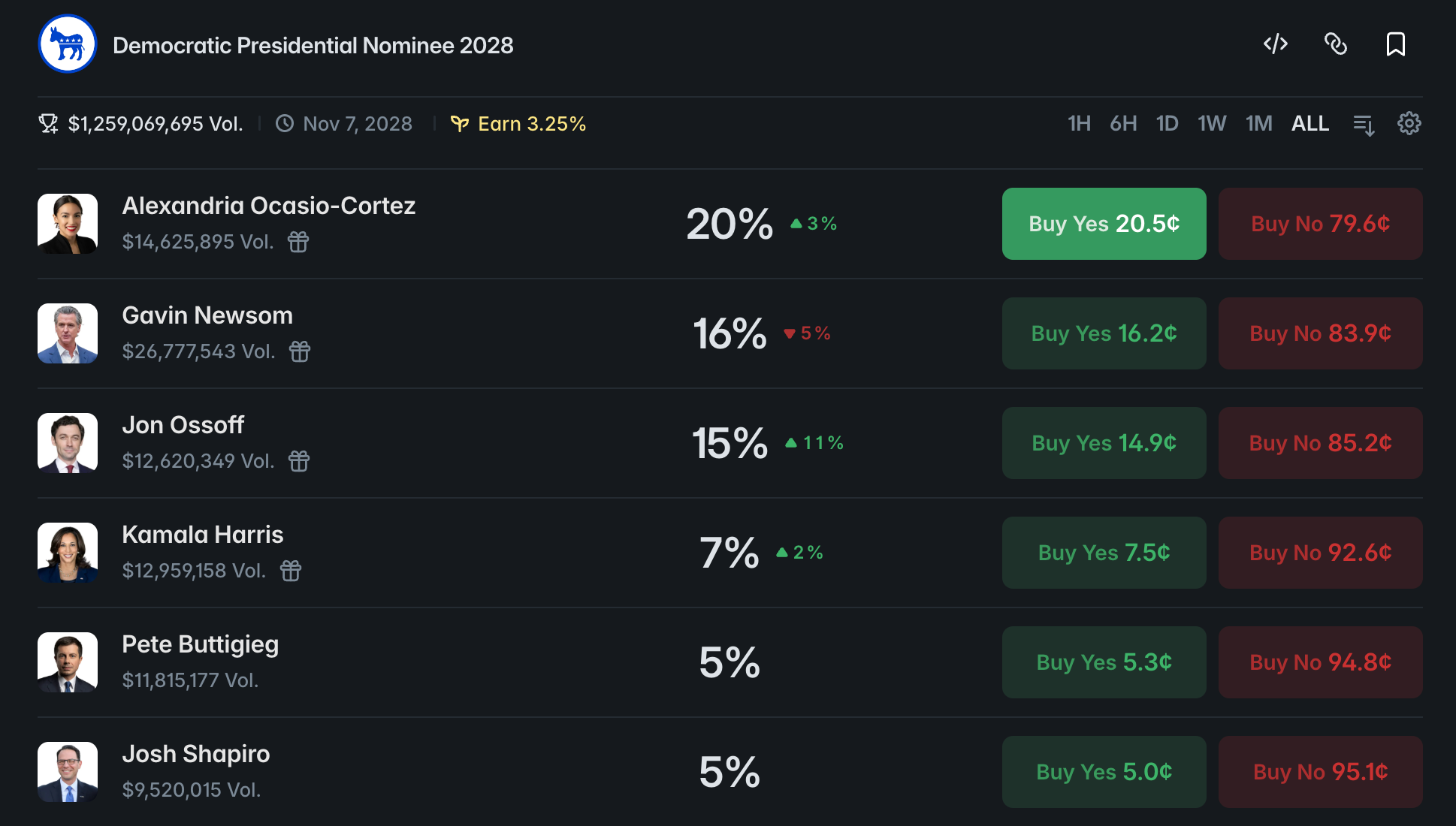
But perspective matters, too. There is a tendency on cable television to use socialist, democratic socialist, and sometimes even communist almost interchangeably. They are not interchangeable ideologies. And whatever one thinks of the DSA and its influence within the Democratic Party, its elected officials still represent a tiny fraction of the hundreds of thousands of elected positions across America.
While DSA-backed candidates had already scored several notable victories, including congressional races in New York, Pennsylvania, Colorado and Michigan, the Democratic Party is much bigger than its loudest faction.
A primary victory in a deep-blue district is also very different from winning a statewide race in Wisconsin—or a swing congressional district in Arizona, Pennsylvania or Iowa. Brooklyn is not Bucks County – or Staten Island for that matter. And in a year when control of Congress may come down to a few dozen competitive seats, that distinction matters enormously.
Wisconsin offered a useful reminder last week. State Rep. Francesca Hong, a democratic socialist who had been heavily favored in polling, appeared positioned to win the Democratic nomination for governor. Milwaukee County Executive David Crowley had actually left the race before reentering just ten days later. Then the race changed. Hong had come under scrutiny for past comments calling Thanksgiving a “colonizer holiday” that should be canceled. Crowley, meanwhile, offered voters a very different biography: he grew up amid severe poverty and family instability before serving in the Wisconsin legislature and ultimately becoming Milwaukee County Executive. Crowley pulled off the upset. Also crucial to remember, the electorate in a Democratic primary is not the electorate Democrats will face in November. A general requires a much broader appeal.
I learned that lesson firsthand in 2006. Pennsylvania’s 8th District was purple territory, and there was no shortcut to winning it. More than 2,000 volunteers knocked on roughly 160,000 doors for our campaign. We called voters, showed up at local party meetings, competed in Republican communities, and built support one relationship at a time.
It was grassroots politics in the most literal sense. We could not win by speaking only to Democrats. We had to persuade independents and Republicans, too. What Fox News doesn’t share is the fastest-growing party in the U.S. isn’t the DSA or Democrats and Republicans; the fastest-growing party is Independents. In Pennsylvania, they comprise 1.2 million voters (16%), in Michigan, 1.3 million (16%), in Texas, 2.9 million (16%).
That is the difference between winning a primary and building a coalition capable of winning a competitive race in November.
That is why I am particularly excited by some of the men and women running this year whose lives were defined by service long before they ever considered running for Congress.
In Arizona’s 6th District, JoAnna Mendoza is a retired Marine who enlisted at 17 and spent two decades serving in the Navy and Marine Corps, including deployments to Iraq and Afghanistan. She is now running in one of the most competitive congressional districts in America.
In New Hampshire, Maura Sullivan, another Marine veteran and former Assistant Secretary of Veterans Affairs, is running for an open House seat.
And today, in Florida, Democratic voters will choose nominees in several congressional races. Among them are James Pericola, running in the district that includes The Villages, and Kendrick Meek Jr., running in Miami to continue a remarkable family tradition of public service. Florida’s congressional primaries are today.
These are the kinds of candidates I believe Democrats need to keep finding: people who can talk credibly about affordability, public safety, national security and the basic competence Americans expect from their government.
It is also why we built Taking the Hill, our federal PAC supporting military and law-enforcement veterans running for Congress, and the Kennedy Democrats PAC, focused on helping Democrats compete in the parts of Pennsylvania outside Philadelphia and Pittsburgh where the party too often struggles.
Winning those places requires showing up with candidates who understand them.
Redistricting has made the House map harder for Democrats, and capturing the Senate remains a considerably steeper climb. But less than three months from Election Day, the political weather is unmistakable.
Americans are frustrated with an unpopular president who has waged an unnecessary overseas war and an affordability crisis dominating kitchen-table conversations. I have seen this movie before.
In 2006, voters decided they wanted something different and sent an unlikely group of candidates—including a 33-year-old Iraq War veteran from Bucks County—to Congress.
The opportunity is there. Now Democrats have to earn it.
Comments
Nothing yet. Say the first thing.
Sign in to join the conversation.