
Deep Dive Podcast
Audio segment produced with AI narration summarizing Patrick Madrid’s written content.
0:00
-21:06
JESUS SAID, “All who take the sword will perish by the sword” (Matthew 26:52).
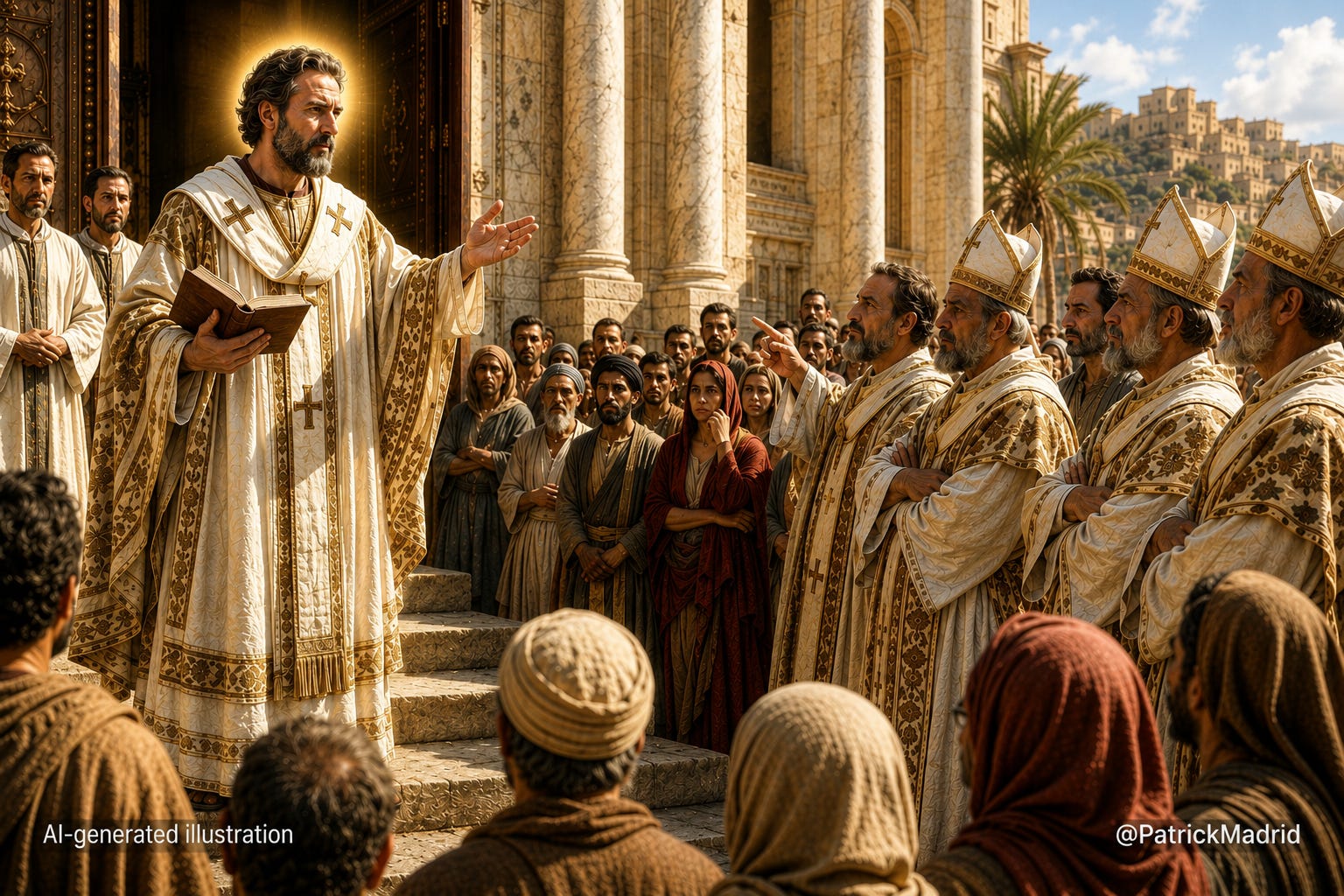
This grim edict is a fitting epitaph for the heresy of Donatism. Its roughly three-hundred-year lifespan, a rather brief one, as heresies go, was marked from beginning to end with violence and death. Yet the challenge posed by this heresy over 1,500 years ago still troubles some Catholics even today.
By the end of this article, you will understand exactly why the spiritual state of the priest (i.e., is he personally in the state of grace or the state of serious sin?) has no bearing on the validity of the sacraments you receive from him.
North Africa was roiling in political, social, ethnic, and religious controversies when, in A.D. 311-312, Donatus Magnus (c. 270-355), the schismatic bishop of Carthage, succeeded Majorinus as the rival of the validly elected bishop Caecilianus.
Donatus was a shrewd leader with impressive intellectual and rhetorical abilities. He had a skill for exploiting, to his own advantage, the ethnic unrest that simmered among the Berbers and Punics in the North African Roman provinces of Africa Proconsularis and Numidia (modern-day northern Tunisia and northeastern Algeria).
These rustic people chafed under the rule of the Latin-speaking Roman Empire, and Donatus skillfully harnessed their discontent as the engine of growth for his heresy.
The schism had gotten under way before Donatus came to power, but it became identified with him thereafter. His predecessor, Majorinus, was elected as a rival bishop in Carthage because the bishops who had elected Caecilianus had dealt leniently with the traditores, men and women whose faith had been compromised during Diocletian’s brief but bloody persecution, which began in February 303.
The Catholic Church was outlawed, and professing the Catholic faith was a crime punishable by death. Those who refused to offer incense to Roman idols were executed. Churches were razed, relics and sacred vessels were seized, and any copies of Scripture that could be found were burned.
The traditores were those who renounced Christ to avoid martyrdom or who, when their churches and homes were searched by the Roman authorities, handed over sacred artifacts rather than face death.
In light of the many who endured martyrdom rather than renounce Christ, those who survived the persecution, which ended in A.D. 305, were outraged that priests and deacons who had been traditores were allowed to resume their ministry after being reconciled to the Church through confession. This perceived injustice provoked a popular backlash with grave theological implications.
Majorinus and other leaders of this faction asserted that the sacraments were invalid, even wicked in the eyes of God, if dispensed by a traditor bishop, priest, or deacon. This view expanded to include clergy who were in a state of mortal sin of whatever sort.
By denying the intrinsic efficacy of the sacraments, the Donatists claimed that the sacraments could be celebrated validly only by those in the state of grace. They required the rebaptism of any Catholic who came over to their sect.
The Donatists had the outward forms of Catholicism, including bishops, priests, and deacons, the Mass, and the veneration of the relics of martyrs. The heresy of Donatism lay not primarily in the denial of particular Catholic doctrines but in the assertion that only “sinless” men could administer the sacraments validly.
The schism was effected by the rejection of the lawful authority of validly elected Catholic bishops and culminated in the illicit but valid ordinations of schismatic bishops, priests, and deacons.
Writing several years before Vatican II, Church historian Frederick van der Meer describes the Donatists’ implacable fanaticism:
“The Donatists behaved like embittered integralists. They claimed to be the exclusive possessors of the only pure tradition and held that duty called them to that tradition’s lone and bitter defense. Despite the fact that externally and in matters of ritual they were wholly indistinguishable from the Catholics . . . they avoided the latter like the plague, cursing their sacraments as arts of the devil and declaring the Catholic Canon of the Eucharist . . . to be a sorcerer’s formula. . . .
“With worrying emphasis they voiced their misgivings concerning an institutional priesthood. How, they asked, could an unholy man make others holy? How can the dead call others to life, how can one who is not possessed of the Spirit impart the Spirit to others by the laying-on of hands? How can the blind open other men’s eyes? . . .
“Under the leadership of the returning [Donatist] exiles they had stormed the churches and had washed them with salt water, for the ordinary water had been made unclean by the allegedly bogus baptisms for which the traditores had used it.
“They had planed off the surface of the wood from the altars and scratched away the limestone from the walls, relegated the reputedly sham sacraments of their oppressors to the dustheap, poured the oil from the lamps out of the window, burnt the books, thrown the Eucharist to the dogs, imposed the great penance on all who had partaken of the “sham sacraments,” declared all baptism and all consecrations of priests and virgins to be null and void and reconsecrated the persons concerned.”
Frederick van der Meer, Augustine the Bishop (London: Sheed and Ward, 1961), 84-85.
Donatus advanced his theology with vigor, drawing many of the common folk who were fed up with Roman imperial rule and who began to equate Catholicism with foreign domination. His organizational skills and charismatic personality attracted huge numbers to his cause. He ordained hundreds, who fanned out across Numidia to establish schismatic churches.
Van der Meer describes Donatism’s proliferation:
“It was the strangest mixture of African and Numidian particularism, early Christian idealism, and personal resentment, but the Church which it created rose up in every town and locality as a rival to the Church Catholic, altar set against altar in every neighborhood where a Catholic church was to be found.
“Everywhere at the edges of the ancient towns two great basilicas towered over the houses, one Catholic, one non-Catholic. . . . Donatism was from its inception a popular movement, poor in original ideas, but nevertheless full of people who were easily inflamed and drawing from these its principal strength. Indeed, once the leaders had got the Punic-speaking masses on to their side, no power on earth could heal the schism” (Ibid., 80-81).
The Donatists adopted Deo laudes (“God be praised”) as their slogan to counter the ancient Catholic Deo gratias (“Thanks be to God”). This was the rallying cry with which they harangued Catholics.
Another distinctive characteristic of the Donatists was their maniacal desire for “martyrdom.” Donatus taught that death for the “cause,” even death by suicide, was holy and merited a martyr’s crown and eternal life. They did their best to incite Catholics and pagans to kill them.
When their provocations failed, they sometimes took their own lives, a favored method being to leap from high cliffs with the cry, “Deo laudes!“
In his letter to the Tribune Boniface, St. Augustine recounts a bizarre, if humorous, incident involving a Catholic judge who was cornered by a group of zealous Donatists who threatened to kill him if he refused to “martyr” them. 1
Thinking quickly, Augustine says, he agreed to kill them, but only if they first allowed themselves to be bound with rope to make his work easier. Once they had been securely tied up, he left them there on the ground, and “so escaped their violence without injury to himself or them.”
(Personally, I can’t help but wonder whether the resourceful judge may have whacked them all soundly a few times with a stick before departing.)
In keeping with their penchant for violence, there arose among the Donatists a particularly vile faction known as the Circumcellions. These ruffians’ main goal was to harass, despoil, and even kill Catholics. They preyed on the cellae (farms, rural chapels, and country estates).
Although Donatus himself was not a Circumcellion, he gave tacit approval to the depredations of these roving gangs and wielded influence through them to force Catholics, whenever possible, to convert to his religion. Those who refused the invitation were promptly relieved of their property and, often, their lives.
In a letter to Victorianus, a Spanish priest, Augustine lamented,
“We too have nothing but misery here, for instead of the barbarians we have the Circumcellions, and it is an open question which is the worse of the two. They murder and burn everywhere, throw lime and vinegar into the eyes of our priests; only yesterday I heard of forty-eight helpless persons who were compelled to submit to [Donatist] rebaptism in this place” (Letter 111:1-2).
While killing Catholics was a favored pastime, the principal aim of the Circumcellions was the destruction of Catholic churches, Bible manuscripts, and sacred objects. This aroused the ire of the government, which enacted anti-Donatist laws that confiscated their property and forced their reentry into the Catholic Church. The North African Catholic bishops welcomed the first intervention, but not the second.
Originally Augustine opposed the eradication of heresy by force (cf. Letter 23), preferring argumentation to physical coercion. He believed that heresy must never be tolerated, but that heretics themselves must never be forced to join the Church. As time wore on, Augustine’s view changed as he warmed to the idea of the state having a role in the suppression of heresy after theological persuasion had failed.
He is regarded by some historians as the “Father of the Inquisition” since he became a supporter of the state’s right to suppress heresy (cf. Letter 185).
Although Optatus of Milevis was the first notable bishop to write against the Donatists in The Schism of the Donatists, it was the indefatigable Augustine who, in numerous works, almost single-handedly demolished the Donatist challenge. He gave a biblical and theological explanation of the sacraments (especially baptism, the Eucharist, and holy orders), the unity of the Church, and the evils of schism.
This energetic bishop was not content to rely solely on the pen. He engaged Donatist apologists in public debates, knowing that public disputations would draw crowds of Catholics and Donatists; the Catholics would be strengthened, and the Donatists converted. Augustine was as forceful and brilliant an orator (he had received excellent training in rhetoric during his youth) as he was an author, and even the most skilled Donatist spokesmen were no match for him.
He even composed apologetic songs designed to inculcate Catholic doctrine and refute Donatism, notes van der Meer.
“Augustine did not neglect to protect his people from the insidious effect of Donatist catchwords, and sometimes to the detriment of good artistic taste. It was probably as early as 393 that he composed an alphabetical psalm against the Donatist party for the more unlettered among his followers. This tells in very simple verses the story of the origin and development of the schism, its malice, and the only possible cure for it. . . . He wanted the nature of the Donatist issue brought to the knowledge of the simplest person and thus to stamp it into the memory of even the most uneducated” (van der Meer, 104-105).
This hymn was long (293 verses) and employed a melody and poetic meter that were popular among the common people, who were accustomed to singing similar songs (with profane lyrics, of course) in taverns and theaters. Catholics learned the hymn enthusiastically and sang it in public as a rebuke to the Donatists.
Under St. Augustine’s aggressive leadership, the Catholic Church in North Africa gradually overpowered the Donatists by force of argument. In time, entire Donatist congregations and even dioceses came back to the Catholic Church.
By A.D. 411, the Donatists were still numerous in Numidia and the rest of North Africa, but, with their theological errors so thoroughly refuted by St. Augustine, Optatus, and other Catholic apologists, their vigor waned. It would take two more centuries before they finally disappeared.
In keeping with its violent past, the last vestiges of Donatism vanished in the seventh century as its adherents were mowed down by the sword of Islam, the cry of Deo laudes! being replaced by Allahu Akbar, which heralded the Muslim subjugation of North Africa.
In its retention of all the liturgical externals of Catholicism and most of its doctrines while rejecting a single doctrine or practice, Donatism is mirrored by groups that might be characterized as rigorist. Among such groups have been the Jansenists of Port Royal (seventeenth through nineteenth centuries) and certain schismatic “Traditionalist Catholic” factions of our own time.
The Donatist heresy of rebaptism is alive in the Baptistic churches of Protestantism, although Baptists do not regard baptism as a means of grace and regeneration as the Donatists did.
The Donatist tactic of forcing Catholics to “convert” to their heresy was adopted by the Calvinists (especially under John Calvin in Geneva) and, most notoriously, by the Anglicans (under King Henry VIII, Archbishop Thomas Cranmer, and Queen Elizabeth I).
Even though the threat posed by the heresy of Donatism fizzled out some fifteen hundred years ago, flashes of it still flare up today in the form of those who claim, or at least suspect, that priests in the state of mortal sin cannot validly confect the sacraments.
“Why should I confess my sins to a man,” some ask, “who might be an even worse sinner than I am?” Others wonder, “What if the priest I go to confession to, or whose Masses I attend, is someday shown to have been sexually abusing people?”
In the wake of the Church’s terrible priestly sex-abuse scandals, especially those involving children and teenagers, the heightened concern, even to the point of suspicion, about priests’ moral fitness is understandable, even if it is not theologically well grounded.
Although St. Augustine decisively refuted the Donatists in the fifth century, St. Thomas Aquinas later explained the theological principle underlying Augustine’s argument with his customary precision. Addressing this very question in the Summa Theologiae, under the question, “whether the sacraments can be conferred by evil ministers?” he writes:
“The validity of a sacrament does not require that the minister should have charity . . . and consequently even sinners can confer sacraments.” (Summa Theologiae III, q. 64, a. 5)
He adds:
“He who approaches a sacrament receives it from a minister of the Church, not because he is such and such a man, but because he is a minister of the Church. Consequently, as long as [he] is tolerated in the ministry, he that receives a sacrament from him does not communicate in his sin, but communicates with the Church from whom he has his ministry.” (Summa Theologiae III, q. 64, a. 6, ad 2)
The reason is that the priest acts as Christ’s instrument. Christ himself is the principal minister of every sacrament. The efficacy of the sacrament therefore comes from Christ, not from the personal holiness of the priest.
This is just as pertinent for Catholics today as it was for those confronting the Donatist heresy during St. Augustine’s lifetime. The Church remains just as clear. The moral state of the priest celebrating Mass or hearing confessions does not affect the validity of the sacrament, provided the proper matter and form are used, the priest is validly ordained, and he intends to do what the Church does in celebrating that sacrament.
In other words, you do not have to wonder or worry whether the Mass you attend or the absolution you receive is valid simply because you cannot know whether the priest is in the state of grace or in the state of mortal sin.
Ironically, the heresy of Donatism perished under the violent sword of Islam even as it wrongly relied on the sword (or cliff) to perpetuate its own misguided beliefs and create new “martyrs.” The Catholic Church, on the other hand, continues to this day, and will until the Last Day, because of Christ’s promise that “Upon this rock I will build my Church, and the gates of hades shall not prevail against it” (Matthew 16:18).
Copyright © 2026 Patrick Madrid. All rights reserved. All text, images, and other original content are the property of the author. Adapted and expanded from my 1989 article “The Donatist Heresy” that appeared in the Catholic Answers newsletter.
I hope you enjoy my articles here. If so, please tap the Share button above to post any of them on X or Instagram or to send it to someone who might be interested in it. Restacking this article will also help it reach a wider audience. Thank you!
And if you enjoy thoughtful, friendly, faith related content, you’ll appreciate my daily program on Relevant Radio. Listen here or get the free Relevant Radio app.
If so, please tap the Share button above to post any of them on X or Instagram or to send it to someone who might be interested in it. And if you enjoy thoughtful, friendly, faith related content, you’ll appreciate my daily program on Relevant Radio. Listen here or get the free Relevant Radio app.
No posts
Comments
Nothing yet. Say the first thing.
Sign in to join the conversation.