
Deep Dive Podcast
Audio segment produced with AI narration summarizing Patrick Madrid’s written content.
0:00
-22:04
WHAT I’M ABOUT to share with you happened ten years before 9/11. As I write these words, that dark and hideous day, when nearly 3,000 Americans were murdered in jihadist terrorist attacks, lies twenty-five years in the past.
This chronology matters because it explains why, when a prominent member of a large Southern California Islamic center asked me point blank whether I was an undercover FBI agent, the question didn’t alarm me. It simply struck me as bizarre, almost comical.
Why would he, or the imam, even wonder such a thing? I asked myself.
As part of my work in apologetics, that is, giving a reasoned defense of Christianity, I started studying the history and beliefs of Islam so I could improve my ability to share the gospel of Jesus with Muslims and be better prepared to respond to their questions and objections about Christianity. The Trinity and the divinity of Christ are at the very top of their objections.
I had read several books on Islam, as well as a good deal of the Qur'an, and I listened to several polemical lectures on cassette tape by a South African Muslim apologist named Ahmed Deedat.
A flamboyant and entertaining speaker, Deedat devoted his apologetics almost entirely to attacking Christianity, especially the doctrines of the Trinity and the divinity of Jesus Christ. Studying his lectures gave me a solid introduction to the kinds of arguments Muslims commonly raise against Christianity. But I soon realized that books and tapes could take me only so far. If I wanted to acquire a deeper understanding of Christian-Muslim dialogue, I needed to learn from Muslims themselves. So I decided to visit a mosque in a nearby Southern California city.
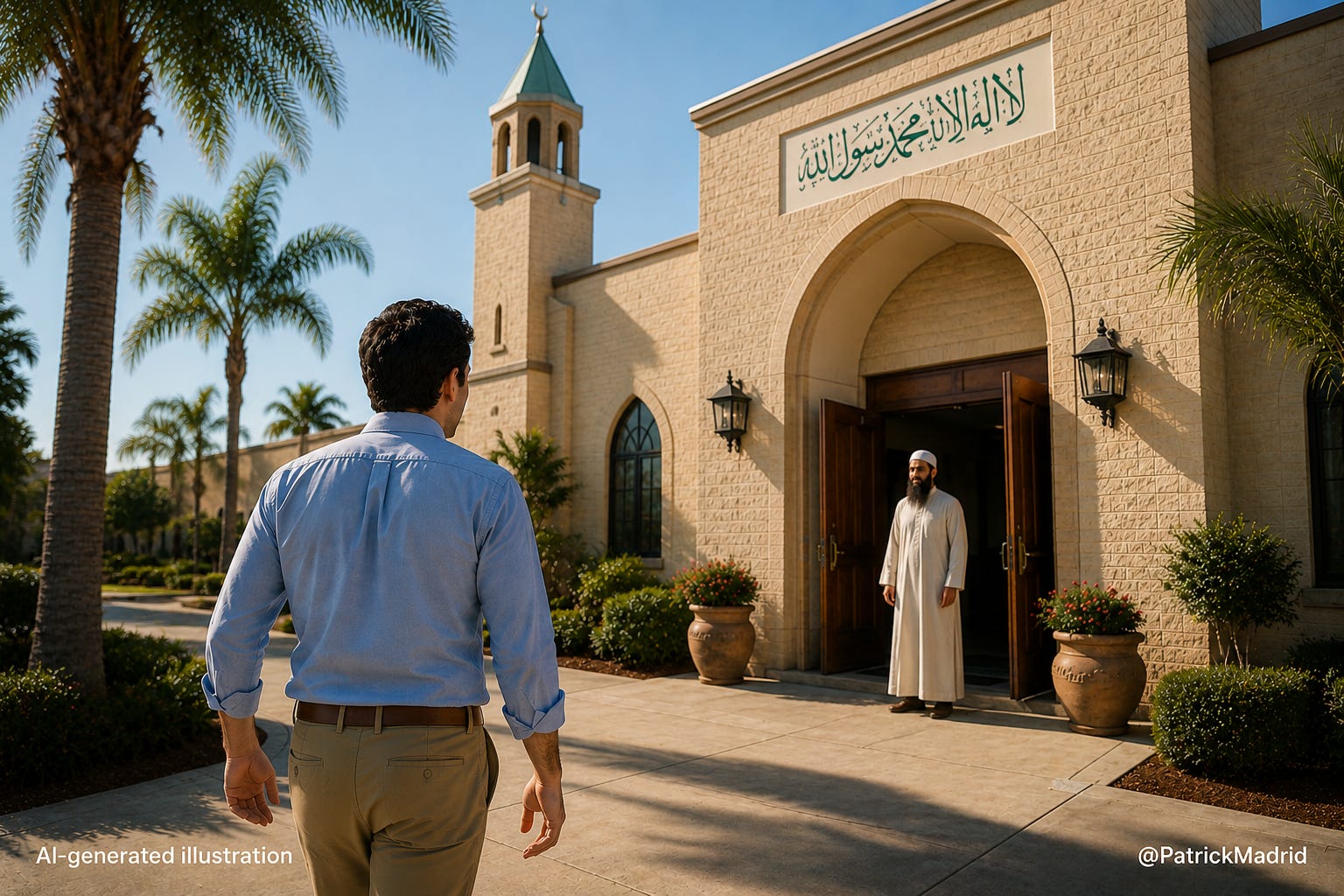
The Islamic center I chose was located down the street from a major state university. I figured I’d find there a variety of Muslims, not just Americans. But only rarely did I ever see any Westerners. Virtually everyone I saw at the Islamic center was Middle Eastern.
A bearded Arab man in his 30s wearing a long white thawb (tunic) and white kufi (hat) stood just outside the open doorway. He greeted me in good, though strongly Arabic-accented English as I approached.
“Hello, how may I help you?”
“Hi, my name’s Patrick,” I responded, smiling. “As-salam alaykum” (“peace be upon you”), one of a few Arabic phrases I had memorized in preparation for my first visit to the center.
I expected the customary response, wa alaykum as-salam, but didn’t get it.
Ahmed simply nodded, not smiling, and again said, “Hello” in a businesslike tone that conveyed more a sense of “Can I help you?” than “welcome.” I discovered later that some devout Muslims, he apparently being one of them, refrain from exchanging this Arabic greeting with non-Muslims because of religious scruples.
“I’ve never been to a mosque before,” I said, looking around. “I’m Catholic, I believe in Jesus, and I’d like to know more about Islam. I have a lot of questions.”
At this, he smiled and nodded, his guarded manner softening slightly. “Very good! I am Ahmed, and I will be happy to answer them,” he said, gesturing for me to enter.
Once inside, I explained that though I was a convinced Christian, I was curious about Islam and wanted to understand the religion better. All of this was true, of course, but I strategically omitted the part about how my specific reason for being there was that I wanted to learn how to engage in apologetics with Muslims, particularly on the divinity of Jesus Christ. I suspect that if I had mentioned that bit, our conversation would have gone in a very different direction.
That first visit to the Islamic center lasted for about an hour. Ahmed gave me a tour of the complex which, in addition to the mosque itself, comprised several large meeting rooms, a modest commercial kitchen, a dining hall, a wing of classrooms, and a special tiled room adjacent to the restrooms that was equipped with several water spigots and drains for ritual washing of face, hands, and feet before entering the mosque proper. He invited me in to observe afternoon prayers which, handily, were due to start in a few minutes.
The mosque was a large open room with a high ceiling and several tall, narrow windows. The floor entirely covered with many overlapping ornate area rugs. It was empty of furniture except for a single chair set inside a small niche in the middle of the far wall toward which those inside faced.
“That is where the imam sits during Friday prayers,” Ahmed explained, pointing to the chair.
I sat quietly in the very back, praying the Our Father and asking the Holy Spirit to enlighten me with whatever words He wanted me to speak while there. I had no clear sense of anything resembling divine guidance other than an intuition to stay alert, learn what I could, and do my best to speak the truth about Jesus clearly and persuasively if called upon to do so.
Perhaps fifty men (I saw no women) had entered the mosque. All knelt, facing the wall with the niche, toward Mecca, bowing their heads to the ground repeatedly in prayer.
Afterward, Ahmed and I spoke for another fifteen minutes or so before I thanked him and left, but not before I made an appointment to return the following week. My mind was racing with thoughts about what I had just experienced.
On my next visit, Ahmed introduced me to several Muslim men, all in their 20s and 30s, all students at the nearby university. He had probably told them about me ahead of time. They asked a few mildly challenging questions about Christianity, though some seemed genuinely curious and unaccustomed to speaking about such things with an American Catholic. These guys hailed from across the Arab world, Egypt, Kuwait, Iraq, Syria, and a few, like Ahmed, were from Saudi Arabia.
Their English was reasonably okay, though not as good as Ahmed’s, and with heavy Arabic accents. They seemed eager to explain the basics of Islam to me, with Ahmed taking the lead in our discussions, which usually were held in one of the center’s meeting rooms.
The mood was friendly and relaxed, and I asked every question about Islam I could think of, some of them intended to round out what I had read in the books and heard on the tapes I had studied ahead of time, others to see what their hot-button triggers were that would propel us into an apologetics discussion. I didn’t have to wait long for that.
At the end of my third visit, they invited me to come back to the Islamic center the following week and have dinner with them. I accepted, and when the time came I found myself seated with a dozen of them, cross-legged on the floor, as we partook of a tasty meal of lamb, rice, vegetables, and khubz, traditional Arab bread I knew as “pita.” The food was served communal style on large platters, and there were no utensils in sight. Everyone, including me, ate with his hands.
They no doubt anticipated my curiosity at the unusual seating arrangements. When I asked why they didn’t eat at a table with utensils, Ahmed explained that because Muhammad was said to dine seated on the floor using no utensils, it was customary, he said, to imitate his practice. Eating seated on the floor was, I discovered, an example of how intent (and intense) they were in their unswerving devotion to Muhammad, his teachings, and his lifestyle.
The meal conversation remained at the level of pleasantries and general discussion, with my asking many questions about Arab culture. The topic I think we all really wanted to discuss, religion, was deferred until after the meal. Then we got down to business. An intense but still friendly conversation about Islam and Christianity continued for another twenty minutes or so, after which they turned on a TV and we watched a videotaped debate between a Protestant minister and . . . guess who? Ahmed Deedat.
It was Deedat’s 1986 debate with Pentecostal minister Jimmy Swaggart at the University of Louisiana before some 8,000 people. Deedat was his rhetorically flamboyant self, but Swaggart was clearly not up to the task. I quickly realized why they wanted me to watch it. They felt sure that it clearly demonstrated Islam’s purported superiority over Christianity.
It didn’t.
My prior study of Islam, including multiple hours of Ahmed Deedat’s apologetics had prepared me for every argument that came up in the debate. As the video went on, I noticed the dozen or so Muslim men in the room glancing at me surreptitiously whenever Deedat landed one of his rhetorical zingers or Swaggart struggled to answer. My best poker face revealed nothing.
When it ended, they were anxious to know what I thought and whether I now had any doubts about my Christian faith. They had no understanding of the distinction between Catholicism and Protestantism, and had simply assumed that, as a Catholic, I would regard Jimmy Swaggart as a champion of my own beliefs. Their disappointment deepened when I told them that, in my opinion, Deedat had not only not disproved Christianity but that Swaggart was completely unqualified and unprepared for such a debate.
“But thank you for helping me understand the issues better by showing me the debate,” I added cheerfully.
That comment disappointed them even more. They clearly regarded the debate as a decisive vindication of Islam and a devastating refutation of Christianity and seemed mystified that I wasn’t bowled over by Deedat’s performance.
On a following visit, there was another meal, this time at Ahmed’s apartment, only a few blocks away from the Islamic center. I got the impression that though he may not have been technically an employee, he spent his whole time there. Doing what exactly, he never said, but anytime I showed up, he was there. In retrospect, it seems he was studying me as closely (if for different reasons) as I was studying them.
After we ate, I sat for over an hour with a group of half a dozen of them, talking earnestly, and at times a little animatedly, about our religious differences. There were plenty of those, but the main ones focused on God, Allah in Arabic.
Our conversation ended on a strained but still somewhat friendly note when, after I had explained to them at length why I believe Jesus is God, Ahmed informed me that they did not really want to hear about that. They very much wanted to convince me that not only is Jesus not God, though they do revere him as a prophet, but that I should abandon Christianity and become Muslim.
“That I could never do, my friends,” I said firmly but with a sincere smile. It had become clear that their patience with me was nearing its end.
“Why do you keep coming back here?” one of them asked me pointedly, genuinely puzzled at my persistence.
Realizing that I now needed some kind of pretext for being there if I was going to continue visiting the mosque, I enrolled in weekly Arabic classes, but I sensed that Ahmed saw that as a contrivance. It was. And I soon realized that I was the only non-Muslim studying basic Arabic there.
One evening as Ahmed and I were walking slowly out to the parking lot, continuing our discussion about God, he stopped, his brow furrowed. Without trying to finesse things, he said:
“The imam is becoming concerned about your visits. He wonders why you keep coming back here even though you don’t show any signs of embracing Islam.”
An awkward moment hung between us.
“Well,” I responded, “I’m sincerely trying to learn. Is that a problem?”
“I want to ask you a direct question,” he replied. “And I hope you will give me a direct answer.”
I nodded.
“Are you an FBI agent?”
“What?!” I exclaimed with a laugh. “No, of course I’m not from the FBI! I’m just a guy with questions.”
But it was clear from the look in his eye that he wasn’t convinced. Looking at me closely, he said, “There is some concern that perhaps . . . ” He paused for a moment. “ . . . that perhaps you have been trying to gather information about this mosque.”
Holding his gaze, I responded calmly: “I assure you that that’s definitely not the case, Ahmed. I am not FBI or any other kind of government agent. I just want to know more about your religion.”
I learned a great deal from the experience, things that have helped me over the years since then to be respectful and understanding whenever I’ve had a chance to talk about Jesus with Muslims. It also taught me how important it is for Christians to know Jesus Christ: who He is, why He died for our sins, and why He truly is God and truly man.
No argument raised against those truths can overturn them.
In the end, my visits to that mosque did exactly the opposite of what my Muslim acquaintances had hoped. They didn’t weaken my Christian faith. They strengthened it.
Ten years later, though, when 9/11 happened and our grieving and outraged nation was riveted on the emerging details about the attackers and their network of accomplices and enablers, I thought a lot about Ahmed’s suspicions about me. His abrupt, quasi-confrontational “Are you an FBI agent?” demand made a lot more sense to me. 1
I’m not accusing him or the imam of that mosque of having any part in the terror attacks. Would any of them have been sympathetic? I will never know, though my hope is that they would not have been.
But now, twenty-five years after 9/11, I can see why they were wary then and, in the imam’s case, suspicious about my real reasons for showing up at the mosque to “talk” as often as I did. Back in 1991, though, as I pulled out of the parking lot for the final time, I wondered how my sincere interest in learning about Islam had somehow led to suspicion bordering on paranoia about my visits.
I never returned to the Islamic center and never saw Ahmed again. It was clear that my presence there was no longer welcome. I did, though, gain the deeper understanding of Islam that I had sought.
In one sense, I was indeed there undercover. Not as an infiltrator or a spy looking for evidence of terrorist activity. I was completely truthful about who I was: a Christian, a follower of Jesus, who sincerely wanted to understand Islam better. What I had not told them was why. My purpose in coming to the mosque was to learn firsthand how to engage more effectively with Muslims when sharing the truth about Jesus Christ.
“For though I am free from all men, I have made myself a slave to all, that I might win the more. To the Jews I became as a Jew, in order to win Jews; to those under the law I became as one under the law, though not being myself under the law, that I might win those under the law. To those outside the law I became as one outside the law, not being without law toward God but under the law of Christ, that I might win those outside the law. To the weak I became weak, that I might win the weak. I have become all things to all men, that I might by all means save some.”
1 Corinthians 9:19-22
Copyright © 2026 Patrick Madrid. All rights reserved. All text, images, and other original content are the property of the author.
I hope you enjoy my articles here. If so, please tap the Share button above to post any of them on X or Instagram or to send it to someone who might be interested in it. Restacking this article will also help it reach a wider audience. Thank you!
And if you enjoy thoughtful, friendly, faith related content, you’ll appreciate my daily program on Relevant Radio. Listen here or get the free Relevant Radio app.

What I didn’t know then was that the FBI had indeed begun investigating radical Islamic networks in the U.S. following jihadist violence such as the 1990 assassination of the controversial rabbi Meir Kahane. The assassin, El Sayyid Nosair, was later convicted of seditious conspiracy in the federal terrorism trial connected to the 1993 World Trade Center bombing. Osama bin Laden helped fund his legal defense. None of that was on my radar screen then, but it may well have been on the imam’s.
No posts
Comments
Nothing yet. Say the first thing.
Sign in to join the conversation.