
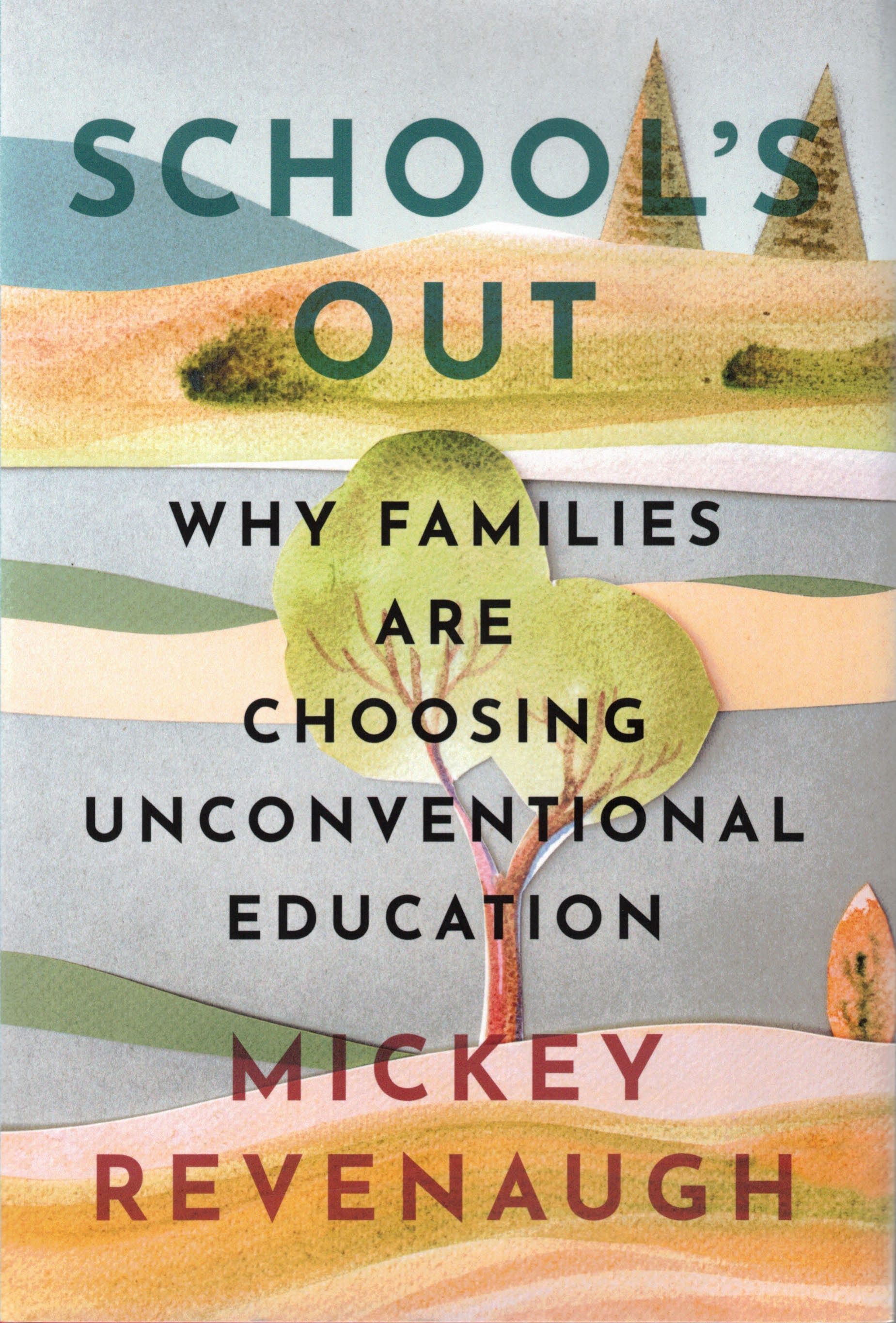
This book is about the many varieties of teaching and learning that exist outside of conventional school walls that have emerged from local roots and are now being cultivated by a number of families and entrepreneurs. Author Mickey Revenaugh, an education journalist and cofounder of an online learning company, writes:
Through more than 100 interviews, 100,000 miles of travel, and innumerable hours spent crouched down for a kid’s-eye view of learning as it happens, I’ve come to believe that this phenomenon of unconventional education will have—already is having—a significant impact on our education system. Driven in large part by a grassroots army of recovering classroom teachers, entrepreneurs, and especially parents and kids, this multiplication of options outside the traditional classroom is changing what we expect our local school districts to offer and how we remix our time from a strict separation of school and home and community into an everything DIY (do-it-yourself) blend.
The book’s descriptions of Black and Brown homeschoolers, neurodiverse learners and families, and online education are timely and interesting. Its description of the growth of homeschooling and how it nurtured the growth of various schools and online services is valid to a point. That point is, as often happens when the word “education” enters the discussion, that many families decide to homeschool not because they want to purchase or learn the best methods for teaching their children, but to provide a unique family life, celebrate their personal beliefs, find new friends, activities, games, learn by helping out and pitching in to help others, being around different ages and types of people and experiences than one meets in a standard classroom. A child’s local community, people in the flesh before them, becomes an important part of growing up in this scenario. But consumer choice seems to be the goal for school reform throughout this book, not a complete rethinking of the goals and means of modern education.
Parents might be guided by navigators or counselors through a shopping mall of curriculum and scheduling and learning-style options. Their choices would embrace a new porousness between in-school and out-of-school, public and private, allowing kids to collect “stackable” credits from all over. Mastery transcripts would capture what a student actually knows and portfolios showing what they can do, not just what they memorized for a test.
In an April 2025 paper subtitled Designing Schools as Community Hubs Within a Personalized Ecosystem, researchers at Getting Smart foresee a future in which traditional school buildings, emptied out of declining enrollment, are repurposed to his “school as a service.” In this vision, school is no longer a place but instead a network of co-authored experiences stitched into purposeful pathways linked to opportunity.” With the right supports and guidance in place, students at these repurposed schools could learn both from online experts and “place-based” resources in their community—as envisioned by RESCHOOL Colorado and others—while enjoying the social connections that come with congregating regularly under one roof with their peers.
I appreciate the attempt to envision a new school system, and I do like the concept of “place-based” resources for people to teach and learn in their local communities. But the devil is in the details: Who determines what credits a student needs for a job and how much they are worth to a prospective employer? Schools have increased the credits and courses needed to graduate but has more schooling made better employees? We need clear answers from employers about the reasonable expectations they have for employees put in clear language, and fair, dynamic performance tests/simulations, to determine if they can do the job rather than relying solely on a diploma. Education Week, March 2026, sums it up well:
We asked executives what skills young workers are missing? Students need to learn:
—How to solve problems
—Manage conflict
—Be curious
It’s hard to see how school’s reflexive response to this—increase time on task, intensive tutoring, and pressure to score high on tests—addresses the skills gap identified by employers.
School’s Out ends with a look at the impact artificial intelligence might have on education. The podcaster Michael Horn (Future of Education/Class Disrupted) is quoted:
“In a world where the half-life of skills is shrinking and the nature of work is constantly shifting, the idea that we can codify a fixed curriculum—‘learn this, and you’ll be prepared’—starts to feel crazy. … Every single one of the stakeholders is like, ‘This ain’t working.’”
Whether the future will be defined by an AGI big bang or a rapid stream of smaller AI-driven changes, advocates argue that kids in unconventional education will be all prepared for the world before them. Having “learned how to learn” anytime and anywhere under their own steam, imbued with an avid curiosity not extinguished by years of traditional classroom “sit and get,” they enter the AI-transformed world specially equipped with resilience, flexibility, and self-direction.
There have been school reform movements ever since compulsory schooling was founded, but somehow the result of those reforms has been more schooling, just as the solution for AI seems to be that we must accept more AI. I believe that people with resilience, flexibility, and self-direction will refuse to be cowed by AI and its promoters and instead see it as a tool for us to use as needed, rather than a tool to further the goals of the AI company.
Revenaugh starts her book with an overview of the funding mechanisms that allow some families to afford unconventional schooling—Education Savings Accounts/ESA, federal tax credits, and microgrants—but doesn’t discuss the negative aspects of these mechanisms, such as reduced public school funding and the capture by the wealthy of the tax breaks and outlays for attending charter schools that lower income families can’t leverage which have been noted in Arizona and other states. The concept of a commonwealth of learning is not examined as much here as the business of learning is. Indeed, many of the homeschoolers, unschoolers, and road schoolers described in the book are families who use public resources, and barter or share their skills, knowledge, and childcare to nurture children’s learning.
School’s Out is a broad overview of the many educational options available to families today, but the deeper issues wrought in the battle between unconventional and conventional schooling still need to be addressed. This book can be a start towards that discussion.
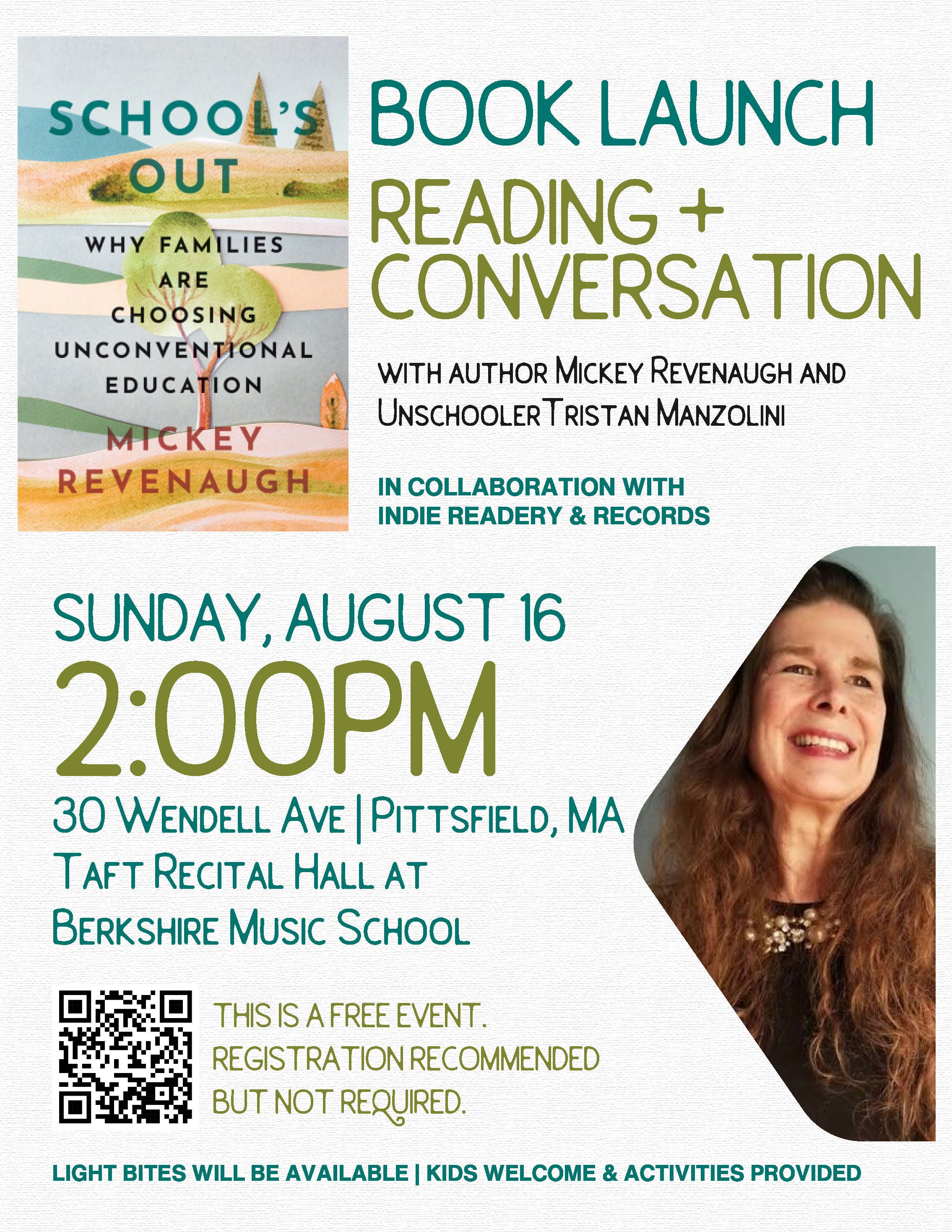
FYI: If you’re in Western Massachusetts you can meet Mickey Revenaugh at her book launch on August 16.
Comments
Nothing yet. Say the first thing.
Sign in to join the conversation.