
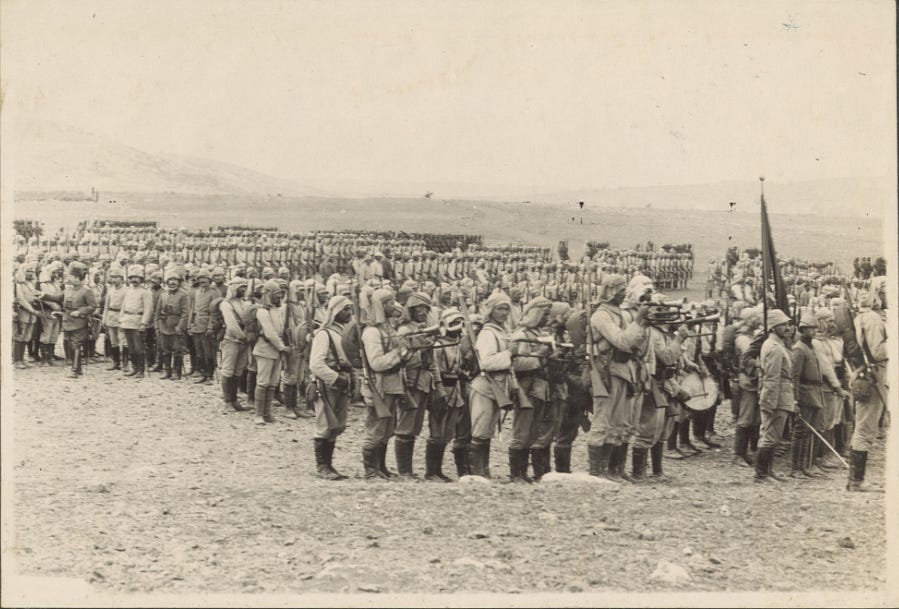
The destruction of the Ottoman Empire in 1918 has been examined extensively by historians who seek to identify how and when it precisely came apart. At its height in 1683, it controlled just over 2 million square miles of territory, including territory that today lies in Ukraine, Yemen, Algeria, Slovakia, and Iraq. By 1914, it had shrunk to around 700,000 square miles and was barely able to provide basic services to much of the periphery of the empire. It became beholden to whichever country was willing to provide it support in its various conflicts: Britain and France during the Crimean War or Germany and Austria/Hungary during the First World War. Not for nothing did it become known as the “Sick Man of Europe.”
However, the Ottomans still proved to have significant military capabilities in their waning years and could attain significant military victories. In 1897, Ottoman forces devastated the Greek Army in Thrace, almost marching on Athens. In 1913, Enver Pasha’s army retook the city of Edirne after it had been lost in the 1st Balkan War. Some of these victories created a false sense of security amongst the Young Turk regime, now dominating Constantinople. The new leaders of the Empire after the 1908 Revolution became convinced that they had infused new life into the structure of Ottoman society and that they could become a modernized, capable military. The destruction of much of the Ottoman military during WWI was a direct consequence of the CUP (Committee of Union and Progress) ignoring structural failings in the Empire’s ability to fight on several wide-ranging fronts.
In my prior article, I talked about how South Africa’s conscription program was too exclusionary and that it contributed to the fall of Apartheid. The Ottoman Empire’s conscription policies were also deeply flawed, but for a variety of different reasons. Firstly, the military’s attempt to put everyone under arms proved to be disastrous when it led to severe labor shortages in farms and industries. Secondly, Ottoman abuses of their men and supply crises led to a soaring rate of desertion. Lastly, the Ottoman decision to persecute non-Muslim minorities (culminating in the genocide of Christians) forced the Porte to allocate troops to internally policing the empire and deprived the military of much-needed educated and qualified manpower. These three contributing factors doomed the Ottoman war effort as much as their military defeats and decision to align with the Central Powers did.
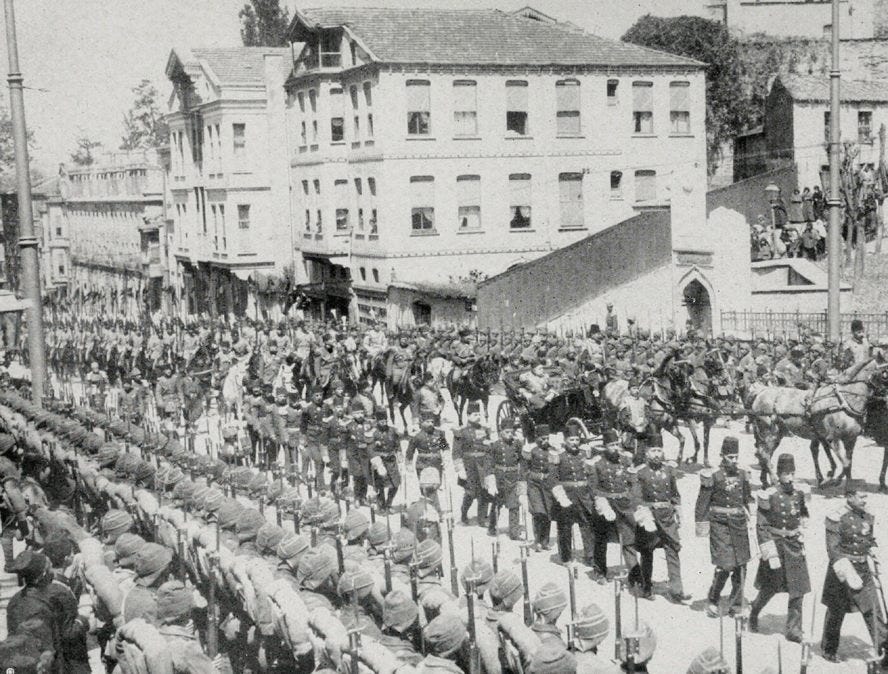
Throughout its long history, the Ottoman Empire had utilized a wide variety of measures to man its military. Mobilization and conscription practices varied: sometimes the military relied on a partial mobilization or used a predominantly volunteer force. By 1914, Ottoman conscription regulations were governed by the Temporary Law for Military Service. This law created a regional conscription model that was more centralized than the prior mobilization infrastructure. Additionally, it lowered the minimum draft age to 18 and raised the maximum age to 45. Conscripts could be allocated to two different categories (this mainly applied to the army): armed or unarmed. Unarmed units were used for labor and logistics purposes. Armed units were required to have no more than 10% non-Muslims in the ranks. Previously, a man who was the sole breadwinner was exempt from mandatory service. The law abolished this, promising families 30 piasters instead. Lastly, the law did leave in place some restrictions on recruiting the relatives of the Ottoman elite, but it did allow for the conscription of criminals and recent refugees, specifically Balkan and Caucasus Muslims who hadn’t been living in Anatolia for very long.
The Ottomans had felt that the previous rounds of mobilization, involving a lottery system called the Kura, had denied them the necessary manpower to win the Balkan Wars or the 1878 Russo-Turkish War. Therefore, they aimed to do a total mobilization right at the onset, notwithstanding the potential costs of such a policy. Smaller peacetime units were bolstered by swathes of newly conscripted men, swelling the army from just over 200,000 men to over 500,000. The navy (and later air force) did not rely as much on mobilization, but they required manpower too as the war ground on. The way that mobilization (Seferberlik) worked was as follows: mukhtars or Ottoman government officials maintained detailed lists of every male between 18 and 45. These men were ordered to respond to a recruitment office within 3 days. From there, they were transported to a training facility, where they were supposed to receive at least 2 years of training (infantry) or 3 (other arms/branches). In reality, the intensity of the fighting meant that Ottoman troops were often given just a few weeks of weapons training and spent much time marching to the front carrying heavy loads. The lack of munitions, professional officers, and the proliferation of threats on the Empire’s borders meant that the training cycles weren’t conducted as planned. To fill leadership gaps, the CUP government called upon German and Austrian officers to help and high school students were often given “officer-candidate” status.
Abuse was rife during and after training. The lack of railroads crisscrossing the Empire meant that Ottoman troops often had to march with all of their equipment. Any man who fell out of column while marching was attacked by an officer or NCO. A common practice was beating a man on the soles of his feet, known as Falaka. Going AWOL could lead to the offender being imprisoned for a long period of time or executed on the spot. Leave was rarely granted due to the Empire’s manpower shortages. As a result, desertion rates soared, especially when the writing was on the wall. The Defense Ministry issued three separate general amnesties to convince deserters to return to their units, but they failed to stem the flow. Matters weren’t helped by the fact that the mobilization’s exemption policies contributed to major social rifts in Ottoman society. Much of the population of Constantinople, Mecca, and Medina was not mobilized at all because the Porte didn’t want to lose its administrative backbone or fuel unrest in the cities. Mullahs, religious students, and senior civil servants were typically protected from the draft to ensure the continued functioning of the state and religious institutions. Despite some efforts to close loopholes, the Empire still accepted 50 lira payments as exemptions from wealthy families to avoid serving. Even in the best of times, the authorities in Constantinople were chronically short of money, so the exemption fees were still needed to help the Porte maintain a budget.
During the war, the European militaries were typically able to conscript or recruit around 10%-20% of their populations to fight. Despite the passage of the 1914 law and the total mobilization declared in August of that year, the Ottomans were only able to get 4% of their population to take up arms from 1914 to 1918. In villages throughout the Arab territories of the empire, mukhtars helped local men evade service. As the food situation got worse, the Porte agreed to release a lot of the Mehmetçiks from service to tend their fields. The census of 1914 was outdated and didn’t include a lot of young men in Bedouin or Kurdish tribes. Only a small portion of the Empire’s citizens were properly educated, creating shortages among specialized troops. Many Ottoman units, already strained due to poor logistics, proved unable to supply and feed a lot of their men. While the Ottomans did manage to mobilize around 2.9 million throughout the whole war (peak strength was ~800,000 men in 1915-1916), their attempt at mass mobilization exposed significant cracks in the Empire’s war effort.
Sources:
https://encyclopedia.1914-1918-online.net/article/pre-war-military-planning-ottoman-empire/
https://encyclopedia.1914-1918-online.net/article/mobilization-ottoman-empiremiddle-east/
Ibid
https://nzhistory.govt.nz/war/ottoman-empire-facts
https://encyclopedia.1914-1918-online.net/article/mobilization-ottoman-empiremiddle-east/
https://www.geschkult.fu-berlin.de/en/e/mwme/essays/german-ottoman/_Stein_German_Soldiers_O_Emp/index.html
https://nzhistory.govt.nz/war/ottoman-empire/turkish-soldier-experience#:~:text=If%20their%20upbringing%20left%20the,shelter%20and%20clothing%20%E2%80%93%20were%20met.
https://encyclopedia.1914-1918-online.net/article/between-acceptance-and-refusal-soldiers-attitudes-towards-war-ottoman-empire-middle-east/
https://encyclopedia.1914-1918-online.net/article/civilian-and-military-power-ottoman-empire/
https://encyclopedia.1914-1918-online.net/article/war-finance-ottoman-empire/#:~:text=12-,Taxation,the%20tax%20on%20rak%C4%B1%20production.
https://encyclopedia.1914-1918-online.net/article/civilian-and-military-power-ottoman-empire/
https://encyclopedia.1914-1918-online.net/article/mobilization-ottoman-empiremiddle-east/
https://www.thecollector.com/ottoman-empire-world-war-i-overview/
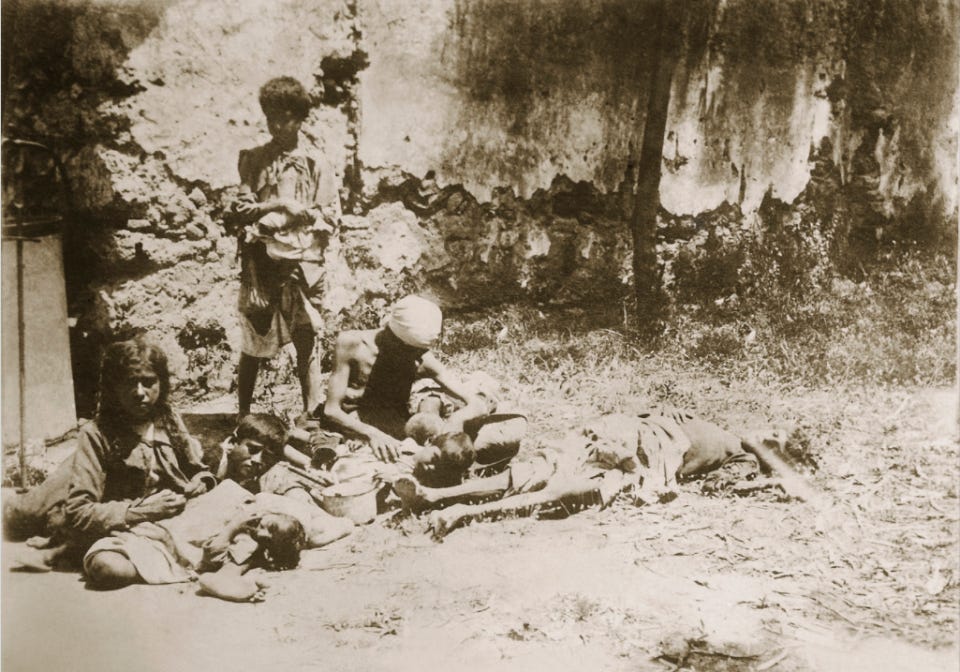
Despite its size and longevity, the Ottoman Empire was one of the least industrially developed governing entities on Earth at the time. Large swaths of the Empire were geographically cut off from the imperial heartland in Anatolia. Despite the claims by CUP officials that they sought to modernize the Empire, they largely failed. By 1914, transportation links were still woefully underdeveloped and much of the Empire’s debt was controlled by European creditors. A sizable portion of the economy was agricultural and human and animal labor was a crucial element of production and distribution (in lieu of the necessary machinery). The Empire had dealt with famines and shortages before due to a variety of reasons: natural disasters, poor harvests, and inefficient bureaucracy. What transpired in the Empire during WWI was a worse food-related catastrophe than any of these prior crises and was largely man-made due to the decisions of the Three Pashas.
The Ottoman decision to mobilize as many young and middle-aged men as possible in 1914 ensured that many farming families were deprived of the manpower that they needed to keep up the growth and distribution of crops on their lands. Due to the exemptions policies and the fact that many Anatolian or Arab urban dwellers were not conscripted, a disproportionate amount of the Ottoman military’s rank-and-file came from rural households. Inevitably, chronic food shortages began to afflict the empire’s subjects. The Allies blockaded most of the Ottoman coastline, meaning that external food shipments could only be transported overland through the Balkans. The military, trying to get as many men and horses as possible to the front, monopolized control over the railways, which they often denied to food producers trying to get their crops to the markets they were accustomed to selling to. In 1915, Palestine, Lebanon, and Syria were hit with a terrible locust plague that devastated much of the fertile farmland in the region. In many of the affected areas, 60% to 100% of summer and autumn harvests (fruits, vegetables, legumes, and fodder) were completely devoured. Even in Anatolia proper, food shortages were severe, though not as fatal. Wheat production in Anatolia fell by roughly 40%, and high-value exports like olive oil and raisins dropped by more than 50%. The government’s attempts to buy crops using the heavily depreciated lira caused hoarding and hindered the centralization of food distribution.
The Empire belatedly tried to address the shortages by ordering the civilian population to destroy as many locust eggs as possible and creating the Central Food Supply Committee, which implemented rationing. However, the Defense Ministry refused to release many of the men they had mobilized to work on their farms. As a result, desertions began to climb, especially among men from the most devastated areas of the Empire. Units stationed in Anatolia proper were likely to be better fed than those in Arabia, Palestine, or the Caucasus, generating resentment. Labor battalions were often treated callously, leading to tens of thousands of men’s deaths. This undermined the ability of the Ottomans to improve their transport networks, further hindering supply chains. Black markets flourished in cities and many Ottoman officials from the Finance and Interior Ministries were implicated in smuggling and profiteering schemes.
The death toll from the food shortages throughout the Empire is not known exactly because Ottoman record-keeping was notoriously poor. What is beyond a doubt is that the suffering was immense, especially in the Arab vilayets of the Empire. Over 200,000 Lebanese died, predominantly Maronite and Greek Orthodox Christians, in the Mt. Lebanon Mutasarrifate. This was thanks to the deliberately genocidal policies of Djemal Pasha, who cut off food transportation to the area. In Greater Syria, Palestine, and Iraq, hundreds of thousands more died. The Ottoman leadership did not much care about the cost, figuring that the residents of the Arab vilayets were expendable anyway. It did, however, contribute to the unravelling of the Ottoman Army.
Sources:
https://www.tandfonline.com/doi/full/10.1080/19448953.2023.2167180?needAccess=true
https://scholarworks.smith.edu/cgi/viewcontent.cgi?article=1016&context=env_facpubs#:~:text=Page%204,%2C%20and%20technological%20dis%2D%20junctures.
https://repository.digital.georgetown.edu/handle/10822/760795
https://www.palestine-studies.org/sites/default/files/jq-articles/JQ_56-57_The_1915_Locust_0.pdf
https://encyclopedia.1914-1918-online.net/article/food-and-nutrition-ottoman-empiremiddle-east/
https://www.theworldwar.org/sites/default/files/2024-04/famine-disease-ottoman-empire-wwi-lesson-presentation.pdf
https://turkeyswar.com/economy/feeding-the-population/#:~:text=In%20January%201915,%20Kemal%20Bey,to%20cultivate%20a%20minimum%20area.
https://encyclopedia.1914-1918-online.net/article/labour-battalions-ottoman-empiremiddle-east/
https://www.history.ox.ac.uk/article/how-hunger-shook-europe-and-the-ottoman-empire-after-world-war-i#:~:text=And%20how%20did%20being%20hungry,a%20story%20about%20everyday%20people.
https://www.washingtoninstitute.org/policy-analysis/armenian-genocide-maronite-starvation-and-lessons-past-atrocities
https://encyclopedia.1914-1918-online.net/article/war-losses-ottoman-empiremiddle-east/
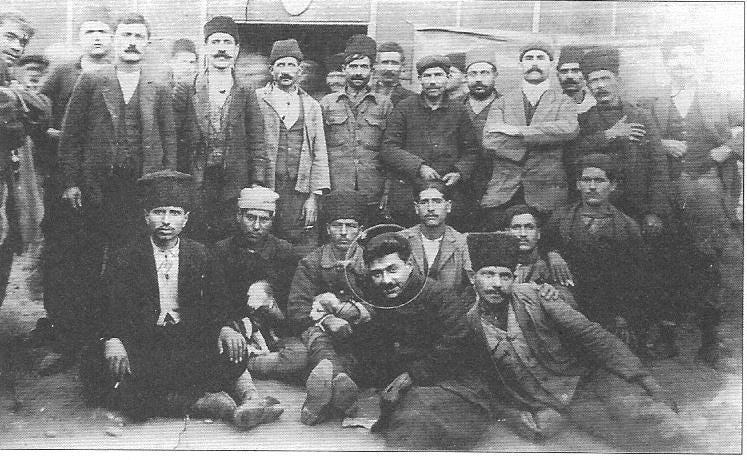
Historically, the Ottomans had been reluctant to call upon non-Muslims to serve in their military, except for the practice of conscripting Christian boys to serve as Janissaries. This ended in 1909 after the Young Turk Revolution, in which the new government announced its intention to conscript non-Muslims in the same capacity it recruited Muslim men. There were supposed to be no restrictions on how Christians and Jews could serve and they could become officers if they wanted to. However, significant distrust was pervasive among the Ottoman officer corps towards non-Muslims, especially Christians. The catastrophe at Sarikamish against the Russians in 1915 convinced much of the Ottoman High Command that Christians and Jews were effectively a fifth column. The CUP was a believer in Pan-Turkism and thought that non-Muslims were a threat to the unity of the Empire. Thus, on February 25th, 1915, Enver Pasha issued Directive No. 8682, which ordered the disarming of all Christian and Jewish members of the military (Druze were the only unaffected non-Muslim group in the Empire’s military). These men were ordered into labor battalions to work on infrastructure projects for the military. This was a stepping stone towards the Ottoman genocide of Christians.
Service in the labor battalions was one of the most hellish experiences of the war. Instead of being treated as specialized engineers or logistics troops, the men in these units were treated as slaves by Ottoman commanders. They had to dig tunnels and roads with little machinery. Most men were intentionally underfed and overworked. Often, the infrastructure they worked on was of negligible value; the cruelty was the point. These battalions were largely located far from their men’s homes so that the deportations of Christians (and Jews in Palestine) could be done with less resistance. In many cases, once a project was completed, the men in the work detail were rounded up and shot just so that Ottoman commanders did not have to feed them.
For much of Ottoman history, its Christian and Jewish populations were among the most productive sectors in society. They were largely better educated and wealthier than the median Ottoman Muslim. In theory, they could have been a crucial component of the Turkish war effort. Notwithstanding the chronic social tensions within the Empire, many Christians and Jews argued that they were true Ottoman patriots and most welcomed the 1908 Revolution. However, a lethal cocktail of stupidity, tribalism, and arrogance meant that the CUP did not take advantage of their talents. Instead, it effectively waged war on its own minorities. Tens of thousands of Christians and Jews were killed while serving in the labor battalions, with some battalions having a death toll approaching 90%. At any given time during the war, there were between 70 and 120 labor battalions, with a total fluctuating strength of 25,000 to 50,000 men at a time, meaning the total number of men who passed through (and died in) these units over four years was significantly higher than the standing total.
By mid-to-late 1915, the Empire was purging and destroying most of its Christians, except in the cities of Smyrna and Constantinople. Arranging for the deportations and killings of these people required a lot of manpower and greatly strained Ottoman resources. At times, resistance from Armenians and Assyrians drew in thousands of Ottoman troops, such as the Siege of Van. To avoid diluting frontline units of their necessary manpower, the Ottomans turned to tribal militias, gendarmes, and a paramilitary organization largely composed of released criminals called the Teşkilât-ı Mahsusa (Special Organization). Nonetheless, Ottoman units were still relied upon to help with the CUP’s nefarious plans. Just like how the Holocaust diverted resources from Germany’s war effort, the Ottoman genocide of its Christians strained its manpower and resources.
Sources:
https://www.cambridge.org/core/journals/international-journal-of-middle-east-studies/article/abs/conscription-of-greek-ottomans-into-the-sultans-army-19081912/0DED8F1A8C7519E9FF28EF694892ED36
https://milwaukeearmenians.com/2015/01/04/battle-of-sarikamish/
https://encyclopedia.1914-1918-online.net/article/labour-battalions-ottoman-empiremiddle-east/
Ibid
https://neareastmuseum.com/exhibit/the-genocide/massacres-and-death-by-forced-labor/
https://armenianweekly.com/2021/04/21/the-class-struggle-in-the-ottoman-empire-and-the-armenian-genocide/
https://www.opendemocracy.net/en/two-revolutions-young-turk-and-arab-spring/
https://neareastmuseum.com/exhibit/the-genocide/massacres-and-death-by-forced-labor/
https://davekopel.org/NRO/Genocide-resistance-Armenia.html
https://encyclopedia.1914-1918-online.net/article/teskilat-i-mahsusa-ottoman-empire-1-1/
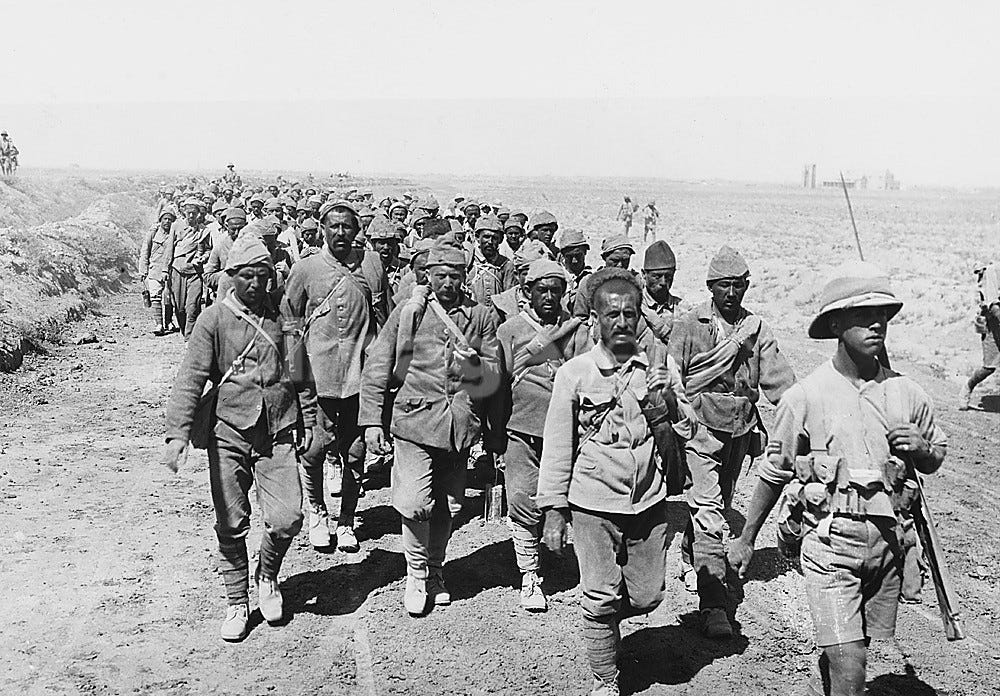
Throughout the war, the Ottoman military was plagued by horrendously high desertion rates. As mentioned above, a mixture of abuse of enlisted men and the food/supply crises meant that desertion rates steadily rose as the war ground on. By 1918, desertion had become an existential crisis for the Porte. Conservative estimates suggested that around 500,000 Ottoman servicemen were AWOL by 1918, close to 20% of the mobilized force. Some estimates suggested that as many as 1,000,000 men were reporting for duty. This was only exceeded by the Russian collapse in 1917, which saw over 1,000,000 men vanish from their units when the Tsar and Kerensky’s governments collapsed. Many Ottoman units were severely understrength: by 1918, the Ottoman 3rd Army in the Caucasus only had 20-30% of its authorized strength due to desertions and losses. By the Armistice of Mudros in 1918, a mere 330,000 men were still in uniform, a far cry from the near-1,000,000 men at the army’s height in 1915. While there weren’t large-scale mutinies like the Kiel Mutiny or the Bulgarian Army march on Sofia, the flood of men abandoning the fight proved fatal to Ottoman war planning.
What exactly led to such an exodus? The Ottomans were certainly involved in some very intense battles, but no more so than other militaries. The deficit of trained officers had been addressed by accepting the support of the German and Austrian military missions early in the war. Additionally, much of the Empire was physically untouched by the fighting. What precipitated such a massive flight of armed men was the fact that the Ottoman war machine was a creaky institution that could not handle such intense pressure in far-flung areas for a long time. When the famines and locust plagues began in 1915, many Ottoman soldiers who were the main breadwinners in their households fled to help their families stay fed. The Porte had previously allowed a large contingent of men to stay home as long as they could help maintain the harvest. The CUP was not prepared to address the possibility that mobilizing such a large number of men right at the onset of war could create a significant supply chain crisis. Many of the men who deserted due to the food crisis brought their rifles with them and formed small gangs to stop army and police units from seizing the crops without compensation. These bands, known as firari, became a significant impediment to Ottoman control over many of its Arab vilayets. Even when the Porte offered several amnesties to stem the flow, desertion rates remained astronomically high.
One issue that plagued many militaries in WWI was the fact that a lot of ethnic groups subject to conscription by certain countries were often reluctant to fight. For the Ottomans, it wasn’t just the Christian and Jewish soldiers that were abused and murdered; Arab Muslim soldiers often felt ostracized by their Turkish commanders and comrades. The CUP long believed that Arabs were primitive people who needed to be made to accept Turkish hegemony. Djemal Pasha had Arab nationalists hanged from the city square in Damascus to try to send a message to any Arab who wished to rebel against the Porte’s authority. This backfired; the British were able to convince thousands of Arabs to rise against the Ottomans in what became known as the Great Arab Revolt. When the rebels stormed across the Arabian Peninsula, their ranks were bolstered by Ottoman deserters, who were aggrieved towards their Turkish masters. While the total number of Arabs in the Ottoman military remained very high, fewer and fewer of them fought each year and the rebels led by King Faisal and Sherif Hussein were able to convince many Arabs in Ottoman uniform to defect to their ranks. Additionally, the Ottoman failure to stem locust plague and food shortages convinced a lot of Arabs that they were nothing more than cannon fodder for the Porte, especially as these crises disproportionately affected the Arab vilayets.
Sources:
https://encyclopedia.1914-1918-online.net/article/between-acceptance-and-refusal-soldiers-attitudes-towards-war-ottoman-empire-middle-east/
https://turkeyswar.com/campaigns/caucasus/
https://encyclopedia.1914-1918-online.net/article/ottoman-empiremiddle-east/
https://encyclopedia.1914-1918-online.net/article/disease-and-public-health-ottoman-empiremiddle-east/
https://encyclopedia.1914-1918-online.net/article/making-sense-of-the-war-ottoman-empiremiddle-east/
https://academic.oup.com/edited-volume/28170/chapter/213011909
https://www.nytimes.com/1915/11/22/archives/rebel-turk-for-armenians-djemal-pasha-orders-two-of-their.html
https://awayfromthewesternfront.org/campaigns/egypt-palestine-syria-arabia/arab-revolt/
https://journals.sagepub.com/doi/10.1177/0968344513494658
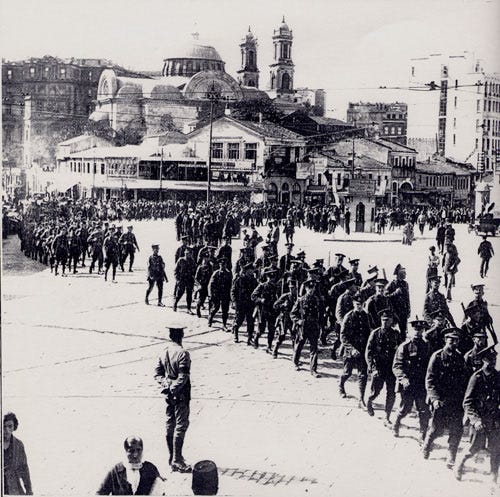
The Ottoman Empire’s demise was a brutal and violent process. Over a period of several centuries, the Porte lost control over large swaths of territory in Europe and North Africa. All the while, it suffered from significant internal political turmoil, with palace coups being a common occurrence and revolts on the periphery. Efforts at reforming the Empire’s creaky bureaucracy were insufficient and its finances were in arrears. Additionally, the flood of Muslim refugees from the Balkans and the Caucasus (muhacirs) strained the system even more. However, the Empire still had significant military capabilities that enabled it to fight hard. When Allied troops landed at Gallipoli, they were stunned at the ferocity of the defenders, who proved to be more lethal than Allied commanders anticipated. The destruction of Major General Sir Charles Townsend’s garrison in Kut (modern-day Iraq) was one of the worst British disasters of the war. Ottoman Mehmetçiks were tough men who could fight hard, especially on the defense. Yet, their sacrifices proved to be for nought. The Porte’s mobilization model, designed to overcome the disadvantages of the Ottomans’ previous wars in the Balkans, exemplified the incompetence that was pervasive among the Ottomans’ leadership and bureaucracy.
The Ottoman Empire faced similar challenges to other empires at the time when trying to allocate its resources and manpower. While it had a large pool of men available to conscript, only a very small portion of them were educated. The lack of industry in the Empire meant that much of the goods produced were agricultural. Taking men away from their farms when the Porte knew that the Allies planned to blockade all Ottoman-controlled ports was a colossal act of folly. Making matters worse, the Ottomans didn’t attempt to allocate men to certain roles based on their previous talents. Specialization did take place in military academies, but most Ottoman troops weren’t eligible for them. Men who had no qualifications for artillery and engineering work were assigned to those roles. Certain specialist positions could have been filled by Jewish and Christian servicemen, but the Ottomans abused, wasted, and, in the case of the Christians, murdered many of them. There was no military logic to the Ottoman decision to attack some of their own minorities. But logic was not the strong suit of the CUP during the war.
When Turkey fought the Entente occupation in the War of Independence, it faced many of the same issues. But by this point, they were better led and aided by interior lines of communication in Anatolia. Additionally, they were more efficient at preventing desertion by relying less on Arab and Kurdish troops to bolster their ranks. Fighting on their home turf was a strong motivating factor. Men were less likely to desert when they knew that their families’ lives and national sovereignty were at risk. Anatolia did not face the sweeping food shortages in the early 1920s that plagued the rest of the Empire during World War I. While the army did commit gruesome atrocities against Christians, as the Ottoman military had done, it did so after the heaviest fighting was over, not in the middle of the war. The differences between how Kemal Atatürk and the Three Pashas ran their respective war efforts were night and day. If the Ottoman Empire had a coroner’s report when it ended, it would have listed many causes of death, with its failed mobilization being one of the biggest ones.
Postscript: My third article in this series is about the Ottomans’ arch-rival, the Tsarist Empire, and its similar failure to effectively mobilize its manpower. These two entities, while being fierce foes, were mirror images of each other in their failings and weaknesses.
No posts
Comments
Nothing yet. Say the first thing.
Sign in to join the conversation.