
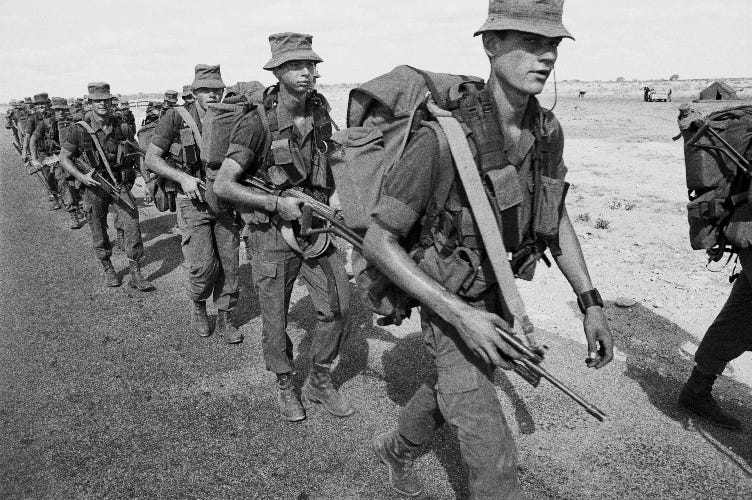
During the Cold War, the South African military was considered one of the most lethal forces on the African continent. It conducted combat operations in multiple theaters, invaded its neighbors with relative ease, and outperformed militaries that vastly outnumbered and outgunned it. In the Battle of Cuito Cuanavale, a few thousand South African troops in support of the Angolan UNITA movement managed to halt a major offensive of Angolan government forces backed by the Cuban Army and the Soviet Union. In one day, South Africa’s Air Force bombed three separate African capitals and devastated ANC (African National Congress) strongholds in each of the cities bombed. The military had a reputation as being tactically very capable and utilized some of the most effective artillery systems in the world at the time. Yet, by 1994, the SADF (South African Defense Forces) was disbanded and Apartheid was no more. The South African Border War was considered a defeat and South Africa’s new military would come to be dominated by veterans of the “struggle” loyal to the ANC. How could a military formerly considered a top-tier fighting force fold against enemies it outclassed and outgunned?
Much has been written about South Africa’s struggle for democracy and the struggles faced by victims of the regime. Something that is often not understood outside of the country, however, is how South Africa’s national security strategy in the Apartheid years, called “Total Onslaught”, effectively cannibalized the state. South Africa insisted that its white male population do mandatory military service starting in 1967. The burden of service fell on a small sliver of the country’s total population, notwithstanding the willingness of some nonwhite people to join the military or police. As resistance to conscription increased and South Africa came under sanctions and embargoes, the model that the state pursued began to fail, culminating in the National Party’s agreement with the ANC and the transition to majority rule.
Conscription can serve several purposes for states. The most obvious one is ensuring that militaries are always properly manned. Another one is creating a common experience for people to share that reinforces national identity. These two purposes definitely resonated with the South African political establishment. However, the main purpose behind conscription in South Africa was to maintain control. Military service meant that white families effectively had to give up their men and boys to the state so that they could defend apartheid regardless of whether or not they supported the system. The National Party (the ruling party from 1948-1994) wanted South Africa’s white population to understand that they had a stake in whether or not Apartheid existed. People could not be apathetic about the future of white rule if their families’ lives were on the line, so the logic went. However, it should have been plainly obvious to even the most diehard supporters of Apartheid that making military service mandatory for only a certain portion of the population was a disastrous venture. This failed strategy played just as much a role in the National Party’s decline as the township uprisings and the international campaign against Apartheid. It also offered an excellent example of how selective conscription models can cause governments to fail.
Long before South Africa gained independence in 1910 and the passage of the Defense Amendment Act of 1967, different forms of mandatory military service existed in South Africa. The Afrikaner republics, known as the Transvaal and the Orange Free State, required all white men who were citizens to join commandos, irregular cavalry units. The British, in control of the Natal and Cape regions, also mobilized local white men for military service to fight unrest in their colonies. The Zulu, Ndebele, Swati, Sotho, and Xhosa tribes all mobilized large portions of their manpower for periods of conflict. The Zulus, with their amabutho system, institutionalized the practice as they sought to displace rival tribes across the southern tip of Africa.
Upon its creation, the Union of South Africa (which became a republic in 1961) registered white men for potential mobilization but did not enforce conscription for decades. Even during WWI and WWII, the government did not dare try to forcibly mobilize its white population because there was still significant anger among Afrikaners over the British conquest of their lands. When the Apartheid system was set up after the 1948 general election, South Africa’s security chiefs did not require mass-mobilizing white men to deal with the country’s security threats. The country’s borders were mostly secure, the ANC and SACP could be handled by the police and security services, and much of Africa was still ruled by the European powers. Additionally, the major communist powers were not yet supporting any major insurgent activity against South Africa. However, South Africa began to face significant security challenges starting in 1962. That year, SWAPO (Southwest African People’s Organization) announced that it would wage an armed revolution to create an independent state in what is today Namibia. Small teams of guerrillas infiltrated over the border and began attacking police stations and border posts. When SWAPO began securing aid from the Organization of African Unity and several Eastern Bloc governments, the South Africans began to realize that they were facing threats on several fronts that were bound to get more dangerous.
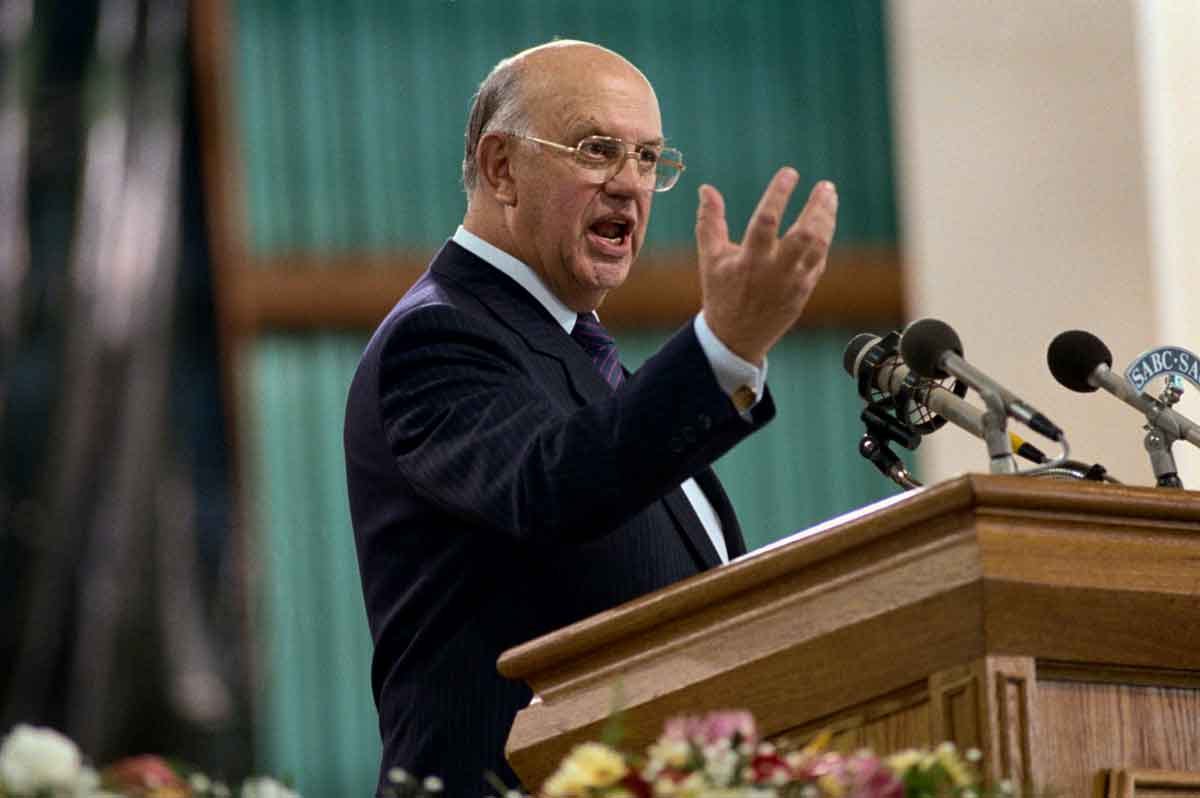
Initially, the South African Police were the primary force responsible for addressing attacks by ANC and SWAPO militants in South Africa and Namibia. However, the military began to deploy troops to assist the police when it became clear that they were under a lot of strain. As the military realized its ranks were woefully understrength to assist the police, calls grew for the creation of a full lottery system for all white men. Defense Minister P.W. Botha was the main advocate for this in the cabinet and Prime Minister B.J. Vorster supported him. Thus, on June 9th, 1967, the Defense Amendment Act (Act No. 85) was passed. Surprisingly, almost all of South Africa’s Parliament, including much of the opposition, supported the passage of the bill, fearing that communist movements were plotting to overthrow the state. With the passage of the bill, the annual intake of recruits in the SADF grew from 10,000 men to 25,000 men per year. Initially, conscripts were supposed to do nine months of active service followed by nine years in the reserves (if you were in the Citizen Force) or 19 years (if you were in the Commando Reserves). The introduction of conscription proved a turning point in South Africa’s national security strategy. From then on, tens of thousands of South Africans were sent to war zones all around southern Africa.
Sources:
https://www.angloboerwar.com/unit-information/boer-units/1953-boer-forces?start=1
https://ditsong.org.za/en/amabutho-akwazulu-the-royal-patronage-since-the-pre-shakan-era/
https://mg.co.za/article/2018-05-29-remembering-south-africas-catastrophe-the-1948-poll-that-heralded-apartheid/
https://sahistory.org.za/article/south-west-africa-peoples-organisation-swapo-organisational-timeline
https://sahistory.org.za/dated-event/military-service-becomes-compulsory-white-south-african-men
Ibid
https://omalley.nelsonmandela.org/index.php/site/q/03lv01538/04lv01828/05lv01829/06lv01925.htm#:~:text=It%20is%20the%20product%20of,(Riley%201991:%2098).
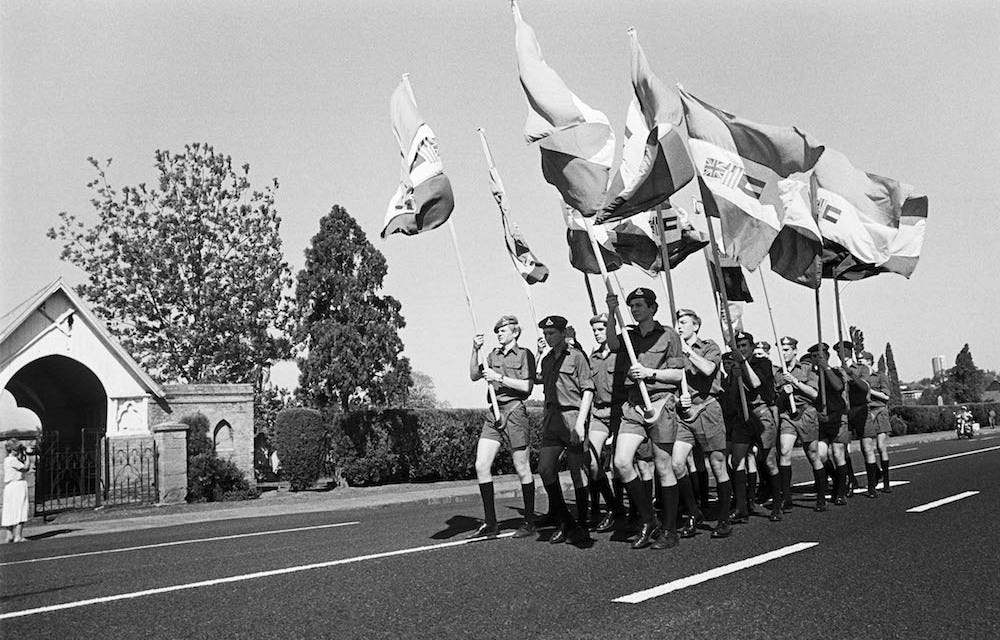
The process that young South Africans went through when being conscripted was intense and often brutal. Most troepies were conscripted right after high school and sent off to a series of depots where they underwent a harsh training regimen. On the day they were assigned to go to their respective training facilities, they gathered at a predetermined point (like the Expo Center in Johannesburg) and headed out by train. Any refusal to answer a summons could lead to the military police arresting the evader and bringing them to a court-martial. Based on their skills, they were sent to either the Army, Navy, Air Force, or Medical Services. The Army received the largest number of new recruits and, therefore, had a larger network of bases and camps.
Basic training took place over a period of 12-13 weeks. While it was considered effective in preparing men for battle, it was dehumanizing and left serious scars on South Africans who had to undergo it. Regardless of their native language, instructions were given to recruits in Afrikaans in the Army (the Navy and Air Force had more Anglophone commanders). Drill sergeants and junior officers aimed to break down the men in their charge so that it was easier to order them around. Recruits were forced to perform extreme physical exercises, like leopard crawling over sharp gravel or running miles in full combat gear with heavy rifles held above their heads, until they vomited or collapsed from heat exhaustion. Physical assaults were common. When men were about to ship out to their respective commands after finishing training, they were allowed to abuse new intakes. Political training was also mandatory to weed out “weaklings and liberals”. If soldiers were found to be gay, sympathetic to the ANC or communism, or unwilling to do certain tasks, they could be transferred to Ward 22, a notorious medical facility where the staff conducted experiments on patients. It was truly a brutal experience, which was fully exposed by former conscripts during the Truth and Reconciliation Commission Hearings held after Apartheid ended.
After basic training ended, recruits were often sent to specialized schools for whatever their next tasks were. Then, they were deployed to their respective areas of operation. Initially, service was nine months long, followed by reserve duty in the Citizen or Commando Forces. In 1972, it was extended to twelve months. After 1977, SADF conscripts spent two full years in uniform before transferring to the reserves. If a troepie wanted to stay in the service full-time after their period of mandatory service was done, they became part of the Permanent Force. Theoretically, young men could get a deferment if they were studying, but that meant they still had to do their service later on. Certain exemptions were made for men who would not agree to fight for religious reasons, but they were still expected to serve. Whites in Namibia were also conscripted, even though South Africa’s control over the territory (and thus its right to conscript its residents) was legally dubious. In 1980, South Africa even attempted to conscript all military-aged males in Namibia regardless of their race, something they did not dare attempt in South Africa proper. This backfired as the government effectively violated its own conscription laws and few nonwhite Namibians who received summons agreed to show up to their assigned posts. From 1967 to 1994, South Africa drafted over 600,000 men from all over the territory it controlled. Additionally, tens of thousands of black, South and East Asian, and mixed-race South Africans volunteered for service, notwithstanding the racism of the system they were defending.
For the average troepie, military service varied greatly. Some, especially in the special forces or Air Force, got to undertake missions that were legendary (long-range air raids or sabotage missions in Angolan ports). Others spent much of their time doing menial work. As South Africa’s security situation deteriorated, service became much uglier. Men who were on active service or mobilized as reservists found themselves fighting in intense combat in Namibia, Angola, Rhodesia, or South Africa’s own townships. Casualties steadily increased, as did anger about the lack of an appropriate resolution to the conflict from white families. The pay was not great; conscripts earned anywhere between R2.00 and R5.00 per day, depending on their rank and year of service. If they stayed in the Permanent Force, they got R1,000+ per month by the 1980s. While they were well-equipped and backed by a formidable array of firepower, many of them were not psychologically prepared for the intensity of the fighting. The SADF did not provide any form of psychological care for its men, which caused significant issues in the future with PTSD afflicting veterans of the wars. Being stuck in ditches fighting SWAPO, MPLA, or ANC insurgents, flying combat missions against the Cuban Air Force in Angola, or manning checkpoints in the townships was a draining and life-altering experience that came to define a generation of South African youth.
Sources:
https://humanities.uct.ac.za/apc/run-army-how-one-man-evaded-conscription
https://theconversation.com/the-lingering-unspoken-pain-of-white-youth-who-fought-for-apartheid-46218
https://digitalcollections.sit.edu/cgi/viewcontent.cgi?article=4517&context=isp_collection
https://www.trc-inquiry.org.za/wp-content/uploads/2025/11/The-Aversion-TRC-Report.pdf
https://journals.sagepub.com/doi/10.1177/0907568220922877#:~:text=Furthermore%2C%20Msila%20(2007)%20points,service%20(Evans%2C%201989).
https://www.trc-inquiry.org.za/wp-content/uploads/2025/11/The-Aversion-TRC-Report.pdf
https://sabctrc.saha.org.za/originals/finalreport/volume4/html/BMvolume4_s1ch8.htm
https://www.saha.org.za/the_militarisation_of_the_south_african_state.htm
https://www.cia.gov/readingroom/docs/CIA-RDP86T00589R000200150006-4.pdf
https://theconversation.com/the-lingering-unspoken-pain-of-white-youth-who-fought-for-apartheid-46218
https://www.samvo.international/copy-of-border-war-casualties-1
https://www.researchgate.net/publication/12043387_TheAversion_Project_-_Psychiatric_abuses_in_the_South_AfricanDefence_Force_during_the_Apartheid_Era
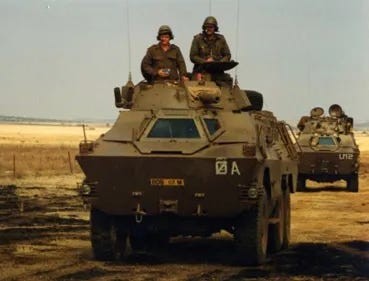
Until the late 1970s-early 1980s, South Africa had relatively little difficulty in dealing with the threats posed to the government. The ANC’s leadership was in prison or in exile. Newly independent African states were largely too weak and consumed with their own problems to seriously challenge Pretoria’s might. And South Africa was not yet a target of international boycotts and divestment campaigns. Working closely with the governments of Rhodesia and Portugal, South Africa managed to keep its adversaries at bay.
However, the end of Portuguese rule in Africa in 1974 and the collapse of Ian Smith’s government in Rhodesia in 1980 proved to be devastating to South Africa’s security situation. The Portuguese had kept the communists at bay in Angola and Mozambique and Rhodesia had created a buffer zone of minority rule on South Africa’s longest border. Now, ANC and SWAPO militants could cross into South Africa and Namibia more easily. In 1975, the Organization of African Unity developed a network known as the Frontline States, a collection of countries and militant groups that would seek to undermine Apartheid. This network gained formidable backing from the Soviet Union, China, the Eastern Bloc, and Cuba. Meanwhile, South Africa’s backing weakened with the UN Arms Embargo declared in 1977 (a voluntary one was passed in the General Assembly in 1963; the second one was mandatory). South Africa’s image of “stability” was shattered with the crushing of the Soweto Uprising in 1976, an event that led to thousands of young men and women joining the ANC’s armed wing (MK) and led to more calls for sanctions on the republic. From 1978 to 1989, the South African state found itself in combat with no fewer than five militant groups, all of whom had external backing, and the Cuban military. It was a dangerous state of affairs.
Theoretically, a strong, well-led country with a lot of resources could have handled the multitude of threats faced by the South African government. Revolutionary France in the 1790s and Israel from the 1940s to the 1970s were able to defeat an array of enemies (both conventional and unconventional) that outnumbered and outgunned them. South Africa did have a formidable military industry and a well-organized military and security force. However, the manpower issues got worse and worse every year. By the mid-1980s, South Africa was capable of calling up 58,000 men per year through conscription (not including Permanent Force regulars or nonwhite volunteers). By 1986, 82,000 men were on active duty, stretched all over South Africa, Namibia, and Angola. Some 30,000 were stationed in Namibia or Angola, taking heavy casualties from SWAPO and the Angolan MPLA, both of whom got more firepower and support from their allies as the war went on. In 1983, South Africa also began to deploy troops into its own townships because the police were overwhelmed by the sheer number of armed insurgents operating there. During the 1986 National State of Emergency, the combined presence of active-duty soldiers, regular police, and reservists patrolling urban areas frequently exceeded 80,000 to 100,000 personnel at any given time. This was an enormous amount of manpower that could not be sent to the border areas. During the biggest battle of the Angola war in Cuito Cuanavale, the SADF could only spare a few of their maneuver battalions, meaning that they could not break through the enemy lines. When Cuba threatened a major invasion of Namibia, South Africa issued a general call-up of reservists, placing a major strain on the economy. South Africa’s white community was exhausted, and the military proved incapable of gaining a decisive victory on all fronts by the late 1980s.
It is commonly believed that White South Africans were universally in favor of Apartheid and willing to fight in the regime’s defense. In reality, while most White South Africans accepted Apartheid and conscription as a fact, a growing number of eligible men fled the country or joined the left-wing militias fighting the state. Military service was arduous and felt unending because of the many years of reserve service required after a conscript's tour of duty ended. The inability of the government to obtain strategic gains through military force disheartened even the most conservative elements of the White population. Resistance to the draft skyrocketed in the 1980s. In 1983, the End Conscription Campaign was formed after a resolution by a pacifist women’s organization known as the Black Sash. The organization’s numbers boomed even after President PW Botha banned the group from existing. Many South African artists created songs, such as “Hou My Vas Korporaal”, to appeal to White youth and convince them not to join the military. These efforts had an effect. Estimates from anti-conscription activists suggest as many as 10,000 men fled into exile over a 15-year period specifically to avoid the draft. By 1985 alone, the number of non-reportees surged to 7,589. This was part of an exodus of South Africans that led to the liberal Progressive Federal Party (which opposed the Border War and the deployment of troops to townships) being nicknamed the “Packing for Perth” party. It became clear to SADF commanders and National Party politicians that South Africa was facing a significant manpower crisis that was undermining the state’s ability to deal with the multitude of threats it was facing. Even when increasing the recruitment of nonwhite servicemen into the ranks, Pretoria could see that the writing was on the wall.
Sources:
https://open.uct.ac.za/handle/11427/21147
https://www.aamarchives.org/history/front-line-states.html
https://digitallibrary.un.org/record/66633
https://www.epsjournal.org.uk/index.php/EPSJ/article/view/18
https://www.routledge.com/Politics-and-Government-in-African-States-1960---1985/Duignan-Jackson/p/book/9781032319599
https://www.saha.org.za/into_the_states_of_emergency.htm
https://sahistory.org.za/article/battle-cuito-cuanavale-1988
https://tribunemag.co.uk/2024/08/how-cuba-helped-end-apartheid-at-cuito-cuanavale#:~:text=The%20siege%20dragged%20on%20inconclusively,SADF’s%20hopes%20for%20military%20victory.
https://scholarship.law.vanderbilt.edu/vjtl/vol22/iss1/2/#:~:text=Much%20to%20South%20Africa’s%20chagrin,total%20intolerance%20of%20conscientious%20objection.
https://sahistory.org.za/article/end-conscription-campaign-ecc
https://antiapartheidlegacy.org.uk/heritage-arts-culture/history/articles/part-a-freedom-songs-the-role-of-music-in-the-anti-apartheid-struggle/
https://www.upi.com/Archives/1990/12/01/Draft-dodgers-return-from-exile/8667660027600/#:~:text=’Military%20service%20in%20the%20SADF,needs%2C’%20the%20report%20said.
Life in a battleground. For the Monitor's correspondent, a year in South Africa has revealed glimpses of hope and helplessness. One example: the ret... - CSMonitor.com
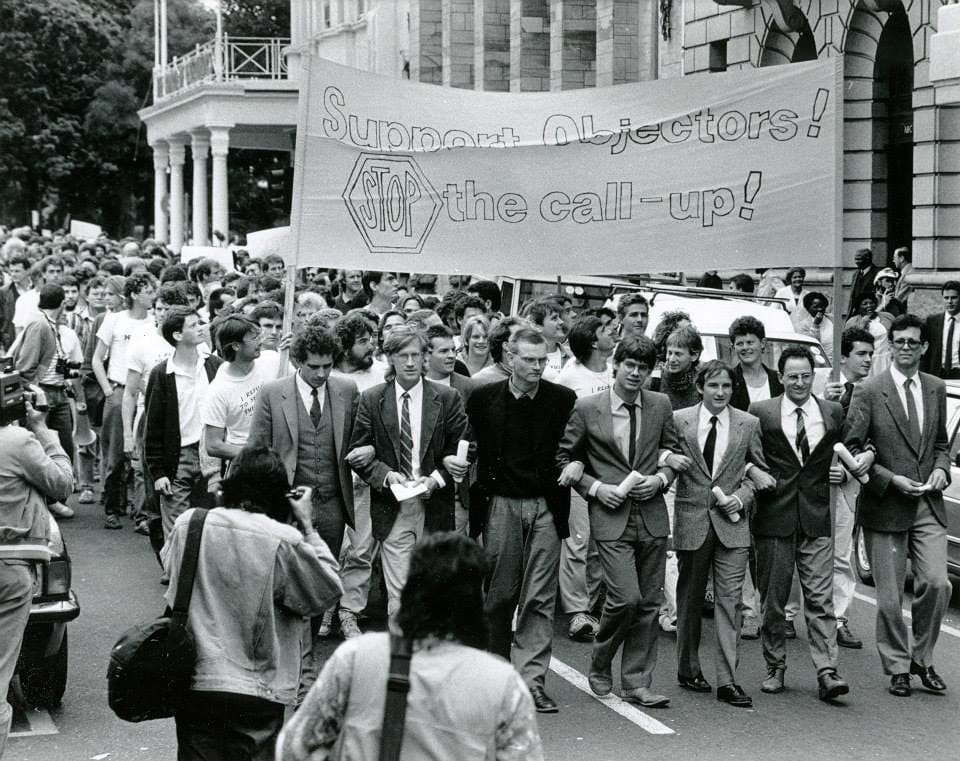
By 1989, SADF and police units were in the process of withdrawing from Namibia and Angola, turning over the future of that region to the UN-mandated peace process. Pretoria was eager to try to stop the explosion of violence affecting South Africa’s streets and hoped to use the army for this. At the same time, the government of President FW de Klerk was involved in sensitive negotiations with the ANC and hoped to maintain a strong hand at the negotiating table. Having the military and security services on hand meant that de Klerk could insist on a smooth transition to majority rule, as opposed to the views espoused by hardliners on both the left and right.
However, the instability in South Africa (largely a result of the National Party’s attempts to pit different African nationalist groups against each other) was at its worst since the Second World War. Making matters worse, South Africa’s economy was in a tailspin. As such, the defense budget had to be cut by 40% over a period of four years due to the unsustainable debt that the wars had incurred. Personnel costs dropped to, leading to questions about how large the military could be. While most SADF units were still operational, the increased draft dodging and refusal by reservists to join their units were making it much harder for the military to operate. In the final call-up of July 1993, the military summoned 12,000 young men, but only 2,600 reported for duty.
When de Klerk’s government banned the ANC in 1990, Pretoria began to scale back its call-ups for military service. The draft became more selective and South African units began to operate more like peacekeepers in their own land, as opposed to being used as a counterinsurgency force or for supporting police raids in the townships. Mandatory service was reduced by one year. Some South Africans who had fled the country to avoid being conscripted started to return as it became clear that Apartheid was in its final throes. On August 24, 1993, Minister of Defence Kobie Coetsee announced the official abolition of white male conscription. The final intakes were accepted at the end of that year. Additionally, a full moratorium on prosecutions for not responding to call-ups was enacted in August 1994, shortly after Nelson Mandela took office. When the SANDF (South African National Defense Forces) was birthed out of the amalgamation of the ANC, SADF, and other paramilitary groups, none of its men or women were conscripted to serve. The end of conscription was tied intrinsically to the dominance of the National Party. Its ending symbolized the turning of the page in that country’s history.
Sources:
https://sahistory.org.za/dated-event/last-remaining-sa-troops-have-been-withdrawn-namibia
https://www.nelsonmandela.org/omalley/cis/omalley/OMalleyWeb/03lv02424/04lv03370/05lv03405.htm
https://www.nytimes.com/1990/07/25/world/across-south-africa-shattering-days-of-violence.html
https://www.scielo.org.za/scielo.php?script=sci_arttext&pid=S2224-00202024000100004
https://www.nytimes.com/1993/08/25/world/south-africa-ends-conscription-of-whites.html
https://omalley.nelsonmandela.org/index.php/site/q/03lv02424/04lv02730/05lv03188/06lv03200.htm
https://www.nytimes.com/1993/08/25/world/south-africa-ends-conscription-of-whites.html
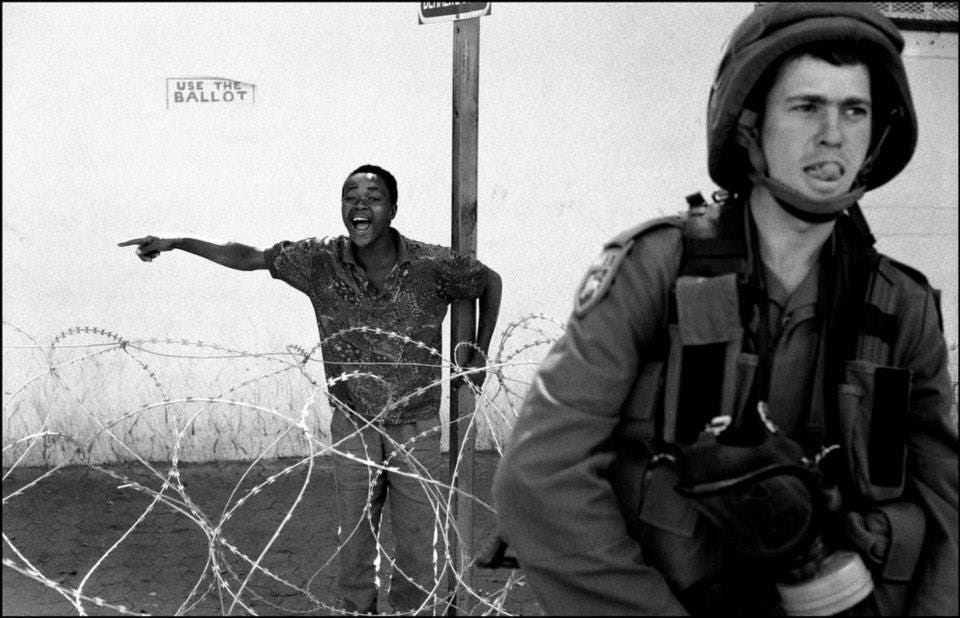
The idea of a country only conscripting certain ethnic or racial groups seems outlandish in today’s world. If the purpose of a country’s military is to win a war using as much of its available manpower as possible, then logic would state that a country should not restrict who it can draft. However, South Africa’s decision to mainly limit its draft to white people was not as surprising as it seems now. Many western countries limited conscription to their white populations when they were empires, on the grounds that it was foolish to attempt to force colonial subjects into their ranks. In some cases, certain white populations were exempted too; Britain refused to conscript Irish Catholics into the military during WWI due to concerns about their loyalty and fear of unrest. The racism that defined the Apartheid regime had colonial roots and was present in Western governments too. While the United States did draft black men in both world wars, they were still segregated and often treated much worse than white servicemen.
What made South Africa’s conscription model unsustainable was the fact that only a small portion of the population was eligible to be called up. Non-white South Africans, for all the troubles they went through during Apartheid, could count their lucky stars that they were not obligated to do military service for a state that treated them miserably. While South Africa’s white minority was large in absolute numbers, it was a small percentage of the country’s total population that got smaller every year that the National Party ruled the country. The arrival of tens of thousands of Portuguese and Rhodesian refugees did give the SADF to obtain additional men and women from these communities, but it still wasn’t enough. Officials in Pretoria should have recognized the failures of Rhodesia’s conscription and reservist model, which was very similar to South Africa’s. Instead, they doubled down, extending the terms of service and increasing punishments for draft evasion.
By the height of the Apartheid wars, South Africa was involved in an interlocking series of conflicts against a multitude of enemies who received significant external backing. It had no allies after 1980 with Rhodesia’s collapse and the Portuguese Revolution of 1974. Most Western countries (including those with prior close ties) were withdrawing support for South Africa’s regime. While South African concerns about communism were legitimate (some of the postcolonial communist regimes in Africa proved to be more violent that the National Party’s regime), their defense of a racist system was strategically baffling, even without taking moral considerations into account. If the SADF had wished to ensure it could draft enough men for service every year, it would have needed to open its lottery to non-white people. This would have required significant concessions to be made by the government, including changing much of the legislation that kept separate races apart. Because these were nonstarters for most National Party members until de Klerk took over, there was no feasible way in which the SADF could conscript non-white men at scale. The one attempt to do so in Namibia only helped swell SWAPO’s numbers. After the end of Apartheid, many former SADF commanders insisted that the military they led was more competent and effective than the new South African military. Yet, these men could not reconcile their belief that they were more capable with the fact that, due to the willingness of South Africa’s government to only draft a small portion of its population, they were never able to obtain the victory that they hoped for.
Sources:
https://www.theirishstory.com/2018/04/24/a-declaration-of-war-on-the-irish-people-the-conscription-crisis-of-1918/
https://everything.explained.today/Conscription_in_Rhodesia/#google_vignette
Postscript
My next article will cover another failed conscription model: the Ottoman Empire’s. Like South Africa, its exclusionary model proved to be fatal to the Turkish ability to defend its far-flung borders.
No posts
Comments
Nothing yet. Say the first thing.
Sign in to join the conversation.