
When I think about sharks, crocodiles, and motorbikes, I do not think first of drama. I think of contingency. At 73, I am still here, which means that a great many things that might have ended badly did not. That is not proof of invulnerability. It is evidence that survival is usually the outcome of many small decisions made inside a world that never stops being dangerous.
My work on coral reefs has made me increasingly suspicious of neat explanations. In that writing, I argued that we have descriptions, models, and statistics, but not necessarily understanding. That point applies not only to ecology but to life itself. We like to explain survival with a single story: luck, toughness, recklessness, genes, character. But real lives, like real reefs, are not built that way. They are historical systems. They accumulate outcomes. They carry the traces of what happened, what did not happen, and what was narrowly avoided.
I have spent much of my scientific life resisting models that become too elegant for their own good. In ecology, there is always a temptation to impose a tidy theory on a messy system and then mistake the theory for the organism. A reef is not a cartoon of competition. It is a layered, contingent, interdependent world in which history matters as much as mechanism. The same is true of a human life. To say that I have survived to 73 is not to say that I have defeated danger. It is to say that danger has been present, sometimes close, and that I have so far remained on the right side of the line.
The older I get, the less I trust heroic narratives of survival. They are too neat. They imply a single virtue, a single cause, a single lesson. But survival is usually more ordinary than that. It is not just courage. It is not just caution. It is not just luck. It is the accumulation of judgment, timing, circumstance, and a willingness to respect the world as it is rather than as one would prefer it to be.
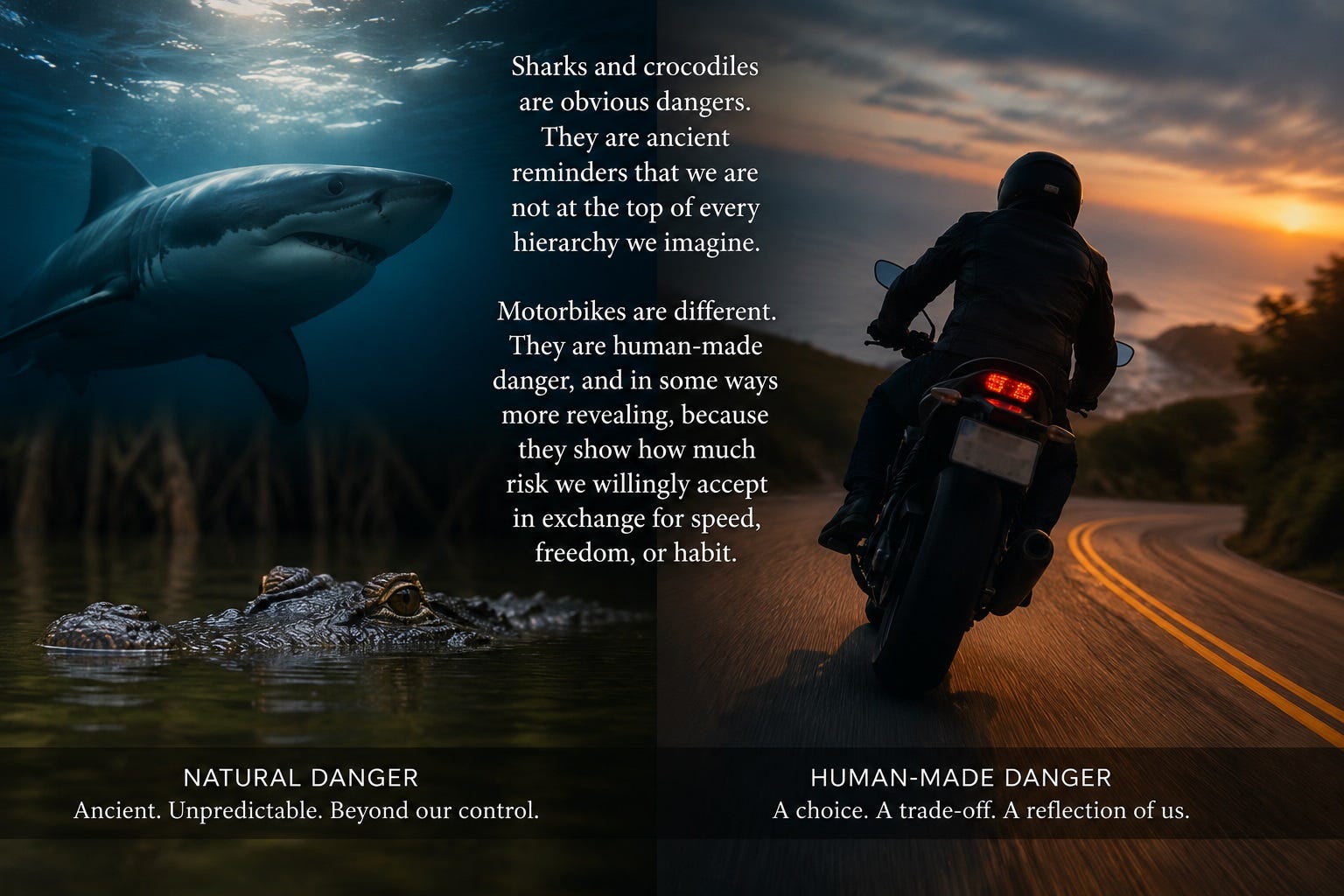
Sharks and crocodiles are obvious dangers. They are ancient reminders that we are not at the top of every hierarchy we imagine. Motorbikes are different. They are human-made danger, and in some ways more revealing, because they show how much risk we willingly accept in exchange for speed, freedom, or habit. We do not always survive because the danger was minor. Sometimes we survive because we were lucky. Sometimes because we were careful. Usually because both were involved.
What interests me most is not whether I have been lucky, but how luck is distributed. A life is not one event. It is a chain of near misses, choices, exposures, and delays. Some risks are obvious. Others are silent. Age itself changes the ledger. By 73, one has already outlived many of the obvious hazards, and what remains is less spectacular but no less real: chronic disease, falls, frailty, and the slow erosion of reserve. The body, like the reef, is an archive of stress.
That is why I resist sentimental reflections on ageing. There is nothing mystical about reaching old age. There is also nothing trivial about it. To be alive at 73 is to have passed through an enormous number of contingencies without being removed from the story. That alone deserves a sober gratitude. Not triumph. Not denial. Just recognition.
My reef writing keeps returning to the same thought: explanation should be earned, not assumed. That applies to my own survival as much as to starfish assemblages or giant tritons. If I have lasted this long, it is because the world has been complex, my own choices have sometimes been decent, and chance has not yet finished with me. That is enough of an explanation for me. It is also enough to make me humble.
In the end, I do not think of myself as unusually brave or unusually fortunate. I think of myself as someone who has simply remained in motion through a long sequence of hazards. Some were visible. Some were not. Some I understood. Some I only understood after the event. That, perhaps, is the real lesson of both ecology and age: survival is not proof that the world is safe. It is proof that a dangerous world can still be inhabited, navigated, and sometimes, just barely, lived through.
No posts
Comments
Nothing yet. Say the first thing.
Sign in to join the conversation.