
Historical videogames do not make the past meaningful in the same way. Some rely on visual persuasion, others on systems and simulation, while others transform historical material through myth, folklore and supernatural causality. Across three case studies, a useful distinction has begun to emerge:
Ghost of Tsushima makes history persuasive through visual and cinematic representation. Nobunaga’s Ambition makes history intelligible through simulation and systems. Nioh transforms history through mythic counterfactuality.
Persuasion Through Spectacle
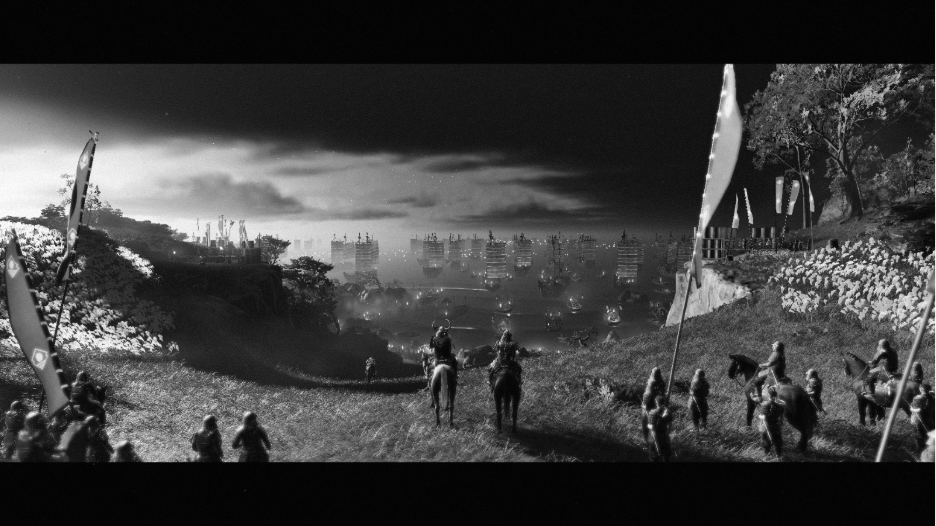
Screenshot 1: The Mongol invasion fleet viewed through Kurosawa Mode. The game’s monochrome presentation explicitly invokes samurai cinema, reinforcing its construction of the past through cinematic spectacle. Credit: Sucker Punch Productions.
In Ghost of Tsushima, historical meaning is produced primarily through spectacle. Its version of thirteenth-century Japan is shaped by samurai cinema, dramatic landscapes, stylised duels and the deliberate construction of a cinematic warrior aesthetic. Systems such as the Guiding Wind, standoffs and Kurosawa Mode reinforce the sense of inhabiting a historical period drama rather than reproducing the Mongol invasion with strict factual precision.
Its historical effectiveness therefore depends less on exact reconstruction than on persuasion. The game constructs a version of the past that looks, sounds and feels historically convincing, even when that image is selective, romanticised or anachronistic.
Argument Through Simulation
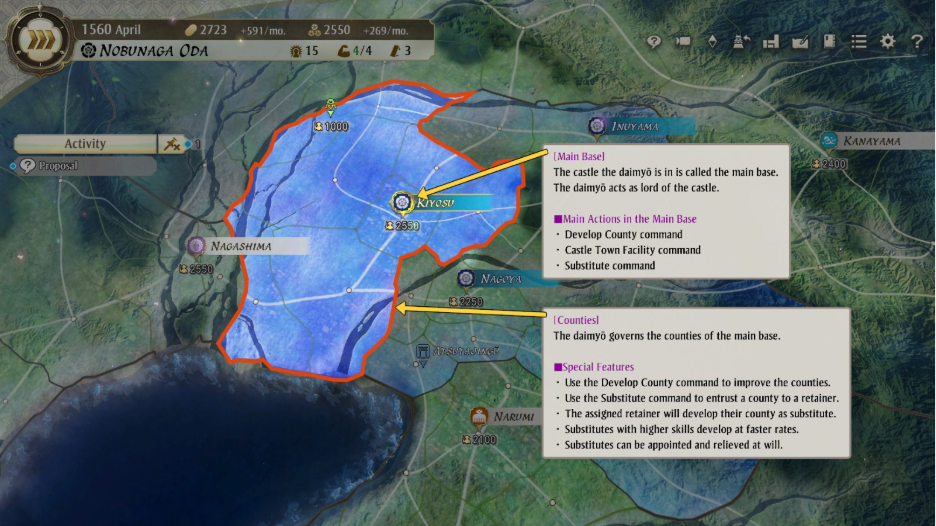
Screenshot 2: Territorial administration in Nobunaga’s Ambition: Awakening, where the daimyo, castles and counties are translated into interconnected systems of governance and development. Credit: KOEI TECMO GAMES.
Nobunaga’s Ambition: Awakening approaches history differently. Here the past is organised through systems: officers, castles, territories, agriculture, diplomacy, logistics and military supply. Historical actors become statistics, relationships and strategic resources, while political power becomes something governed through the interaction of multiple systems. The importance of rice production, infrastructure and provisioning is not simply described but incorporated into the mechanics of territorial expansion and warfare.
Where Ghost of Tsushima persuades through spectacle, Nobunaga’s Ambition makes Sengoku history intelligible through simulation. Historical structures become understandable because they are turned into rules that the player must operate within.
Toward Mythic Counterfactuality
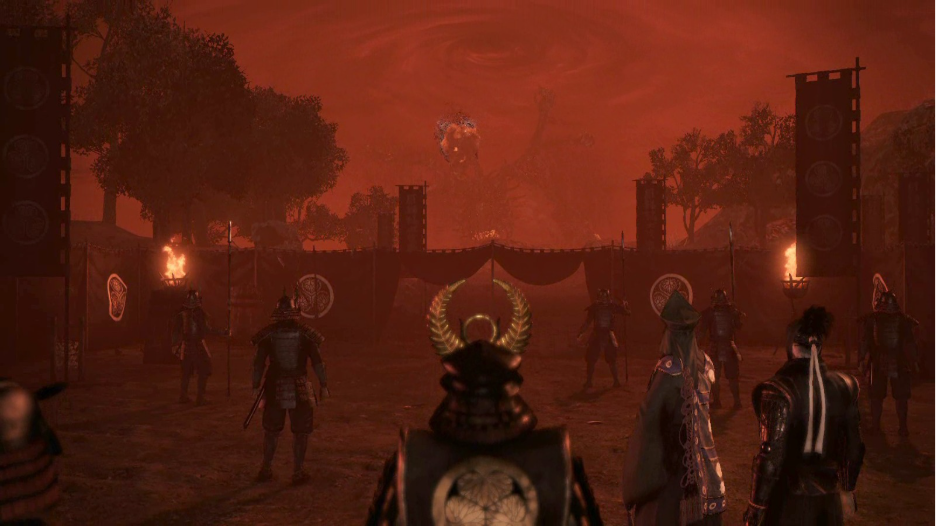
Screenshot 3: Sekigahara transformed by the aftermath of battle, with Gasha-dokuro looming over the encampment. The historical battlefield becomes the basis for a supernatural manifestation of the fallen. Credit: Team Ninja.
Nioh introduces a third mode.
Its Sengoku world remains anchored in recognisable historical people, places and conflicts, but those anchors are repeatedly transformed through yokai, Guardian Spirits, Amrita, resurrection and supernatural corruption. Its relationship with history is therefore neither primarily one of cinematic persuasion nor systemic simulation. Instead, history is reworked through what can be described as mythic counterfactuality:
historical anchor → mythic transformation → playable manifestation
The central question shifts from whether a historical event occurred exactly as represented to what happens when the legends, resentments and memories attached to the Sengoku period are given supernatural form and made playable.
This produces a different relationship between history and fiction. Rather than replacing historical figures and places with fantasy equivalents, Nioh often preserves the recognisable historical anchor while allowing folklore and supernatural causality to reshape how that history is encountered. A castle can become the site of a folkloric manifestation; political resentment can become miasma or yokai; the dead of a battlefield can become the material for a supernatural boss encounter.
Taken together, the three games suggest that the question of historical accuracy is only one part of how videogames represent the past. Historical games can also be distinguished by the mode through which they make history meaningful.
Comments
Nothing yet. Say the first thing.
Sign in to join the conversation.