
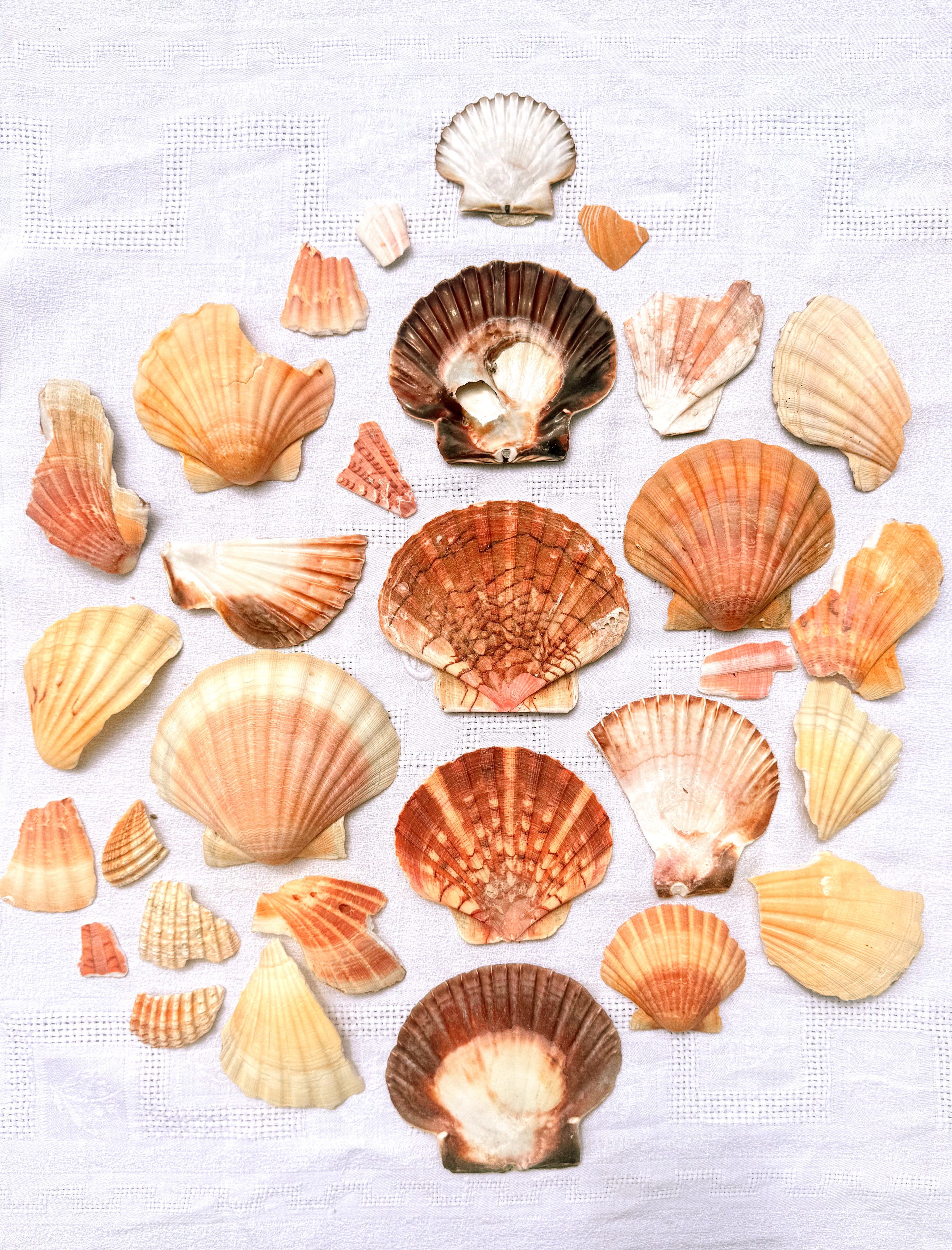
And then, some morning in the second week, the mind wakes, comes to life again. Not in a city sense – no—but beach-wise. It begins to drift, to play, to turn over in gentle careless rolls like those lazy waves on the beach. One never knows what chance treasures these easy unconscious rollers may toss up, on the smooth white sand of the conscious mind; what perfectly rounded stone, what rare shell from the ocean floor. Perhaps a channeled whelk, a moon shell, or even an argonaut.
But it must not be sought for or – heaven forbid! – dug for. No, no dredging of the sea-bottom here. That would defeat one’s purpose. The sea does not reward those who are too anxious, too greedy, or too impatient. To dig for treasures shows not only impatience and greed, but lack of faith. Patience, patience, patience, is what the sea teaches. Patience and faith. One should lie empty, open, choiceless as a beach – waiting for a gift from the sea.
Anne Morrow Lindbergh, Gift from the Sea
We came to France to press pause. That was the whole brief. I threw mesh market totes in the suitcase impulsively before we left home and I have never been so pleased with a thoughtless decision, because now they come with us everywhere. They went in empty and with no list, which I did not think about at the time and have thought about a great deal since. Every beach here is scattered with shells, some perfect, some chipped, some worn so smooth they have gone abstract, and every walk ends with another handful. The haul clinks on the drive back like a jar of loose change. My daughter will spend unhurried minutes staring at two nearly identical scallops because one of them is obviously, unarguably the more special one, and I have decided not to rush her, partly because she is right and partly because that deliberation is the exact skill I bill for. As a maximalist myself, I grab them both now and decide what’s best later.
I am not the first woman to go to a beach and start thinking this way, and I am not even the first to do it in a rented house with children underfoot. In 1955 Anne Morrow Lindbergh took herself off to an island for a couple of weeks and wrote Gift from the Sea, a small book about how a woman might actually live, and she built the entire thing out of shells. A chapter for each one. What she worked out on that beach is that you cannot dig for what the tide intends to hand you. Anxiety will not produce it. Greed certainly will not. Digging is not just impatient, it is a small failure of faith, an admission that you do not believe anything is coming unless you go and wrench it out of the sand yourself. The only posture that works is to arrive empty and stay open and let the beach do what beaches do.
She is right, and I have known she was right since my twenties, which is when I read this book religiously and thought I understood it. Coming back to it almost twenty years later it says something else entirely, or I am finally in a position to hear it. Patience has never been my strong suit. My natural posture on a beach, in a project, in most of my life, is to turn up with a shovel and dig until I have what I came for. So I have been carrying the line at the top of this page around with me all summer, turning it over, trying to get it past the part of me that would rather just make something happen.
And the history of the shell, as it happens, is one long argument on her side.
Consider that the badge of the greatest pilgrimage in Christendom was free. Pilgrims walking to Santiago carried a scallop, wore it on the hat or the bag, used it as a scoop, brought it home as proof that they had gone somewhere and come back. Nobody manufactured it. You reached the end of the road and bent down. Consider Rococo, an entire century of European taste, which takes its name from rocaille, the shell and rock work that people were encrusting on grotto walls. The most exuberant decorative movement in Western history began with beachcombing. Nobody briefed it. Consider sailors’ valentines, those octagonal cases packed with shells in mandalas and hearts and mottoes. The romantic story is that lonely sailors made them at sea, which turns out to be mostly untrue and somehow better. They were largely made in Barbados and bought in port on the way home, which means the real gift was a man walking into a shop, choosing well, and carrying it back across an ocean to someone.
And then consider the counterexample, because there is a spectacular one. In the eighteenth century the Dutch went properly mad for shells, the way they had gone mad for tulips, and at one Amsterdam auction the story goes that a single rare cone shell sold for more than a Vermeer in the same sale. That is the anxious, greedy, impatient version. It is also the version nobody remembers fondly. The shells that lasted are the ones somebody picked up on a walk and could not bring themselves to put down.
Which is, I am sorry to report, also true of taste.
This is the job. Not the sofa. Anyone with a trade account can get you a very nice sofa. What you are hiring is the fifteen years of looking, the rabbit holes and the beaches and the estate sales, the shell that becomes a reading list that becomes a wall treatment for a client who will never once hear the word rocaille. A room feels alive when it was assembled by somebody who stayed open long enough to be handed things. It feels dead when it was dug for, everything premeditated, when every object arrived on schedule because a schedule demanded it. Everyone can tell the difference and almost nobody can name it.
I want to be honest that this is easier to write on a beach than to practice when I’m racing around to site visits and checking on ETAs of deliveries. Waiting is a luxury and it is also a nerve, and there are weeks when staying open feels indistinguishable from doing nothing. But every project I am incredibly proud of has one thing in it that could not have been planned.
It is more or less why I called this place Pastiche. The word comes from an Italian word for a pie with a great many things in it, and it came to mean a work built out of borrowed and gathered fragments. A sailors’ valentine is a pastiche. A grotto wall is a pastiche. A jar of chipped scallops on my vanity is a pastiche. So is any room worth sitting in, and so, on the good days, is a life. None of it forced. All of it waited on and then picked-up.
Which makes the practice smaller and more available than I keep making it out to be. Wander with no agenda. Look at the ground instead of at your phone. Come home with pockets full of things that have no practical value and every sentimental one.
I know I keep talking about shells and you may be tired of hearing about them, but I am not, and I think I am only getting started. So, in the spirit of enabling one another’s curiosities, here is where the rabbit holes are currently leading me.
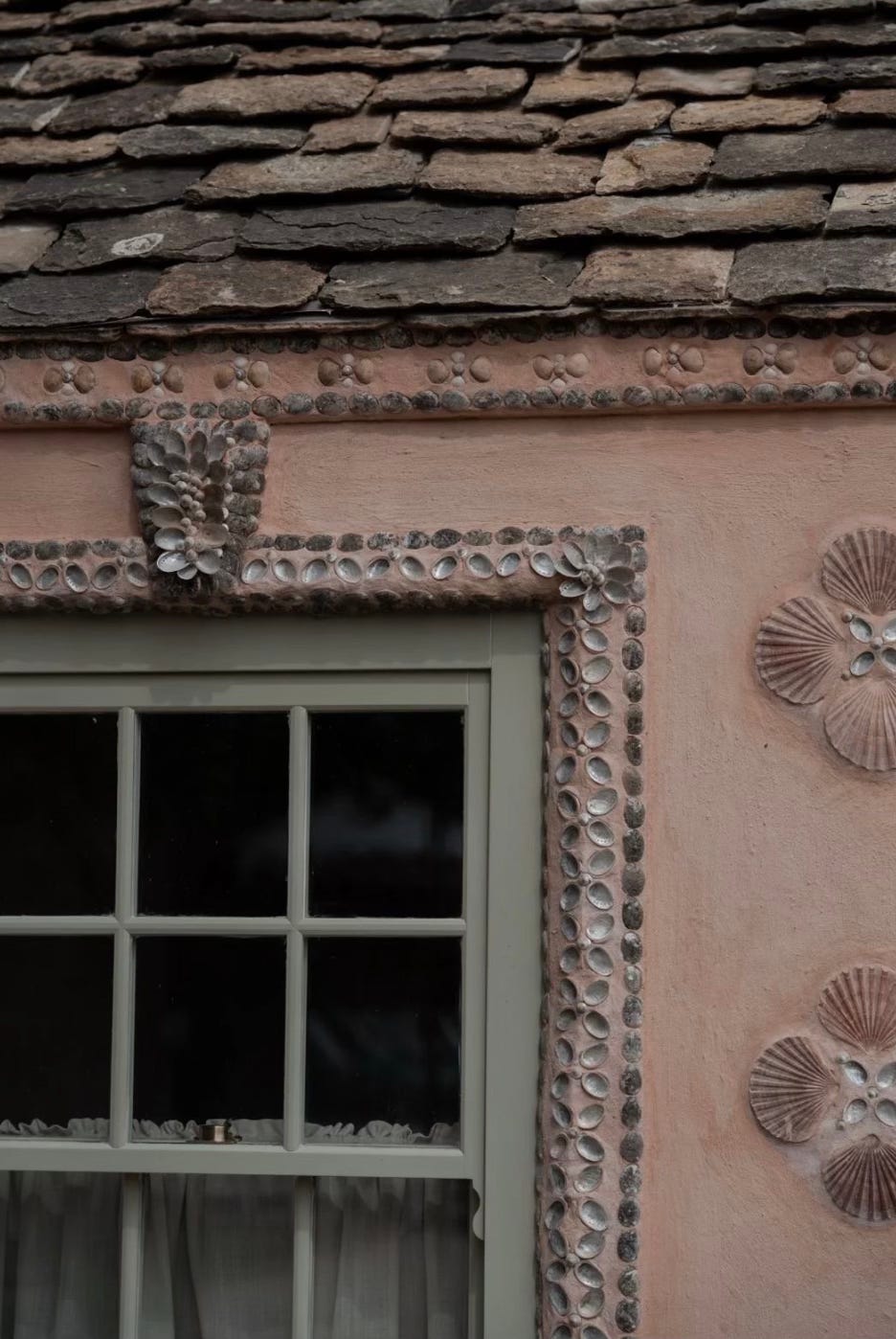
Mel and Ella Campion are a mother and daughter working in shells, which is either a coincidence or the universe being heavy handed with me this month. Their grotto at Kin House is the thing I cannot stop looking at. It sits in a niche in the main hall of a Georgian manor in Wiltshire, pink and dense and slightly delirious, and the part that undoes me is why it exists at all. There is a clam shell carved into the pediment over the front door, and it has been there since the house was built. Two centuries of people walking underneath it. Mel Campion looked up, noticed, and spent weeks answering it one shell at a time.
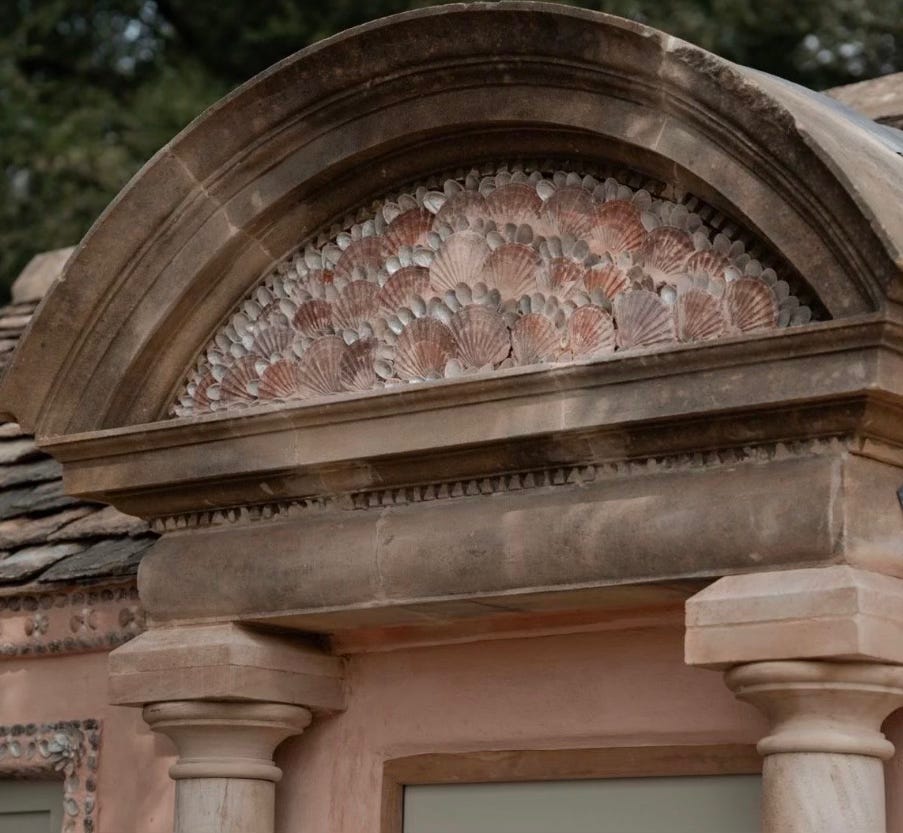
That is the whole thing, isn’t it. She did not invent anything. She found what the house had been quietly saying since the eighteenth century and said it back, louder.
Their work is a joy to follow, and I suspect I will be thinking about that niche for a very long time.
I have loved Lulu de Kwiatkowski’s work since I fell for her collages in college, back when I could not have told you why. I think it was that she treats color like it is not a risk. And that her collages are really assemblages, painting and drawing and photography and her own handwriting all piled in together, which is just collecting by another name.
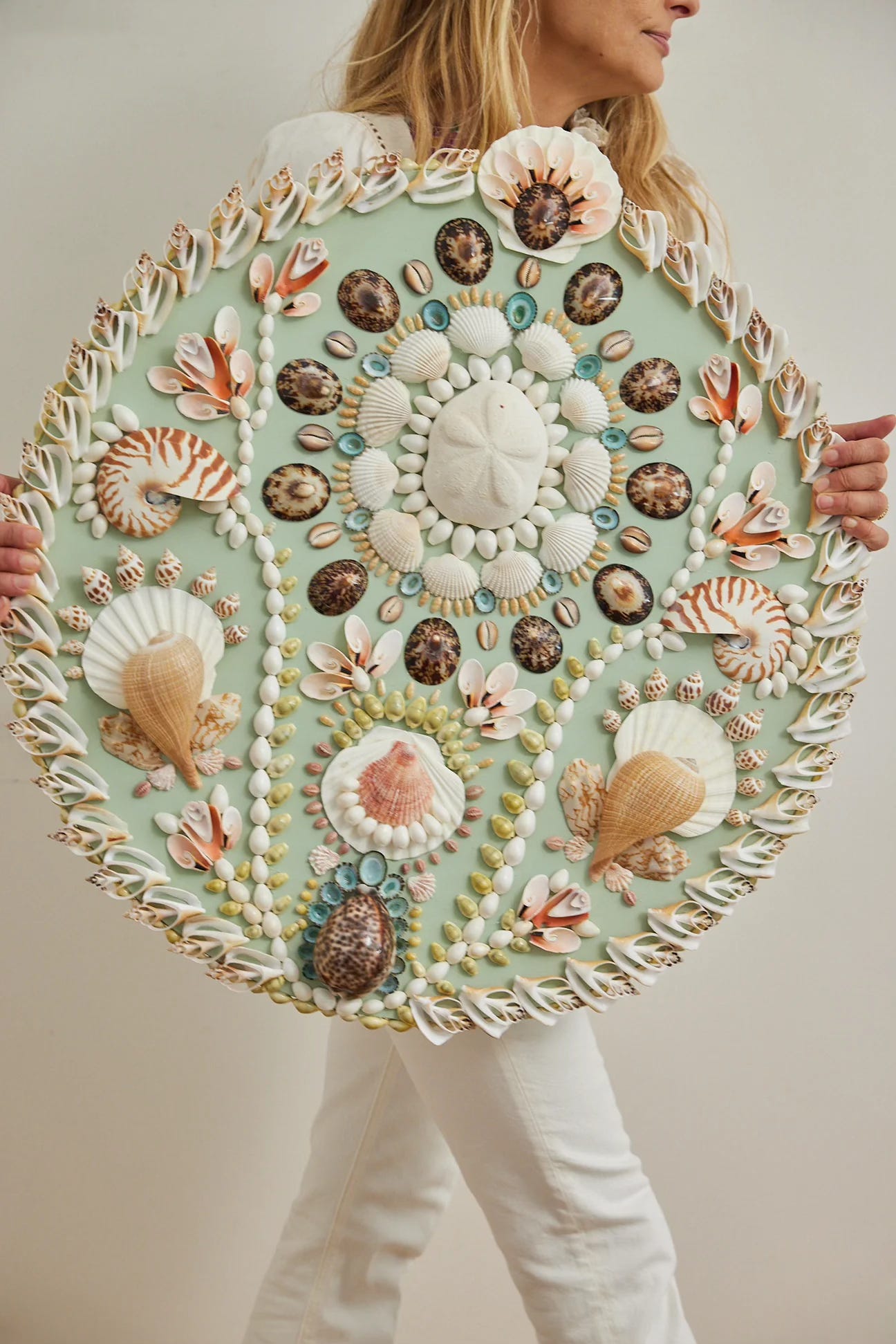
Lately it is the shell panels. The story of how they started is my favorite part. She was restoring her house, the entrance was bland, and she decided to work with shells she already had. A friend saw them, asked her to do a whole bar, and now, by her own account, she is a shell girl.
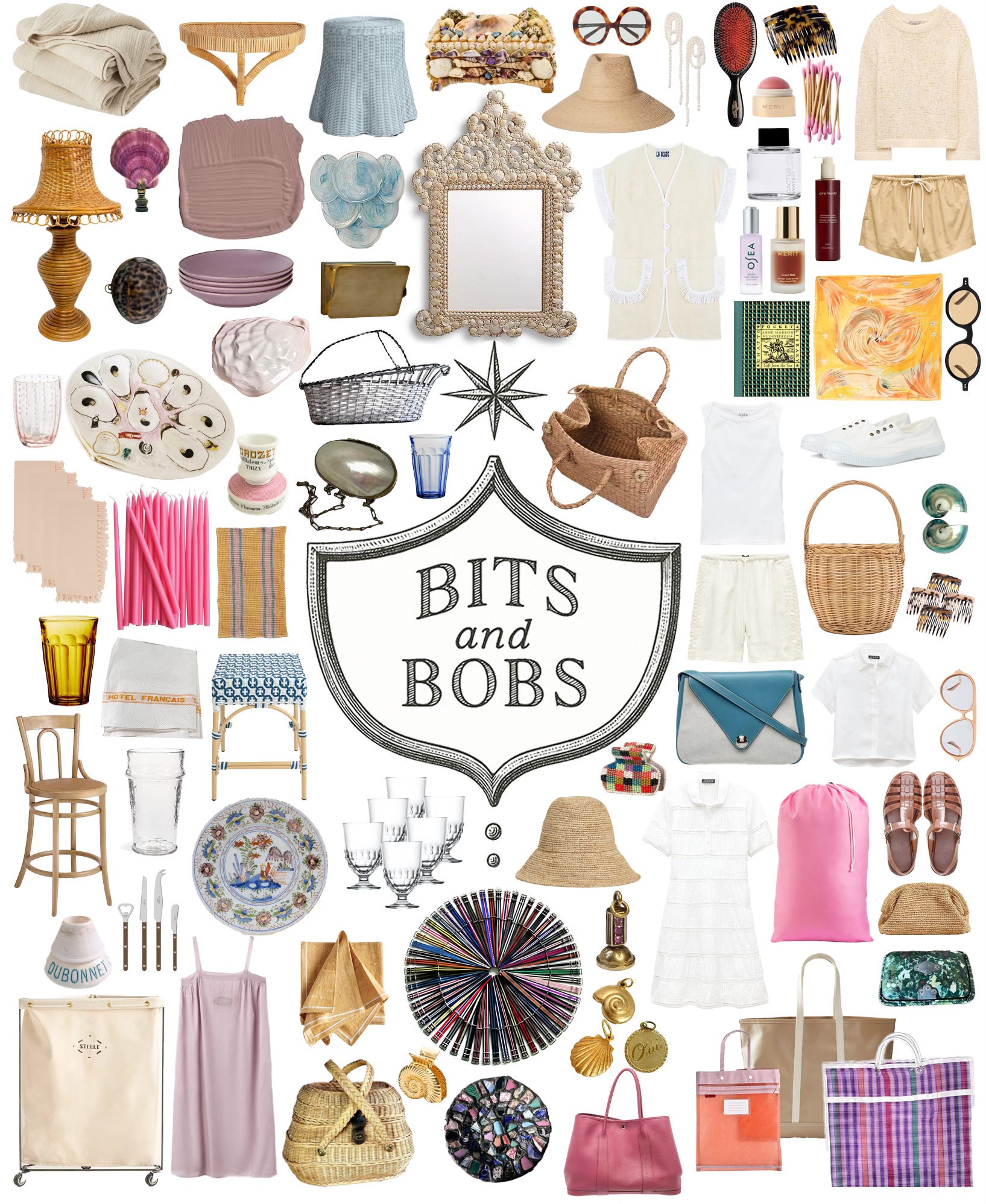
The items that I’m using non-stop this summer and the items that I loved while hunting this week. The pearl shorts I can’t take off. The Mexican market totes that are accompanying us everywhere. Vintage French items that may make you feel like you’re wandering a brocante alongside me. To see all the details go over here. Not a member of ShopMy, yet? Create an account here.
Send me yours. Tell me what you have been unable to stop thinking about lately, however ridiculous, and I will very likely tumble into it with you. And if you have a room that has been dug for rather than gathered, I have a little space this autumn.
Best,
SK
No posts
Comments
Nothing yet. Say the first thing.
Sign in to join the conversation.