

Philosopher and professor Elsa Dorlin has devoted most of her career to exploring the relations between violence, gender, and race, which she brought to the old-fashioned philosophy department of the Sorbonne, winning awards on the way. Her book Self-Defense: A Philosophy of Violence is an important step in spreading her feminist approach of the importance of the body in everyday and political struggles. When she is not teaching in Toulouse or working at home, Elsa can usually be spotted grading papers on a train (her preferred mode of travel) or shopping at flea markets. We talked to her about her political background, and anti-capitalist commitment which she considers the most fundamental political question of our times, and the issue with contemporary feminism.
Text within this block will maintain its original spacing when published
Text within this block will maintain its original spacing when published
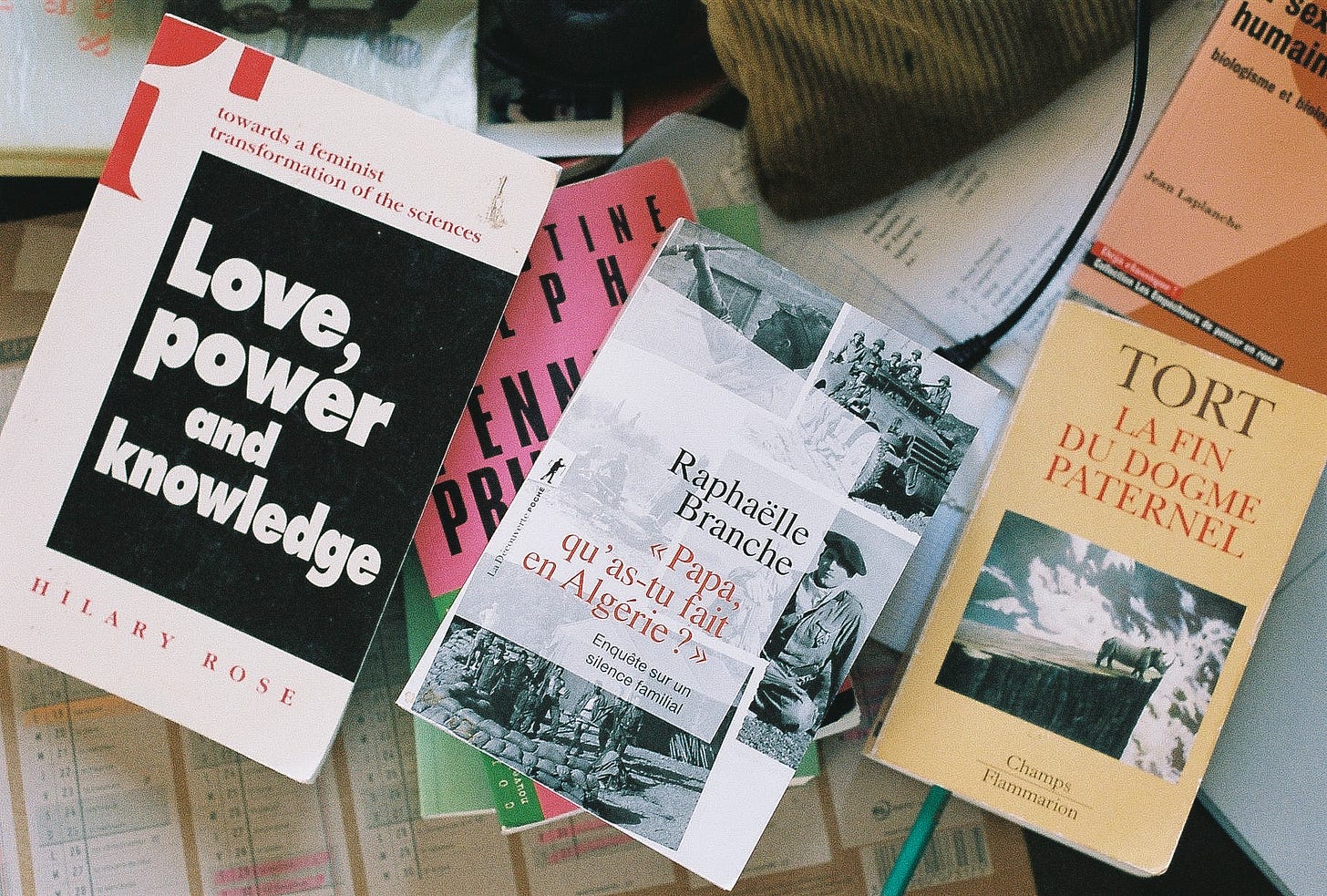
Text within this block will maintain its original spacing when published
“Writing and theoretical work requires long time slots, which require a form of tranquility, and an absolute de-responsibility of care. What’s complicated with the issue of reproductive labor is all the care involved. To write a book, you can’t think of what you’re going to eat for dinner, that you’re picking up your son from school, wake him up in the morning, or make sure his school bag is filled the way it should be. That’s why, when you think of a philosopher or an academic or a thought leader, you think of a man from a certain social class who has the means to delegate the work of reproduction to someone else, or to several people (usually women): you don’t think of a single mother! Nowadays, even women in academia often have the economic capacity or belong to a certain class that gives them the means to pay another woman to do part of the reproductive work. It’s not the case for me, for political and economical reasons. That’s why writing takes me longer, and why my books stay connected to the real world.”
Text within this block will maintain its original spacing when published

Text within this block will maintain its original spacing when published
Text within this block will maintain its original spacing when published
Whether you’ve been with us for years or just found us — thank you. But passerby isn’t sustainable without support, and we want to keep going.
Support this decade-long project — and get every new interview from the archive delivered straight to your inbox, along with recommendations and upcoming events. Your support enables us to push back against traditional narratives, free from commercial pressure, and enables us to pay writers, editors, translators, photographers, and more.
Read about passerby in The New York Times, The Guardian, and Servide95.
Text within this block will maintain its original spacing when published
Comments
Nothing yet. Say the first thing.
Sign in to join the conversation.