
There is so much we can learn from a narcissist. Not because we want to be one. Anyone who knows anything about a narcissist, and cares, strives to be the opposite. We are the empathetic ones. We care very deeply, and this is our gift.
But, we must admit that the narcissist does one thing so well that we could actually take notes on. They protect what they have. Their image, their ability to manipulate and control. And they give nothing away for free. And while I would never want their empty heart, I have come to believe there is something we can borrow from them. Not their lack of care and concern for others. Their boundaries.
I used to marvel at how easy it was for my ex to say no, and not just the word no, there was variety in his no. I’m not doing that, I changed my mind, I don’t feel like it, because I don’t want to, and the list goes on. The words would just flow out of his mouth, as easily as we say yes, sure, why not, I don’t mind, whatever you want to do, I’m fine with that, and the list goes on.
I have had many clients ask me how they can stop being so empathetic in order to stop attracting narcissists. And my answer is always the same. The goal is not to care less. The goal is to know what your caring is worth.
The Diamond in the Window
Picture this. You walk into a jewelry store and you see a diamond ring in the case. It immediately gets your attention but you can’t afford it, so you look away. You know it is out of reach. But you keep glancing at it, just out of curiosity. You think, if I had that I would treasure it. You stand in awe of its beauty, imagining if it were yours how amazing that would be.
Then one day you save enough. You go back. You buy that ring, you put it on your finger, and you marvel at it. You take care of it. You keep it clean. You put it in a safe when you are not wearing it. Because you know exactly what it’s worth.
That is what our empathy is. Our empathy is a diamond ring. It was shaped and formed with love and care and detail. It is real. It is not the cubic zirconia stone that looks like a diamond from across the room. It is the real deal.
Could someone just walk into a jewelry store and say, give me that, with nothing in return? No. That would be a robbery.
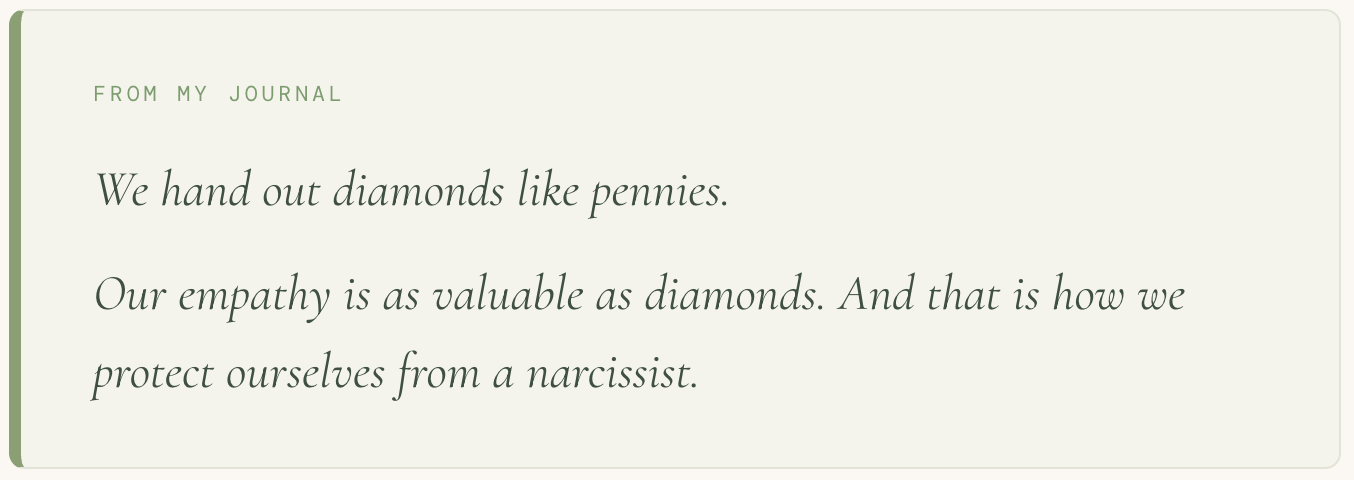
So why do we let people walk off with our diamond for free? Someone walks into our life, flashes a little charm, gives us a breadcrumb of effort, and we hand over the whole ring. We do it again and again. We hand out diamond rings like pennies.
The narcissist would never do that. And that is the lesson. I do not have to give you something you cannot afford. Something you cannot pay for. Something you will not take care of. My empathy is invaluable, and it has to be earned.
The Science
For most of my life, my empathy had no off switch. Someone near me was in pain, and I bent over backwards to help them. I could not sleep when my ex was disappointed. I felt compelled to resolve what upset him even when I wasn’t sure what I had done or how I was the cause. I used to wish I could stop caring so much. I don’t wish that anymore. That is not who I am, and I would not trade my ability to care for anything.
But I did need to understand what was happening in my body, because empathy with no boundary is not love. It is depletion.
The nervous system and the cost of constant rescue
Dr. Stephen Porges and his Polyvagal Theory describe how our nervous system is always scanning for safety or danger, often before our thinking mind catches up. For an empath living with a narcissist, the system is tuned to one channel. His moods. His needs. His distress. We call it caring. The body calls it fawning, the survival response where we keep ourselves safe by keeping someone else regulated.
That is why a narcissist needs us. They have no empathy of their own, so they pull it out of us to fill the hole. That is how we supply them. And a body stuck in fawn cannot rest, because it never decides the threat is gone. Learning to guard your empathy is not becoming cold. It is letting your nervous system finally return to safety.
The Framework
Think about what it actually takes to walk out of a store with a million-dollar diamond. Nobody just hands it over. There is a process. And once you see the process, you see exactly what a narcissist skips. Here is what I walked through in my own head.
1. THE CREDIT CHECK
Have they earned trust over time?
A jeweler checks your history before handing you anything valuable. People show us their history too, if we are willing to look. A narcissist leaves a trail of discarded people and broken promises. We ignore the report because we want the sale to go through. Slow down. Read the history first.
2. PROOF OF INCOME
Can they actually give what they promise?
A narcissist flashes money, then puts down a dollar. Big words, big love bombing, and almost nothing behind it. Proof of income is not what they say they will do. It is what they have already done, consistently. Watch the deposits, not the promises.
3. COLLATERAL
Do they have something to lose if they hurt you?
Real commitment means taking risks. A narcissist risks nothing because he never truly invests. He keeps one foot out the door so leaving costs him nothing. The person worthy of your diamond has skin in the game. They are building something with you, not borrowing against you.
4. THE RECEIPT
Will they protect what they were given?
When you buy something precious, you take special care of it. You clean it. You keep it safe. The right person treasures your empathy the way you would treasure that ring. The wrong one leaves it in the gutter and asks for more. Give your diamond to the one who proves they will guard it.
IFS and the Spiritual Lens
In Internal Family Systems work, we learn that the part of us that overgives is not foolish. She is a protector. Somewhere along the way, she learned that the way to stay safe and stay loved was to pour out everything she had. She handed out diamonds because she believed her worth was in the giving, not in the gift.
“Above all else, guard your heart, for everything you do flows from it."
PROVERBS 4:23
Guard your heart. Don't close it. Guard it. A guard does not keep everyone out. A guard knows the difference between who has earned entry and who has not.
You were never too emotional.
You were just giving the real thing to people holding monopoly money.
If You Are Earlier in Your Healing
Maybe the idea of guarding your empathy feels selfish to you. Maybe you were taught that a good woman gives without expecting anything in return. I get it. I lived there for 30 years, longer. Setting a boundary felt like betrayal, and saying no felt like I was being heartless.
So hear me when I say that protecting your empathy is not the opposite of love. It is what keeps your love alive long enough to give it to someone who will treasure it. The diamond does not lose its value in the safe. It is simply waiting for hands that have earned it.
A Reflection For You
Who in your life has been holding your diamond without ever paying for it?
What would change if you decided, today, that your empathy was no longer free?
The narcissist taught me one lesson by accident. He always knew the value of what he held, even when it was nothing. We hold something real, and we have to learn the same thing. We are expensive. We are as valuable as diamonds. WOW.
And that is how we protect ourselves from a narcissist.
You can keep your empathy, and finally learn to guard it.
Passage to Peace is a healing and transformation program for survivors of narcissistic abuse, built on the five stages I lived through myself. If you have been handing out diamonds for pennies, your journey to knowing your worth begins here.
No posts
Comments
Nothing yet. Say the first thing.
Sign in to join the conversation.