
This article is adapted from my latest book: The Human-Agent Orchestrator, about leading hybrid teams of humans and AI agents.
I still think about one conversation more than almost any other in my career. The woman was a relationship manager with twenty-two years of experience. Her bank had introduced an AI agent that now handled most of her client analysis. I asked her how it was going. She paused. “It’s very efficient,” she said. That pause told me more than her answer.
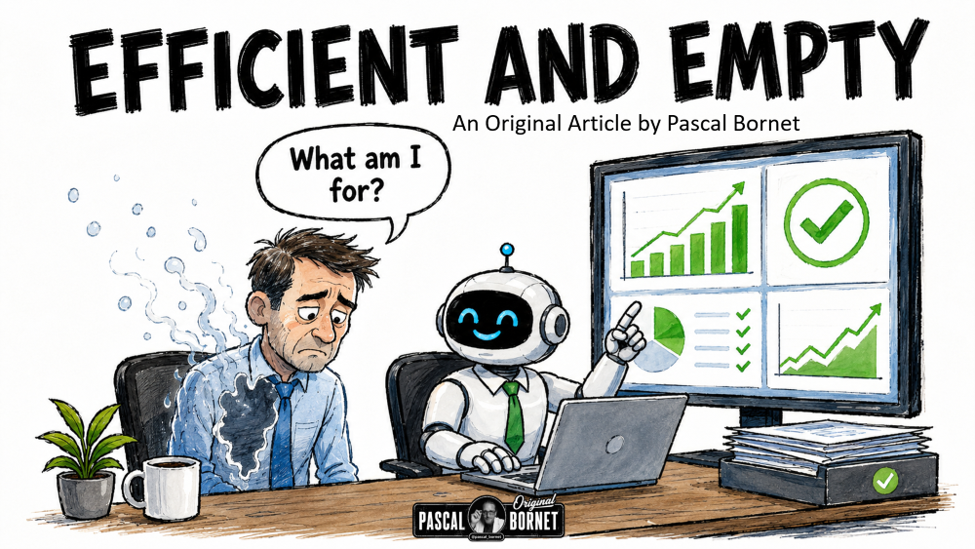
She was not struggling with the technology—she had adapted faster than most of her team. She was struggling with something we lack good language for: the quiet erosion of knowing where your value lives once the parts of your job you were measured on have been automated out from under you.
This is not an isolated story. Across the organizations I work with, roughly seven in ten leaders make no changes to how they support their people after deploying agents. Roughly two in three of those people report genuine uncertainty about the value of their own contribution. That gap between what leaders track and what people quietly feel is not a morale problem fixed with a town hall. It is a design problem, starting the moment a leader treats efficiency as the finish line rather than the start of a redesign.
I see this failure take three shapes. Scope Collapse: someone who used to own an entire process now only reviews the final output, and the accountability that came with ownership disappears with the scope. Mastery Vacuum: a skill someone spent fifteen years building becomes something an agent does in ninety seconds, and no one has said what the next fifteen years are supposed to build toward instead. Purpose Drift, the hardest to name: the satisfaction of finishing work moves to the machine, and the human watches an output appear they no longer feel ownership over, even having approved it.
I want to make an argument that cuts against current enthusiasm for AI productivity metrics. You cannot responsibly celebrate a productivity gain without auditing what happened to the humans who used to produce that output the slower way. Productivity and engagement are not the same curve, and most organizations are measuring only one, then acting surprised when their best people quietly start looking elsewhere.
The relationship manager did not leave her job. But I think about how close that conversation came to being an exit interview, and how preventable that would have been. The fix is not complicated, though it requires actually having the conversation rather than assuming efficiency speaks for itself. Ask each person what they now bring that the agent cannot. Write it down. Make sure it is not smaller than what they brought before.
If your organization has deployed agents this year, I would ask: for each person whose role changed, do you know where they believe their value now lives? If not, I would treat that as more urgent than your next productivity dashboard.
I would really like to know if this lands for you too. Have you noticed this quiet erosion on your own team, or in yourself? Tell me in the comments, I read all of them.
🔥 If this resonated, the book goes deeper. We are celebrating two months since launch by dropping the e-book to $2.99 for a limited time. You can find it here: The Human-Agent Orchestrator. If you liked this article, I think you will find the rest genuinely useful.
#AgenticAI #FutureOfWork #EmployeeExperience #Leadership #WorkforceTransformation #HumanAgentOrchestration
No posts
Comments
Nothing yet. Say the first thing.
Sign in to join the conversation.