
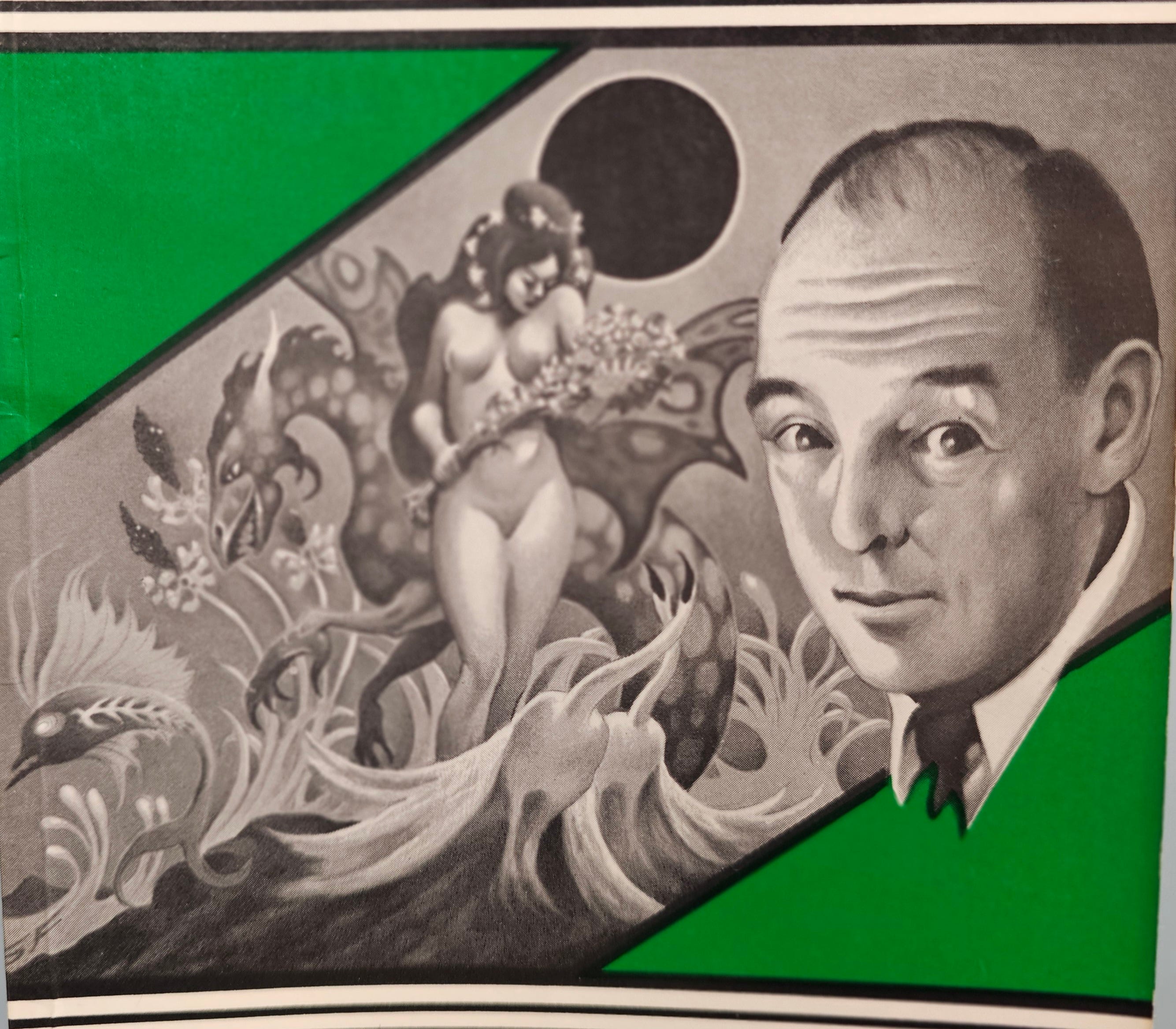
C.S. Lewis wrote science fiction. He also thought a lot about what makes for good science fiction. He started his own science fiction trilogy, the Ransom Trilogy (or the cosmic trilogy (not the ‘space’ trilogy!)) because he and J.R.R. Tolkien both lamented the state of SF in the 1930s. As the story goes, the two friends agreed to write a time travel story and a space travel story to help ameliorate the situation. They flipped a coin to see who would write what and Lewis ended up with Out of the Silent Planet, the first of his trilogy.
We’re reading through all three books in my philosophical book club this year and we’ve already made it through the first two books. You can find my companion essays for them, and the recordings of our Book Club conversations, below:
Great, so C.S. Lewis was a science fiction author. But the question to ask is: was he any good at it? Was C.S. Lewis a good science fiction author? Well, that probably depends.
Did C.S. Lewis write good science fiction? What’s good science fiction? That too depends.
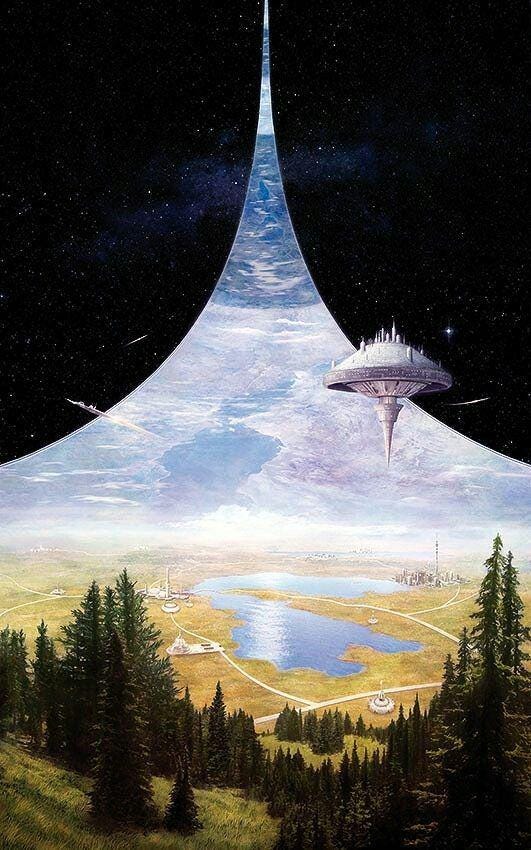
Some folks, though increasingly less and less, believe good science fiction ought to incorporate aspects of our best (current) scientific understanding of whatever science is at play in the story. Good science fiction, on this view, is about scientific accuracy, lots of technical details, and logical extrapolations from there. You can make a change or two to the science—but actually you better stick to just one change to be safe.
This kind of science fiction is often called hard science fiction (hard SF) and many point to works like Larry Niven’s Ring World or more modern works like The Martian by Andy Weir or The Three Body Problem by Liu Cixin as examples.
Hard SF was definitely not C.S. Lewis’s cup of tea. In an essay called “On Science Fiction” (originally given as a talk to the Cambridge University English Club on Nov. 24th 1955), Lewis carves the species ‘Science Fiction’ into 6 or 7 sub-species, some of which he enjoyed and others which he did not. Lewis describes what we now call hard SF as the science fiction of engineers.
If you want to read more on C.S. Lewis’s 6 or 7 sub-species, check out this post:
Then check out this post on Severance to see how I apply CSL’s categories to the show to see if it qualifies as good SF for Lewis:
Lewis describes this sub-species of SF as being written by authors who are primarily interested in giving plausible depictions of space-travel, or some other SF theme, which isn’t impossible in-principle. They’re interested in giving their best guesses as to how scientist might actually bring these potentialities into actualities, in an imaginative way and inside a story. Lewis cites Jules Verne’s Twenty Thousand Leagues Under the Sea, H.G. Wells’s Land Ironclads, as well as Arthur C. Clarke’s Prelude to Space. Lewis respected this sub-species, but didn’t “have the slightest taste” for them. He notes that the original appeal of these works is altered by the coming of the real thing, i.e., the invention of submarines and tanks in the case of Verne and Wells books cited above.
So, if you think the only good SF is hard SF focused on accurate depictions of the natural ‘hard’ sciences (mostly physics), then you’re not going to think that C.S. Lewis’s science fiction trilogy is good SF.
If there’s hard SF, does that mean there’s ‘soft’ SF too? It is!
Soft SF, as the name suggests, focuses more on the ‘softer’ sciences like the social sciences.
These two sub-species are pretty good for categorizing different SF stories in order to help you find your next read, but there are some outliers which resist the neat categorization. Books like Isaac Asimov’s Foundation trilogy resist, for instance, wherein his invented ‘psychohistory’, which is a type of mathematical sociology, is the device that causes all the action. Is mathematical sociology a hard or soft science?
But assuming that the Foundation series doesn’t render the categories useless, it’s safe to say that C.S. Lewis was a soft SF author as he primarily focuses on philosophical and theological devices, machines, and furniture to build and people his worlds—”but those aren’t sciences at all!!”, sure they are, theology is the queen of the sciences and philosophy is her handmaiden.
In addition to the sub-species of hard and soft SF, there are also the Golden Age and the New Wave of SF to consider.
Science fiction probably goes back at least to Mary Shelley’s Frankenstein in 1818 but some have argued that it goes back as far as Plato, if not farther—the Allegory of the Cave, The Ring of Gyges, the Myth of Atlantis, etc. Maybe that’s crazy, but Ray Bradbury put forth the “Plato wrote SF” view and that guy still carries a lot of weight in the SF community, so disagree at your own peril. Find his take on Plato over on my other publication through this post here:
But whenever SF actually started, during the 1900s it stared going through various discrete transformations. In the 1920s, SF entered its ‘pulp era’ where stories were short and mostly consumed in cheap magazines made from cheap ‘pulpy’ paper.
Between 1937 and 1940, SF entered its ‘Golden Age’ marked by the beginning of John W. Campbell’s tenure as editor of Astounding Stories SF magazine (later to be renamed Analog: Science Fiction | Science Fact). The Golden Age was golden in that SF came to its maturity—there were lots of great authors writing lots of great stories, different from the hokey space-adventurer-saves-a-mad-scientist’s-daughter-from-a-space-monster stories of the earlier pulp era.
To my lights, the Golden Age was marked by more hard SF stories soft. Additionally, most of the stories were written or rewritten to favor Campbell’s tastes. SF author, Adam Roberts, describes those tastes as those tastes being:
"idea-fictions rooted in recognisable science"
"can-do stories about heroes solving problems or overcoming enemies"
"expansionist humano-centric narratives",
"extrapolations of possible technologies and their social and human impacts"
(Roberts, Adam (2016). “Golden Age SF: 1940–1960”. The History of Science Fiction. Palgrave Histories of Literature (2nd ed.). Palgrave Macmillan.)
The Golden Age vibe eventually ended and the New Wave era began, probably around the 1960s, but maybe starting somewhere in the 1950s with much of Philip K. Dick’s stories. If the golden age was marked by more hard SF, the New Wave was marked by more soft SF and rich character development.
When did the Golden Age die? August 6th, 1945. The nuclear weapons that many Golden Age writers envisioned and anticipated were here and were horrible, leading to what some have called a loss of innocence for the whole genre.
Hey if you’re enjoying this post, consider upgrading to a paid subscription to help support my work.
You’ll get access to all:
of my Book Club essays
my digital intro to philosophy text book
access to the paid subscriber chat
access to our live Zoom Book Club chats
lots more
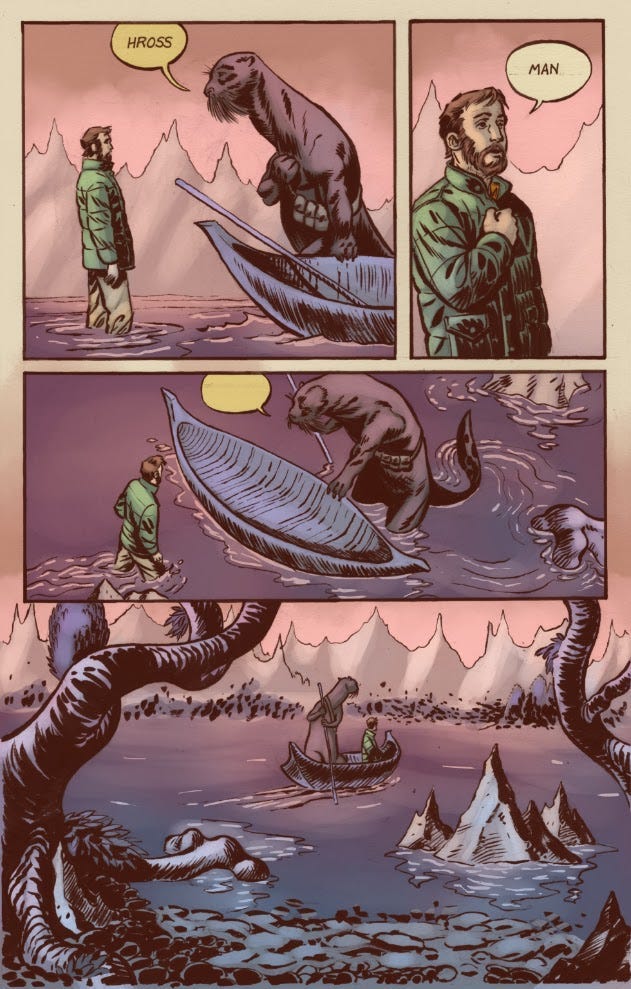
Why bring up any of that? Well, to show you I know ball. No. I bring up the history of SF because C.S. Lewis published Out of the Silent Planet in 1938, Perelandra in 1943, and That Hideous Strength in 1945. He was writing his science fiction from the beginning to the end of the Golden Age! C.S. Lewis was a Golden Age writer, but he was intentionally writing against the Golden Age philosophy, that philosophy primarily shaped by John Campbell, particularly #2 and #3 above: “can-do stories about heroes solving problems or overcoming enemies”, “expansionist humano-centric narratives”. Points 2 & 3 produce a philosophy of human heroes using science and reason to solve all of humanity’s problems on their own without reference to God, without dealing with their own sinful natures, and then expanding out all over the galaxy and universe to colonize everything in a utopian age of secular reason. It’s secular humanism with a dose of scientism.
SF scholar James Gunn (not the director) explains that an essential aspect of this sort of humanistic SF is that
The farther into space one travels the less significant become the passions and agonies of man, and the only matter of importance in the long morning of man’s struggle to survive is his survival so that his sons could be seeded among the stars
(Science Fiction Today and Tomorrow, pg. 199 in Starmont Reader’s Guide 14, pg. 15)
Lewis did not like the Golden Age philosophy to say the least. In fact, it was the presence of this philosophy which prompted him to write his own, contrary, Christian humanistic SF, for as he says in the Weight of Glory: “Good philosophy must exist, if for no other reason, because bad philosophy needs to be answered.”
But Lewis got even more specific than that in a letter he wrote just after the publication of Out of The Silent Planet:
What set me about writing the book was the book was the discovery that a pupil of mine took all that dream of interplanetary colonization quite seriously, and the realization that thousands of people in one way and another depend on some hope of perpetuating and improving the human race for the whole meaning of the universe—that a ‘scientific’ hope of defeating death is a real rival to Christianity
(Letters of C.S. Lewis, pg. 167, 1966 in Starmont Reader’s Guide 14, pg. 26)
Lewis wrote what he called a “kind of theologized science fiction” in direct response to the philosophy he found in the later pulp and proto Golden Age SF stories (Letters, pg. 260).
Brian Murphy, author of the C.S. Lewis Starmont Reader’s Guide, a series in science fiction criticism, explains that Lewis, though writing during the time of the Golden Age, was not accepted as a SF author because,
Science fiction is not only a literary form but also a kind of loosely held philosophy. What makes Lewis something of a critical pariah is that while he wrote two formally brilliant science-fiction novels, his values do not seem compatible with the philosophy of science fiction. (15) \
C.S. Lewis was a Golden Age SF author writing soft SF in a New Wave style with theology and philosophy as his subject matter and directly counter to the prevailing humanistic scientism. It’s understandable why he was something of a pariah!
Well, you need to read him for yourself so you can decide.
Coincidentally, I am teaching a Summer course on the philosophy and theology of C.S. Lewis starting July 11th and running through August 15th. It’s an accredited course, so you can take it for credit and potentially transfer it in to your university for undergrad credit, or you can audit it for no credit and a reduced price.
You can read all about it here:
Or just read my companion essays to the first two of the Ransom books and join us for That Hideous Strength later this year. Check out out 2026 Philosophical Book Club:
If you guys learned something please give this post a like and a share. It actually does help spread my work out to others.
And if you want to see more stuff like this, please consider supporting my work by becoming a paid subscriber today
No posts
Comments
Nothing yet. Say the first thing.
Sign in to join the conversation.