

This week, I’m offering a bit of a behind-the-scenes look at Episode 4 of The French Culture Podcast: the second installment in our two-part look at Edith Piaf. If you haven’t listened to Part I, I suggest you go back and do so now before lending your ear to the current episode. You’ll find it here:
Part II begins in 1940, at a moment when Piaf was consolidating her career, bolstering her collaborations with key producers, songwriters and composers, and grappling (alongside the rest of France) with a shocking new war.
We’ll spend some time considering Piaf’s under-rated talents as an actor, both in theatre and films. She moved with remarkable ease between concert halls, stages and film sets– and I think she could have had a formidable career as an actor, had she wanted one.
{Related at Paris Unlocked: Key Places to Find Edith Piaf’s Traces in Paris}
I was particularly interested to learn about her leading performance in a film called “Etoile Sans Lumière”— written and directed by her friend Marcel Blistène, who she helped to hide from the Gestapo during the Occupation, this is a film whose premise and plot is eerily similar to a later Hollywood blockbuster that also contemplates the end of the silent film era. I invite you to listen to the full episode (or read the transcript) for more details on that.
In this episode, I also confront the thorny (and wholly unresolved) question of whether Piaf was a resistance hero during the years of German occupation in wartime France, or a “soft” collaborationist who in some ways benefited from the Occupation. As with so many aspects of her life, the picture remains decidedly hazy— and Piaf’s tendency to weave her own biographical myths, as discussed in the last episode, certainly doesn’t elucidate things.

Writing this episode had me struggling to decide what to focus on, since I’d discovered that Piaf was, as mentioned above, a formidable actor, budding songrwriter in her own right, mentor to other musicians, and master of self-promotion— in addition to ascending on stages and radio stations worldwide as an iconic crooner. I also found it a daunting task to sift through the many (often conflicting) accounts of Piaf’s activities during the war: one biographer here claiming she was a hero of the French resistance, another here dismissing reports of Piaf saving POWs by smuggling them out with fake papers as just another self-inflated myth.
It was intriguing, and infuriating, to try to get at something like the truth— and I still very much doubt I cracked the riddle as to whether Piaf was a “résistante” or a “soft collaborator” during the Nazi occupation of France. Let’s settle on “it’s complicated”. I know, one can use that particular get-out-of-jail-card for almost anything. But if there’s one thing I’ve learned in the process of teaching myself how to write biographical stuff through this podcast: established facts about a life only stretch so far. The remote horizon consists in murkier shades.
The more you try to get at the “truth” of who a person was, the more you’re confronted with the impossibility of such a task. Still, trying to arrive at greater understanding is still worthwhile— and I’ve always intensely disliked how Piaf has been made into a cartoon character of Frenchness. I wanted, more than anything, to pull away from that image.
Faced with all this complexity and only having an hour and a bit to cover 1940 to Piaf’s death in 1963, I attempted to tackle all of the above with as much precision and economy as I could, all the while weaving a larger story about Piaf growing into herself as an artist, setting aside her prior dependence on (often-controlling) male mentors to instead seize control of her artistry— not to mention her finances.
Not that she was talented at finance. By all counts, her fortune fell through her like a sieve, partly because she was too generous with her “chosen family”, including hangers-on and parasitic personalities like her supposed half-sister, “Mômone”.
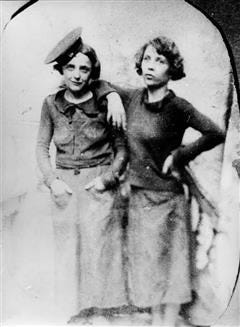
What surprised me the most in researching and writing about Piaf’s rise to global stardom, and her later, most vulnerable years, was that all the talk about her obsession with romantic love started to look grossly exaggerated, if not total “poppycock”. (I recently gained British citizenship, so I’m now allowed to use words like that— thank you very much.)
As I discuss at length in the full episode, my contention is that Piaf, at least in her later life, was more devoted to her artistic collaborators and her “chosen family” than she was to an ideal of romantic love. Often, the lines blurred as she pursued serial relationships with various male collaborators. But she also expressed intense love and devotion for her longstanding composer and friend, Marguerite Monnot, whose early death devastated her. And in the last years of her life, it was companionship— often with gay men— that seemed to be most important to her. In the end, popular culture’s tendency to frame Piaf as a love addict got it wrong, in my count— at least in terms of the sort of love she pursued.
In any case, I hope you enjoy this second hour on Edith, and that it expands your sense of her life, work and legacy, making her seem less like her wax figure counterpart at the Musée Grévin. As always, I welcome your comments and feedback.
In the next few months, I’m planning to release a bonus episode with some additional materials on Edith, and also go into some detail on my research process and subjective responses to Piaf’s work and biography.
If you’re not yet a paid subscriber, please do consider upgrading your subscription now. In addition to getting bonus episodes and early-release materials from the podcast, you’ll also have access to our full archive of Paris and France-related news stories, reviews, editorials, travel tips and in-depth itineraries— plus have the opportunity to schedule a personal consultation with me by email to help you plan your next trip! Here’s an example of a bonus episode I recently put out:
Bonus Episode: Were Matisse & Picasso Really "Frenemies"?
·
Jun 23
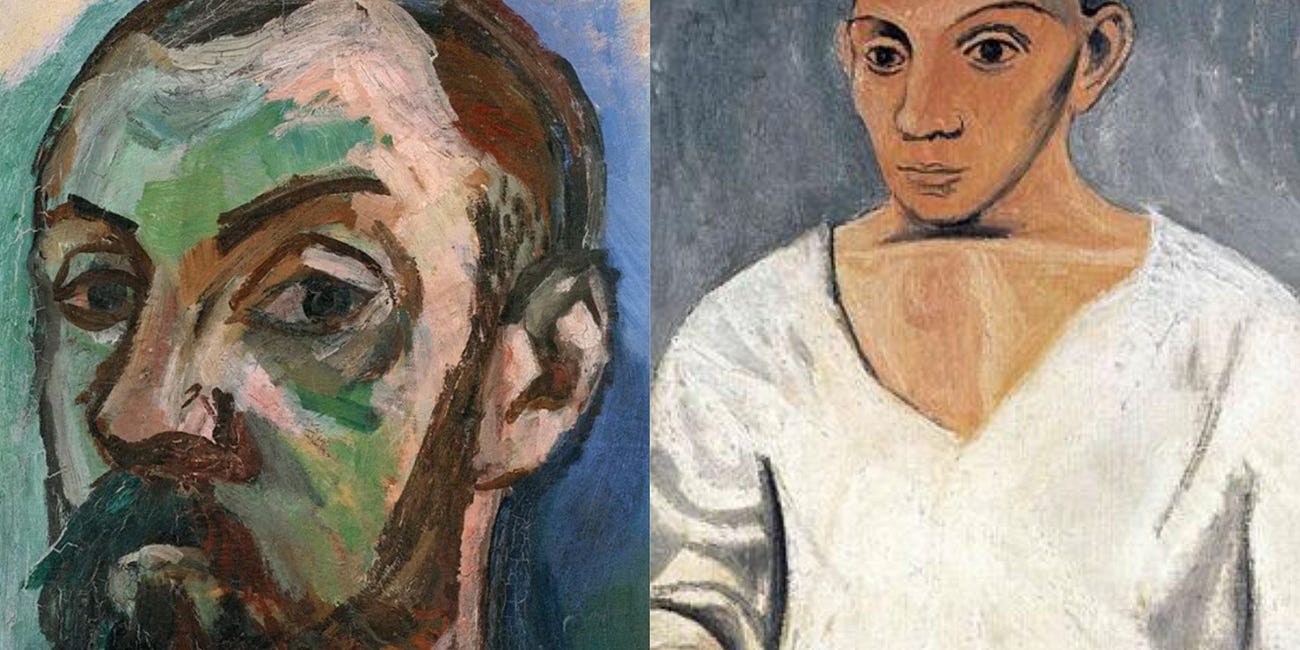
In this bonus episode for The French Culture Podcast, I tackle a common myth about Henri Matisse and Pablo Picasso: were they really “frenemies”, or is the truth more complicated? I also offer a behind-the-scenes looks at my research process for the full (free) episode on Matisse...
Not only will it help support the development of the podcast, which, let’s face it, isn’t typically a lucrative endeavor at the outset— it’ll also allow me to keep writing and publishing deeply researched features on French and Parisian culture here at Substack.
Imagine this: for less than one expensive barista drink every month, you’ll be contributing to the creation of something made by a human, for humans— not for search algorithms or clickbait.
And if you love French culture— as I assume many or most of you do— this is one good way to help more people learn about and enjoy la culture française.
If you already have too many subscriptions, I get it. I probably do too. Why not consider giving whatever you can by buying us a coffee or tea at Ko-fi? No matter how small the amount, it will make a difference, helping to fund my work, as well as that of my producer and sound engineer. You can make a one-off donation, or offer a small monthly amount if you’d prefer to choose an amount different from the subscription options here at Substack.
Again, I can’t thank you enough for your vital support, whether it’s through a paid subscription or through telling a friend about the podcast or the newsletter.
Here are just a few places where you’ll find The French Culture Podcast, if you prefer to listen elsewhere:
I’d so appreciate it if you could take the time to add a rating (hopefully a good one!) on these platforms, as this will go a long way in helping me to build an audience beyond Substack.
We also have a YouTube channel, though as I mentioned in my last post, episodes there will feature only decorative stills or slideshows, rather than show me reading the episode or interviewing guests. Still, if YouTube is your preferred place to stream audio, you can find us there too!
This episode was conceived, written, narrated and edited by Courtney Traub. It was produced by Brendan Whalen, who contributed additional research, script editing, and voiceovers (read: memorable impressions of Yves Montand). Additional audio editing and sound design was by Engin Hassan of Edit Fade Warp. Artwork for the Paris Unlocked Podcast was created by Mateeya.
If you liked this episode, please follow (and rate) The French Culture Podcast, then share it as widely as you can.
Translations of original French quotes in this episode are all by Courtney Traub. All images displayed in the show notes are out of copyright and in the public domain.
The problem of fair use and music clips: As I discuss in the episode, I was unable to secure the rights to Piaf’s music, in order to play short excerpts of the songs I reference in this episode. There is no “safe” amount of a piece of copyrighted music that one can play under fair use laws, so I preferred to be cautious in this regard and include none.
Spotify playlist: Please listen to the songs referred to in this episode by going to the Spotify playlist I’ve put together. It’s less ideal than playing clips from the songs in the episode, but it’s (at the least) a way to listen . If you can, I recommend keeping the playlist open as you listen to the episode, and pausing to play the song being referenced. Of course, please don’t attempt this while driving or operating machinery!
Intro and outro: Music by Trygve Larsen from Pixabay (“Erik Satie’s Gnossienne 1 – Classical Remix Piano and Sax”)
Music in order of use throughout episode:
Music by Konstantin Nestsiarovich from Pixabay (“Gritty Noir”)
Music by Striptease-Soundtrack from Pixabay (“French Cabaret Elite 9)
Music by Konstantin Nestsiarovich from Pixabay (“Forensic Evidence: ASMR Noir Jazz”)
Music by Mikado Koko from Pixabay (“Cool Jazz Session 8”)
Music by Striptease-Soundtrack from Pixabay (“French Cabaret Elite 5”)
Music by Alban_Gogh from Pixabay (“Night Walk in Paris”)
Music by Mircea Iancu from Pixabay (“Midnight ashes 2 (piano and sax dark jazz”)
For this episode, we consulted a variety of print and online primary sources, including books, newspaper articles, blogs, documentaries, film clips and archival documents. They are presented in relative order of importance and/or order in which their information appears in the episode, rather than in alphabetical order. Sources are both in English and French; where available, I have also linked to the English-language version of the source.
Carolyn Burke, No Regrets: Edith Piaf. Bloomsbury, 2012.
David Loosely, Edith Piaf: A Cultural History. Liverpool University Press, 2015. Available online in open source: https://library.oapen.org/bitstream/handle/20.500.12657/26016/1004069.pdf
David Bret, Edith Piaf: Find Me a New Way to Die. Oberon Books, 2015.
Albert Bensoussan, Édith Piaf. Gallimard: 2013 (French-language paperback)
Robert Belleret, Piaf: Un Mythe Francais. Fayard, 2013.
“Montmartre sur Seine”, 1941, dir. Georges Lacombe. IMDB,https://www.imdb.com/title/tt0140386/
“L’accordéoniste”, Edith Piaf in Five Songs, BBC Sounds, 5 March 2024 (written and narrated by Catherine Franc), https://www.bbc.co.uk/sounds/play/m001wqsz
Daisy Fancourt, “Edith Piaf”, Music and the Holocaust, no date, https://holocaustmusic.ort.org/resistance-and-exile/french-resistance/edith-piaf/
Vanessa Moley, “La vie devant moi: choisir le courage sous l’occupation”, Herodote.net, no date, https://www.herodote.net/Choisir_le_courage_sous_l_Occupation-article-3037.php
“Madame Jacob”, ajpn.org, no date, https://www.ajpn.org/personne-Madame-Jacob-12899.html
Frantz Vaillant, “Piaf? Une enfant-dictateur!”, TV5 Monde, 10 October 2013, https://information.tv5monde.com/international/piaf-une-enfant-dictateur-20140
Susan Heller Anderson, “Piaf Remains a Mix of Myth and Reality”, The New York Times, 22 February 1981, https://www.nytimes.com/1981/02/22/arts/piaf-remains-a-mix-of-myth-and-reality.html
Jay Carr, “Etoile Sans Lumière AKA Star Without Light”, TCM, 18 August 2011, https://www.tcm.com/articles/444341/etoile-sans-lumiere-aka-star-without-light
“‘Etoile Sans Lumière’”- Film Complet’, Old French Films (YouTube channel),
“Etoile Sans Lumière”, Cinemafrancais.fr, no date, no author, https://www.cinema-francais.fr/les_films/films_b/films_blistene_marcel/etoile_sans_lumiere.htm
C. de R, “Edith Piaf à l’Olympia”, Le Monde, 1 February 1955, https://www.lemonde.fr/archives/article/1955/02/01/edith-piaf-a-l-olympia_1945914_1819218.html?search-type=classic&ise_click_rank=4
“Edith Piaf at Carnegie Hall”, Carnegie Hall, no author, no date, https://www.carnegiehall.org/Explore/Articles/2020/06/29/Edith-Piaf-at-Carnegie-Hall
Howard Taubman, “Music: High Priestess of Agony; French Singer Offers Heart Rending Songs Carnegie Hall Soaked in Tears by Edith Piaf Maria Tip Returns Handel Anthems Will be Sung”, The New York Times, 5 January 1956, https://www.nytimes.com/1956/01/05/archives/music-high-priestess-of-agony-french-singer-offers-heartrending.html?searchResultPosition=2
Bee Wilson, “Like Cold Oysters: Edith Piaf, A Cultural History by David Loosely”, The London Review of Books, 19 May 2016, https://www.lrb.co.uk/the-paper/v38/n10/bee-wilson/like-cold-oysters
“The Last Days of Edith Piaf” (Les derniers jours d’Edith Piaf), French with subtitles and voiceovers in English, directed by Philippe Pichon, 2006, https://www.imdb.com/title/tt6510418/ ; available on YouTube:
“‘Non, je ne regrette rien’: La chanson engagée d’Edith Piaf”, France Inter, 7 October 2014, https://www.radiofrance.fr/franceinter/non-je-ne-regrette-rien-la-chanson-engagee-d-edith-piaf-4986618
Claude Sarraute, “Edith Piaf à l’Olympia”, Le Monde, 31 December 1960, https://www.lemonde.fr/archives/article/1960/12/31/edith-piaf-a-l-olympia_2104494_1819218.html?search-type=classic&ise_click_rank=5
Robert Alden, “Piaf Triumphant in Paris, Critics Find Her Splendid on Her Return to Bobino A Voice Defiance Something Special”, The New York Times, February 23 1963, https://www.nytimes.com/1963/02/23/archives/piaf-triuphant-in-paris-recital-critics-find-her-splendid-on-return.html?searchResultPosition=1
Yves Jaegle, “2 octobre 1963: Edith Piaf et Jean Cocteau s’eteignent , ‘deux êtres hors-série’ à la une”, Le Parisien, 10 October 2024, https://www.leparisien.fr/culture-loisirs/12-octobre-1963-edith-piaf-et-jean-cocteau-seteignent-deux-etres-hors-serie-a-la-une-10-10-2024-CWFDDME2C5AJBAFF6Q36DA5JFU.php
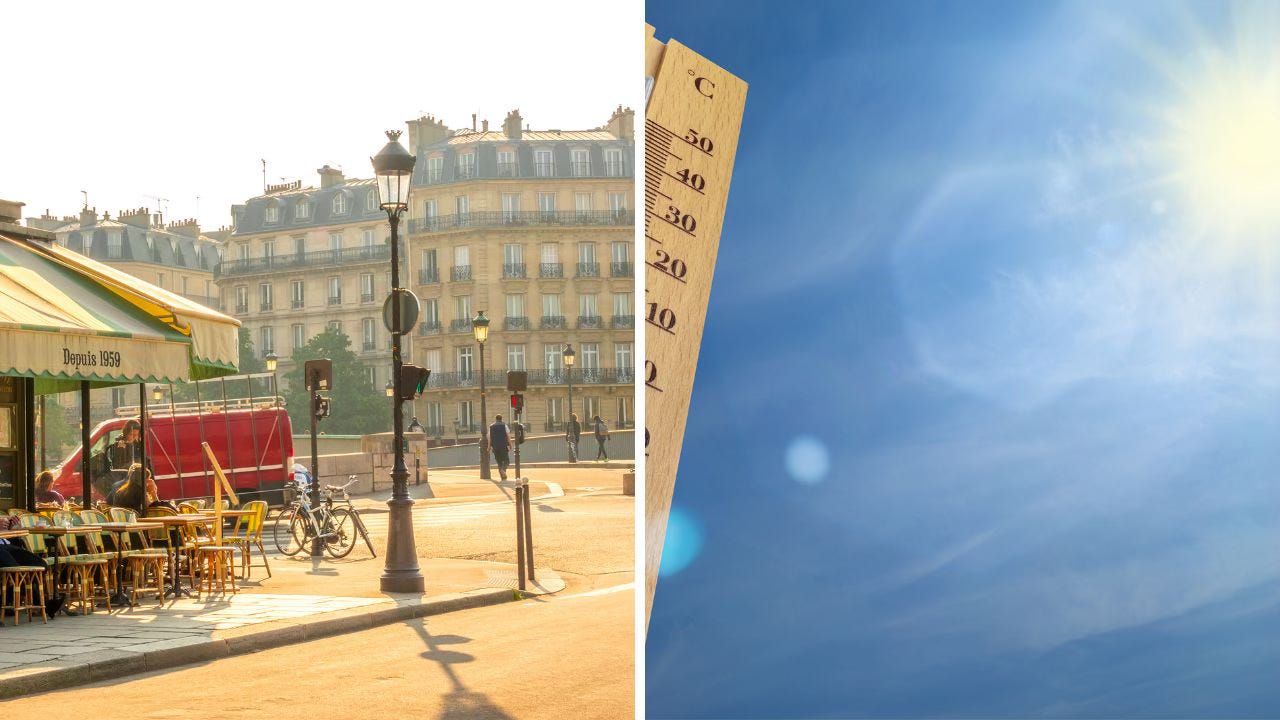
Lastly for this issue, I wasn’t in France in late June, when millions of people suffered through an intense heatwave that saw temperatures reach 41 C/105.8 F in Paris, and in Bordeaux, peaked at 42.1 C/nearly 108 F. But I watched from an (also very hot) UK, feeling anxious as I read reports of nights that weren’t cooling down enough to allow human bodies to recover from heat stress, and humidity levels that made going outside for any extended period literally dangerous. I received firsthand accounts from friends that they were feeling panicked and trapped; my good friend and CSM Special Correspondent Colette Davidson fled Paris for the beach town of Trouville with her kids and a group of friends, renting a house together and working remotely— all in hopes of escaping heat levels that felt genuinely frightening.
As of this week over 2,000 people are estimated to have died in last month’s heatwave— and the number is likely to rise. Even the joyous scenes of people swimming in the (typically very mucky) Canal St-Martin seemed in part fueled by desperation. A desperation that also led over 70 people in France, many teenagers, to perish from drowning or cold shock last month, after they tried to cool down in rivers and other bodies of water not necessarily suitable for swimming.
And with reports of another episode of extreme temperatures falling over France this weekend (albeit forecast to be less severe than last month’s “heat dome”), there’s a growing sense that this is no anomaly: in fact, the World Health Organization has warned that Europeans should brace for repeated extreme heat episodes, both this year and going forward.
This new normal is not only alarming: it’s bringing up feelings of profound dread, and even sadness. Many writers and observers are writing from France with an elegiacal tone about what they see as the end of summer as we’d come to know it.
Véronique Savoye from France With Véro notably shared a Facebook post (in French) from Maxime Cochard that I found both moving and highly disturbing. In the essay-length post, he details the ordeal of enduring days upon days and nights upon nights of suffocating, unrelenting heat, and worries that his beloved cat might succumb. And he ends the post this way (my translation is below):
…l’été n’est plus. La saison des amours s’est muée en saison des horreurs. L’été et ses rivages de sable, ses mers d’azur, ses couchants profonds. Les mollets des garçons et les bras nus des filles… L’été et les soirs qui s’éternisent, le désir qui met du rouge aux joues, le farniente qu’on voulait faire durer pour toujours. Tous ces livres, tous ces poèmes qui ont chanté le soleil de l’été, qu’en reste-t-il désormais ? La joie des grandes vacances, le sel sur la peau après la baignade… Rideau. C’est fini, on nous l’a volé. L’été, désormais, c’est la peur.
…[Summer is no longer. The season of love has mutated into a season of horrors. The summer and its sandy coasts, its azure seas, its profound sunsets. The bare calves of boys and the nude arms of girls….the summer and its eternal evenings, the desire that brings a blush to the cheeks, the far niente that one wanted to last forever. All the books, all the poems that sang about the summer sun— what has become of them? The immense joy of summer vacation, of salt on the skin after a swim— Show’s over. It’s gone, it’s been stolen from us. From now on, summer is fear. ]
One might protest that this is all melodramatic; that heat variations have always been with us; that the widespread panic is a predictable effect of a social media age that encourages hyperbole and clickbait, and fuels overreaction. I wish I could get on board with that perspective— it’s a very reassuring one. But the data is clear: as reported in Al Jazeera, “A study by World Weather Attribution (WWA) has found that intense heat on this level is now tens to hundreds of times more likely than it was in 2003, and was unheard of 50 years ago”. And it’s only forecast to get worse in the coming years, especially if carbon emissions keep getting pumped into the air at the same rates.
What about the way these events have brought people together, from neighbors checking on one another to the aforementioned swim parties in the Canal St Martin? Signs of collective solidarity are always heartening to see— but this doesn’t mean that we should just keep calm and carry on (sorry, Brits, but the technique has its limits— especially political). If there’s anything I’m holding out hope for, it’s the idea that the growing daily reality of climate change will finally spur something like collective rage and action against oil companies, and the governments that continue to bankroll them.
I could go on about this for a long time. Instead, here are a few essays on last month’s nightmare that both moved and disturbed me, and that I highly recommend reading (assuming you’re not assuming a head-in-the-sand pose at the moment):
As cited earlier, my friend Colette Davidson has an excellent piece at The Christian Science Monitor about her response to the unbearable heat in Paris, and worries for her young children: “in a fit of heat-driven panic, I bought cheap train tickets to the northern beach town of Trouville in search of cool. But if this impromptu vacation is anything to go by, I am starting to realize that when it comes to this heat wave – and climate change in general – there is nowhere to run and nowhere to hide”
Lindsey Tramuta from The New Paris Dispatch offers a probing analysis of how Paris’ obsession with preserving architectural heritage is condemning city residents to suffer inhuman conditions in the heat— and calls for much-needed political courage: “Take Paris: installing external AC compressors or modern solar shading (like shutters or awnings) is strictly regulated or outright banned by Architectes des Bâtiments de France (heritage architects) to protect the city’s uniform aesthetic. And those iconic gray zinc roofscovering 80% of buildings? The material isn’t inherently ill-suited, but given improper ventilation and insulation, the roofs end up absorbing too much heat, turning top-floor chambres de bonne into boilers. Replacing or painting them with reflective white coatings would obviously alter the city’s historic skyline so those in charge of preserving the city’s heritage won’t even consider it. No one will consider condemning top-floor apartments, either, to improve insulation. As my friend Brent Longley, a trained urban planner, said to me this morning, “The city has got to modernize, and that will require letting go of some of its precious attachment to its glorious past.”
In a heartbreaking essay entitled “Paris on Fire", Jennifer Steil, a remarkable writer who is battling late-stage cancer, details her growing panic and physical overwhelm as the temperatures reach unbearable levels, underlining how the “wet bulb” conditions of last month’s heatwave can make people with fragile health even more vulnerable: “I worry about how I will be spending what is left of my life. I am afraid I will become so anxious I’ll need a psychiatric hospital. I’m afraid of suffering. I’m afraid of my abdomen swelling again. I’m afraid of spending a hot summer with a drain installed, unable to take frequent cold showers or swim. I’m afraid of being stuck at home all day at least two days a week waiting for the nurses to drain me.
I’m terrified of ending up in a hospital room that is over 100 degrees. Which they all are. I’ve never been truly homesick, but now I want more than anything to be in a country with airconditioned hospital rooms.”
And Emma Kate-Symons at The New World takes on the air-conditioning debate (sane response, or selfish climate-change accelerant?) with a refreshing rationality and even-handedness that seems largely absent from many other pieces I’ve seen floating around: “Halbran argues that there are twelve French received ideas about air conditioning, beginning with ‘the myth of the ecological sin.’ France’s hostility rests on outdated assumptions about emissions, refrigerant gases and electricity consumption, while modern reversible heat pumps are among the most efficient low-carbon technologies available.
He dismantles the myth of the ‘perfect solution’ or the belief that insulation, trees, fans, geothermal energy or simply enduring the heat can replace active cooling. Finally he torpedoes the ‘myth of tolerable heat,’ demonstrating that extreme temperatures are a growing public health emergency that damages health, productivity and learning.”
That’s (finally) a wrap for this week, les ami/es. I’m off to central France and the west coast for some much-needed relaxation, and of course, some new intel. My only hope is that I won’t return home feeling like I’ve spent two weeks on a sauté pan. We shall see whether the next heat dome slated to mercilessly settle over the continent will feel quite as relentless and scary.
On that cheery note, a bientôt,
Comments
Nothing yet. Say the first thing.
Sign in to join the conversation.