
For the past several months, the Rural Health Transformation Program has been defined by one question:
What opportunities are coming next?
That question helped make sense of an extraordinary first-year funding wave. Across the Rural Care Journey dataset, approved non-archived opportunities rose from just 7 postings in January to 157 in July 2026.
But August looks different.
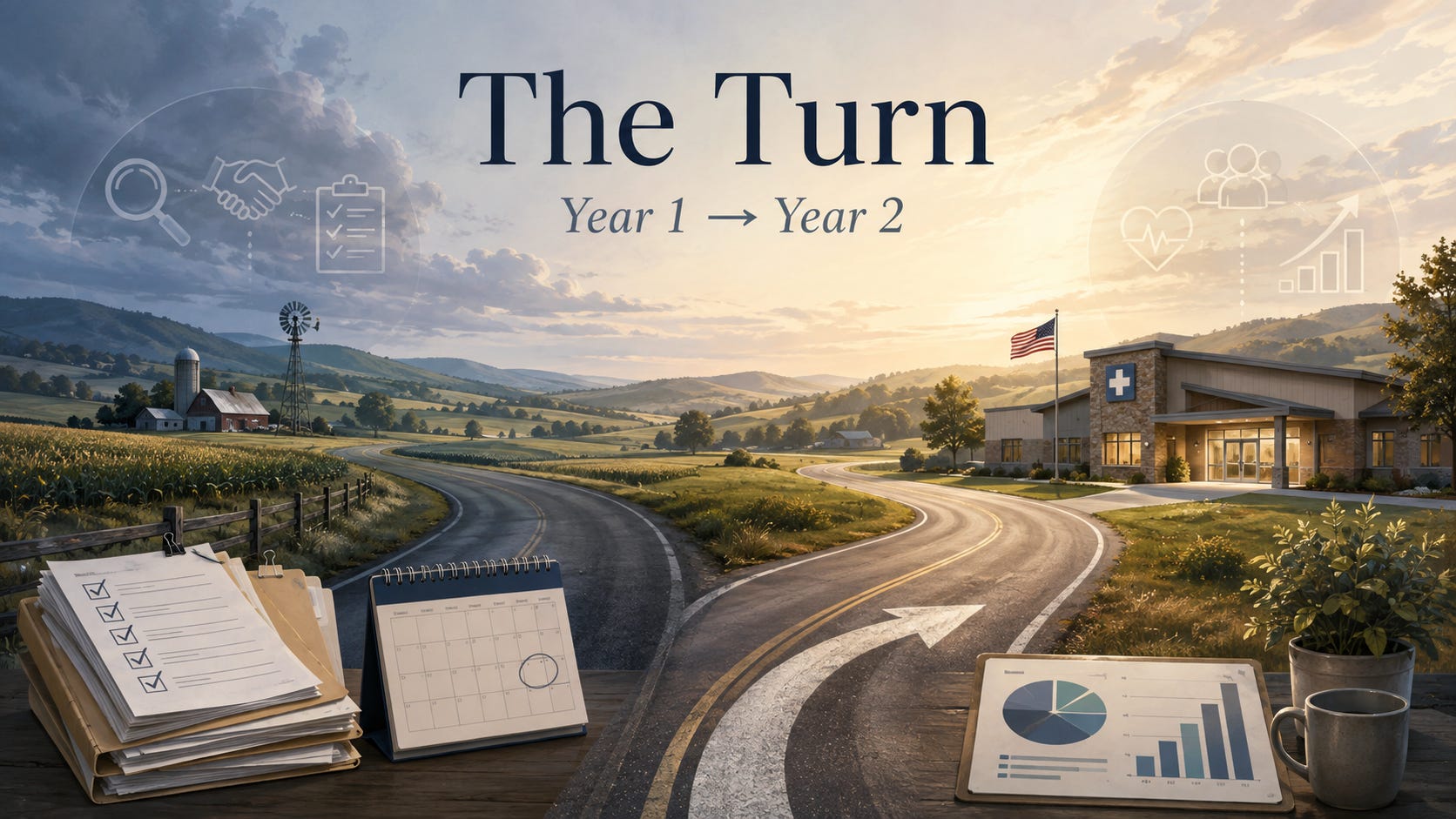
The RHTP market is beginning to turn.
Not because the program is slowing down. Quite the opposite.
The center of gravity is shifting from opportunity discovery to implementation, closeout, and preparation for Year 2.
And the most important part of that transition may still be largely invisible to vendors.
As of August 8, Rural Care Journey tracks:
603 approved, non-archived Year 1 opportunity records
394 records with deadlines already past
81 additional records due within 30 days
130 records carrying August 2026 deadlines
That does not look like an empty market.
It looks like a market entering a massive conversion and reconciliation phase.
For every opportunity that has passed its deadline, someone now has to determine what actually happened.
Was it awarded?
Extended?
Amended?
Cancelled?
Still active?
Or simply left behind with an outdated status?
That distinction matters because yesterday’s RFP can become tomorrow’s implementation contract, subcontracting opportunity, technology procurement, workforce initiative, evaluation project, or renewal.
The opportunity itself may close.
The commercial lifecycle often does not.
July produced the largest overall posting volume in the dataset, with 157 opportunities.
But competitive procurement postings actually declined from 83 in June to 71 in July.
That is a subtle but important signal.
The market appears to be moving beyond the initial wave of RFAs and RFPs and into a broader mix of grants, awards, implementation notices, amendments, and administrative activity.
In other words:
RHTP is moving from “what will states fund?” toward “who will actually deliver it?”
That is a very different market.
Across indexed state documents, workforce remains by far the strongest recurring theme:
Workforce — 1,534 indexed mentions
Behavioral health — 621
Chronic disease — 382
Health IT / AI — 360
Telehealth — 350
Maternal and child health — 312
Care coordination — 263
These are not unique opportunities or dollar amounts. They are signals of what states repeatedly discuss.
And the signal is remarkably consistent.
Technology matters.
Telehealth matters.
AI matters.
Chronic disease and behavioral health matter.
But nearly every transformation strategy eventually runs into the same constraint:
Who is going to do the work?
That is why the strongest opportunities over the next phase may combine workforce capacity with a concrete delivery model — rather than offering technology or consulting as a standalone proposition.
This is where the market becomes much more interesting.
RHTP is not a one-time grant.
It is a five-year cooperative agreement organized around annual budget periods.
And across 29 of 50 states, Rural Care Journey has already identified source documents containing Year 1-to-Year 2 calendar signals.
Two dates recur repeatedly:
August 30–31, 2026
Year 1 annual reporting and the Year 2 application to CMS.
October 30–31, 2026
The end of the first budget period / Year 1 obligation deadline, and effectively the beginning of the Year 2 budget period in many documented states.
That means Year 2 is not something that begins next spring.
Administratively, it is happening now.
This may be the most important finding in the entire report.
The tracked pipeline contains roughly:
150 approved, non-archived opportunities due between August and December 2026.
But only:
2 opportunities due between January and July 2027.
That is an extraordinary visibility gap.
The CMS calendar is already appearing across state documents.
Current solicitations in states such as Iowa and Vermont already include language making future scope or funding contingent on Year 2 CMS approval.
South Dakota goes even further, with procurement documentation stating:
“Expected release of Year 2 RFP: January 2027.”
The administrative transition is visible.
The procurement wave is not — yet.
If Year 1 taught us anything, it is that RHTP opportunities do not arrive as a smooth, predictable stream.
They arrive in waves.
January began with 7 postings.
By July, there were 157.
The same pattern could repeat after Year 2 budgets are approved.
That creates an unusually valuable preparation window between now and early 2027.
States are finalizing plans.
CMS is reviewing Year 2 applications.
Existing programs are being evaluated.
Awards are moving into implementation.
And vendors still have time to position themselves before the next concentrated release cycle begins.
The strongest strategy is probably not to wait for the words “Year 2 RFP” to appear.
Instead, start upstream.
Watch current awards.
Watch planning contracts.
Watch programs already reopening for a second round.
Read the fine print in active solicitations for Year 2 funding contingencies.
And most importantly, build state-specific readiness now.
A generic “we support rural health transformation” message will become increasingly weak.
States will want evidence:
Can you implement in this population?
Do you have a rural delivery model?
Can you staff it?
Can you integrate with existing systems?
Can you report outcomes?
Can you operate within state procurement and compliance requirements?
Can you begin quickly?
Those questions are becoming more important than whether a vendor simply fits a broad RHTP category.
There is also a smaller but faster-moving pattern worth watching.
Several states are already launching Round 2 or Wave 2 versions of Year 1 programs.
Texas, Pennsylvania, Ohio, and Oregon are among the states showing this pattern in the current dataset.
These are not technically the same as the federal Year 2 funding cycle.
But they matter.
A program that reopens for another application round is telling us something:
There was demand.
There was money.
And the state considered the model worth continuing.
That makes Round 2 activity one of the best early indicators of where future Year 2 procurement may emerge.
The first half of 2026 was largely about discovery.
The next phase will be about positioning.
Between now and the end of October, states will move through a shared federal compliance and budgeting cycle.
After that, the first truly new Year 2 opportunities should begin to emerge.
By January, if South Dakota’s published timeline proves representative, the next procurement wave may already be underway.
That means the highest-value work today may not be submitting another proposal.
It may be figuring out:
Which Year 1 programs are being renewed?
Which awards will generate subcontracting?
Which states are building Year 2 budgets around proven Year 1 initiatives?
Which capabilities are still missing?
And which organizations will already be in position when the next RFP arrives?
Year 1 is not disappearing.
It is being converted into implementation.
At the same time, Year 2 is not waiting somewhere in the distance.
Its administrative machinery is already moving.
The interesting period is the space between those two realities.
The procurement pipeline looks unusually quiet looking into 2027.
The underlying program does not.
That disconnect is the signal.
And for organizations trying to participate in the next phase of rural health transformation, this may be the best moment to prepare before everyone else sees the wave coming.
Read and download the full Rural Care Journey research report:
The Turn — RHTP’s Year 1 Closeout and Year 2 Forecast
Download the full report on Rural Care Journey
Rural Care Journey tracks RHTP opportunities, state program documents, awards, and vendor activity across all 50 states. Data in this report reflects the production snapshot as of August 8, 2026 and should be verified against official state and federal sources before procurement or compliance decisions.
Comments
Nothing yet. Say the first thing.
Sign in to join the conversation.