
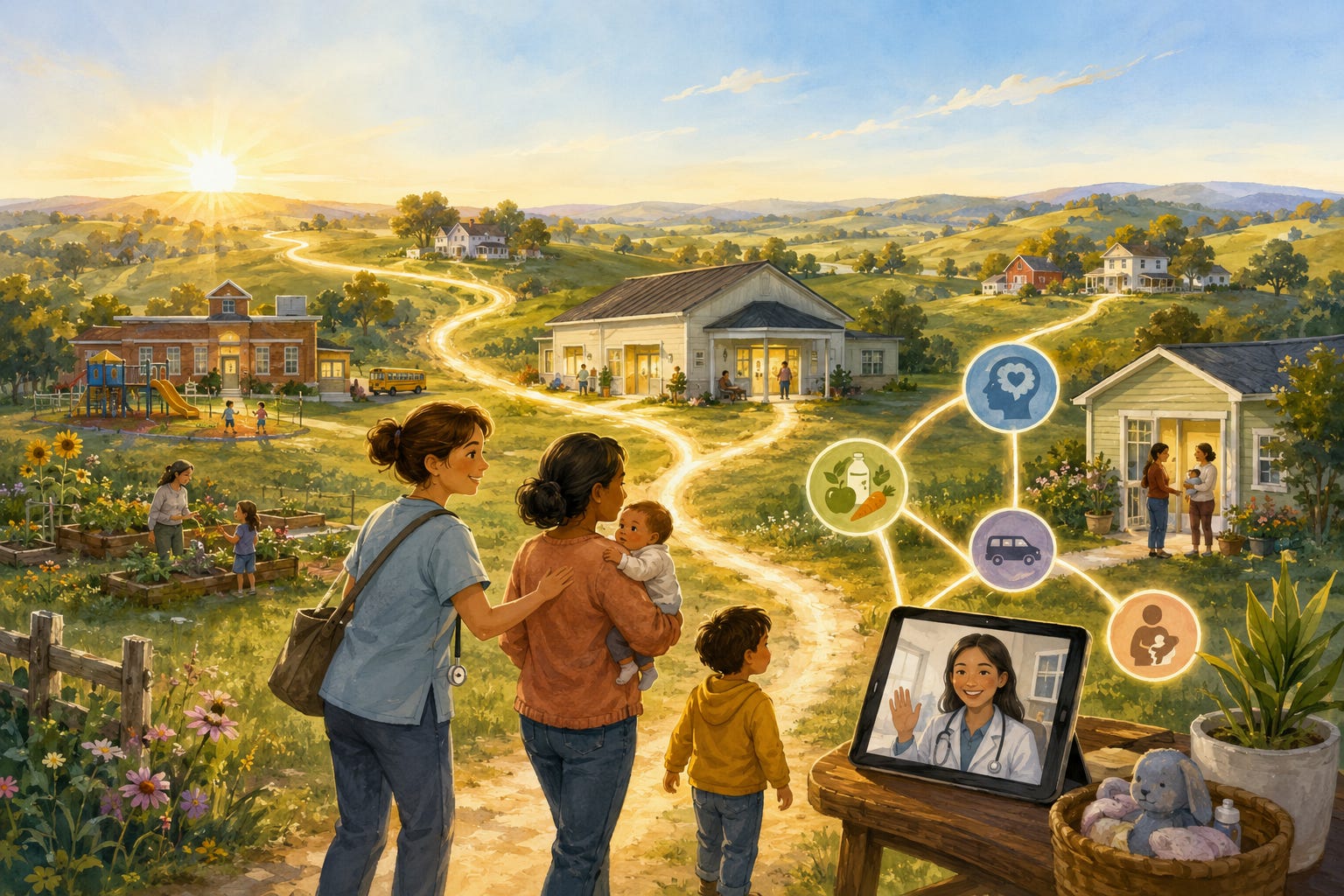
The rural health question is no longer whether the need exists.
Everyone knows it exists.
The real question is more practical: can a pregnant mother, a newborn, or a child in a rural county get timely care without the family being forced to overcome distance, workforce shortages, transportation gaps, and fragmented local systems on their own?
That is where the Rural Health Transformation Program landscape becomes interesting.
As of June 27, 2026, Rural Care Journey is tracking 570 opportunities, with 267 currently active, closing soon, or upcoming. Within that broader landscape, 67 opportunities are connected to women, infants, children, pediatric care, or WIC-related needs. Of those, 59 are not just policy references. They are direct funding or procurement channels: RFAs, RFPs, NOFOs, grants, and IFBs. [1]
That is the first major signal.
Rural pediatric access is moving from conversation into contract language.
Among the active and actionable women/infant/child/pediatric opportunities, RCJ identifies 29 opportunities across 13 states. Sixteen are due within 30 days. [2]
That matters because rural transformation is not only a policy challenge. It is an implementation challenge.
A state can have a good plan and still miss the moment if local providers, vendors, workforce partners, schools, FQHCs, hospitals, EMS agencies, and community organizations are not ready to respond.
This is becoming an execution race.
The organizations that can translate broad rural health goals into practical care pathways will have an advantage. The ones still waiting for perfect clarity may find that the first wave has already passed.
WIC appears in the current RCJ pipeline, but its footprint is still small.
RCJ shows 7 WIC-tagged records, collapsing to 3 distinct opportunities after deduplication. The active-future WIC opportunities are concentrated in West Virginia, North Carolina, and South Dakota. [3]
That does not mean WIC is unimportant. It means the opposite.
WIC may be one of the most under-leveraged access points in rural maternal and child health. It already touches nutrition, pregnancy, infant development, family support, and public health infrastructure. But too often, it is treated as a program lane rather than a bridge into broader care continuity.
The better strategy is to connect WIC with maternal care, pediatric behavioral health, referral navigation, tele-specialty access, and follow-up workflows.
In rural communities, the most valuable access point is often the one families already trust.
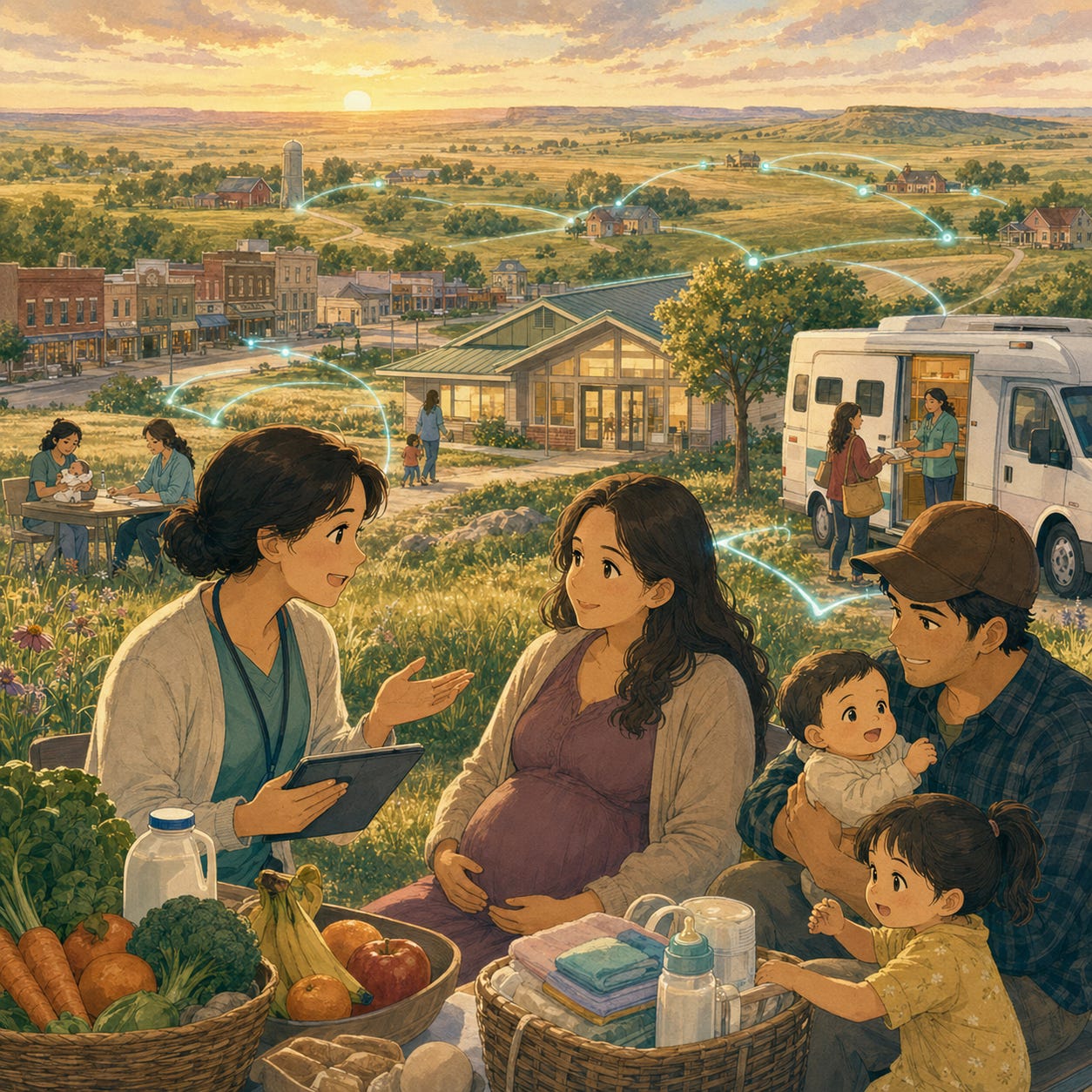
By count of actionable opportunities, Tennessee leads with 5, followed by Iowa, Idaho, Indiana, and West Virginia with 4 each. [4]
But the more interesting signal is concentration.
In Iowa and Indiana, two-thirds of the active opportunity pipeline is connected to this women/infant/child/pediatric theme. Tennessee is also strongly weighted in this direction. [5]
That tells us something important: some states are not treating pediatric and family access as a side issue. They are placing it near the center of their rural transformation strategy.
West Virginia, by contrast, has broader overall activity, with pediatric and family-related opportunities forming a smaller share of a larger pipeline. That may still be meaningful, but it reflects a different posture: broad rural transformation rather than thematic concentration.
Both approaches can work. But they require different execution models.
The RCJ data shows several recurring patterns.
Across the themed cohort, the most common categories are behavioral and psychiatric care, workforce and fellowship models, telehealth and virtual care, hub-and-spoke structures, and mobile or transport-enabled models. [6]
This makes sense.
Rural pediatric access is rarely solved by one intervention. A telehealth platform alone will not fix the problem. A workforce grant alone will not fix the problem. A referral system alone will not fix the problem.
The real solution is usually a connected pathway:
screening, referral, tele-specialty access, local follow-up, family navigation, workforce support, and outcome tracking.
That is why telehealth should not be treated as the destination. It is infrastructure. The real destination is continuity.
The strongest rural health strategies are honest about workforce.
States are buying technology, but the recurring presence of workforce, fellowship, incentive, and training opportunities shows that technology is being asked to support human capacity, not replace it. [7]
That distinction matters.
For rural women, infants, and children, access is relational. Families need someone to explain, schedule, follow up, translate, coordinate, and notice when a referral did not happen.
That work is often invisible in policy documents, but it is the work that determines whether a child actually receives care.
The most successful RHTP proposals will likely be the ones that combine workforce durability with practical digital infrastructure.
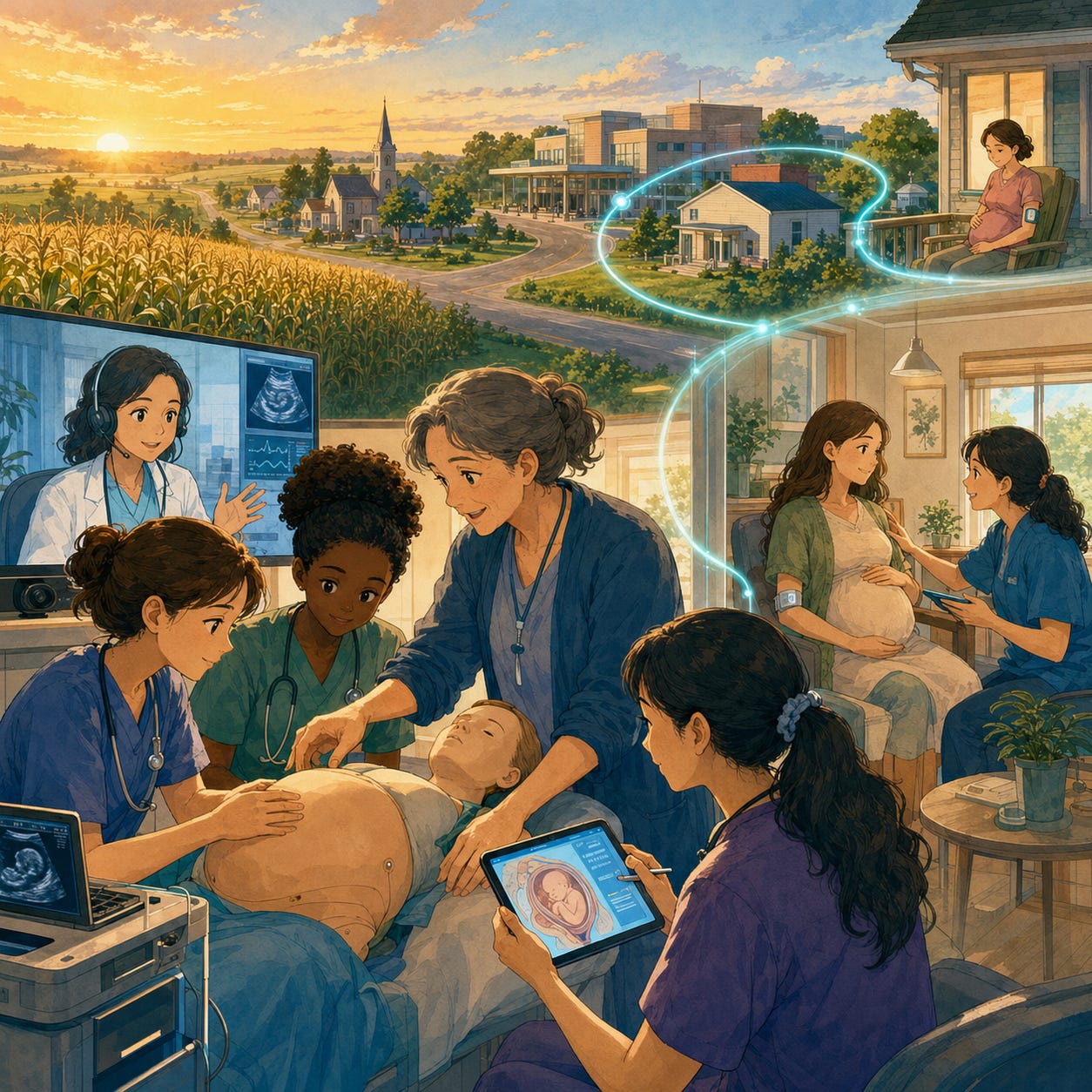
RCJ vendor workflow data does not predict winners. It does not prove award outcomes.
But it does show which vendors are appearing repeatedly in relevant evaluation activity.
Multi-capability vendors showing up across telehealth, RPM, care coordination, navigation, and workforce categories include Engineering Solutions Inc., WebMD Ignite, and Ashmi Health. High-scoring single-focus records include cliexa for care coordination, Be Well Innovations for RPM, and Bedside Matters for telehealth. [8]
Lead workflow data also shows ongoing market activity around WebMD Ignite, Elemeno Health, Ashmi Health, Engineering Solutions Inc., and Equum Medical. [9]
The point is not that these are final winners.
The point is that the market is beginning to sort itself around readiness. States and local applicants will need partners who can move beyond generic capability claims and show how their solution fits a real rural care pathway.
The current landscape points to five practical moves.
First, procure integrated scopes, not isolated services. Maternal care, pediatric access, behavioral health, WIC, navigation, and follow-up should be designed together.
Second, treat tele-specialty as a default access layer. In rural pediatric care, specialty access should not depend on whether a family can travel several hours.
Third, invest in workforce durability. Incentives, fellowships, training, local navigators, CHWs, nurses, and care coordinators are not secondary. They are the operating system.
Fourth, make WIC operational in contracts. If WIC is included, define the workflow: who screens, who refers, who schedules, who follows up, and how completion is measured.
Fifth, measure continuity, not activity. Counting encounters is not enough. The better metric is whether the pathway was completed: screen, referral, consult, treatment, follow-up.
RCJ currently contains 50 award-labeled records explicitly tied to FY2026-FY2030, covering all 50 states. In the women/infant/child/pediatric cohort, future-year markers continue into 2027, 2028, and 2030. [10]
That suggests this is not a one-year burst.
The first phase, from 2026 into 2027, will likely be procurement-heavy. States will fund behavioral health, workforce, telehealth, and pediatric access models.
The second phase, around 2027 and 2028, will likely bring more standardization: hub-and-spoke models, referral infrastructure, shared reporting, and regional care pathways.
By 2028 to 2030, the pressure will shift toward performance. Renewals and expansions will depend less on promising language and more on measurable continuity.
Did families get care closer to home?
Were referrals completed?
Did rural providers gain capacity?
Did the model survive beyond the first grant cycle?
The data does not support complacency. It supports urgency.
Rural pediatric access is becoming one of the clearest tests of whether rural health transformation can move from funding announcements to durable systems.
The winners will not simply be the organizations with the strongest language about innovation. They will be the ones that can build practical pathways for women, infants, and children under real rural constraints.
In the end, rural transformation is not proven by the size of the award.
It is proven when a family does not have to fight the system just to get basic care.
[1] Rural Care Journey production data, June 27, 2026: 570 total opportunities; 267 active, closing soon, or upcoming; 67 women/infant/child/pediatric/WIC-related opportunities; 59 in direct funding or procurement channels.
[2] RCJ actionable themed opportunity count: 29 opportunities across 13 states; 16 due within 30 days.
[3] RCJ WIC-tagged records: 7 total records, 3 distinct titles after deduplication; active-future WIC records in West Virginia, North Carolina, and South Dakota.
[4] RCJ actionable themed state counts: Tennessee 5; Iowa 4; Idaho 4; Indiana 4; West Virginia 4.
[5] RCJ themed share of active state pipeline: Iowa 66.7%; Indiana 66.7%; Tennessee 41.7%; Idaho 30.8%; West Virginia 12.5%.
[6] RCJ themed approach-pattern counts: behavioral/psychiatry 26; workforce/fellowship/incentive 24; telehealth/virtual 20; transport/mobile 8; hub-and-spoke 6.
[7] RCJ actionable themed subset: workforce/fellowship 9; behavioral/psychiatry 9; telehealth/virtual 7; hub-and-spoke 3.
[8] RCJ vendor consideration data: Engineering Solutions Inc., WebMD Ignite, Ashmi Health; single-focus high-score entries include cliexa, Be Well Innovations, and Bedside Matters.
[9] RCJ vendor campaign email log and lead workflow activity: WebMD Ignite, Elemeno Health, Ashmi Health, Engineering Solutions Inc., and Equum Medical.
[10] RCJ FY2026-FY2030 award-labeled records: 50 records covering 50 states; future-year markers in themed cohort extending into 2027, 2028, and 2030.
No posts
Comments
Nothing yet. Say the first thing.
Sign in to join the conversation.