
This is a side-scrolling black-and-white monster horror film that got a mention in Scott Mendelson’s Best Movies of 2025 post (paywall). It’s low-budget: various sources say $20,000. I don’t know what type of dollars those are; it was shot in Sydney and you hear some Australian accents. It runs for a bit over an hour and is on YouTube. I’d say it’s just OK, but I recommend it:
I recommend it because seeing the behind-the-scenes afterwards is fascinating, at least for me as someone who has never seen a film being made before. A lot of work and creativity goes into making something that’s “just OK”! Most scenes were shot in a pretty small studio apartment, with green sheets on one wall and a camera with wide-angle lens on the opposite wall, juuuust far enough away to capture all the ~5-metre set.
Super cool stuff.
This is a Holocaust film mostly centred on a US Army psychiatrist tasked with assessing the mental health and stability of the Nazi prisoners before the Nuremberg trials. He spends much of the runtime talking with Göring, played by a sometimes German-speaking Russell Crowe.
Much of the emotional gravity of the film comes from the real-life history, and some documentary film scenes are shown during the trial. But I have the sense, without having read the non-fiction book that it was based on (The Nazi and the Psychiatrist by Jack El-Hai), that the movie plot was fictionalised in critical aspects more than I would have liked, with minor historical footnotes overly dramatised.
We follow Jean-Luc Godard and his sunglasses as he very pretentiously directs A Bout de Souffle, his first feature film. I don’t think I’ve seen any of Godard’s work, though probably at some point I saw something of the French New Wave, most likely by Truffaut – whether on SBS or in the UQ library, it’s the sort of thing I would have watched when studying French. I’ve surely read some Wikipedia articles on the group, film critics becoming film makers.
The 2025 film matches the 1960 film in being black and white with a 1.37:1 aspect ratio (un trente-sept dubiously subtitled as “1:37”), though other reviewers note an absence of the jump cuts for which Godard is apparently famous. Each character is introduced with their name in a caption as they briefly hold a pose looking directly at the camera, a funny gimmick repeated for a comically large number of names, of which I recognised four (Godard, Truffaut, Belmondo, Cocteau). At one point in the dialogue Sacha Guitry was mentioned, and I missed the next few seconds as I tried to figure out where I’d heard of him; I still can’t remember, but the name is extremely familiar.
The 1960 film was shot without “sync sound”, dialogue being dubbed later, so we see the director giving instructions as the camera rolls; the actors might say random words of no importance if the camera isn’t directed at their faces. Despite Truffaut having written some sort of story outline, Godard was apparently making up details as he went, with an erratic filming schedule following his daily inspirations or lack thereof. Its depiction is joyful and amusing, and I was often smiling. The only reason I didn’t bump the rating up even higher is that some of the cast or crew’s frustration feels a little artificial.
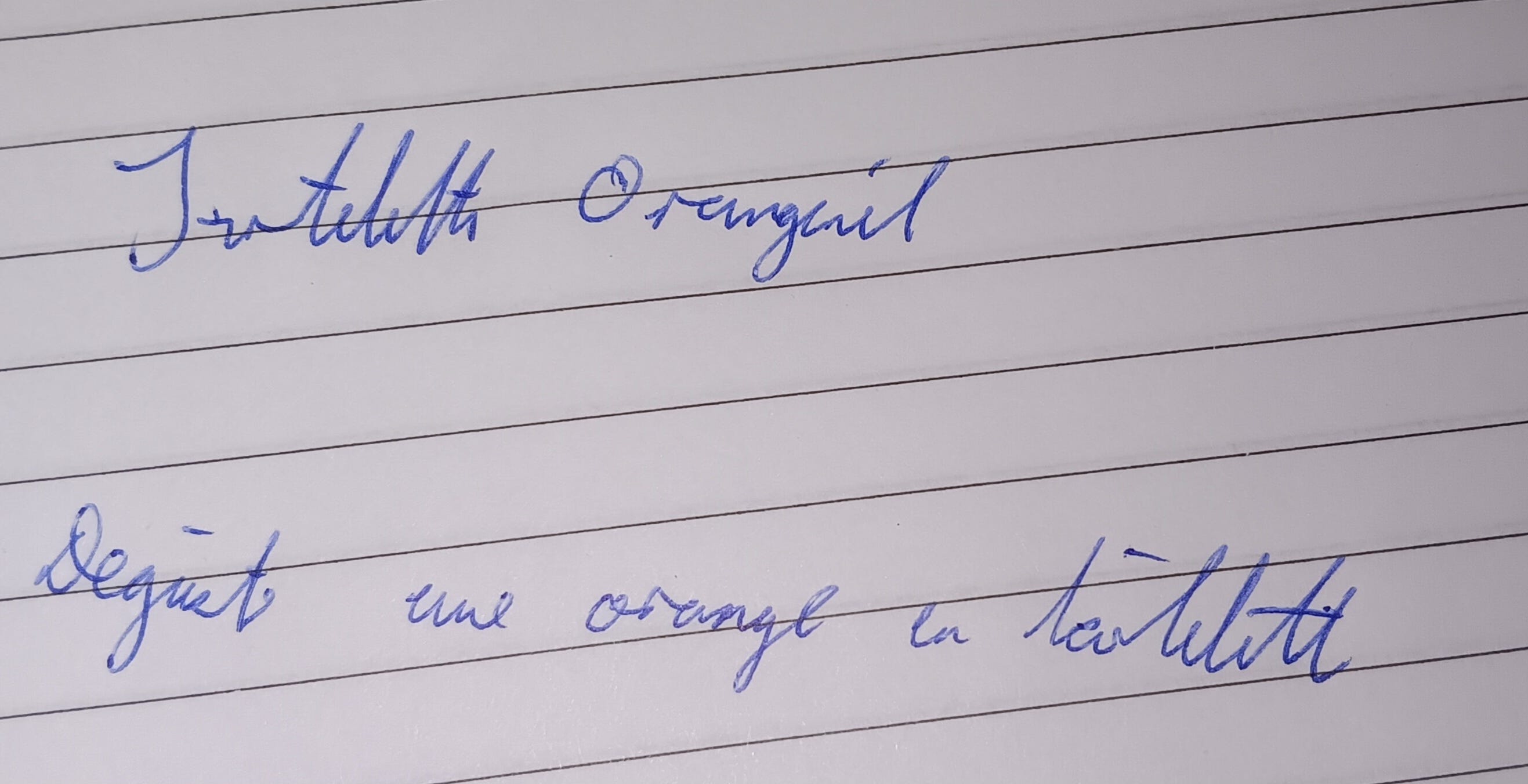
In the background of a scene in a Métro station is a billboard for “TARTELETTE ORANGINEL”, with a tagline “Déguste une orange en tartelette”. Without wishing to claim expertise in mid-century French advertising, the tagline feels stylistically anachronistic to me (and would remain so even if the ad were vouvoying me).
Hahahahahaha there’s continuous dubbed speech across the jump cuts! It’s a funny experience watching a film having just seen many of its scenes recreated (not in order). The 2025 film did a good job with the lookalikes. The scene in which the streetlights are suddenly illuminated is a particularly memorable visual; I didn’t catch which scene was filmed with the cameraman hidden in a cart being rolled along the footpath – naturalness so successful that it passed unnoticed.
(Ah! After rewatching Nouvelle Vague, it’s when Seberg is walking down the street selling newspapers.
)
The plot feels very thin by today’s standards, a murderer on the run wants to take an American woman with him as he flees to Italy; details don’t matter. And yet the story becomes quite compelling, largely thanks to the very long bedroom scene and its back and forth between Belmondo and Seberg.
Perhaps Godard really did know the essence of what should go in a film: une fille et un flingue and I, the simple viewer, am entertained.
Belmondo’s character occasionally uses the Swiss words for 80 (huitante) and 90 (nonante). In 2006 I used to watch the Swiss TV news each morning (the Swiss speak more slowly than the French, which makes their TV easier for the second-language learner), and while septante and nonante were in common usage, I only heard huitante from vox pops of old people – the French quatre-vingt·s had taken over among younger Francophone Swiss. I suppose I must acknowledge that an adult in 1960 would have already been old in 2006.
I watched the film on SBS On Demand, the experience being spoiled by repeated video playback errors and subsequent ads after a refresh. The subtitlers softened almost all the French swearing, presumably in a doomed effort to avoid the M rating which was given anyway because of a closeup of photos of topless women in a magazine.
With the pretty big proviso that I watched this in unsubtitled French, and therefore probably missed some jokes: this is a very tedious film. We follow a group of five Maoist uni students who are making a documentary about themselves, and often the movie is presented as the making of that documentary, complete with a clapperboard with Godard’s name on it as director.
The students lecture each other about communism at great earnest length, and the ridiculousness of the enterprise and their very large collection of Little Red Books was not enough to sustain my interest in between the occasional jokes that I caught. (My favourite was the heckling received by the one member of the group who’s favourable towards the French Communist Party, whistles and chants of “Révisionniste !” from his audience of three people.) There were probably more jokes accessible to a more fluent French speaker, but I doubt they’d be enough to get my rating up past 5.
“By 1968,” a year after this film, “he had switched to an overtly-political phase of revolutionary Maoist-collectivist didactic films,” says Wikipedia; Godard gets worse! That’s enough for now.
No amount of Hollywood propaganda is going to get me to listen to jazz. 😠 The harmonies are too complex for me to understand it.
I feel like of all recent non-superhero movies that I hadn’t seen, La La Land has the largest cultural footprint; I didn’t like it as much as the hype suggested I would. It has maybe the strongest ending of any movie I’ve ever seen 😭😭😭😭, but a day later it’s already fading. I thought it dragged a bit in the middle; the mass choreography was pleasant. None of the songs have wormed their way into my brain like Mao Mao.
I’d thought that La La Land had won Best Picture, but Wikipedia suggests that my memory wasn’t quite right.
Members of a poor family con their way into working in an extremely rich household. The film is funny and more or less perfectly executed, I just found the awkwardness of the first 45 minutes so powerful that it was unpleasant.
I cried every time I saw the trailer for this – Shakespeare’s son Hamnet dies – so it was quite disappointing to not be swept up in the story; I watched Jessie Buckley’s extensive emoting of acute grief with some detachment.
That the father is William Shakespeare is only explicitly revealed about an hour and a half into the film, so I like to think that some people saw none of the marketing material and got to experience it as a big surprising reveal.
It was useful to read Hamlet beforehand, which I hadn’t done previously (in high school English, we studied Macbeth, The Taming of the Shrew, and then Macbeth again).
A Korean comedy in which a middle-aged long-serving paper factory worker is laid off, and decides that his best chance of being re-hired is to murder other well-qualified former paper factory workers who’d be applying for the same positions.
The film feels aesthetically serious, appropriate for a weighty study of the human toll as manufacturing jobs are lost to automation, but there are occasional detours into farce in a plot that should be amusing. But I didn’t find it consistently funny, so its overall effect was strange; I think the Korean speakers in the audience were laughing more readily than I was.
No posts
Comments
Nothing yet. Say the first thing.
Sign in to join the conversation.