
For most of the last decade, nobody talked about Italy’s Investor Visa.
Portugal and Greece got the headlines and the waiting lists. Meanwhile, Italy sat in the background, cheaper and simpler than people assumed, letting a small number of investors in every year.
That low profile was the whole opportunity: a €250,000 investment that got you Italian residency in three to six months, renewable forever, with no requirement to live in Italy a single day, and money you didn’t wire until the visa had already been approved.
But then something changed.
The applications started climbing, the Nulla Osta started stretching, and the advisers I speak with every week are all saying the same thing: it’s shifting from effortless to busy, and quickly.
This piece walks through the transparent numbers, an updated timeline, the parts most write-ups skip, and the case for waiting compared to the case for moving. We have a solution for this, so take my urgency with the appropriate pinch of salt. I’ve also tried to give you every reason to walk away if it isn’t for you.
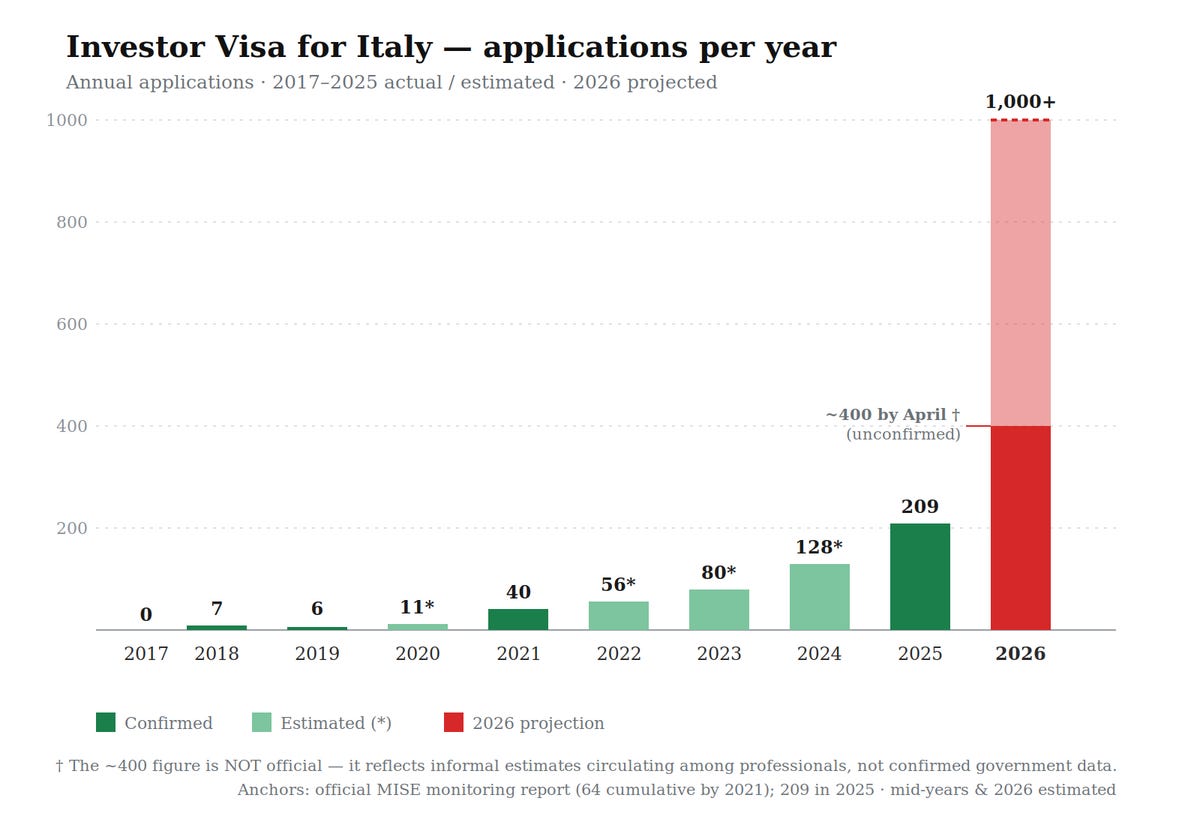
The program launched in 2018 and got 7 applications that year. Growth was slow for a long time. 2024 brought 128. Then 2025 jumped 63% to 209, the busiest year Italy has ever had with this visa. Most of those applicants came from the US, Canada, the UK, and Turkey, and most used either the €250,000 startup route or the €500,000 company route.
The 2026 number is still a rumor, but it’s the one that matters.
The people who file these cases are saying Italy took in more than 400 Investor Visa applications in the first months of the year. I can’t confirm that, and I want to flag it as unconfirmed. But we are seeing signs that this could at least be close to reality.
Because all of 2025, a record year, came to 209. If the rumor holds, the opening stretch of 2026 has nearly doubled that in a few months. Annualise it and you’re looking at close to 1,000 for the year, about five times 2025.
After years of a slow climb, the curve is very likely to have gone vertical.

This isn’t really an Italy story.
It’s a continent putting up the price on the same product, and Italy happens to be the last big door still open at the old one.
Golden visas are being repriced like any asset in demand. Spain shut its program completely in April 2025. Greece pushed its real estate threshold to €800,000 in the areas people actually want. Portugal pulled real estate out of its program entirely and funneled applicants into funds, and the queues there are long. The UK and Ireland closed their investor routes years ago. Door after door, either locked or more expensive.
What’s left standing at €250,000 with no stay requirement is Italy. Add a few years of geopolitical nerves pushing mobile families to finally pull the trigger, and you get the surge those numbers describe. Everyone found the last good option at roughly the same moment.
There’s a second pull working on the very top of the market. For ultra-high-net-worth families, the draw isn’t only the visa. It’s Italy’s flat tax for new residents, which caps tax on all foreign income at a fixed annual figure no matter how large that income is.
The UK scrapped its non-dom regime, and a chunk of that displaced wealth has been looking for a new home – many going to Milan.
Italy then raised the price of its flat tax for 2026, which tells you all you need to know about demand: it was strong enough to push the price up. More on how that works below, but it’s a big part of why the program is suddenly crowded at the top.
On paper Italy still looks great. The Nulla Osta, the online pre-approval, is fully digital and used to come back in a few weeks. The whole journey from application to residence permit usually gets quoted at three to six months. For Europe, that’s excellent, and officially nothing has changed.
But the number to actually plan around is this. The Nulla Osta now takes one to three months on its own. Budget six to nine months for the whole process to be safe, and treat anything quicker as a gift.
Why the wide range? Because two things are working against you.
Since January 2025 you have to show up in person at the Italian consulate for fingerprinting. Investor files get priority at this stage, and once you have the appointment the visa itself usually issues within days, so the consulate isn’t where most people get stuck. The one variable is the biometric slot. Slots vary by city, and in high-demand consulates like New York and London they can take a few weeks to book. Priority moves your file to the front of the processing queue, not always to the front of the appointment calendar.
Then there’s plain arithmetic. A system built to handle a few dozen cases a year doesn’t absorb a 63% jump, let alone a possible five-fold one, without something giving. We’re watching it happen in our own caseload at Bitizenship. Files that flew through a year ago are dragging, and for more and more people the Nulla Osta is now closer to three months than to one. Officially there’s no backlog. On the ground, the queue is clearly forming. If those 400-plus filings are real, that’s a volume landing on a desk sized for a fraction of it, and the Nulla Osta is where you’ll feel it first.
I lean on what practitioners tell me in real time, and they’re all saying the same thing.
Italy hasn’t slowed down in any scary way yet. But the program is shifting from effortless to busy, and the people who move first are the ones who’ll still catch it at its easiest.
Three things line up in this program that rarely line up together anywhere else.
You invest after approval, not before. You get the Nulla Osta and the visa first, then you transfer the capital, within three months of arriving. Your money isn’t sitting in limbo while a government makes up its mind. Most programs don’t work like this, and most people don’t realise how much risk it takes off the table.
You don’t have to live there. You can hold and renew the visa without uprooting anything. The first permit lasts two years, then renews in three-year blocks, with permanent residency on the table after five years and citizenship eligibility after ten, language and other conditions included. You keep control of your own calendar instead of handing it to an immigration office.
The entry point is low for what you’re getting. €250,000 into an Italian innovative startup is the floor. Here’s how the live options stack up.
Italy sits at €250,000 for the startup route, no minimum stay, with demand surging and the Nulla Osta stage now stretching to one to three months.
Greece has a startup route at €250,000 too, or real estate at €400,000 to €800,000, no minimum stay. But Greece attaches a job-creation condition to its startup route (at least two jobs in the first year, kept for five, or you lose renewal). There are also roughly 42,000 applications pending in the Greek system as of late 2025.
Portugal is €500,000 in funds with no real estate route anymore. Minimum stay around seven days a year, but the biometric appointment wait alone now runs many months, with some applicants reporting a year or more. Portugal still grants permanent residency at year five with light stay requirements, though the 2026 rules pushed citizenship out to ten years.
Spain closed its program entirely in April 2025.
Italy also gives you four routes, not one. €250,000 into an innovative startup, €500,000 into an established company, €1,000,000 as a philanthropic donation, or €2,000,000 into government bonds. The startup route is the popular one because it’s the cheapest to enter. But be clear-eyed about the trade-off. A startup equity stake carries single-company risk, whereas the €2,000,000 bond route is the safe, capital-heavy end of the same program. Pick the route that matches your risk tolerance, not just the smallest number.

This trips up a lot of buyers.
Holding the Investor Visa doesn’t make you an Italian taxpayer. With no minimum stay, you can keep the permit while your tax home stays wherever it is now. That split is one of the least understood parts of the program, and often the most useful.
If you do decide to move your tax residence to Italy, there’s a specific regime for incoming wealth.
New residents can elect a flat tax that wipes out ordinary tax on all foreign income. At the end of 2025 the 2026 Budget Law raised it from €200,000 to €300,000 a year, plus €50,000 per extra family member, and you can run it for up to fifteen years. It’s completely separate from the visa, but for the right person the two click together into one relocation plan. The visa gives you the right to be in Italy. You decide separately, on purpose, whether and how you’re taxed there.
The visa itself is one thing.
What it unlocks is another, and this is where the program gets interesting for the right kind of buyer.
The first thing most people don’t realise is that your Italian residency doesn’t burn your Schengen allowance elsewhere. Once you hold the permit, you’re inside the Schengen area on Italian residence rights. Time spent in Italy on that permit doesn’t count against the 90-day-in-180 allowance non-Europeans have in other Schengen countries. Which means you can live in Italy for months at a time and still have a fresh 90-day clock to spend in France, Spain, Germany, Portugal, and so on. For anyone who wants to move around Europe as a base rather than only visit Italy, that’s what the visa unlocks.
Family joins with no additional investment. Spouse and minor children apply through the family reunion process and get their own residence permits with full working rights. Kids gain access to Italian and European schooling, and after five years of legal residence permanent residency is on the table for the whole family. €250,000 covers the household, not just you.
You can also stack tax structures across borders. Because Italy doesn’t force you into tax residency, you can hold the Italian permit and elect tax residency somewhere else entirely. A common structure is to use your Schengen mobility to establish non-dom residency in a low-tax European jurisdiction, sit at 0% on foreign income there, and keep the Italian permit as your Schengen anchor. That gives you EU mobility plus a tax structure that extends well beyond Italy. This is the part of the program most people don’t consider until an adviser walks them through it.
And for anyone holding Bitcoin, the €250K startup route is the only golden visa left in Europe that lets you get residency through equity in an operating company rather than either forcing a taxable Bitcoin sale into fiat or parking capital in real estate you don’t want. More on the specific vehicle we built for this at the end.
Quick pause.
If you want the full breakdown of everything above, the four routes end to end, the 2026 timeline in detail, the tax stack including 24-bis and how it clicks with the visa, and a plain read on whether you should move now or wait, I’m hosting a free 90-minute webinar on Saturday, July 25th at 6pm Milan (12pm New York, 9am California).
Live Q&A at the end with our Italian migration counsel joining the call, so bring your specific situation. If you can’t make it live, register and I’ll send you the recording afterwards.
Now, the mistakes that catch people out.


These come from Giancarlo Ostetto, our Italian migration counsel, who has run these files for years and knows every way they go sideways.
Incomplete source-of-funds documentation. The Italian government wants a full paper trail on how you acquired the capital. For crypto specifically that means exchange statements, blockchain records, wallet addresses, and a clean narrative. This is where crypto-funded applications fail most often.
Investing in a startup that’s about to lose its innovativa status. Roughly 11,000 Italian companies hold the innovative-startup designation, but it’s not permanent. Companies lose it after five years of age, or when revenue crosses €5M, or on other grounds. Verify status at the moment you invest, not months before.
Treating this as a passive immigration exercise instead of an investment. Your €250,000 goes into a company that carries equity risk. That’s enough money to demand serious diligence on the team, the business model, the financials, the shareholder agreement, and the valuation. Negotiate your terms before the money moves, not after.
Not understanding the renewal requirements. Each renewal requires a fresh Nulla Osta from the Comitato Interministeriale. It is not an administrative rubber stamp. Plan for it.
Assuming the permit equals citizenship. A residence permit is the right to live in Italy. Citizenship is a separate ten-year path with a language requirement and case-by-case discretion. And the years toward citizenship only count if you’re actually resident, not if you’re using the zero-stay feature. You can hold the visa forever and never be Italian, and that is often the intended trade.

Any decision worth making should survive its own counterargument. So here’s the other side.
There’s a real case for waiting. If the program is creaking and the authorities might respond by lifting the threshold or piling on paperwork, why not let it settle first? And if you’re eyeing the startup route, throwing €250,000 at single-company equity without proper diligence is a far worse mistake than losing a quarter to patience.
On the investment side, that case holds completely. Never compress your diligence to beat a queue. Know exactly what you’re buying, what the exit looks like, and what comes back to you, before a euro moves.
On the visa timing, it falls apart. Every repricing in this corner of the world has gone one way, up, and the people who waited paid for it in time and money both.
Greece is the obvious lesson. Demand surged, waits hit 18 months at the worst of 2024, the backlog blew past 52,000 cases by early 2025, and the government’s fix was to jack the price to €800,000. Waiting didn’t make Greece cheaper, it just made it slower and more expensive.
So don’t rush. Get the slow, reversible parts moving now, and never rush the parts you can’t undo.
A few people should pass, and I’d rather say so up front.
If all you want is a cheap EU passport on a short clock, this is the wrong tool. Citizenship is a ten-year road with a language requirement and case-by-case discretion baked in. If €250,000 is money you can’t comfortably tie up or risk, don’t put it into startup equity to chase a visa. If a pure property play is what you’re after, Greece is the one that still fits, since Portugal took real estate out of its program. And if you’re not ready to do serious diligence on whatever you put money into, wait until you are.
None of that is a criticism of the program. It’s just a mismatch, and mismatches are expensive.
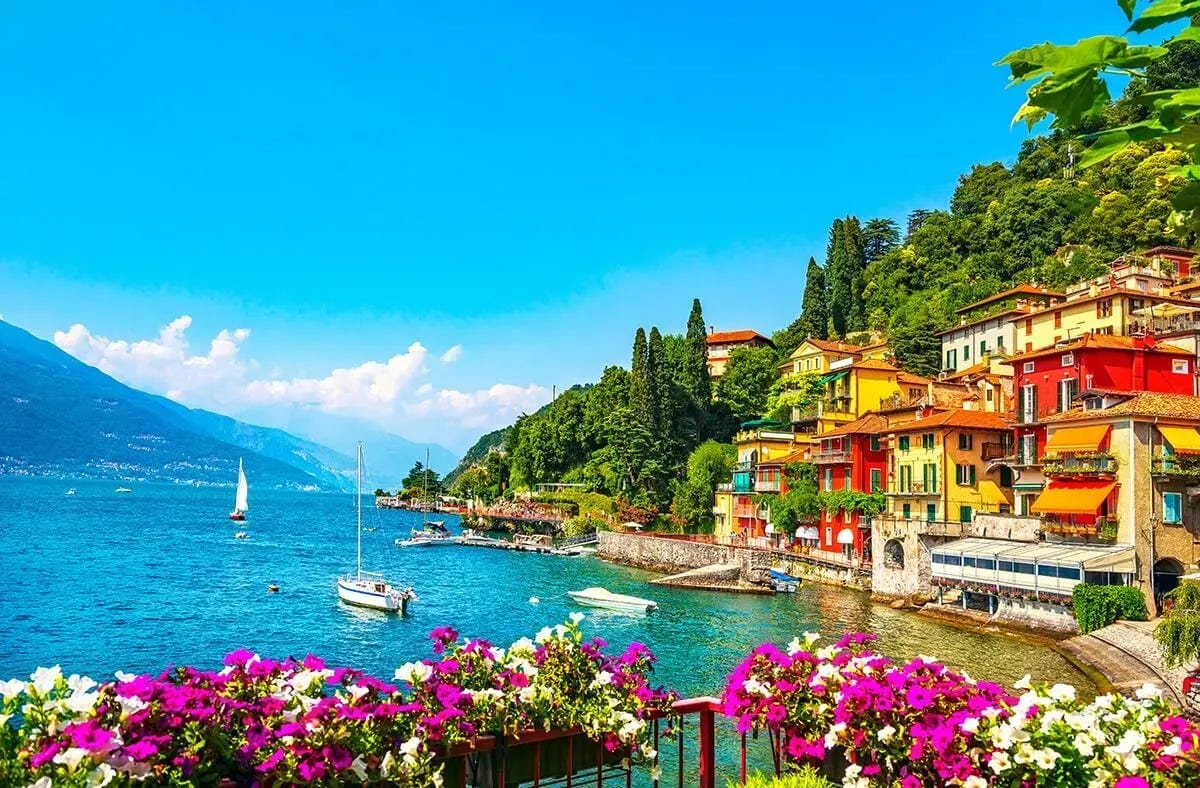
If Italy’s on your list, work backwards from a target date instead of forwards from today.
Get the slow documents going first: criminal-record certificates, proof of funds, apostilles. Across a couple of countries those take longer than anyone expects. While that’s in motion, choose your route, and if it’s the startup or company option, do your diligence properly. Then file the Nulla Osta, because that’s the clock that’s stretching. Only after it’s approved do you book the consular appointment, and after you arrive you complete the investment within three months.
The documents and the diligence cost you nothing to start and you can change course anytime. The queue is the one thing you can’t speed up later. Start the first, respect the second.

Our Italy route at Bitizenship, the Bitcoin Dolce Visa, runs on the €250,000 innovative-startup option. Investors take a Class B equity stake in Bitizenship Italia S.r.l., a Milan-based innovative startup focused on Bitcoin, which may qualify them for the Investor Visa under Article 26-bis of Legislative Decree 286/1998.
It’s built for Bitcoin-aligned investors who want speed, flexibility, and indirect Bitcoin exposure through equity in an operating company.
If a solution like this is on your radar, schedule a free consultation with our team and we’ll walk you through the structure, the Class B shareholder terms, the treasury and yield mechanics, the withdrawal windows, and whether the fit is right for your situation.

Italy’s Investor Visa isn’t a secret anymore. It’s becoming one of the most wanted residency routes in Europe, especially for high-net-worth families, which is the whole reason it won’t stay this smooth. Today it’s excellent: low to enter, no days required, money committed only after the visa is approved and you’ve arrived. Demand and the Nulla Osta bottleneck are both pulling in the same direction, and that direction is busier and slower from here.
Do your diligence carefully, with no hurry at all. Start the paperwork and the Nulla Osta without any. That’s the entire strategy.
If you’re seriously evaluating this, the fastest way to get the full picture is the webinar on Saturday, July 25th. 90 minutes, free, live Q&A at the end with our migration counsel on the call, and the recording sent to everyone who registers.
If you’re an American and weighing Italy against your options, this piece maps which European countries actually work for which profile:
Reply and let me know your situation, or which program you want me to break down next.
And if you enjoyed this, click the ❤️ button and restack.
Stay free,
Ale
Writing from Lisbon
A note on the figures: the early-2026 application numbers are an unofficial, unconfirmed practitioner rumor and should be read that way. The historical figures (7 in 2018, 128 in 2024, 209 in 2025) come from public reporting. Pipeline observations are our own and aren’t confirmed by the Italian authorities. Timelines vary by consulate and by case. The Bitcoin Dolce Visa is an equity investment in an Italian innovative startup, not a fund or a direct purchase of Bitcoin. Returns aren’t guaranteed and startup risk applies. Residency and citizenship outcomes depend on meeting all legal requirements and are never automatic. Tax treatment depends on personal circumstances and can change. This is information, not legal, tax, or investment advice.
Comments
Nothing yet. Say the first thing.
Sign in to join the conversation.