
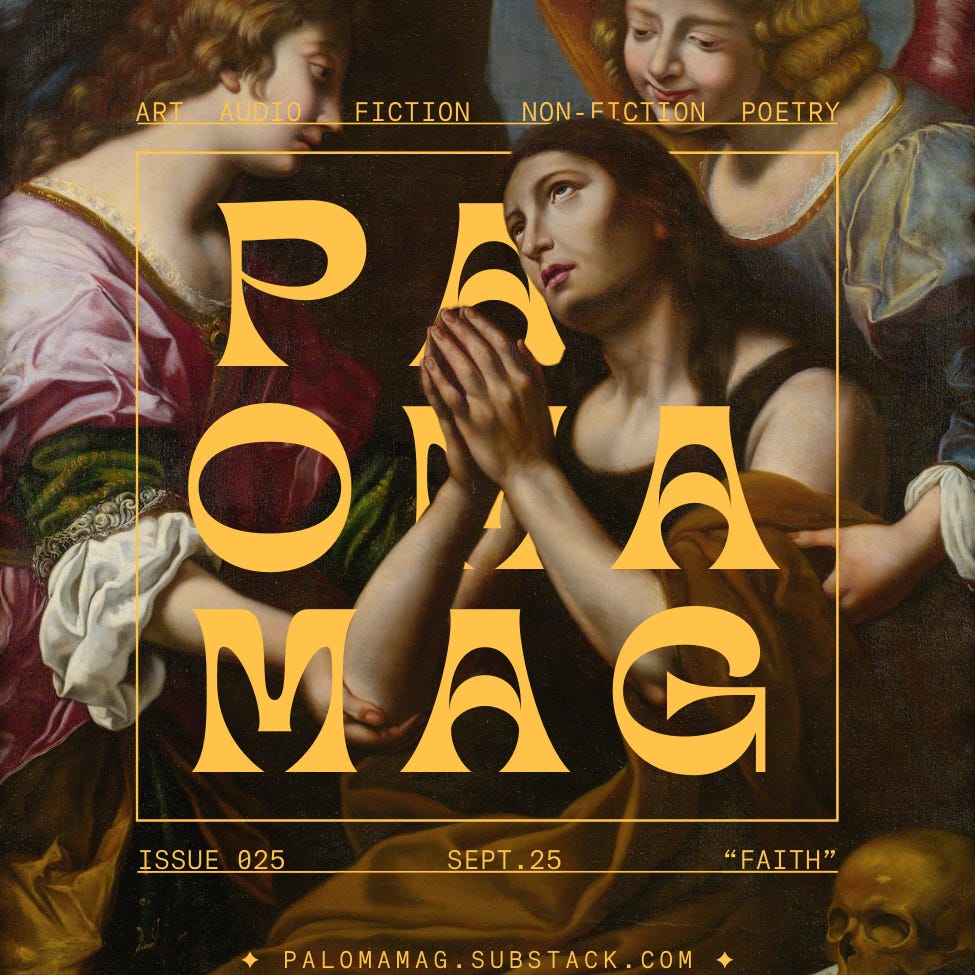

Welcome to ISSUE 025: FAITH 🪽
In the waiting room at the doctors office, I count the tiles on the ceiling. My phone is dead and I’m bored so I’m ruminating and counting. I think about praying, though I’m not sure to whom, or to what. Lately, or maybe always, I’m searching for religion. I’ll take whatever I can get, but usually I settle on some sort of vague and undefined spiritually. A devotion to hope but mixed with a little (a lot) of suffering, a bet on the future being worth it (though I’m not entirely convinced). My therapist asks me what keeps me up at night, I say obsession but what I really mean is faith. If I mention the word faith, I think she might call someone. But faith and obsession? Those are one in the same. I find faith in all the same places I hide my obsessions. In walking my dog dutifully every day–in the scorching sun or in the dead of winter–because Kierkegaard said that one should walk every day or else you’ll never have a good idea again. In praying to God every time my throat is sore even though I forget about him all the rest of the time. Today I find faith in looking in the mirror, seeing not God nor ghost, just myself, dependable and sane (for now). I search for something infallible to exalt, though I think that is likely a foolish endeavour. Instead, I should find peace in the constant flux of faith–some may call it instability, I call it devotion.
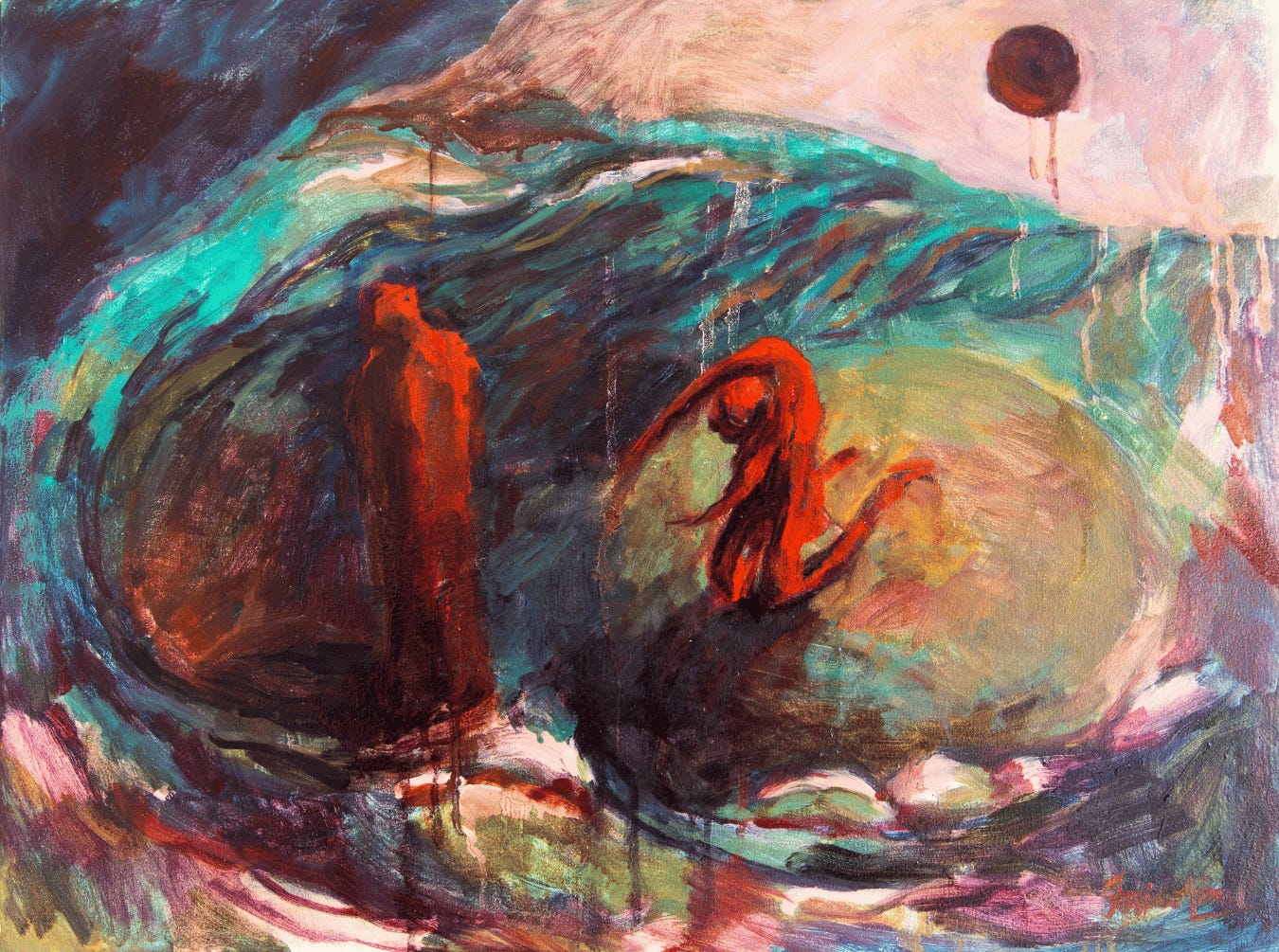
I think we all must worship something, be it a god, or a feeling, or a contradiction. Perhaps a lover, a landscape, or a perfect line of poetry. Instead of the confessional, we read, we write. We commune over words and themes and interpretation, our hunt for religion therefore has led us here. Issue 025 of paloma magazine looks at our incessant search for spiritually, at love and faith, devotion and obsession, and heaven and hell, too. Poet Nazir Awad investigates and implores his father’s god while Katie Vasquez highlights the thin line between compulsion and devotion, between self and something bigger. Fatima Ahmed’s artwork evokes an unnameable feeling, depicting something otherworldly. Kiana Rezakhanlou dives into the depths, baptizing us in her poem “Liquid Ladders.” In “Another Heaven” Katrina J. Paddock conjures up an aloof earth angel. A joint piece featuring both prose and music by Mbusi Nhlakanipho Mzolo and Maqhawenkosi Nhlakanipho (Msfit), “uKUFA” is a multimedial surrender best enjoyed synchronously. Janna Abbas wonders what to do when you can’t be mad at god and, to close out the issue, author Ajith Thangavelautham writes of swimming and lovers and the spiritual-something gleaned in light refracting off glass and water.
Whether you find in this issue a god, a ghost, or an affirmation of what you already believed, we hope you found a moment to worship these words with us.
Cat Barlowe | editor

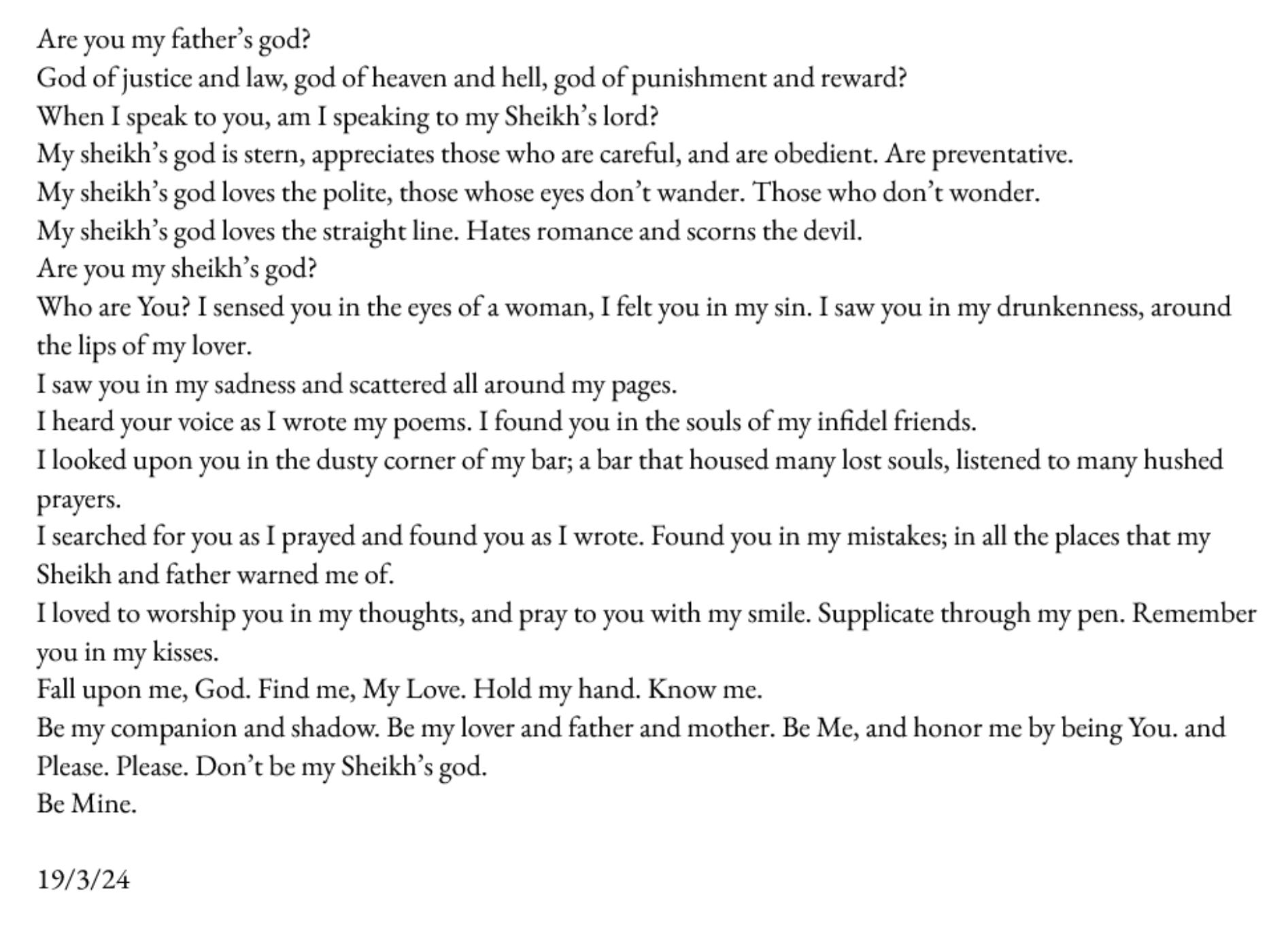
Be Mine by Nazir Awad [Poetry]
Obsessive Compulsive Devotion by Katie Vasquez [Non-Fiction]
The Tide Unravels and Uninhabited Spaces by Fatima Ahmed [Visual Art]
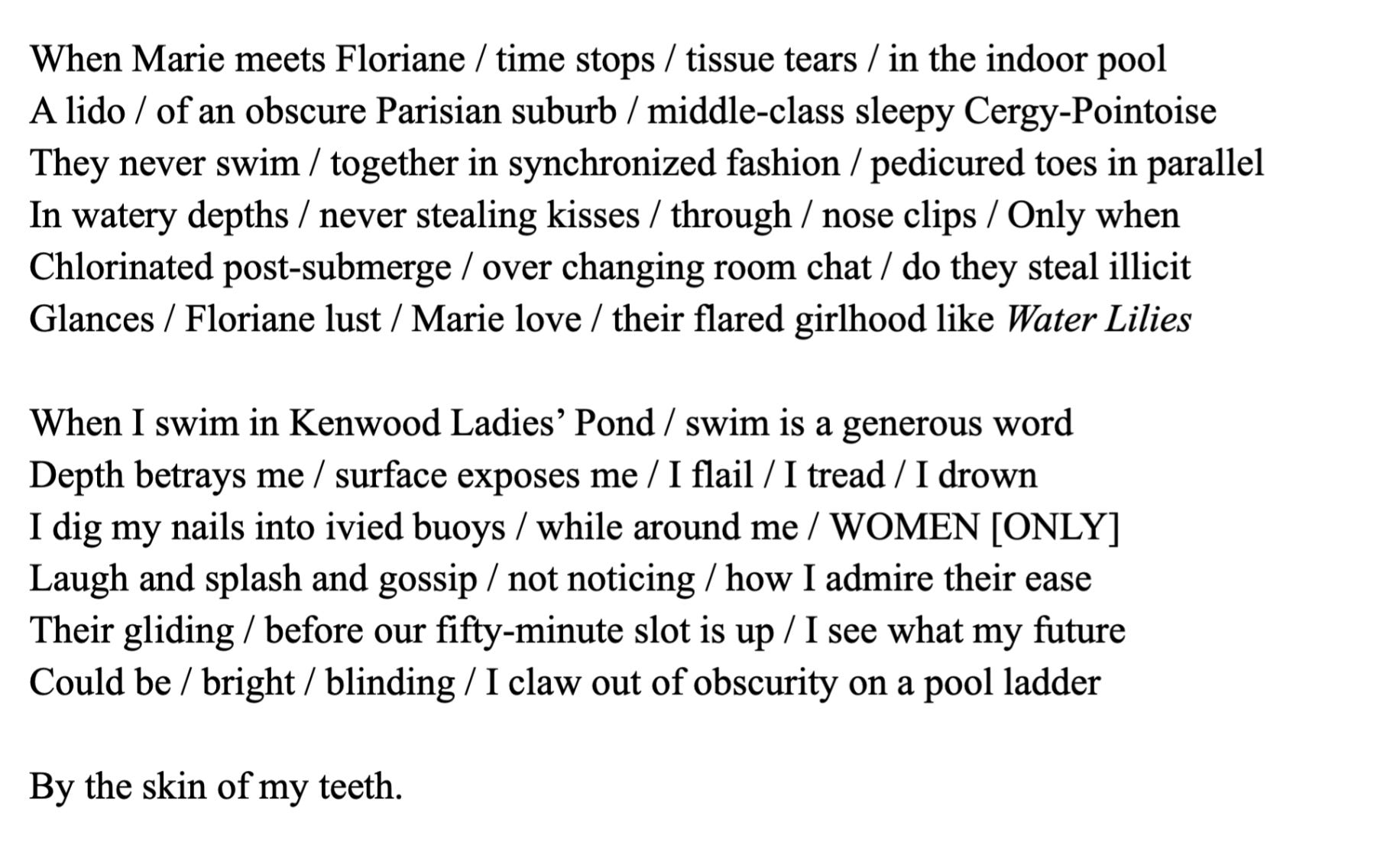
Liquid Ladders by Kiana Rezakhanlou [Poetry]
uKUFA by Maqhawenkosi Nhlakanipho; paired with audio by Maqhawe Nkosi (Msfit) [Audio + Fiction]
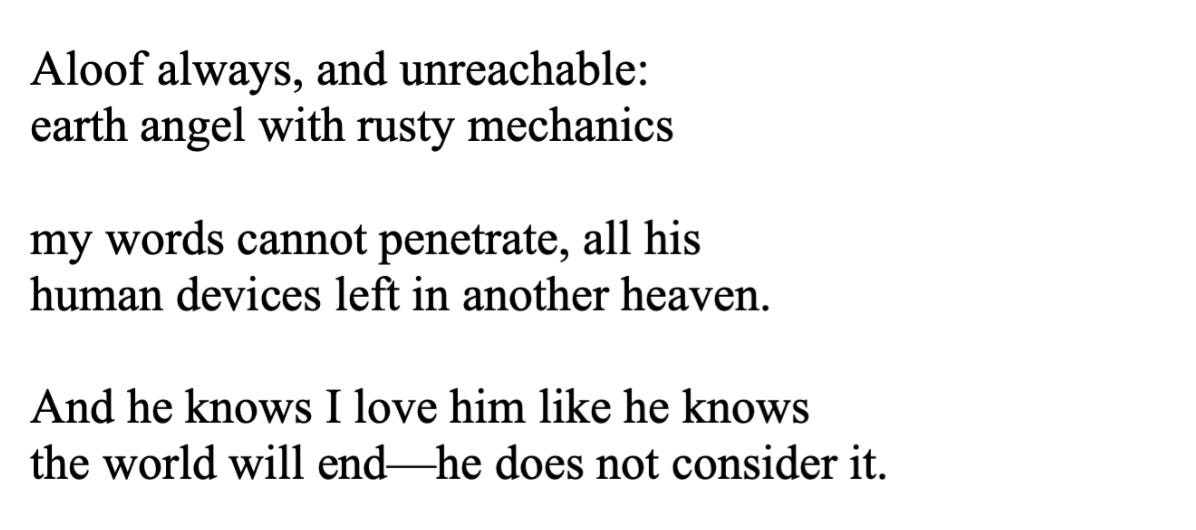
Another Heaven by Katrina J. Paddock [Poetry]
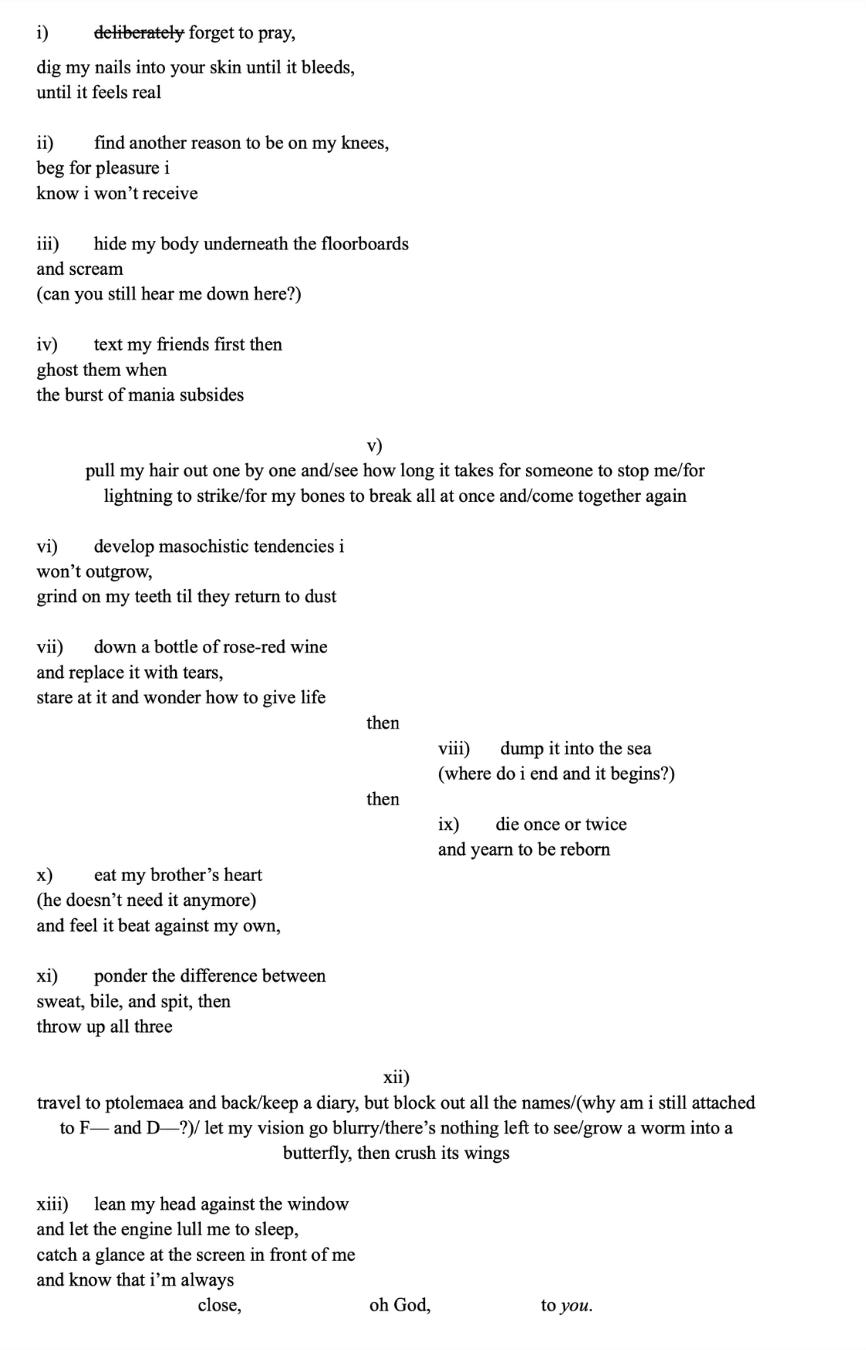
what to do when: you can’t be mad at god by Janna Abbas [Poetry]
Swimming Pool by Ajith Thangavelautham [Fiction]



Anytime we drove past our church, my parents instinctually touched their foreheads with their right hands, moving down to the center of their chests and shoulder to shoulder, quietly whispering, “In the name of the Father, and of the Son, and of the Holy Spirit.” I was meant to do the same, but would only do it once I checked the rearview mirror to ensure they didn’t see me in the back seat. When I knew they weren’t looking, I’d press myself farther into the car door and rest my forehead against the window, quickly crossing myself, and then repeat the action two more times as an apology to God for not doing it right away. While keeping my lips closed, I’d silently click my tongue against the roof of my mouth while thinking the words “In the name of the Father, and of the Son, and of the Holy Spirit.” If the prayer didn’t feel right, I would start over, looping and repeating the actions three more times, and then again three more times.
I instinctively knew when to help pull the kneeler down into place on the floor and rest both my knees on top, clasping my hands together and gently resting them on the pew in front of me, head bent, and eyes closed in prayer. Repeated rituals like pulling the kneeler down and placing it back up multiple times during mass in what felt like a continuous up-down, up-down, switching between sitting on hard pews, standing, and kneeling again, would follow me out the church grounds past the steaming suburban Texas asphalt parking lot. It all mixed and clung to my body.
It was the continuous choreography, like the barre routines in ballet class, the almost mindless pirouetting repetition of actions, not necessarily the words coming out of my mouth or prayers silently prayed. Year after year of a continuous spiritual echo, grooming my impressionable body. A searing anguish, as though I were holding my hands over a lit flame to prove my devotion. But it lived not only in my body—but in specific areas of my being like stigmata, less visible but still closer to God.
As the months of Sundays came and went, I noticed myself feeling exhausted after standing for a two-minute hymn, swaying back and forth, not moved by the organ and various singing voices lifting towards the ceiling, but picking up one foot and then another from the hard floor to relieve the throbbing in my heels. Bones popping like the wood pews relaxing after hundreds of pounds of weight lifted off them. I kept losing track of where we were in the order of mass, dizzied by the effort of keeping myself upright. Somewhat settled, I noticed someone reaching for my hand to shake, offering a blessing of “peace be with you.” Wincing, I responded, “and also with you,” feeling a quiver in my hands like invisible ants were crawling all over. I desperately wanted to thrust my hand into holy water. I became more and more uncomfortable as the hour-long mass stretched ahead.
Kneeling again, I opened a single eye, and glanced around at my parents and down the long pew. I shifted my bent knees on the kneeler, feeling a slip in my kneecaps as they held my body’s burden, a sensation that didn’t feel quite right, like cake on a hot day, layers of icing melting and sliding out the sides. Their posture was erect—they weren’t shifting or fidgeting like I was. I lifted my gaze up towards the altar at a large cross with the crucifixion, opening both eyes wide—Christ had obvious reasons to be suffering. He bleed rose-red blood from a crown of thorns slicing into his head, blood clumping his hair and staining the wooden cross. The nails in him didn’t look like the nails dad had me practice my hammering skills with–these were larger cruder more brutal looking. He was slumped and emaciated with an anguished expression on his porcelain face, a slight tear running down his cheek. His body slack from pain, his chin slightly lifted, and his eyes looking up towards his father, God in heaven. Christ had a reason to be in pain—anyone could see that. No one could see my pain.
I decided to be like the saints I saw in stained glass and stone sculptures in the garden outside the church. Like Saint Rita of Cascia, her concrete forehead rubbed oily smooth where her stigmata supposedly appeared surrounded by wreaths of woven roses, and St. Francis, hands open onto a verdant earth, welcoming the stone animals to eat the seeds from his open palms. Their suffering was not visual for the sake of humanity—I didn’t look at them and feel unentitled to my pain like I did when witnessing Christ on the cross. The saints embodied serenity, deep in contemplation, open-armed and accessible to those seeking comfort. If they could overcome their pain and hardships and stand before me in stillness, offering a respite for my earthly afflictions, then I would emulate them.
My mouth became a silent place for my obsessions to live. My pain felt deserved, a sin for what I lacked spiritually. My tongue held onto and repeated prayers while lying in bed at night until the sun began streaming through my bedroom blinds. I started counting the hours between meals, restricting when my body could eat. Once I completed my first Holy Communion and could take part in receiving the Sacrament of the Eucharist, the paper-thin wafer representing the body of Christ would satiate the hungriest parts of myself. For my first communion, I was expected to allow the priest standing at the altar to tip the gold cup to my lips, taking in a small mouthful of wine. I believed this sip would cause my body to lose control and my silent tongue to whip and lash about the church. I’d flail around the pews and release every lewd movement my body could muster. Words I was told never to say would exorcise forth from my throat.
The vision wouldn’t leave my head. Walking up the aisle to the altar, my mind raced. A decision had to be made. The priest tipped the cup to my lips, and they remained sealed shut—a droplet of sweet red liquid lingered on my upper lip—my tongue snuck out from between my lips, and I licked.



0:00
-2:30
The Story Behind uKUFA. U “kufa” is isiZulu for “death”. Death can be understood through a plethora of lenses. The lens or lenses one chooses to use when engaging with the subject and reality of death, is primarily influenced by one’s relationship to death. Some were introduced to death at an early age. An age too green for trauma processing. Others get to deal with death when they’re seasoned and have the necessary tools to deal with death.
Below is a story by Maqhawenkosi Nhlakanipho. It touches on the many elements attached to death with care and candour.

The village of Emadadeni was never the same after the day Thembi's brother, Sibusiso, passed away. Thembi was consumed by grief, unable to bear the thought of living without his sibling and best friend.
As he wandered through the village, Thembi felt the weight of death's dark presence. Everywhere he looked, he saw reminders of Sibusiso's absence: the empty chair at the family dinner table, the silence where his brother's laughter once filled the air, the unspoken words that would forever remain unsaid.
Thembi's emotions swirled like a raging storm, threatening to destroy him. He felt angry, sad, and helpless all at once. He couldn't understand why death had to take his brother, leaving him with a gaping hole in his heart.
One day, while walking through the village, Thembi stumbled upon an old man sitting by the river. The man's eyes seemed to hold a deep wisdom, and his presence radiated an aura of peace.
"Kufa, kufa," the old man whispered, as if speaking to the wind. "Death, death. It is a part of life, my child. A reminder to cherish every moment, to hold dear those we love." He felt a lump form in his throat as he listened to the old man's words. He realized that death was not just an end, but also a beginning – a chance to celebrate the life of his brother, to honour his memory, and to find a way to heal.
As the sun dipped below the horizon, casting a warm orange glow over the village, Thembi felt a sense of peace settle within him. He knew that he would always carry Sibusiso's memory with him, but he also understood that he had to keep moving forward, one step at a time.
Death became a reminder to Thembi to live each day with intention, to appreciate the beauty of life, and to find strength in the face of adversity. And as he walked back to his village, he felt Sibusiso's presence with him, guiding him toward a brighter tomorrow.



Ka stripped down to his tighty-whities and jumped into the pool - we were at the same swimming level, still scared to go into the deep end. He was my nephew, a child, so he would surpass me soon enough. My shoulder made it difficult to practice often, I had other excuses too. I wondered in what other ways he would surpass me and how soon.
The body’s deterioration was new to me, I had believed so fundamentally in the immortality of youth, it was the only thing I truly had faith in, not the pantheon of hindu gods, not my parents, not money, not the west or the east, not earth or space or love or art, only youth and its wonders, until I was rudely and suddenly excommunicated for no reason other than time. It wasn’t that youth ended, youth was still out there - I watched Ka swim heedlessly like he would never grow up, I hoped I would never be bitter, especially not towards him.
I waited for Shani on one of three folding metal chairs. I never bought her flowers but every time I saw her I wished I had. Her chin-length hair was wet and curly and she smelled like coconut oil. I unfolded a chair beside me and she sat. Ka waved furiously from across the room and then flipped underwater when she waved back so that his skinny legs were in the air.
“I saw the news,” she said to me, “Did you hear from your dad? How’s your mom?”
“Not yet,” and, “She’s fine.”
The pool felt like an illusion it was so out of place in Shani’s shitty building, one of those lego and plaster buildings that went up in less than a month with the cheapest materials possible. The pool was a revelation, until you saw it up close: the tiled walls were browning, ventilation was poor so the smell of chlorine was nauseating, the pool itself was the length of 3 large men. There was never any supervision, the temperature was a constant lukewarm. The ceilings were surprisingly high with narrow horizontal frosted windows placed maybe 2 large men high off the ground which gave the room an ethereal quality, filtering light, when the sun was angled right, across the surface of the water, dazzling like we were somewhere beautiful.
“It’s ironic though, me learning how to swim over here, then there’s a tsunami over there. Like broken telephone.” She hit me on my once-broken shoulder. I winced, exaggerating.
“You shouldn’t joke about things like that.” She thought I thought it was funny. I didn’t. I thought it was serendipitous, in that devilish sort of way that fortune telling worked, like my bones knew the earth was preparing to seize halfway across the world, like the piece of tooth I chipped as a child over there had burrowed its way deep down, felt the unusual tremors off the coast of Sumatra months ago, and sent me a warning. As if knowing how to swim was useful in a tsunami. Swimming feels like language, you couldn’t forget it even if you wanted to. But without practice my Tamil had become stuttered and flat, and I could barely even float anymore, as though my body didn’t understand chlorinated pool water.
Shani massaged the stitches gently underneath my shirt. My body melted when I was around her, I was a puddle of glorious formless flesh, I thought this was the point of love, to become formless. She slid down into her chair, she must’ve felt it too. She was wearing uggs and sweatpants and a big hoodie. Her skin looked so smooth I wanted to kiss her. I moved my chair closer and held her hand but she didn’t curl her fingers around my palm like she usually did, they splayed out, straight and taut.
“I’m seeing someone else,” she said and then relaxed her fingers into mine.
Shani and I broke up almost a year ago. We promised to tell each other when we started seeing other people. I didn’t say anything to her when Ali kissed me because I didn’t like how he tasted, meaning it didn’t count. I had other excuses too.
Ka was trying to get our attention, we hadn’t looked at him in some time and he knew it.
Shani looked at me and I looked at him, and he looked at her, Ka only wanted her eyes and he looked jealous at the way she watched me. The water around him dazzled like we were somewhere beautiful, it was that time of day, almost sunset but not quite.
I felt we were at the temple, a different kind of temple, one more suitable to prayer. I thought of the plaza temple near my house, in between a hakka restaurant and a used car dealership, or the newly opened million dollar temple an hour’s drive North West, painted all white, not so different looking from Shani’s paper mache building, an underwhelming but passionate imitation of once-greatness. It looked like I could hook it up to a truck and move it around, its one redeeming quality being its apparent movability. I found places meant for prayer to be so sacred and thus sanitized and, because of the sterility, that god could not be reached. I found them to be so specific and desperate, I preferred to find god in the dirty grout of a pool floor or the sweaty hand of a lover.
Here I prayed for what seemed like a graciously long time, the longest I had ever consciously prayed. I didn’t know any mantras or mudras, or even how to sit. I was slumped and my dick wasn’t erect but it was harder than it should’ve been because I was still holding onto Shani and she made me feel like a puddle. My mind wasn’t empty it was almost the exact opposite of that. This was the only way I could pray, like a human, and the holy sun-touched chlorinated pool water bestowed upon me atonement, atonement for my helpless aging and my memories of salt water and my ugly way of loving Shani, none of which would ever change.
Then the sun moved and the water turned dark and stale again and Ka went underneath to curse me probably.
Shani and I sat, still holding hands, her watching me and me watching Ka, until a group of Chinese men came in with goggles and speedos and swim caps. We didn’t bring a towel so Shani ran upstairs to get one. I told Ka to put his clothes on quick, he grumbled because he was soaking but did it anyway, he knew when not to argue with me.
We ran out of the building and I imagined it toppling behind us, or better, melting into pulp and glue, but we didn’t look back, we kept running along the sidewalk and Ka started sneezing because his hair was wet and it was cold out and he asked why we were running and slowed down because his lungs were smaller than mine. I was pleased, as if it were some sort of accomplishment to outrun a 7 year old.
I knew I should wait for him but I couldn’t make my legs stop moving, I felt more human than ever, my feet alternately touching the ground with every swing. I thought it was the first time I ever really felt the ground, and then I tripped and scraped my cheek.
A man across the street yelled out, “damn are you okay.” Cars passed but the sidewalks were otherwise empty. I waited like that on my stomach for Ka to catch up. He said nothing, he was a smart kid, uncomfortably perceptive for his age. He helped me up and we waited for the bus to go back home.

Thank you for reading paloma, a monthly art and literature magazine. For information on submitting your work, please see the Submission Guide. You can find us on Instagram, and you can catch up on past issues here.
Subscribe today to receive the next issue directly to your inbox ↓
Comments
Nothing yet. Say the first thing.
Sign in to join the conversation.