
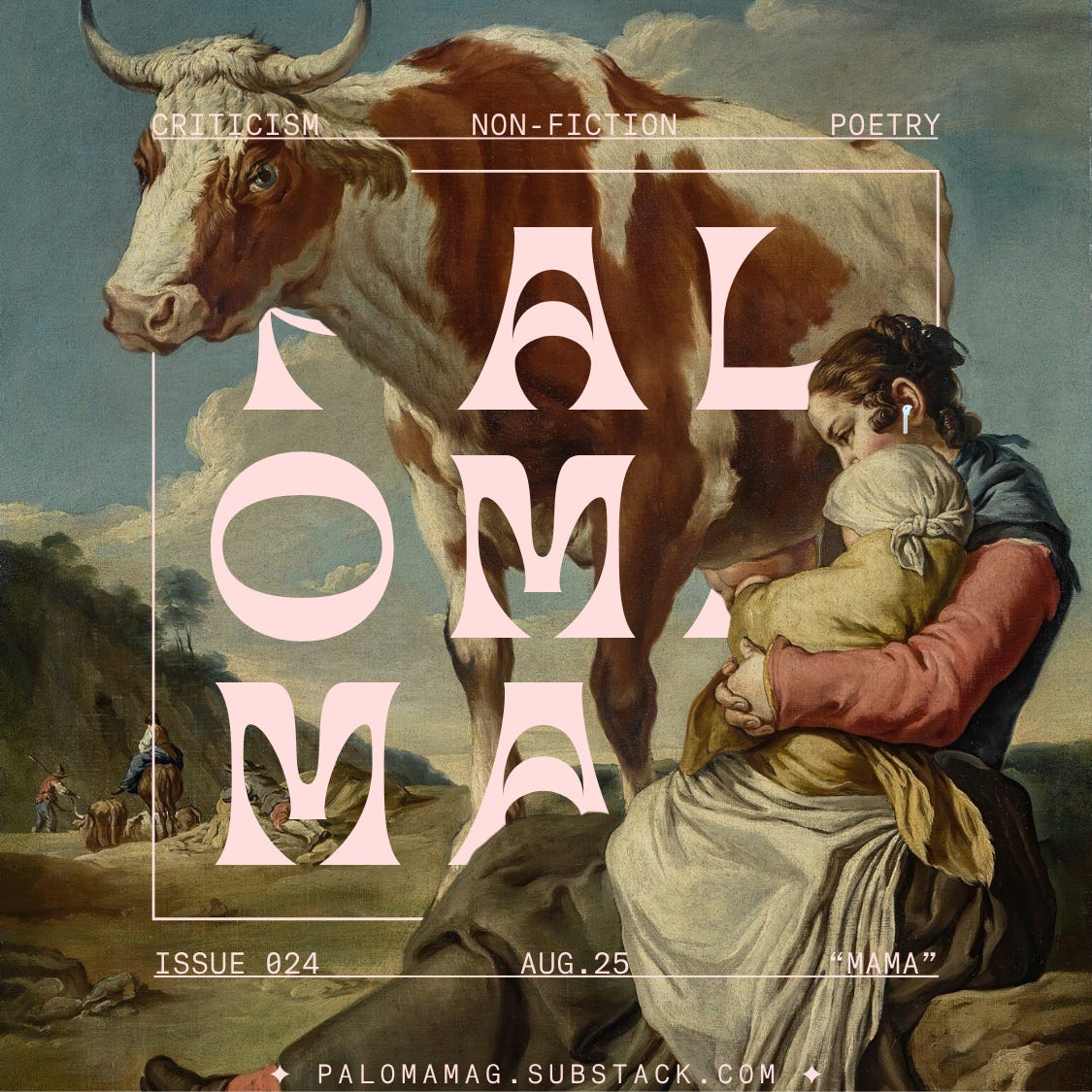

Welcome to ISSUE 024: MAMA 🍼
Earlier this year, my best friend’s book club decided to read Boulder by Eva Baltasar. Although I am not part of the club, as I live in another country, I like keeping up with their monthly book choices and inquiring about the opinions shared during their meetings. I hurried to get my own copy when I heard of the visceral, rage-to-tears reaction some members had had to the above-mentioned sapphic story of motherhood. I am not a mother, but I am a woman born in the 1990s. Motherhood is one of the liveliest matters of discussion orbiting me and my peers these days—whether it’s a deep desire for, or a resolute rejection of, its implications. But wherever we land on the spectrum, none of us escape the comparison of our childhoods, during which we witnessed the Internet’s first assured steps into our daily lives and those of our children, intimately bound to the vertical aspect ratio from birth. This comparison leads to the fecund questions on what this means for our children, for our societies and, crucially, for our mothers.
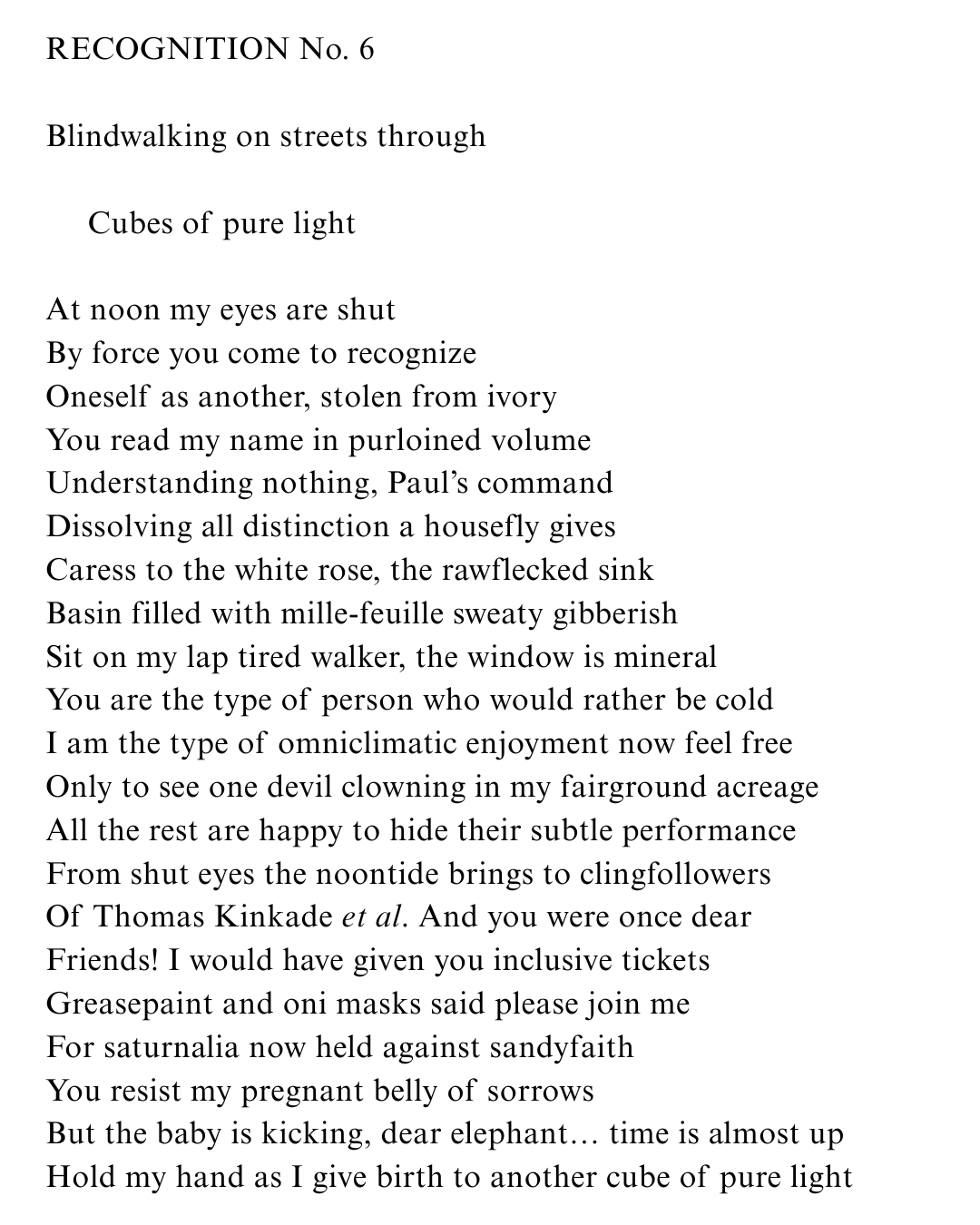
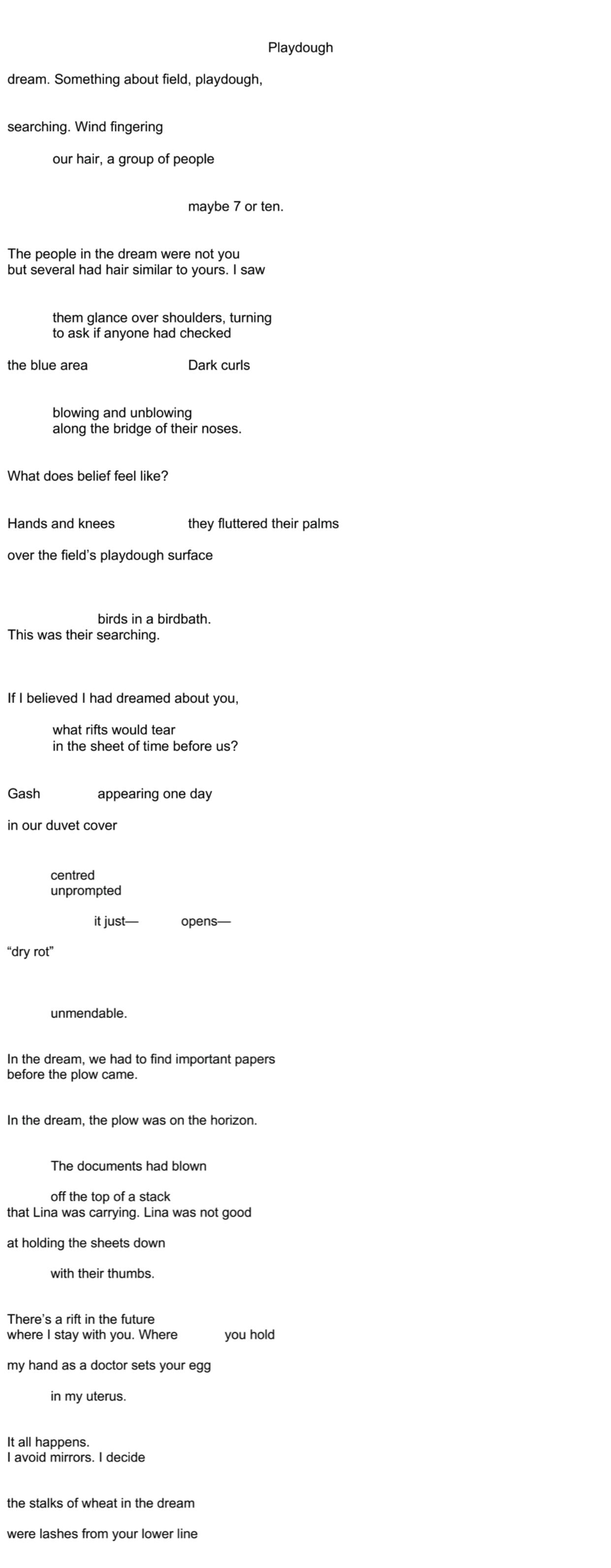
Like my co-editors at paloma magazine, I am therefore thrilled by the engagement that our recent themed call on millennial motherhood generated. Samara’s poem “29 November 2023” opens this issue with sharp sincerity by giving thanks “for that little muscle of enduring.” In “Wholly Mother,” Clare reads Rachel Cusk, and responds from a place of raw, personal experience: “I became a Cassandra revealing who I could become as a mother.” Meanwhile, “You resist my pregnant belly of sorrows,” writes Sam Robinson in the singular and striking piece “RECOGNITION No. 6.” In “Vita Ex Machina,” Abby Lacelle reviews Amanda Hess’ Second Life: Having a Child in the Digital Age, an insightful and moving look at technoparenting and online motherhood. Claire Geddes Bailey leads us into an oneiric experience of queer partnership evolving into queer parenthood, foreseeing that “There’s a rift in the future / where I stay with you” in the poem “Playdough.” We close with “Transcribing the Milk,” where mother-and-daughter duo Bethany G.L. & Lumyhna Soret enchant us with co-authored diary excerpts. “11 years of life for me,” writes young Lu. “I get so lucky.”
Perhaps fittingly, with this issue paloma magazine turns 2 years old and enters its toddler years! It’s an understatement to say we are grateful for your enduring engagement and for the way this space has continuously expanded. Each month we have been catching ourselves saying “THIS! Is the best issue yet,” until the next one comes around.
We feel ecstatic to be starting our third year with this hopeful and generative thrust!
Nilay CC | poetry editor

29 November 2023 by Samara [Poetry]
Wholly Mother by Clare [Non-Fiction; Criticism]
RECOGNITION No. 6 by Sam Robinson [Poetry]
Vita Ex Machina – Review of Amanda Hess’ Second Life: Having a Child in the Digital Age by Abby Lacelle [Criticism]
Playdough by Claire Geddes Bailey [Poetry]
Transcribing the Milk by Bethany G.L. and Lumyhna Soret [Non-Fiction]


Text within this block will maintain its original spacing when published
On today my birthday
I give thanks
for my washer dryer unit
my baby
my husband
and the state of New Mexico
in no particular order.
Remember in the city
how we would drag
garbage bags of clothes
down two flights of stairs
half a mile in the snow
to the bright laundromat
with tropical plants & Telemundo
how we moaned and grumbled
every time yet amid the grey slush
beneath the fluorescent lights
between shots of Malört
and within plasticked windows
we were falling in love.
On today my birthday
I give thanks
for the element of surprise
for the patience taught by
drudgery, paperwork
bad weather, laundromats
illness, misfortune.
I give thanks
for wonder and how it humbles
I give thanks
for that wiry little muscle
of enduring
that builds the house
and tills the fields
of any lasting happiness.
I give thanks
for you and the baby
who make me suffer
and drown me in joy
and for my washer dryer unit.

“Millennial motherhood does not have to be about ‘having it all,’ but being firm in our personhood. Even as mothers, we are whole.”
I move a small lilac and turquoise toothbrush, its bristles frayed, aside to open my laptop to write this piece. Is my child’s toothbrush left on my desk a metaphor for how motherhood requires careful rearranging of myself to claim moments of personal expression? I recently looked up the meaning of the suffix “-hood—” girlhood, womanhood, motherhood. The suffix, attached to a noun, signifies a condition or a state of being. This linking of mothering with a quality of being feels both insufficient and everything. We are warned to “not lose ourselves” in motherhood, but I have found that I am constantly reminded of what is “lost” once I became mother. It feels as if I have been sucked into the continuum of heteronormative femininity.
The more I tried to disentangle motherhood from my identity, the more entwined the knot became. Every act of motherhood became further proof to me that I was “losing” myself—each diaper, each feeding, each bedtime became evidence of the slow erosion of myself. These feelings of loss amplified as I doomscrolled social media. Flashing on my screen were women, friends even, musing that motherhood signified a loss of freedom, of career growth, of fulfilling friendships, and a healthy body–as if I, as a mother, were purposeless, friendless, and ruined. Images of blissful motherhood hurt even more; photos of smiling women with children in frilled bloomers, Peter Pan collared shirts with delicately embroidered ducklings. Motherhood became a mirror upon which people—and let’s be serious, I am also culpable—could project their (my) fears and internalized misogyny. The state of motherhood is fraught with opinions, projections, and expectations.
Rachel Cusk, in her essay collection on motherhood, posits that “in this enterprise, generosity is more important even than inequality.”. Generosity. At first, Cusk’s suggestion prickles me—don’t I give enough? Toddler hands pinching and pulling at my pants, taking my first bite and getting asked for more water, sitting on the toilet covered by a damp towel, cleaning my son off after a swim in the pool, losing my temper with my partner over him getting the wrong yogurt (doesn’t he know that I like plain vanilla so I can add in my own choice of fruit??)—Cusk also mentions that motherhood teaches us that we can be both martyr and devil. Motherhood has not changed me in any irrevocable way; rather, it has shown me the extremes of the human experience. Not that these experiences cannot be had without children, but the pace at which I oscillated between life’s most beautiful and painful emotions was disorientating. I had less time to do things, and more time to think about doing things. My sense of self became sharper than ever, and that uncovering of my deepest desires and longings left me vulnerable. I became a Cassandra revealing who I could become as a mother.
On a recent work trip to Chicago, I took a photo of a mother and her daughter at the American Girl Doll store. She was thrilled with the simple photos I took, expressing that she has only a few good pictures with her children. I felt possessed to tell this woman I was also a mother. I rarely reveal to people that I am one—I can’t take the feigned expressions of astonishment at my ability to be a functioning person outside of the home, the alter ego of “Superwoman” bestowed upon me by well-meaning acquaintances. Motherhood makes life harder, and I am glad that we can acknowledge that truth. Yet, these “compliments” suggesting that, against all odds, I retained my personhood have left me feeling that motherhood separates me from the outside world. After having a child, I can say that I feel like the same person. However, the world around me insists that somehow I am changed.
Motherhood, like any other life change, requires growth, but somehow, with mothers, we act as if their identity is spliced with the umbilical cord. What results is that mothers are either idealized or othered by society; this allows for mothers to be slowly stripped of their personhood. We become a foil against which others define themselves, or Madonnas through which idealized femininity memorializes.
I wanted to tell that stranger I was also a mother because I wanted her to know that the raw emotion she displayed was coming to a safe space. I would not pity her; I would not use her sadness to justify my own choices. While I will always be a mother, this time of “motherhood,” seems to be to be temporary. When my son leaves my home, I will remain. During this stage of life, I will embrace generosity, be tender and kind, cultivate my relationships, and love my child.


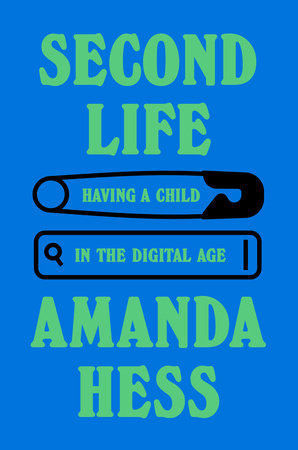
Recently, I’ve shared content with friends—like this article—about frameworks for parenthood. (I am seeding an idea about gestational communism.) We—caught in the crosshairs of millennial and zoomer generations—talk not infrequently about family: the ones we come from and those we long to build together. What would the latter even look like, practically speaking, in our (literal, economic, and political) climate? In Second Life: Having a Child in the Digital Age, Amanda Hess makes clear and digestible for the layreader the technicalities of parenting now, in a hyper-mediated world. The memoir tracks the devices and digital services that accompanied Hess through the pre-conception, gestation, birth, and infancy of her first child, whom she calls “Alma” (in order to preserve his privacy and owing to an AI misinterpretation of a Phantom Thread reference). Second Life is a series of vignettes that read like focused essays detailing the overlapping physicality and virtuality of Hess’ pregnancy and motherhood as a millennial woman during a global pandemic under the reign of technocapitalism. That is, the book shows that supposedly fundamentally human experiences—procreation and parenthood—are, like most things for most of us in the West, borne out as much online as in-person and dependent on gadgets for ease and expediency. Second Life catalogues Hess’ interactions with tech like Flo (the period and fertility tracking app), WebMD, Reddit, and with baby accoutrement like the Owlet (a hypersensitive bassinet), as well as more conventional reproductive technologies (reprotech) and predictive medical imaging like ultrasounds. As such, Hess writes that she did not feel herself to be “a woman doing something natural or inevitable,” but as “a woman doing something odd.” In a “techno-corporate infrastructure” which “processed [Hess’] pregnancy into marketing data,” how else should she feel? Though it may sound niche, the book is readable, revelatory, and broadly relatable—even to the childfree and especially to the chronically-online. Through her investigation of techno-parent assemblages, Hess visibilizes the ways our relationships to technologies inflect at once 1) how we think and feel about procreation (as shaped by pro- and anti- natalist think-pieces, MomTok rhetoric, and targeted maternity advertising) and 2) how we enact parenthood (by turning to online community forums for advice or using screentime as a reward). If nothing else I recommend this summer, this is the book my friends must read.
Hess, a critic-at-large for The New York Times, writes in a journalistic style both narrative and informative. But she explores too with more formally interesting modes, like swapping out essayistic prose for medical chart transcripts. While written mostly in chronological order, the memoir nevertheless rejects, by its analeptic starts and stops, the conventionally linear storytelling progression of gestation. Second Life starts in the middle, toward the end of Hess’ pregnancy, when “the skeletal hand of complication” enters the exam room and an abnormal ultrasound test sets her off on “the diagnostic odyssey.” Hess and her partner, Marc, receive a first diagnosis, a misdiagnosis, and then a final diagnosis, of Beckwith-Wiedmann Syndrome, for their son. Theirs is journey of invasive testing and second opinions—what’s sometimes called a “highly-medicalized” pregnancy—which shapes the relationship between Hess and her pregnancy (and by extension Hess and her son), as well as Hess and her simultaneous reliance on and skepticism of technology more broadly: “I see my hour on the table as the moment that my relationship with technology turned,” “I reached for a sense of control that gripped tightly to my phone. […] It would serve me facts and conspiracies, gadgets and idols, judgment and tips.” Hess reflects that if “natural birth was a storytelling project,” then “pregnancies like mine did not fit into the narrative.” Tech, as a ubiquitous presence in and integral part of her pregnancy, functions as an organizing motif, a way to piece together and make sense of their experience. Thus Hess and Alma’s story also begins months before, the moment she outsources her body and its menstrual rhythms into the data pile of Flo, “trad[ing her] self-knowledge for [the] computer vision structured by ones and zeros.” The software’s predictive features anticipate the user’s bodily patterns and alerts of a possible pregnancy, realizing the maybe-fetus by way of its early digital footprint and “chopping” pregnancy up into a “series of events” or “episodes” with info-dumps corresponding to the fetus’s relative gestational phase. Alma existed first as an idea on a cellphone screen, where Hess was encouraged, as many pregnant people are, to no longer distinguish between a medical ultrasound and the app’s graphics that “visualize” the relative size of a “future baby” as a pea or plum or shrimp. Tech stimulates the proleptic nature of pregnancy–a phenomenon that exists in binary and genetic code. Indeed, it’s as though digital projections supplant at times Hess’ own lived embodiment: “When I was the only one who knew that he existed, I knew him through direct observation. He was the orange vomit rising in my throat at breakfast. Later he was the wandering bubbles in my stomach, then athletic jabs, then squirming rolls that made me feel like I was falling in love. He was still in there, but he delt outside of me now.” There was a time when “a woman was the narrator of her own pregnancy,” but reprotech functions too as a narrative device, creating (what appears to be) irrefutable external evidence for what was formerly experienced as a fluid internal process.
As Victoria Browne writes in Pregnancy Without Birth: A Feminist Philosophy of Miscarriage, “the promotion of ‘optimal’ pregnancy lifestyles becomes deeply internalized, such that many people monitor their every move during pregnancy and also blame themselves when pregnancy does not turn out as willed or expected.” Hess confesses to having sometimes felt like “a bad pre-mother” for not “having become a better person before making a copy.” During her early séjour at The New York Times and after a sexist encounter with John Cleese (of Monty Python notoriety) heightens her anxiousness around celebrities, she begins to take Ativan prior to conducting interviews. She takes a single Ativan in the early stages of her pregnancy which forever haunts her in light of her son’s disability (not because she resents his disability, but because she mourns to think she’s caused him any suffering)—as though taking this pill for herself were something she had selfishly done against him. Corporations capitalize on precisely this affective economy of shame and guilt, preying on the neoliberal sense that an individual can control their pregnancy or child and craft the ideal mothering narrative if only they have access to just the right technology and information. Second Life tells for example of the Owlet, a crib with oximeters and heartrate monitors whose candid branding strategy relies on fear and grief—it mobilizes anxiety over pregnancy loss to coerce new parents into a costly and high-tech means of monitoring their children. And while “the attempt to control for [undesired] outcomes was a technocratic illusion,” there remains something to note about the sense of power, control, and foresight tech offers, such that Hess isn’t willing to fully divest. Despite the upset of Alma’s first diagnosis and its subsequent false diagnosis (one which forecasted that Hess’ child would be cognitively rather than physically disabled), Hess expresses that had she saved herself the emotional tumult of prenatal testing, she also “would have denied [herself] the information [she] needed to protect [her] child after he was born.” Technologies can’t infallibly neutralize threat, nor reliably predict the innumerable contingencies of pregnancy and parenthood; but, critical (and select) engagement with data allows for active and informed parenting.
Despite rapid proliferation of digital media and personal tech in recent years, the imbrication of productive and reproductive labor, value, and technology is nothing new in the United States, which as a nation expanded through an economy “marked by forced and coerced” labor of enslaved persons and Black women’s reproduction in specific. Physicians like J. Marion Sims made gynecological advancements–like development of the speculum–by experimenting on captive Black women. This is the history behind contemporary reproduction and its tools. Hess thus pans her point of view to include a comparison with another pregnant Amanda, Amanda Little-Richardson—a Black New Yorker, OB-GYN, and star of the Netflix docuseries Lenox Hill—which makes clear how racist histories resound into the present. Black women in New York are nine times more likely to die from pregnancy complications than white women and are disproportionately subjected to C-sections (the most commonly performed major surgery in America), frequently for no other reason than that their labor is taking too long and medical professionals are less sympathetic to their pain. Exploring the intersection of race as well as gender, class, and disability in her own pregnancy experience, Hess prods the misguided comfort in thinking that “being in a white body, and dressing it in expensive clothes, could indeed confer protection from death.” There is no guarantee against suffering or loss, but there certainly is a differential in their distribution and technologies don’t negate discrimination: their development occurs, historically, as a result of it.
To paraphrase Shulamith Firestone, while (reproductive) technologies stand to liberate, they are no more utopian than the society that uses them. Hess remarks that “obstetric residents had stopped attending to patients and started to attend to the data instead,” underestimating embodied knowledge and subordinating “the woman’s experience […] to the fetus’s data outputs.” Accordingly, women aren’t freed via technology from the tyranny of reproduction, as Firestone had hoped, but encouraged to view tech as objective and objectively good. Hence in order to be an objectively good mother, one must submit to tech and indeed optimize (oneself, time, resources, attention) by way of it for the good of the child. Therefore Hess didn’t “breastfeed” her baby, she pumped breastmilk and later supplied it to the baby, maximizing milk production via her automatic pump and all the while scouring the internet for information about motherhood (to apply to her own mothering and to use as research in her memoir). This (work and milk) flow is exhaustive. Gamifying reproduction in this way—or, as Hess puts it, feeling that she was “making the empowered choice of surveilling” and regulating herself—eventually renders those same devices more prominent in the lives of her children. Indeed, kids these days are inescapably cyborgian and parents pass down to their children biological and robotic predispositions: “As he rolled around on his mat, I stalked [Alma] with my phone’s sensor, turned him into an electrical signal and exchanged him for the currency of the web.” As websites bid, during her pregnancy, on her data to more strategically target their maternity ads with her due date, Hess felt that what she was producing was not so much a baby as data.
While Hess is suspicious of medical racism and ableism, MomTok tradwives and freebirth mothers are pharmakon to the hypermedicalized working mother. Indeed, online representations of freebirth—homebirth without medical intervention—forward a holistic approach to gestation which nevertheless traffics in inflexible politics of purity and mythologies of the maternal goddess—to the extent even of suggesting dead mothers and babies are sometimes the justifiable price to pay for doing things the good old fashion way. In this light, an all-natural version of “online motherhood” can also be qualified as “a multilevel marketing opportunity” which posits birth as a “brand” and adherence to freebirth “a content strategy” rather than itself a deliberate, informed, and adaptive mode for approaching pregnancy. What’s more, clinging to a domestic and reproductive context prior to (or ignorant of) modern medicine, assistive technologies, and democratized information does not necessarily negate the screentime of iPad kids nor preserve against the very real and very intensive phenomenology of parenthood. Tradwifery thus is predicated on a paramnesic nostalgia not discontinuous with the general Trumpian ethos: to what time of greatness are we harkening back? Who and when were the traditional housewives that online moms emulate? If the options are twilight sleep or pushing through contractions in a field on a picnic blanket, then there are no good options—this polarity of reproduction is indicative of a limited and increasingly stratified landscape itself inflected by broader social questions (of class, disability, race, and gender). Attentive to this dilemma, Hess’ writing is careful and informed, demonstrating sincere compassion for anxious (would-be) parents by subbing a holier-than-thou self-help approach for a vulnerable yet well-researched confessional. Neither for better nor worse but simply as a matter of fact, it takes a virtual village to have a child: “a sense of community […] safely routed through consumer technologies […] The whole-genome prenatal test to assess the embryo’s optimal health. The robot crib to soothe the baby. The artificially intelligent camera to spit out sleep tips. The parenting podcast to simulate the mom friend. The iPad to silence the toddler.” Parents are literally left to their devices.


Text within this block will maintain its original spacing when published
Last night, with just 33 hours to go before Paloma’s deadline for “Millenial Motherhood,” I decided I’d try to write something eloquent on the matter. Coffee was needed. I opened the fridge to find that my daughter had put the carton in sideways, that the fridge was now flooded in milk. It took an hour and a half to put things right, and there were tears shed over spilled milk–the
most cliché and poetically ironic thing. Anyway, during the clean-up, while lamenting the loss of that hour and a half I’d put aside for writing, it came to me: why not just transcribe the milk? So here are a few entries selected from several notebooks as chaotic as motherhood itself that I’ve kept over the past 3 years (and that Lu has left her mark on, too), starting with me quitting academia and abandoning a thesis project in the French Department at U of T on l’écriture maternelle–a topic I found impossible to define because each mama is an individual. There is no la, just what you live, what motherhood is “mine.”
1
Sometime in December, 2022
It felt like free-floating for the first several days after quitting the Department, and I didn’t know if the feeling was that of freedom or that of a deeper depression still, if I was becoming so dissociated from the world that I’d never find my feet in it again. Sometimes I’d work for hours on a menial job that let me turn my brain off, like scrubbing the grout in the shower with baking soda on a toothbrush, and others I would lie flat on my back and let the hours go by without acknowledgement. My presence was a conundrum, a problem I couldn’t solve. I wanted to remove myself from the equation, but as a mother, I could not.
On what seemed to me to be Day 4, boredom drew me to a book I remembered from my early childhood: Skills for Simple Living. It had served my parents well in their early, utopian phase, and some of the pages were dog-eared. It had black and white illustrations for topics like building a compost heap and canning tomatoes, and the language was clear and comforting. I began to make plans for the garden I would grow that spring.
2
September 13, 2023
Lu so giddy & fun today post-piano, waiting at the bus stop. She had “Material Girl” nails –the long, thin Post-its that Joanna told her she could remove from her piano book. Kept on posing like a “sassy girl,” a “pick-me,” and caressing my face with her “nails,” and screeching when they’d fall off. We watched the people milling about outside the Drake Hotel across the street, schmoozing, and decided to rename it the Jerk Hotel. A crazed look in her eye, the kind of giddy, mischievous look I so love to see in my child, and I can hardly contain the love I have for her & I just must give her a kiss & tell her all about the joy she brings to me.
3
May 20th, 2024 Writen by Lu
It is what 7:49 8am? as i rise out of bed and see Sadie curled up in a ball of endless fur i laugh a little then i run downstairs to check if my Magnificent mother is awake. I listen closely as i hear
the birds chirp the river quietly flow and the trees shake the tiniest bit, as I smell a light brees with an lilac sent. [...]
Saturday wakeing at 5:18am the direct hour and minnete I was born 11 years of life for me. I get so lucky. then it starts bethany and i run to get to the car Me in No Shoes! We're heading to a garden sale. I have a pair of sneakers in my backpack in the car i remember! I put them on. [...]
We did not get eggs for the mornig! and so instead of buying em at the IGA we got them at herdman. Mama got a zero shuger diet coke and an egg samich. She let me get a crispy crunch and a lime bubly! We heard a man talking about 2 weeks in jail!!! por him because he drunk drove. We sat outside where i tried to do a cartweel so much. It was the funnest. Idk why maybe because of the food maybe the Nature No i know why because of Mama my FAVorite woman on earth. [...]
the party is over but life is still great. [...] I ask Mikey if we can go for a walk he agrees and says yes this is Sunday by the way! anywhoo we walk and talk and then we go home and mama starts weeding. I use my bow and arrow. I know that wherever i am North or South east or west I will be happy with my family.
4
July 16, 2024
Caroline Dawson est partie. Cancer. At 44. She was a mother. A writer. She spoke of an «écriture maternelle ». No one else had used that term, and it was the term I was in the midst of defining. She was born 10 years before me, exactly. We share a birthday. I’m feeling short for time, irritable, confused.
Writing demands a closed door. It demands uninterrupted time for the development of cohesive thought, of patterns that unify. It is not a harebrained undertaking. Mothering: a proliferation of never ending, somewhat mindless tasks. So many rabbits.
5
Dec. 3/24
Worries about Lu at Middle School next year. Fucked-up dreams of fighting a war with Danny–a sort of holy war we’re totally unprepared for, in which I run down to the basement to find a few of Lu’s homemade bows and arrows–just brittle sticks with twine attached, that I suppose I’ll use as lances, and some pruning shears, for weapons. The side I’m on is mostly female. Up until an
hour ago we’ve been busy making sweets, but now we must be soldiers. The advancing horde is male. Their helmets reflect the sun–they don’t need to try a sneak attack because they’re not at
all afraid. Danny says it’s better to die fighting than to live under their rule. Part of me agrees; part of me wants to take off for wherever we’ve sent the children with a few nurses & get them
even further away. Make them safe.
6
July 17, 2025 (written by Lu)
Lulu & Mikey tasks
- New boquets
- Groceries
- Bed making
- Sweeping
-----
Mama’s tasks
- Write that article
- Bleeding hearts

Thank you for reading paloma, a monthly art and literature magazine. For information on submitting your work, please see the Submission Guide. You can find us on Instagram, and you can catch up on past issues here.
Subscribe today to receive the next issue directly to your inbox ↓
Comments
Nothing yet. Say the first thing.
Sign in to join the conversation.