

Sometimes the simple act of being seen can be the difference or reason one chooses to live.
Have you ever had those moments where you politely smile, nod, or play the expected role? All the while on the inside you are breaking into pieces and burning to the ground, with the small hope that maybe, just maybe, someone might notice and signal a small acknowledgement or reassurance without you having to explain. How many of us are living this same silent war right now, appearing strong on the outside with the little bit of hope that someone might make the space by saying, “Tell me more. I am here to listen”?
There is a story that a friend recently shared with me that stopped me in my tracks. It sums up a familiar feeling that I have experienced over and over again doing the work that I do. The true story belongs to a retired Doctor Jerome Motto who has been passionate about suicide prevention through his career and life. He recalls a 30-year-old life lost in the 1970’s. It’s a memory that has stuck with him since the day he walked into the client’s apartment and read the note he left behind. The note simply read, “I am going to walk to the bridge. If one person smiles at me on the way, I will not jump.”
He was someone who needed a sign. Any human sign would likely have been enough. He left his apartment. He walked to the bridge. No one smiled. No one spoke. No one even noticed. The doctor’s thoughts that followed, like mine, “That was it. It’s so needless, the number of people who are lost.” I feel the senselessness, the loneliness, the disconnection in my bones. This is not just about suicide; it is about absence. The absence of connection. The absence of presence. The absence of being seen and valued. The absence of our sense of humanity.
How many of us are willing or prepared to make space for someone else—friend, family, or even a stranger? Sure, we may say we will. But how many of us actually do?
Whether we like it or not we live in a world where suicidal thoughts are more common than most people would like to admit. They may sound different, some more subtle than others, but all expressing the desire to disappear, escape, or die because one can’t take it anymore or live like this anymore. Some are fleeting while others are haunting. Either way there is nothing extraordinary or uncommon about these thoughts, yet we have created a sense of notoriety, shame, and stigma around them.
Honestly, this has been a huge disservice to ourselves because we have a created an insulated silence where people now must carry their struggles in the shadows rather than turning towards each other. All of us have the moments where hope feels like it has faded away or we are so tired from carrying the weight of our burdens while trying to maintain a face of “everything is fine.” It could be the parent who takes a pause to breathe after dropping off the kids. The person in the shower that crumbles while shedding the tears down the drain. The teenager doom scrolling on their phone late at night trying to find where they fit in or answers to why they exist. It is the healthcare worker, the first responder, the teacher, the business leader, the friend… the human being who feels emotionally exhausted, feeling guilty that they should be grateful, stronger, more resilient, and less dramatic. These are not examples of weakness. They represent the real hurt people don’t know what to do with and are tired of bearing alone.
At the core suicidal thoughts are not truly about death, but a desperate desire for relief. Relief can take on many forms such as less loneliness, less shame, less intense emotions, and create a safe space to breathe. Suicidal thinking is comprised of deeply human thoughts born from real human struggle. As we continue to fail talking about them, we will continue to fail the people who are living with them.
This matters to us as individuals, families, communities because suicide is not just a number or statistic. It is a lifetime of reality our families, workplaces, relationships, schools, and communities are facing and will continue to face with grief. This could be you directly or someone in your circles. It could be a colleague, a leader, a caregiver, a young person who has been carrying a load that is becoming harder to carry by themselves, getting lost in their thoughts, wondering if their existence even matters to anyone.
Sure, we would like to think that we are quick to respond when someone is in crisis, and of course that matters. But I want to challenge that. What if we didn’t wait? What if true prevention begins much earlier, like in the quiet daily moments when someone is not on the edge or screaming for help. That we are more in tune with each other so we can pick up on the more subtle signals or notice the whispers for a need to connect, to feel safe, and belong.
Suicidal thoughts only grow in fertile isolation and alienation. They take hold in superficiality and formalities. They feed on feelings of being misunderstood, dismissed, minimized, or judged. What is heartbreaking is that these can be experienced in plain sight in our everyday routines, masked in shadows of our minds.
I think you can agree that many of our conversations have become almost cliché and predictable when we are trying to awkwardly say the right thing, like “Things will be ok” or “You are fine.” It is time we took a fresh approach in humanizing our conversations again. One that encourages us to open up, connect, and express care.
So, how do we do this, making it easy and accessible no matter who we are? This is where the simple, courageous invitation of Tell Me More can be life-giving and changing. I have witnessed the magic of these three words over and over again. When we do not rush to advise, rescue, correct, or compare…we open the door to curiosity and possibilities. When we express that we are interested in knowing more or understanding more, we are saying, “Tell me more about what you are carrying. Tell me more about where it hurts. Tell me more about what feels so heavy and lonely,” something profound happens for both people in the conversation. Our nervous systems respond by softening as fear falls away and connection fills the void.
We are not normalizing the idea to give up on life. We are acknowledging the commonness and normality in understanding that life involves pain, which is deeply human and deserving of compassion and real conversation creating human bonds.
My invitation to you today is to notice people, slow down, and let them know you see them, whether it is a gesture, a greeting, or a message. Use Tell Me More as a doorway into someone’s emotional world. Be ok with being uncomfortable and being human with someone else, because being human or being seen can be the very thing that keeps us here. Tell Me More reminds us we are not alone and that we matter.

Have a question, story to share, or would like to discuss further? Tell Me More…
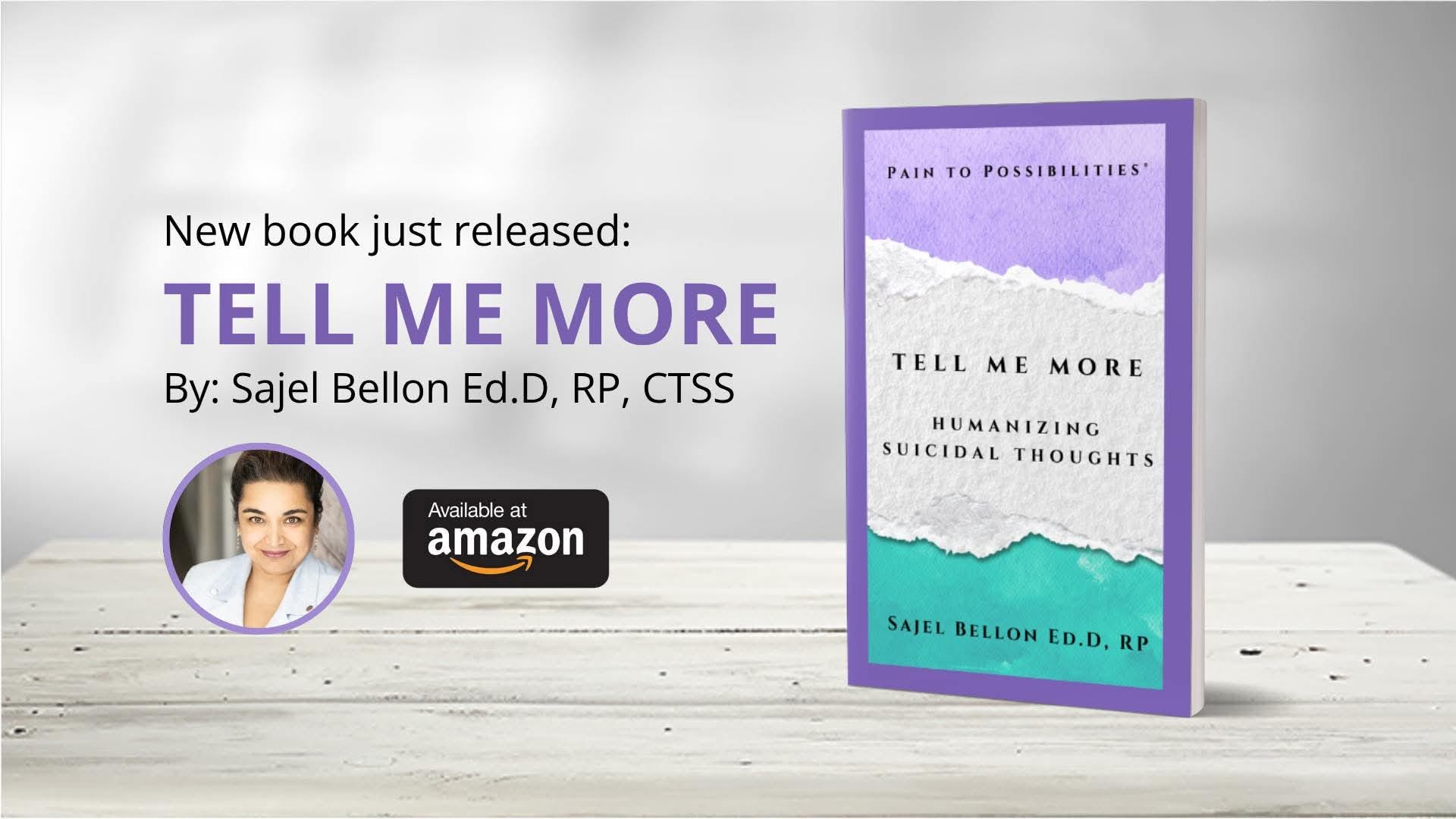
Now Available on AMAZON:
Find more information about Mind Armour® Services & Training Programs
Comments
Nothing yet. Say the first thing.
Sign in to join the conversation.