
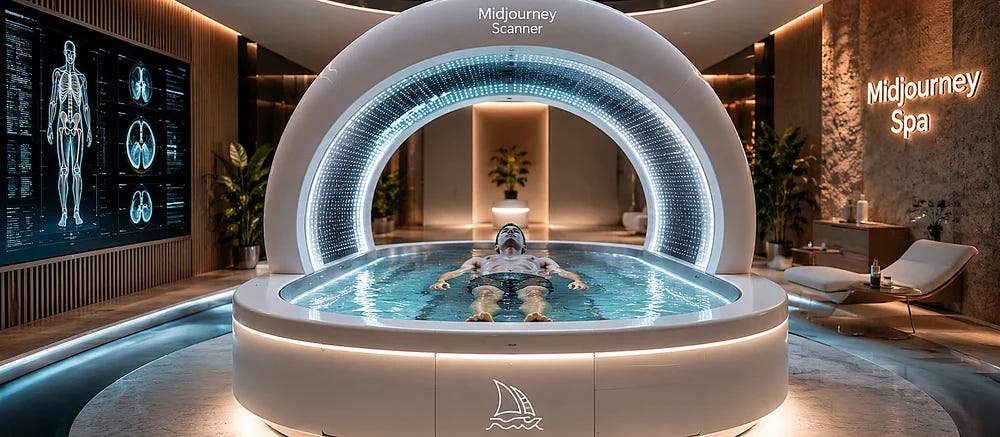
This week, the image-generation company Midjourney announced a whole-body scanner that takes less than a minute and does not use radiation. [1]
You step into a warm pool, a platform lowers you through a ring of sensors, and in about a minute, the machine claims to build a three-dimensional map of everything under your skin, with no radiation and no magnets. [1]
They plan to put the scanners in spas. [1]
The expected number of scanners sits at 50,000.
The response was roughly what you’d expect. Awe. The future had arrived, and it came with a warm bath.
I understand the appeal.
We tell people, rightly, that prevention beats cure, that early beats late, that the diseases most likely to kill us grow in silence for years before they announce themselves.
A machine that lets you look inside cheaply and often sounds like that advice taken to its natural conclusion. If catching things early saves lives, surely seeing everything, all the time, saves the most lives.
That’s the logic. However…..
A picture is not a diagnosis, and a diagnosis is not the same as a benefit.
Let’s have a look at the science and technology behind it rather than relying on a hyped up press release.
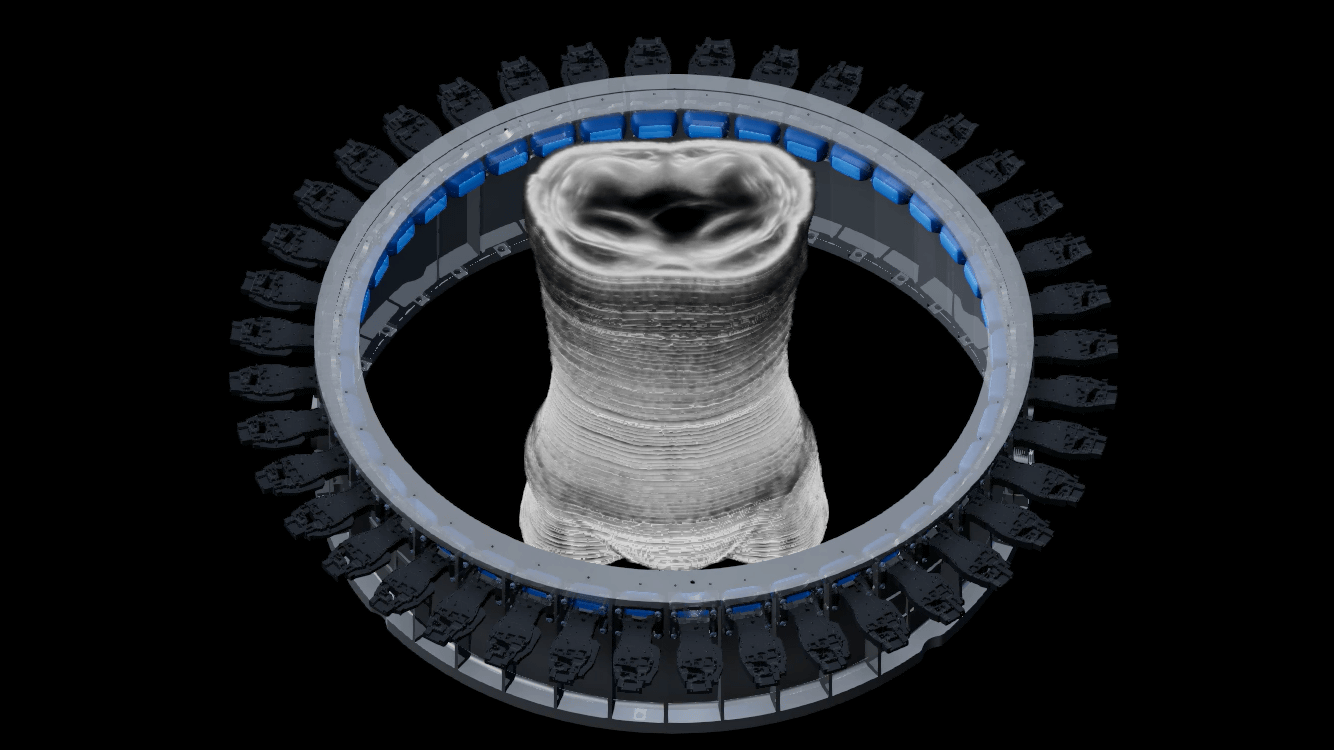
This is ultrasound computed tomography (USCT): sound waves sent through tissue from many angles and reassembled by a computer into cross-sectional images. [2,3]
It wasn’t invented for the press release. A version already exists, already approved by the FDA, for exactly one job. Imaging the breast. [4]
The breast is soft, holds still, and can be lowered into a water bath, so the sound has a clean path in and out, with no compression and no radiation. [4]
In that one setting, the technology clearly works.
The trouble is the jump from that one organ to the ‘whole body’ claim.
Ultrasound and the human body have an awkward relationship that the marketing glosses over.
Sound travels well through soft tissue and water.
It works poorly in air, and it scatters off the high-density barrier of bone. [3]
Your lungs are full of air. Your heart sits behind ribs. Your brain is sealed inside a skull.
Which is why Dr Eric Topol, reacting to the launch, made the plain point that a scan which cannot see the brain is not a full-body scan, whatever the brochure says. [5]
It has been demonstrated that this approach can characterise certain soft tissues. [3,4] The method is genuinely radiation-free, fast and comfortable. [4]
But the headline, that it rivals an MRI or CT for the whole body in sixty seconds, is so far only asserted, with nothing published behind it and no authorisation to diagnose anything. [5,6]

The company’s own first offering is far more modest than the noise around it: a map of your fat and muscle, your body composition. [1,2] ie body composition.
Useful, for sure, but a long way from diagnosing cancer while you soak in a warm bath.
A scan shows anatomy, the things physically present in you. It tells you nothing about whether those things will ever do you harm, or whether knowing about them will do you any good.
Finding things was never our bottleneck.
We have no shortage of ways to look inside people. What we lack is certainty about which of the things we find are worth being concerned about.
Scan a thousand healthy bodies, and you’ll turn up nodules, cysts, shadows, small asymmetries, the overwhelming majority of which would have sat there for the rest of a normal life.
One review of whole-body MRI screening found that 95% of asymptomatic people had at least one abnormal-looking finding, and 91% of those findings turned out not to matter. [7]
Once seen, though, none of them can be unseen.
Each finding may need a repeat scan, a biopsy, a referral and possibly a month of broken sleep worrying about the implications.
That isn’t a thought experiment.
It is the reason the major radiology bodies in the United States, Australia, and New Zealand advise against whole-body scanning of people who have no symptoms and no particular reason to worry. [8,9]
An image can tell you what is there. It cannot tell you what it means.
So what is a sensible person meant to do with any of this?
The failures I see in healthcare are almost never failures of detection. They’re failures of omission.
Someone knew their risk and let it sit, because the danger felt far off and doing something about it felt like it could wait.
No scanner changes that.
I’ll be fair to where this could go, because it could go somewhere worthwhile.
Validated properly, the technology might earn a real seat at the table. Tracking body composition across the years.
Watching particular soft tissues change. Perhaps more in time.
Sitting beside the MRI and CT we already rely on, rather than pretending to replace them. [2]
What’s missing, however, is proof, and a launch event with fancy graphics is not proof.
Proof of concept, maybe, but not scientific proof of utility.
What nobody can honestly tell you today is that being scanned will help you live longer. The same professional bodies note there is no evidence that whole-body screening prolongs life. [8]
Pull back far enough, and it’s an old story in new clothes.
The attraction of being seen, completely and instantly, can feel reassuring.
I really do get that.
But looking was never what made anyone healthy.
Health gets built slowly, out of the decisions you make with the information you already have.
The disease that will define your seventies is most likely taking shape in you now.
The tools to change its course are most likely already in your hands. A new way to see inside yourself might one day join them. It won’t stand in for them.
Being seen will not save you.
What you do next still can.

Midjourney. A New Era of Midjourney (Midjourney Medical announcement). midjourney.com/medical/blogpost. June 2026.
Buntz B. AI image firm Midjourney spins up health division, unveils “Ultrasonic CT”. R&D World. 18 June 2026.
Lasaygues P, et al. Ultrasound Computed Tomography. In: Bone Quantitative Ultrasound. Springer; 2022 (PMID 35508878). [USCT as a soft-tissue method; bone’s high acoustic-impedance contrast as the limiting factor.]
Delphinus Medical Technologies. FDA grants Premarket Approval (PMA) for the SoftVue 3D Whole Breast Ultrasound Tomography System as an adjunct to mammography for asymptomatic women with dense breast tissue; no compression, no radiation, breast in a warm water bath. October 2021 (BusinessWire; Applied Radiology; AuntMinnie).
Topol E. Commentary on the Midjourney full-body scanner (post on X). June 2026. [Ultrasound cannot image the adult brain through the skull; same incidental-finding concerns as whole-body MRI; no peer-reviewed publication to date.]
Constantin AM. Midjourney’s full-body scanner: big claims, no track record. The Next Web. June 2026. [No regulatory clearance for diagnosis; current output limited to body-composition maps.]
Fred Hutch Cancer Center. Pricey whole-body MRIs don’t add up (review of 12 studies: 95% of asymptomatic patients had at least one abnormal finding; 91% were not relevant). August 2025.
American College of Radiology. ACR Statement on Screening Total Body MRI (2023) and ACR Statement on Whole Body CT Screening. acr.org. [Insufficient evidence to recommend total-body screening in people without symptoms, risk factors or relevant family history; no evidence of benefit in prolonging life; risk of incidental findings, anxiety and unnecessary follow-up.]
Royal Australian and New Zealand College of Radiologists (RANZCR). Whole Body MRI Screening in Low-Risk Patients: Position Statement. 2024.
Arnett DK, Blumenthal RS, et al. 2019 ACC/AHA Guideline on the Primary Prevention of Cardiovascular Disease.Circulation. 2019;140:e596-e646.
No posts
Comments
Nothing yet. Say the first thing.
Sign in to join the conversation.