
A research report on personalist rule, the mechanisms used to subvert democratic checks and balances, and capture-resistant models of government, by Claude
Concentrating governing power in a single person is not automatically catastrophic in the short run, but the weight of comparative-politics evidence is decisively negative. Personalist rule is the authoritarian type that produces the worst economic outcomes, the most erratic and aggressive foreign policy, the highest corruption, and the worst post-transition trajectories — and the psychological literature shows that concentrated power itself degrades the judgment of even well-intentioned leaders. The strongest defenses of concentrated executives — decisiveness, crisis response, “energy in the executive” — describe real functional benefits, but they do not require, and are actively undermined by, the removal of checks.
The central danger is less “will this leader become a tyrant tomorrow” than the removal of the guardrails that would let a country recover if he does. The modern pathway to authoritarian rule is rarely a coup; it is gradual “executive aggrandizement” and “autocratic legalism” — court-packing, capturing electoral and anti-corruption bodies, media capture, and abolishing term limits — often financed or amplified by concentrated private wealth. As of 2025–2026, the V-Dem Institute, Freedom House, and leading scholars document a global wave of autocratization that now includes established Western democracies, with the United States the most-discussed new case.
The alternatives are institutional, not merely a matter of electing better people: plural or collective executives and power-sharing, capture-resistant “guardrail” institutions, proportional representation, federalism, robust anti-self-entrenchment rules, deliberative citizens’ assemblies, and — crucially for resisting oligarchic capture — campaign-finance limits, media-ownership rules, and antitrust as a tool of democracy protection.
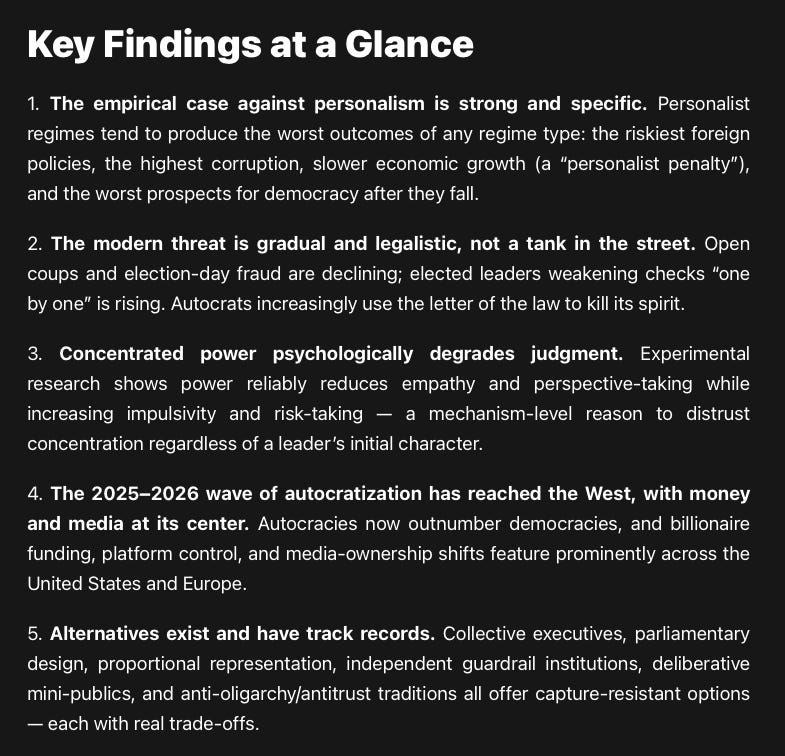
1. The empirical case against personalism is strong and specific. Personalist regimes tend to produce the worst outcomes of any regime type: the riskiest foreign policies, the highest corruption, slower economic growth (a “personalist penalty”), and the worst prospects for democracy after they fall.
2. The modern threat is gradual and legalistic, not a tank in the street. Open coups and election-day fraud are declining; elected leaders weakening checks “one by one” is rising. Autocrats increasingly use the letter of the law to kill its spirit.
3. Concentrated power psychologically degrades judgment. Experimental research shows power reliably reduces empathy and perspective-taking while increasing impulsivity and risk-taking — a mechanism-level reason to distrust concentration regardless of a leader’s initial character.
4. The 2025–2026 wave of autocratization has reached the West, with money and media at its center. Autocracies now outnumber democracies, and billionaire funding, platform control, and media-ownership shifts feature prominently across the United States and Europe.
5. Alternatives exist and have track records. Collective executives, parliamentary design, proportional representation, independent guardrail institutions, deliberative mini-publics, and anti-oligarchy/antitrust traditions all offer capture-resistant options — each with real trade-offs.
An honest assessment must begin with the strongest argument on the other side. The classic defense is Alexander Hamilton’s Federalist No. 70 (1788), which holds that “energy in the executive is a leading character in the definition of good government” — essential to national defense, the steady administration of the laws, the protection of property, and the security of liberty. Hamilton argued that unity in the executive, meaning a single decision-maker rather than a plural council, produces decision, activity, secrecy, and dispatch, and, crucially, clear accountability: the public knows whom to credit or blame.
A caveat matters here. Hamilton’s “unity” is distinct from the modern “unitary executive theory” of total presidential control over the executive branch. Federalist Nos. 71–73 make clear that executive energy was meant to coexist with congressional control of appropriations, fixed but re-electable terms, and mechanisms of accountability. Genuine functional benefits of decisiveness do appear in real emergencies — crisis command, wartime, and disaster response.
The classical philosophical case for benevolent one-person rule runs from Plato’s philosopher-king through later arguments for enlightened monarchy. The most compelling contemporary evidence is El Salvador under Nayib Bukele. His “state of exception” against criminal gangs cut homicides dramatically, and he enjoys genuine popularity — an approval rating near 88 percent in the 2025 Iudop-UCA survey after seven years in office. He won reelection on 4 February 2024 with roughly 85 percent of the vote, and his Nuevas Ideas party took nearly every legislative seat. The honest conclusion is that concentrated authority can deliver speed and popular results in the short run — but it removes the mechanism for correcting errors, and the comparative record shows that the errors, over time, are severe and asymmetric.
Comparative politics distinguishes personalist regimes — where a leader escapes constraint from party or military — from party regimes and military regimes, and finds that personalists behave worst. Barbara Geddes, Joseph Wright, and Erica Frantz, whose datasets code roughly 200–280 authoritarian regimes since 1946, show that personalist regimes tend to eliminate talented rivals, hollow out institutions, and leave societies with very little human infrastructure for post-transition governance. Related work documents that personalist leaders pursue the most risky and aggressive foreign policies, are more likely to invest in nuclear weapons, and are more likely to initiate interstate conflict. Economic research finds a “personalist penalty”: concentrated-power autocracies grow more slowly than both democracies and institutionalized autocracies.
The mechanism is intuitive. With no party or military to check him, a personalist ruler’s private whims become national policy, and accurate information stops flowing upward because advisers fear delivering bad news. This is why the quality of the individual matters less than the presence of constraints.
A parallel body of psychological research explains why even a well-intentioned person tends to become worse once power is concentrated in their hands. Dacher Keltner’s “power paradox” holds that the empathy and social intelligence that help people rise tend to atrophy once power is attained. Experimental studies find that powerful people show diminished compassion for others’ suffering and reduced neural “mirroring” of others, alongside increased impulsivity, entitlement, and risk-taking.
Lord David Owen and Jonathan Davidson’s concept of “hubris syndrome” (Brain, 2009) describes an acquired disorder of leaders who hold great power with few constraints, marked by a messianic self-image, contempt for advice, and a loss of contact with reality. Their analysis notes explicitly that dictators are particularly prone to hubris precisely because there are few, if any, constraints on their behavior. Taken together, these findings imply that constraints are not obstacles to good leadership; they are a precondition for it.
The scholarly literature on democratic backsliding has catalogued a recurring toolkit that elected leaders and would-be autocrats use to disqualify opponents and dismantle checks and balances. Crucially, most of these tactics are formally legal — a pattern scholars call “autocratic legalism” or “stealth authoritarianism,” in which rules and procedures are not openly violated; only their spirit dies a slow death. The main instruments include:
• Capturing courts and tribunals. Packing constitutional courts or reinterpreting their composition to secure loyal majorities, removing the last institution able to block other power grabs.
• Disqualifying, jailing, or banning opponents. Arresting or barring rival candidates and outlawing opposition parties before elections, so that contests continue but competition does not.
• Abolishing or extending term limits. Amending or reinterpreting constitutions to permit indefinite reelection — one of the clearest markers of a shift toward personalist rule.
• Weaponizing state institutions. Turning tax authorities, prosecutors, and security services into instruments against critics, businesses, and civil society.
• Media capture. Engineering the transfer of outlets to friendly owners, starving independent media of advertising, and using state media to crowd out dissent.
• Controlling the information space. Dominating or manipulating social-media platforms and algorithms, and deploying disinformation to shape public discourse.
• Emergency powers and rule by decree. Using prolonged states of exception to govern around the legislature and suspend ordinary rights protections.
• Rigging the electoral machinery. Manipulating electoral commissions and rules, gerrymandering, and malapportionment to convert minority support into durable majorities.
• Purging or co-opting the bureaucracy and military, and restricting NGOs and civil society through funding and registration rules.
A common thread runs through the modern version of this playbook: concentrated private wealth. Money buys media, funds campaigns and allied movements, and can shape judicial and regulatory outcomes — which is why safeguards against oligarchic capture are inseparable from safeguards against personalist rule.
Hungary is the paradigm of backsliding inside the European Union: a supermajority-enabled constitutional rewrite, capture of the Constitutional Court, media capture via loyal owners, and gerrymandering that has let the governing party win around two-thirds of parliamentary seats on roughly half the vote. EU rule-of-law tools — infringement proceedings, the Article 7 process, and funding conditionality — have proven slow relative to the pace of domestic change.
After jailing opposition presidential challengers ahead of its 2021 election, Nicaragua ratified constitutional changes in early 2025 that created “co-presidents” (Daniel Ortega and his wife, Rosario Murillo), extended presidential terms to six years, formally subordinated the judiciary, legislature, and electoral bodies to the presidency, and legalized paramilitary “volunteer” forces. Democracy monitors have described the result as an absolutist, family-run dictatorship. A further amendment targeting exiled opponents by eliminating dual citizenship followed.
Poland illustrates that backsliding is partly reversible — but also how hard reversal is. After the 2023 election, the incoming government began restoring the rule of law and unblocked tens of billions of euros in previously frozen EU funds. Yet hostile presidents and a still-captured constitutional tribunal have left key reforms stalled, a cautionary lesson about the difficulty of repairing captured institutions even after a change of government.
El Salvador is the hard case in which concentration is genuinely popular and has delivered real security gains — at the cost of mass detention under a prolonged state of exception, court-packing, and, as of 2025, indefinite reelection. It shows both the short-run appeal and the structural risk of dismantling constraints.
Venezuela under Chávez and Maduro, Turkey under Erdoğan, and Russia under Putin each trace the personalist arc: incremental capture of courts, media, and electoral machinery, the sidelining of rivals, and the erosion of the line between the leader and the state.
Whether the United States has itself entered a phase of autocratization is a live scholarly dispute, and it should be presented as such rather than as settled fact. The V-Dem Institute’s 2025 and 2026 Democracy Reports describe the US as undergoing an unusually rapid episode of autocratization, attributing the decline to a rapid concentration of powers in the presidency and a historic weakening of legislative constraints, and lowering the US position in its democracy ranking substantially. A large survey of political scientists likewise placed the US between liberal democracy and outright dictatorship on an expert scale.
Steven Levitsky, Lucan Way, and Daniel Ziblatt argued in 2025 that the country had crossed into “competitive authoritarianism” — a system in which elections continue but the state is weaponized against opponents — while stressing that this condition is reversible. Their proposed test is whether people feel safe opposing those in power: protesting, publishing criticism, and backing opposition candidates without fear of punishment. Dissenting scholars counter that this overstates the case given US federalism, independent courts, opposition-controlled states, and a robust civil society, and that the “competitive authoritarian” label is premature. This report treats the constitutional-crisis framing as a serious, well-credentialed argument that remains contested.
What makes the US case unusual is the visible merging of private wealth and public governance. A new government-efficiency initiative embedded teams of private-sector personnel across federal agencies with access to sensitive payment and personnel systems, raising conflict-of-interest concerns and driving the largest peacetime reduction in the federal workforce on record, even as independent analysts found little effect on the actual trajectory of federal spending.
The role of money in politics reached new highs. A single technology billionaire was by far the largest donor of the 2024 cycle, giving well over a quarter of a billion dollars; more broadly, a few hundred billionaire families accounted for roughly a fifth of all federal political contributions in 2024, up from a fraction of a percent before the Citizens United decision. The 2025 presidential inaugural committee raised a record sum, with major corporations and their chief executives among the largest donors, including many firms facing federal investigations.
Media and platform ownership shifted in parallel: prominent newspaper owners blocked planned editorial endorsements and reoriented their opinion sections, a major social platform changed hands and editorial character, and a leading platform company ended third-party fact-checking. Anti-corruption enforcement was also loosened, with a temporary pause on enforcement of the Foreign Corrupt Practices Act before a narrowed enforcement posture resumed. Whatever label one accepts, the concentration of political influence in a small number of very wealthy individuals is the throughline.
Across Europe, concentrated private and foreign wealth has become a primary vector amplifying populist-radical-right movements. There is a documented history of oligarchic and Kremlin-linked financing of far-right parties, including a multi-million-euro loan from a Moscow-based bank to a leading French party, the Austrian “Ibiza affair” in which a senior politician was filmed appearing to solicit support from a purported Russian backer, and a sanctioned Kremlin-linked financier who has cultivated a pan-European far-right network.
More recently, a US technology billionaire has intervened directly in European politics — publicly endorsing Germany’s far-right party, appearing at its campaign events, and amplifying far-right figures elsewhere through his platform — while several European billionaires have funded far-right media and political projects. Democratic responses vary: some party systems maintain a “firewall” against extreme parties, some governments are weighing limits on foreign-linked donations, and at least one country annulled a presidential election over alleged foreign influence. The pattern reinforces the report’s central point: in the present era, concentrating political power and concentrating economic power are closely linked processes.
The following are options with trade-offs, not a single prescription. They are best understood in stages, matched to a country’s vulnerability and its existing institutions. The recurring theme is that resilience comes from distributing power and insulating the institutions that referee it — and, specifically for resisting oligarchic capture, from limiting the political power of concentrated wealth.
• Prefer plural or collective executives, or parliamentary design, where feasible. Switzerland’s seven-member Federal Council — co-equal members sharing power under a rotating, largely ceremonial presidency — shows that a strong-but-non-personal executive is possible, and was deliberately designed to prevent power concentration. The classic argument that parliamentary systems sustain democracy better than presidential ones, especially in polarized multiparty societies, is a strong tendency rather than an iron law; its effect depends on party discipline and the specific variant. Semi-presidential and power-sharing (consociational) arrangements are intermediate options.
• Adopt proportional representation and multiparty systems, which are generally more backsliding-resistant than winner-take-all systems because they force coalition-building and make single-party capture harder.
• Enact robust anti-self-entrenchment rules: hard term limits, “eternity clauses” protecting core democratic provisions, and requirements that constitutional change clear supermajorities, referendums, and time delays — to prevent the single-supermajority rewrites that enabled backsliding elsewhere.
• Make oversight institutions independent by design. Courts, electoral-management bodies, anti-corruption agencies, ombudsmen, and audit institutions should have staggered terms, plural or non-partisan appointment, central-bank-style insulation, and supermajority confirmation, so that no single election can capture them.
• Use federalism and decentralization to distribute power so that national-level capture is never total.
• Reform campaign finance and lobbying: caps on donations, public financing of elections, and real-time disclosure. The concentration of a fifth of national political giving in a few hundred families is the cautionary benchmark.
• Limit media ownership and fund genuinely independent public media, and regulate platform and algorithmic transparency.
• Treat antitrust and wealth policy as democracy protection. The civic-republican, anti-oligarchy tradition holds that extreme concentrations of economic power are a direct threat to political equality — captured in the view that a society can have great wealth concentrated in a few hands or democracy, but not both, and in the argument that extreme inequality tends toward either oligarchy or an authoritarian demagogue.
• Use deliberative citizens’ assemblies and sortition to legitimize reform and bypass captured legislatures for specific questions; catalogued deliberative processes have a strong record of having their recommendations implemented.
• Consider militant-democracy tools — such as banning anti-democratic parties — but bound them narrowly and place them under judicial control, because they carry real risks of abuse.
• Leverage international and regional bodies, such as rule-of-law conditionality, recognizing that these work only partially and often slowly.
Warning signs that concentration is tipping into breakdown include the abolition of term limits, court-packing, the jailing or disqualification of opponents, refusal to accept election results, and the use of tax or prosecutorial power against critics. Signs of health or recovery include independent courts ruling against the executive, opposition parties campaigning freely without retaliation, genuine media plurality, and the peaceful alternation of power.
• Empirical disputes are real. Whether the United States in 2025–2026 meets the threshold of “competitive authoritarianism” is genuinely contested among qualified scholars; this report reports the debate rather than resolving it.
• Backsliding metrics are judgment-laden. Expert-coded indices broadly agree on the global trend but use different methods, and several borderline cases sit close to statistical thresholds.
• Institutional design is not destiny. Presidential systems are not doomed and parliamentary systems can fail; party discipline, polarization, and political culture all mediate outcomes.
• The benevolent-autocrat case has genuine short-run evidence, but the comparative record shows the model’s downside risk — irreversibility, succession crises, corruption, and economic decay — is severe and asymmetric.
• Some 2025–2026 facts are fast-moving. Figures on government reorganizations, enforcement policy, campaign finance, and ongoing legal challenges reflect their reporting dates and may have since evolved.
The following sources informed this report. Each entry lists the source and its full URL.
Barbara Geddes, Joseph Wright & Erica Frantz, “Autocratic Breakdown and Regime Transitions: A New Data Set,” Perspectives on Politics (2014). https://xmarquez.github.io/democracyData/reference/gwf_all.html
Barbara Geddes, Joseph Wright & Erica Frantz, How Dictatorships Work (2018). https://s3.us-west-1.wasabisys.com/p-library/books/34f1f9aedf6846d4627547d7ed8f80ab.pdf
Andrea Kendall-Taylor, Erica Frantz & Joseph Wright, “The Global Rise of Personalized Politics,” The Washington Quarterly (2017). https://cpb-us-e1.wpmucdn.com/blogs.gwu.edu/dist/1/2181/files/2019/03/TWQ_Spring2017_KTFW.pdf
Becker Friedman Institute, University of Chicago, “The Personalist Penalty: Varieties of Autocracy and Economic Growth.” https://bfi.uchicago.edu/insights/the-personalist-penalty-varieties-of-autocracy-and-economic-growth
V-Dem Institute, Democracy Report 2025: 25 Years of Autocratization — Democracy Trumped? https://www.v-dem.net/documents/60/V-dem-dr__2025_lowres.pdf
V-Dem Institute, Democracy Report 2026: Unraveling the Democratic Era? (press release). https://v-dem.net/news/press-release-democratic-backsliding-reaches-western-democracies-with-us-decline-unprecedented/
Nancy Bermeo, “On Democratic Backsliding,” Journal of Democracy (2016). https://muse.jhu.edu/article/607612
Kim Lane Scheppele, “Autocratic Legalism,” University of Chicago Law Review. https://lawreview.uchicago.edu/sites/default/files/11%20Scheppele_SYMP_Online.pdf
Adam Galinsky, Joe Magee, M. Ena Inesi & Deborah Gruenfeld, “Power and Perspectives Not Taken,” Psychological Science. https://web.mit.edu/curhan/www/docs/Articles/15341_Readings/Power/Galinsky_et_al_Power-and-Perspectives-Not-Taken.pdf
David Owen & Jonathan Davidson, “Hubris syndrome: An acquired personality disorder?,” Brain (2009) — author’s copy. https://www.lorddavidowen.co.uk/hubris-syndrome-an-acquired-personality-disorder-a-study-of-us-presidents-and-uk-prime-ministers-over-the-last-100-years/
Alexander Hamilton, Federalist No. 70 (1788). https://billofrightsinstitute.org/primary-sources/federalist-no-70/
Federalist No. 70 — full text (archived). https://en.wikipedia.org/wiki/Federalist_No._70
Juan J. Linz, “The Perils of Presidentialism,” Journal of Democracy (1990). https://ir101.co.uk/wp-content/uploads/2018/11/Linz-The-Perils-of-Presidentialism.pdf
Scott Mainwaring & Matthew Shugart, critique of Linz on presidentialism. https://kellogg.nd.edu/sites/default/files/old_files/documents/200_0.pdf
“The Swiss Federal Council: Shared Executive Power.” https://rulesofthegame.blog/the-swiss-federal-council-shared-executive-power/
“Understanding the Swiss Political System: A Comprehensive Guide.” https://www.peopleandmedia.com/understanding-the-swiss-political-system-a-comprehensive-guide/
“The Mechanics of Autocratic Legalism in Hungary.” https://politics-government.news-articles.net/content/2026/05/13/the-mechanics-of-autocratic-legalism-in-hungary.html
“Hungary’s Legal Coup: How Viktor Orbán is Rewriting Democracy in Slow Motion,” Democratic Erosion. https://democratic-erosion.org/2025/10/31/hungarys-legal-coup-how-viktor-orban-is-rewriting-democracy-in-slow-motion/
“How Autocrats Endure: Viktor Orbán and the Myth of the Strongman,” Foreign Affairs. https://www.foreignaffairs.com/articles/hungary/2022-04-19/how-autocrats-endure
International IDEA, Democracy Tracker — Nicaragua (January 2025). https://www.idea.int/democracytracker/report/nicaragua/january-2025
ConstitutionNet, “Nicaragua: A New Absolutist Constitution Tailor-Made” for the Ortega–Murillo family. https://constitutionnet.org/news/voices/nicaragua-new-absolutist-constitution-tailor-made
Centre for European Reform, “The Difficulties of Restoring Democracy in Poland.” https://www.cer.eu/insights/difficulties-restoring-democracy-poland
Notes From Poland, “Polish parliament passes bill to reverse previous government’s reform of judicial council.” https://notesfrompoland.com/2024/04/13/polish-parliament-passes-bill-to-reverse-previous-governments-reform-of-judicial-council/
House of Commons Library, “Poland: The Tusk Government and the 2025 Presidential Election.” https://commonslibrary.parliament.uk/research-briefings/cbp-10300/
Harvard Gazette, “Closer Look at ‘Coolest Dictator in the World’” (El Salvador / Bukele). https://news.harvard.edu/gazette/story/2025/05/closer-look-at-coolest-dictator-in-the-world/
ConstitutionNet, “Term Limits to No Limits: El Salvador’s Constitutional Reform on Presidential Re-election.” https://constitutionnet.org/news/voices/term-limits-no-limits-el-salvadors-constitutional-reform-presidential-re-election
Steven Levitsky & Lucan Way, “The Path to American Authoritarianism,” Foreign Affairs (Mar/Apr 2025). https://www.foreignaffairs.com/united-states/path-american-authoritarianism-trump
Steven Levitsky, Lucan Way & Daniel Ziblatt, “The Price of American Authoritarianism,” Foreign Affairs. https://www.foreignaffairs.com/united-states/american-authoritarianism-levitsky-way-ziblatt
“Authoritarianism, Reform, or Capture? Democracy in Trump’s America,” American Affairs (dissenting view). https://americanaffairsjournal.org/2025/08/authoritarianism-reform-or-capture-democracy-in-trumps-america/
Time, “DOGE, Musk, and Federal Workers.” https://time.com/7222251/doge-musk-federal-workers-government/
NPR, “The Future of DOGE After Elon Musk.” https://www.npr.org/2025/06/16/nx-s1-5431926/doge-future-elon-musk
OpenSecrets, “Elon Musk Tops List of 2024 Political Donors.” https://www.opensecrets.org/news/2025/03/elon-musk-tops-list-of-2024-political-donors-but-six-others-gave-more-than-100-million
CNN, “Elon Musk’s 2024 Election Spending.” https://www.cnn.com/2025/02/01/politics/elon-musk-2024-election-spending-millions
Washington Post, Trump Inauguration Donors (interactive). https://www.washingtonpost.com/politics/interactive/2025/trump-inauguration-donors-list/
CNBC, “Major Corporate Interests and Megadonors Gave $239 Million to Fund Trump’s Inauguration.” https://www.cnbc.com/2025/04/21/major-corporate-interests-and-megadonors-gave-239-million-to-fund-trumps-inauguration.html
NBC News, “Jeff Bezos, the Washington Post Op-Ed Section, and David Shipley.” https://www.nbcnews.com/media/jeff-bezos-washington-post-op-ed-david-shipley-rcna193817
NPR, “LA Times Editor Resigns Over Presidential Endorsement.” https://www.npr.org/2024/10/24/g-s1-29665/la-times-editor-resigns-presidential-endorsement
Washington Post, “Meta Ends Fact-Checking Program.” https://www.washingtonpost.com/technology/2025/01/07/meta-factchecking-zuckerberg/
Harvard Law School Forum on Corporate Governance, “Takeaways From the Pause on FCPA Enforcement.” https://corpgov.law.harvard.edu/2025/02/24/takeaways-from-the-pause-on-foreign-corrupt-practices-act-enforcement/
Jenner & Block, “Back in Action: The Trump Administration Lifts Pause in FCPA Enforcement.” https://www.jenner.com/en/news-insights/publications/client-alert-back-in-action-the-trump-administration-lifts-pause-in-foreign-corrupt-practices-act-enforcement
Heather Cox Richardson, “May 14, 2025” (context on competitive authoritarianism debate). https://heathercoxrichardson.substack.com/p/may-14-2025
The American Prospect, “Goodbye to All That Democracy.” https://prospect.org/labor/goodbye-democracy/
Time, “Elon Musk Is Boosting Germany’s Far Right. It Will Backfire.” https://time.com/7205548/musk-europe-far-right-germany-afd/
The Jerusalem Post, “Elon Musk, Billionaire Cash Fuels Europe’s Far-Right Surge.” https://www.jpost.com/international/article-868345
Ganesh Sitaraman, The Crisis of the Middle-Class Constitution. https://www.penguinrandomhouse.com/books/545365/the-crisis-of-the-middle-class-constitution-by-ganesh-sitaraman/
Institute for Government, “Citizens’ Assemblies” (explainer). https://www.instituteforgovernment.org.uk/explainer/citizens-assemblies
UK Parliament, written evidence on citizens’ assemblies and deliberative democracy. https://committees.parliament.uk/writtenevidence/26455/html/
Asking AI: whenever one pours a bucket of power, money, influence and admiration over any person, those people tend to end up behaving, acting and speaking in the same concerning and erratic way...
·
September 12, 2023

Question 1 of 3 for AI services: I’ve been around for a while now and I’ve noticed that whenever one pours a bucket of power, money, influence and admiration over any person, those people tend to end up behaving, acting and speaking in the same, sometimes quite concerning and erratic way. What do you think is at the root of this problem and do you have …
No posts
Comments
Nothing yet. Say the first thing.
Sign in to join the conversation.