
Impacts of data-center construction, siting, and operation on communities — for use at public meetings and hearings.
BOTTOM LINE
● Your electric bills can rise. Data-center demand has driven large U.S. grid price increases that utilities often pass on to all customers - PJM’s independent market monitor ties about $29 billion in recent capacity costs to data centers.
● Local water can be strained or fouled. A big facility can use millions of gallons a day; documented cases include household wells running dry in Georgia and a city halting a data center’s wastewater in Wyoming after contamination.
● Air and noise affect health nearby. Thousands of diesel generators, on-site gas turbines and constant 24/7 noise have triggered lawsuits and Clean Air Act action in several states.
● Few permanent jobs, large tax breaks. A typical facility employs only about 50 people while state tax exemptions can cost over $1 billion a year - so it is reasonable to demand enforceable conditions before any rezoning.
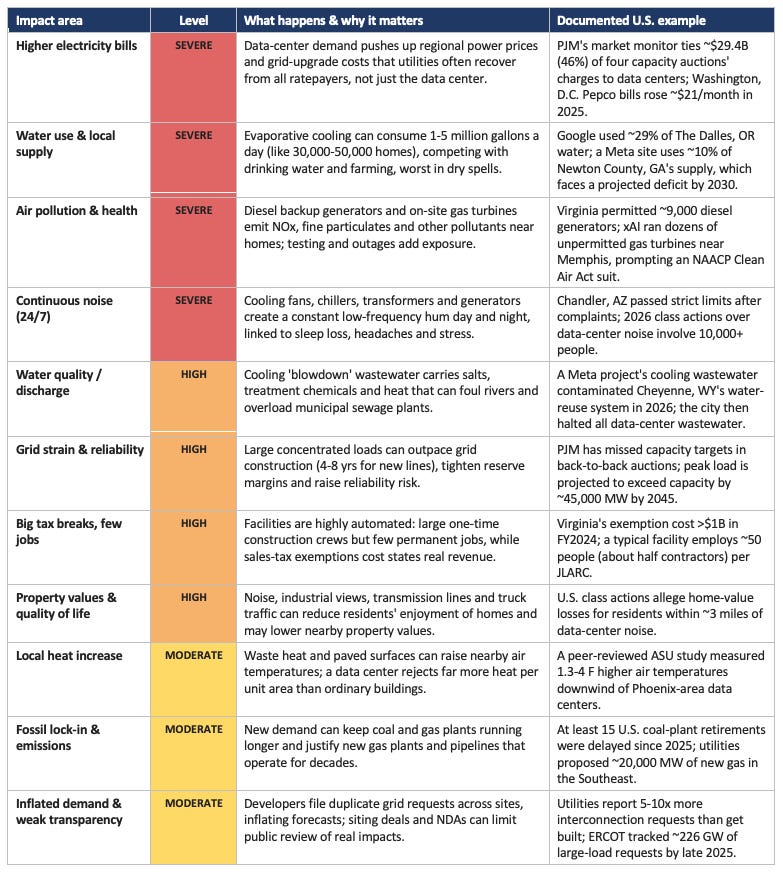
Overview of impacts at a glance
Shading indicates severity for a nearby community: darkest = most severe. In a black-and-white copy, the darkest cells are still the highest-priority concerns.
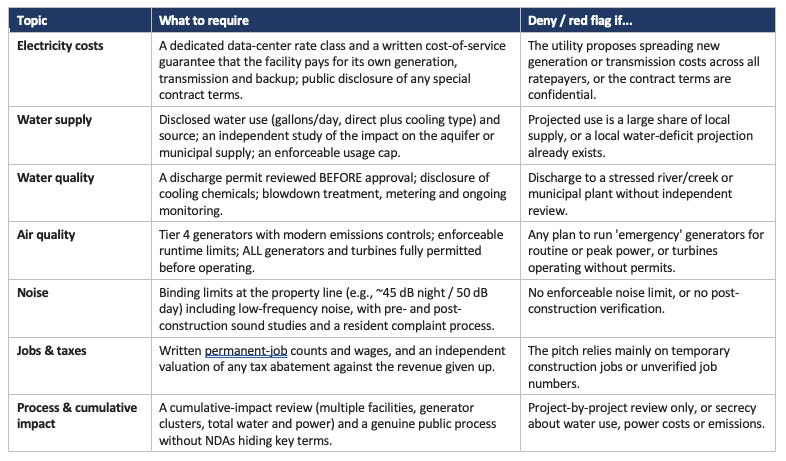
Conditions to demand before any approval or rezoning
If a project moves forward, these are reasonable, enforceable conditions to insist on. The right-hand column lists warning signs that justify a ‘no’ vote or further study.
The evidence, by impact area
1. Higher electricity bills for households and businesses
Data centers already consume a large and fast-rising share of U.S. electricity. The U.S. Department of Energy’s Lawrence Berkeley National Laboratory found they used about 4.4% of all U.S. electricity in 2023 - roughly triple their 2014 level - and projected 6.7% to 12% of national electricity by 2028.
Where demand is concentrated, ordinary customers can end up paying. In the PJM grid region (13 states and Washington, D.C., serving about 67 million people), the July 2024 capacity auction cleared roughly ten times higher than the year before. PJM’s independent market monitor, Monitoring Analytics, estimated data centers were responsible for 63% of that increase - about $9.3 billion - and its president, Joseph Bowring, calculated that data-center demand accounted for $29.4 billion, or 46%, of $63.6 billion in total capacity charges across four auctions. He has recommended removing data-center load from the shared capacity market so that data centers pay for their own capacity and do not impose those costs on other customers.
These costs show up on bills. Washington, D.C. Pepco residential customers saw increases averaging about $21 a month beginning in mid-2025, and the Union of Concerned Scientists estimated PJM ratepayers will pay about $4.4 billion for data-center-related transmission approved in 2024.
A March 2025 Harvard Electricity Law Initiative study reviewed 40 special contracts between utilities and data centers and warned that utilities may be offering discounts that are subsidized by everybody else, often on confidential terms. In one example, a utility proposed more than $3 billion in new gas plants and infrastructure to serve a single data center, with the cost proposed for recovery from all customers. Utilities across Virginia, Georgia and the Carolinas have proposed roughly 20,000 MW of new gas generation by 2040, with data centers driving most of the projected growth.
2. Water consumption and water quality
Cooling is water-intensive. LBNL estimated U.S. data centers directly consumed about 17.4 billion gallons of water in 2023 and could use 38 to 73 billion gallons by 2028. A single large facility can consume 1 to 5 million gallons a day - comparable to 30,000 to 50,000 households - and the strain is worst during hot, dry periods when cooling peaks and local water is scarcest. Counting the water used to generate their electricity adds an indirect footprint LBNL put near 211 billion gallons in 2023.
Concrete U.S. cases show the local pressure. In The Dalles, Oregon, records released only after the city spent public money fighting a public-records lawsuit showed Google’s data centers used about 29% of the city’s water in 2020 and later approached 40%. In Newton County, Georgia, a Meta facility uses roughly 10% of the county’s daily water; nearby residents on wells reported taps running dry and brown water after construction, the county is projected to reach a water deficit by 2030, and water rates are set to rise about 33%. Some later applicants requested up to 6 million gallons a day - more than the county’s entire daily use.
Water quality is a distinct concern. Cooling systems periodically discharge ‘blowdown’ wastewater that can carry elevated dissolved solids, chlorides, heavy metals and treatment chemicals - Virginia discharge records list substances such as sulfuric acid, sodium hydroxide and calcium chloride - plus heat that lowers dissolved oxygen and stresses aquatic life. In early 2026, wastewater from a Meta project’s cooling-system start-up contaminated Cheyenne, Wyoming’s water-reuse system with a rare metal-resistant bacterium and disrupted two treatment plants; the city revoked the discharge privilege and then indefinitely suspended acceptance of all data-center industrial wastewater.
3. Air pollution and health
Data centers keep large fleets of diesel backup generators. Virginia has permitted nearly 9,000 of them, including about 4,700 in Loudoun County alone (roughly 12 gigawatts of capacity). The state’s Joint Legislative Audit and Review Commission (JLARC) estimated that in a worst case these generators could emit about 9,000 tons of nitrogen oxides in Northern Virginia - about half of what the whole region typically emits annually from all sources. Diesel exhaust contains NOx, carbon monoxide and fine particulate matter linked to respiratory and heart harm, and even emergency-only units create local emissions during testing and outages.
On-site power plants raise the stakes further. Near Memphis, Tennessee, xAI’s ‘Colossus’ facility ran as many as 35 unpermitted methane gas turbines starting in 2024, and reporting found dozens more unpermitted turbines at a related site in Southaven, Mississippi. In April 2026 the NAACP - represented by the Southern Environmental Law Center and Earthjustice - sued xAI over the turbines, which sit near Boxtown, a historically Black neighborhood the SELC says already faces roughly four times the national cancer risk. The episode shows how quickly major emissions sources can appear without permits.
4. Continuous noise
Unlike construction, operating noise never stops. Cooling fans, chillers, transformers and generators produce a continuous low-frequency hum; industrial diesel generators can reach about 105 decibels, cooling towers up to about 70 dBA within a few hundred feet, and some sites exceed 90 decibels (sustained exposure above 85 dB can damage hearing). Residents near facilities report sleep disturbance, headaches, nausea and elevated stress. After years of complaints, Chandler, Arizona adopted strict limits - about 50 dB day and 45 dB night at the property line, with required sound studies - and in 2025 rejected a major new AI data center; in 2026, Mississippi residents filed a class action over data-center noise on behalf of more than 10,000 people.
5. Land use, property values, heat and light
Large windowless buildings, substations, transmission lines and paved yards can industrialize rural and residential areas, increase stormwater runoff, and affect property values - U.S. class actions allege home-value losses for residents within about three miles of noisy facilities. Waste heat is also measurable: a peer-reviewed Arizona State University study found four Phoenix-area data centers raised nearby air temperatures by 1.3 to 4 F about a third of a mile downwind, because a data center can reject far more heat per unit area than ordinary buildings. (A 2026 satellite-based preprint reported larger surface-temperature effects, but it measures ground and rooftop temperature rather than air temperature and is not yet peer-reviewed.)
6. Grid strain, reliability and fossil-fuel lock-in
Concentrated demand can outpace the grid. Transmission lines take years to build, and PJM has failed to secure enough capacity in consecutive auctions, with summer peak demand projected to exceed current capacity by about 45,000 MW by 2045. To keep pace, utilities have delayed retiring at least 15 U.S. coal plants since 2025 - plants that together emitted almost 65 million metric tons of greenhouse gases in 2023, more than the entire state of Massachusetts - and have proposed extensive new gas generation. Infrastructure built for a decades-long demand bet can lock in emissions even if individual facilities later become more efficient.
7. Jobs, tax subsidies, transparency and inflated demand
The economic case deserves scrutiny. Data centers are highly automated: JLARC found a typical 250,000-square-foot facility employs about 50 full-time workers, roughly half of them contractors, even though construction can employ up to 1,500 workers per building for a year or more. Meanwhile Virginia’s data-center sales-tax exemption cost the state about $2.73 billion from 2021 to 2024 and more than $1 billion in FY2024 alone, and one analysis estimated $7.8 million of investment for each permanent Virginia data-center job. JLARC also concluded that while current rates allocate costs appropriately, growing demand is likely to increase other customers’ costs.
Demand forecasts are often inflated. Developers file duplicate interconnection requests across multiple utilities for the same project; a former Google engineering director now running a grid-software company estimates there are five to ten times more interconnection requests than data centers actually being built. Texas’s grid operator was tracking about 226 GW of large-load requests by late 2025 - more than triple a year earlier - and one utility expects only about 22% of its pipeline to materialize. This can drive overbuilding that ratepayers fund. Community pushback is widespread: a tracking initiative counted at least 48 projects worth $156 billion blocked or stalled by local opposition in 2025, with active opposition groups in 40 states.
8. Electronic waste and end-of-life
Rapid hardware turnover creates waste. Servers and accelerators are often replaced every three to five years, feeding a global e-waste stream that reached a record 62 million tonnes in 2022 - of which only about 22% was formally collected and recycled - and is on track for 82 million tonnes by 2030. Planning approvals frequently do not require funds to remove obsolete equipment or restore the site once the facility closes.
Important context and caveats
Impacts vary widely by state regulation, siting, cooling design and electricity mix — a well-sited, well-regulated facility causes less harm than a poorly sited one. Data centers also generate real local tax revenue; in the largest host counties this can run to hundreds of millions of dollars a year (JLARC). Some of the most dramatic figures come from expert estimates or preprints and should be treated as such: the satellite heat study measures surface rather than air temperature, and ‘phantom demand’ multiples are estimates. Industry-funded analyses report larger economic benefits than the independent studies cited here. And documented water-contamination events remain rare — the broader, more common risks are competition for shared water and cost-shifting onto other utility customers. The practical question is not whether data centers are always harmful, but whether enforceable conditions on power costs, water, air and noise make a specific project’s trade-offs acceptable.
Sources
All sources are U.S. government reports, utility-regulator filings, national labs, peer-reviewed studies, or reputable news and research organizations, published 2023–2026. Links current as of July 2026.
Electricity demand and ratepayer costs
U.S. DOE - report on rising data-center electricity demand (Dec 2024) https://www.energy.gov/articles/doe-releases-new-report-evaluating-increase-electricity-demand-data-centers
Lawrence Berkeley National Laboratory - 2024 U.S. Data Center Energy Usage Report (PDF) https://eta-publications.lbl.gov/sites/default/files/2024-12/lbnl-2024-united-states-data-center-energy-usage-report_1.pdf
Utility Dive - data centers, PJM capacity auction and the market monitor https://www.utilitydive.com/news/data-centers-pjm-capacity-auction-market-monitor/801780/
Utility Dive - PJM data centers, capacity auction, IMM Bowring https://www.utilitydive.com/news/pjm-data-centers-capacity-auction-imm-bowring/825626/
IEEFA - data-center growth spurs PJM capacity prices (10x) https://ieefa.org/resources/projected-data-center-growth-spurs-pjm-capacity-prices-factor-10
The Hill - data-center power costs and PJM https://thehill.com/policy/technology/5970522-data-center-power-costs-pjm/
Citizens Utility Board - sustained high PJM capacity prices https://www.citizensutilityboard.org/blog/2026/07/15/cub-sustained-high-pjm-capacity-prices-ramp-up-urgency-for-data-center-reform/
Harvard Electricity Law Initiative - Extracting Profits from the Public https://eelp.law.harvard.edu/extracting-profits-from-the-public-how-utility-ratepayers-are-paying-for-big-techs-power/
Utility Dive - utilities subsidize data-center growth (Harvard / Peskoe) https://www.utilitydive.com/news/utilities-subsidize-data-center-growth-ratepayer-cost-shif-harvard-peskoe/742001/
The Conversation - how your electric bill may be paying for data centers https://theconversation.com/how-your-electric-bill-may-be-paying-for-big-data-centers-energy-use-257794
Utility Dive - new gas and coal for data centers https://www.utilitydive.com/news/fossil-fuel-gas-coal-climate-data-centers/753565/
Water consumption and water quality
EESI - data centers and water consumption https://www.eesi.org/articles/view/data-centers-and-water-consumption
MOST Policy Initiative - data center water use https://mostpolicyinitiative.org/science-note/data-center-water-use/
ITIF - data centers and water (2026, PDF) https://www2.itif.org/2026-data-centers-water.pdf
Data Center Dynamics - Google Oregon water use revealed after lawsuit https://www.datacenterdynamics.com/en/news/we-now-know-how-much-water-googles-oregon-data-centers-use-after-city-drops-lawsuit-against-journalists/
Latitude Media - data-center water-use disclosure https://www.latitudemedia.com/news/data-center-water-use-black-box-google-trying-to-change/
NewsNation - Meta data center and muddy water in Georgia https://www.newsnationnow.com/us-news/southeast/meta-data-center-georgia-muddy-water/
CBS News Atlanta - AOC presses EPA over Morgan County drinking water https://www.cbsnews.com/atlanta/news/aoc-presses-epa-over-morgan-county-drinking-water-concerns-tied-to-georgia-data-center-development/
San Juan Daily Star - their water taps ran dry when Meta built next door https://www.sanjuandailystar.com/post/their-water-taps-ran-dry-when-meta-built-next-door
Cowboy State Daily - Cheyenne halts data-center wastewater after contamination https://cowboystatedaily.com/2026/07/02/cheyenne-wont-take-data-center-wastewater-after-meta-company-contaminated-system/
Forbes - Meta AI data center linked to rare bacteria in city water https://www.forbes.com/sites/victoriaforster/2026/07/09/meta-ai-data-center-linked-to-rare-bacteria-in-citys-water-system/
Virginia Mercury - what is in the water: data-center discharge in Virginia https://virginiamercury.com/2026/06/01/whats-in-the-water-what-we-know-and-dont-know-about-data-center-water-discharge-in-virginia/
University of Georgia (CAES) - how data centers impact surface and ground waters https://fieldreport.caes.uga.edu/publications/TP121/how-data-centers-impact-surface-and-ground-waters/
Air pollution and health
Piedmont Environmental Council - data-center diesel generator use https://www.pecva.org/work/energy-work/proposed-increase-to-data-center-diesel-generator-use/
Bay Journal - potential for more air pollution from data centers in Virginia https://www.bayjournal.com/news/pollution/potential-for-more-air-pollution-from-data-centers-causes-concern-in-virginia/article_ebd80514-44da-4885-90bb-56beec4ede02.html
VPM - Virginia data centers, diesel generators, DEQ and Loudoun https://www.vpm.org/news/2025-12-17/virginia-data-centers-diesel-backup-generators-deq-loudoun-turner-dowd
Southern Environmental Law Center - xAI built an illegal power plant https://www.selc.org/news/xai-built-an-illegal-power-plant-to-power-its-data-center/
NAACP - NAACP sues xAI over illegal pollution https://naacp.org/articles/naacp-sues-xai-illegal-pollution-data-center-power-plant
SELC - resistance against xAI facility in South Memphis https://www.selc.org/news/resistance-against-elon-musks-xai-facility-in-south-memphis-gets-stronger/
Noise
ClassAction.org - data-center noise and water-pollution lawsuit https://www.classaction.org/data-center-noise-water-pollution-lawsuit
Consumer Notice - data-center lawsuits https://www.consumernotice.org/legal/data-center-lawsuits/
EESI - communities raising noise-pollution concerns about data centers https://www.eesi.org/articles/view/communities-are-raising-noise-pollution-concernsabout-data-centers
Prince William Times - cities turn to tough limits on data-center noise https://www.princewilliamtimes.com/news/some-cities-suffering-from-data-center-noise-turn-to-tough-limits/article_2aa7fb8c-b6aa-11ed-8626-5738aae2f76c.html
Axios Phoenix - Chandler rejects AI data center https://www.axios.com/local/phoenix/2025/12/16/chandler-rejects-sinema-ai-data-center
Prism - residents near data centers battle constant noise and vibration https://www.prismnews.com/news/residents-near-data-centers-battle-constant-noise-vibration
Land use, heat and property values
ASME Journal of Engineering for Sustainable Buildings and Cities - Sailor et al. (waste heat) https://asmedigitalcollection.asme.org/sustainablebuildings/article/7/2/024501/1233035/Data-Center-Waste-Heat-as-an-Emerging-Urban
Facilities Dive - data centers raise temperatures up to 4 degrees (ASU study) https://www.facilitiesdive.com/news/data-centers-raise-temperatures-4-degrees-ASU-Sailor-thermal-plume/821164/
arXiv - satellite land-surface-temperature preprint (Cambridge, 2026) https://arxiv.org/abs/2603.20897
Grid reliability and fossil-fuel lock-in
Utility Dive - PJM capacity auction and backstop procurement https://www.utilitydive.com/news/pjm-interconnection-capacity-auction-data-center/808264/
American Action Forum - emergency energy auction and data-center rate increases https://www.americanactionforum.org/insight/emergency-energy-auction-to-prevent-data-center-driven-rate-increases/
DeSmog - 15 coal-plant retirements delayed for AI data centers https://www.desmog.com/2025/12/12/15-coal-plant-retirements-delayed-ai-data-centers-trump-doe-orders/
E&E News - AI gives coal plants a lifeline https://www.eenews.net/articles/ai-gives-coal-plants-a-lifeline-as-trump-makes-them-dirtier/
Jobs, subsidies, transparency and demand
WRIC - data-center tax exemption and Virginia incentive spending (JLARC) https://www.wric.com/news/virginia-news/data-centers-tax-exemption-virginias-incentive-spending-jlarc/
Governing - Virginia’s data-center tax breaks cost the state $1 billion https://www.governing.com/infrastructure/virginias-data-center-tax-breaks-cost-the-state-1-billion
Virginia JLARC - Data Centers in Virginia (2024) https://jlarc.virginia.gov/landing-2024-data-centers-in-virginia.asp
Food & Water Watch - data-center jobs research brief (PDF) https://www.foodandwaterwatch.org/wp-content/uploads/2026/01/RB_2601_DataCenterJobs.pdf
WHRO - unprecedented data-center energy demand challenges Virginia (JLARC) https://www.whro.org/environment/2024-12-09/unprecedented-energy-demand-from-data-centers-poses-big-challenges-for-virginia-commission-says
Utility Dive - only a fraction of proposed data centers will get built https://www.utilitydive.com/news/a-fraction-of-proposed-data-centers-will-get-built-utilities-are-wising-up/748214/
POWER Magazine - phantom data centers https://www.powermag.com/phantom-data-centers-didnt-break-the-power-grid-they-proved-it-was-already-broken/
Belfer Center (Harvard) - data centers: Texas and Virginia comparison https://www.belfercenter.org/research-analysis/data-centers-texas-virginia-comparison
Fortune - communities blocking billions in data centers https://fortune.com/2026/05/18/communities-are-blocking-billions-in-data-centers-big-tech-has-wagered-1-trillion-otherwise/
Electronic waste
UNITAR - Global E-waste Monitor 2024 (press release) https://unitar.org/about/news-stories/press/global-e-waste-monitor-2024-electronic-waste-rising-five-times-faster-documented-e-waste-recycling
Global E-waste Monitor 2024 https://ewastemonitor.info/the-global-e-waste-monitor-2024/
No posts
Comments
Nothing yet. Say the first thing.
Sign in to join the conversation.