
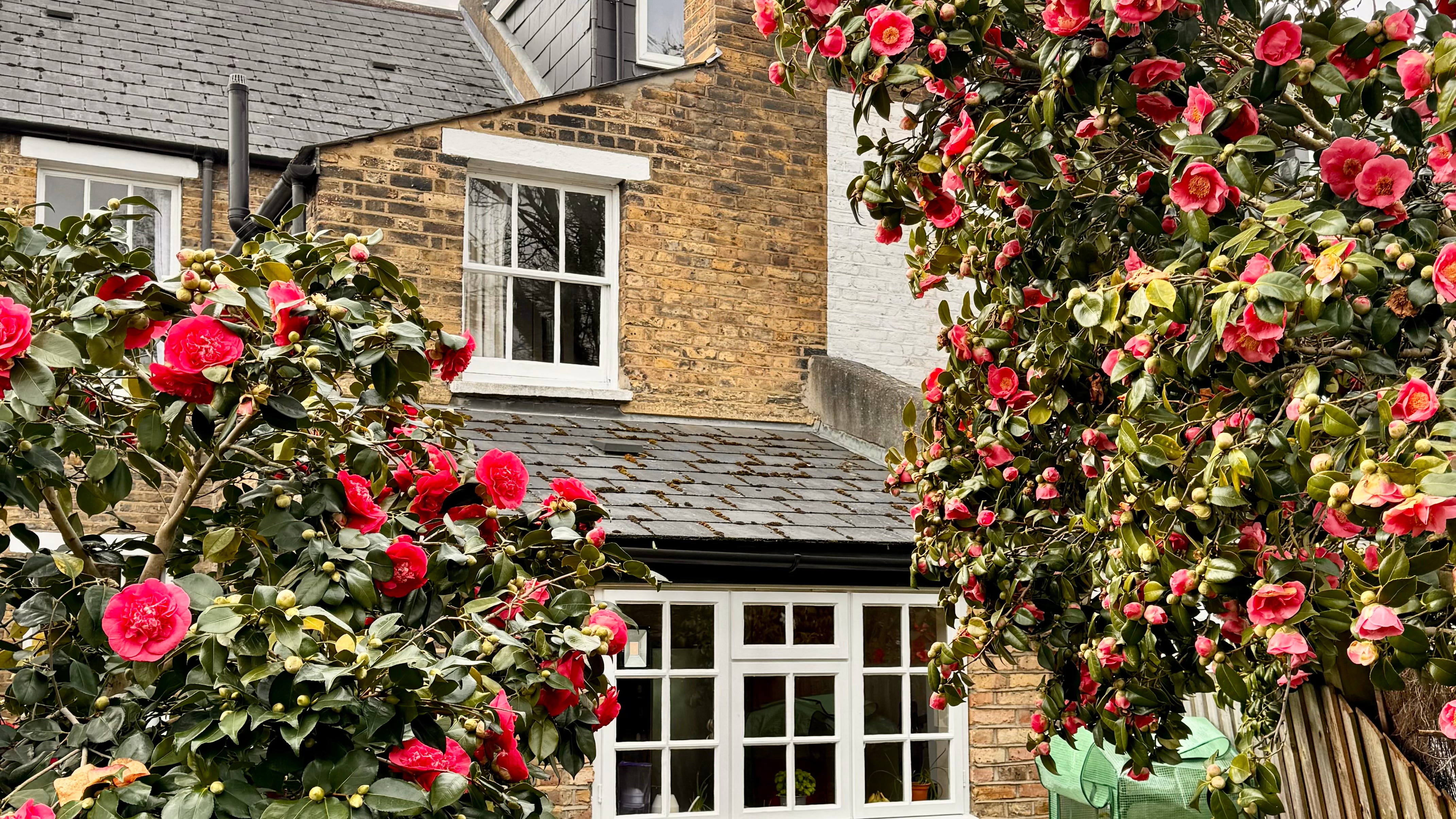
Standing in the kitchen of one of the many properties we visited while house-hunting, my wife and I spoke with a friendly realtor. He was a little younger than us but seemed a grounded, understanding sort. He knew the sale was not happening when I told him that the very, very overlooked back garden felt like being in a fishbowl. (The houses on the opposite side were on a higher elevation, so the upstairs and downstairs windows of the three houses opposite looked down into the garden, along with the upper windows of the houses on the same side. It was awful.)
And so we chatting about houses and house-hunting — us pretending that we might still be slightly interested, him knowing that we weren’t.
I can’t really remember why we ended up on the topic, but we mentioned how many property shows we watched and how we were a little addicted to them. He snorted.
“Stop it. They’re all rubbish. Just don’t even watch those.”
I suppose I shouldn’t be surprised when a realtor rolls his eyes at television that glamorises his profession, but I was taken aback. I didn’t even think to ask why he felt this way; I just laughed and shrugged it off.
Still, his tone had suggested to me that house-hunting and renovation shows didn’t realistically represent the process. And anyone with a lick of sense knows that ‘reality TV’ is barely real at all. It has to be viewed as entertainment first and taken with a brick of salt.
But still, are they that bad?
Home Renovation shows have been around for a while. The American programme This Old House, with Bob Villa, is often cited as the first, starting in 1979. I don’t recall ever watching it. It wasn’t the kind of TV that attracted me as a young man living in Canada.
My German grandfather was a carpenter by trade. With my father and uncle as his crew, he built our family home from the ground up, along with every other house in the family. The idea of hiring a builder to do the work was practically alien. DIY was just upkeep. And, in my mind, renovating and repairing was a part of owning a house.
Back then, watching renovations on TV sounded about as exciting as watching a show of factory work, or reality TV about lawn-mowing.
But after moving to Tokyo many years later and becoming engaged with the world of Japanese TV, I was introduced to the Daikaizou!! Gekiteki Bifō Afutā (大改造!!劇的ビフォーアフター), often referred to in English as simply: Before After. A renovation show, the format was in the title — a dramatic transformation to a family home.
Before After presaged (and perhaps even influenced) American shows like Extreme Makeover: Home Edition. Each episode introduced a Japanese family living in a cramped or run-down space — stairs too steep for elderly parents, entire families sleeping in a single six-mat tatami room, leaking roofs, kitchens that were better suited to single businessmen than whole families — then oversaw a major renovation. In rare cases, this meant an extension, but more often, the builders would redesign the house and fit it with a variety of clever storage solutions and space-saving devices.
The show had an entirely different feel to any renovation programme I’d seen. It focused on the usefulness of the project and the family’s reactions to their new home. This wasn’t a builder telling the audience how to do things or a designer telling us how to make our homes look more prestigious; Before After looked at houses as a space for living, a space for people. It was also about making lives better for those who couldn’t afford anything bigger.
My wife and I were hooked on the show and watched it regularly.
The estate agent we’d spoken to that day might argue that these shows make it look too easy. And some do: a few simple fixes, a bit of graft, and you, too, can have a better life. Suddenly, the participants’ rooms are brighter, their homes are cleaner and more organised, their children are all smiles.
It’s easy to mock. Any disappointment is left on the cutting-room floor. The happily-ever-after story arc is assembled by the editor, who makes sure that all difficulties are met and surmounted in the end.
However, the frustrations of a space that doesn’t ‘work’ are real. Take our current rental, where the bathroom is so small that the sink is located over the back of the toilet. If you want to wash your face, you have to stand in a 25 cm gap between the toilet and bath. You can never really stand over the sink. Not properly. The toilet gets covered in whiskers when I shave, and makeup when my wife gets ready for work. It’s ridiculous.
After two years, we are used to it to some degree, and apart from this, we love the house. But there are moments when I realise that brushing my teeth is a kind of physical contortion that people in normal houses don’t have to deal with. And that’s frustrating. A frustration that builds. If it was our house, we could fix it. This fix wouldn’t make us richer, more popular, or more attractive, but it would make each morning and each evening a little less irritating.
Shows like Before After, on top of being great entertainment, reveal ways that living space works or fails to work and ways that it impacts daily life. After all, what affects your life more than your own home?
When we moved to the UK, we discovered a new obsession: Grand Designs.
Grand Designs started in 1999 and is still going. Kevin McCloud hosts as the enthusiastic but sometimes sceptical witness to difficult, radical, and often massive builds taken on by private owners. Occasionally, the owners are builders, designers or architects themselves, but not always. Sometimes, they are just people with a lot of money and a dream house in their imaginations.
The show has seen homes built on the water, built into hillsides, built from old warehouses or barns, or built into the cliffside of a windswept rock. The title is the show’s premise — these homes are grand designs, often wildly incongruous with their surrounding neighbours.
The audience follows the many pitfalls of a project: Late deliveries. Planning permission nightmares. Six-month plans turning into six-year plans. And once in a while, a project fails utterly, with the owner running out of money and resources and forced to give up. But more often than not, the result is successful and beautiful, if shockingly modern.
The brilliance of Grand Designs is that it is more than just property porn. It doesn’t coddle its audience into believing that anything is possible or that building a house is easy. If anything, Grand Designs teaches its audience that projects like these are incredibly difficult. To build a project from scratch, to challenge the norms and create something that isn’t just another cookie-cutter house, risks everything.
If there is any misrepresentation of the process, it is because we are watching an entire construction project compressed into an hour. But the show is well edited, and we see the time-scales, the frustrations of the owner and their family. And sometimes, the show follows up on an earlier project years later to see how the owners are living now. To see if they are as happy as they thought they’d be.
Sometimes, they aren’t. Sometimes, they’ve sold it.
Grand Designs led to other shows. Restoration Man takes the opposite approach — following the struggles of people who have bought relatively inexpensive but quirky listed properties which they plan to modernise, while keeping the structure true to its roots. It taught us a lot about how difficult listed properties can be, but also how dreamlike it can be to live in one if you have the means to renovate it well.
The host, George Clarke, oversees homes that are built from old folly towers or even water reservoirs. Ruins, churches, and barns are restored to usefulness as houses. Clarke is passionate about history and period features. Unlike McCloud, he is less interested in coy nods toward the original architecture and more interested in seeing things truly restored — while still modernised for contemporary life.
Then, there is Location, Location, Location with Phil Spencer and Kirstie Allsopp — a show that selects people who have struggled in their house-buying process and offers to help. Spencer and Allsopp show them around a series of suitable houses in the hopes that they will buy one. Usually, there is an offer. Sometimes, it fails. Sometimes, the potential buyer says they simply need to keep looking.
There is also the charmingly twee Love It or List It, in which couples who cannot agree whether to renovate or move are challenged to choose. In this low-key reality-TV format, Spencer shows them houses in their price range to convince them to move while co-host Allsopp takes on a major renovation to their existing home that aims to improve their living situation and raise the value of the house. In the final moments, the owners must decide whether they will stay in the house and ‘love it’ or move out and ‘list it.’
And in true British fashion, the losing host buys a pint for the winning one.
There are many, many more. Escape to the Chateau. Escape to the Country. Homes Under the Hammer. Old House, New Home. And Alan Carr’s wonderful competition show Interior Design Masters. The demand for watching houses be bought, built, repaired, and decorated seems as endless as the demand for real estate itself.
And why not? Our homes are important to us. Having the privilege to improve your living environment is a dream for some and a plan for others. Who wouldn’t want to see what’s possible?
I’m not pushing for thoughtless TV consumption. These shows are, of course, selling dreams — and advertising. They are made to draw viewers in, not to educate them. You can see the manipulation if you’re watching carefully — these non-fiction events strung together into a narrative with a satisfying ending. We tell stories even in our documentaries because that’s what keeps people engaged.
But I do believe that watching these shows prepared us, to some extent, for what to expect. Not only in the hunting, but in the renovating. We know what we’re capable of fixing ourselves and what we are not. We have a ballpark idea of how much these changes will cost. And we know what we like.
The estate agent who had shrugged off my complaints about the fishbowl garden seemed to infer that all the houses in that area would be the same.
We’d already looked at 17 houses — a number that every agent seemed to think was excessive. No one ever said it outright, but their expressions said that we were too fussy. Too caught up in finding something ‘perfect.’
This isn’t a TV show where you find the perfect home in the end, they seemed to say. You have to compromise!
But it’s in an agent’s best interests to convince you that finding any other house is hard. Compromise is a real-estate mantra because, of course, compromising means accepting what the agent is selling you. They want you to compromise only when it means accepting their recommendations, their terms. And that’s something to approach with caution.
As we were leaving, we shook hands, and he recommended a pub down the street. “A proper pub,” he said. “A real boozer.”
We peeked inside this ‘proper pub.’ It was sad, run down, and filled with old men. We turned around and found a better one two blocks away. Suddenly, the estate agent’s opinion seemed a little less trustworthy.
The very next day, we visited a house just one street north of the fishbowl. In its back garden, we could not even see the neighbouring property, never mind its windows. The house was spacious and in good condition, the garden private, and it was all within our price range.
That is the house we are in the middle of buying now. That is the house that will be our own, more humble, grand design. ◾️
What I’m watching: It feels like there’s been an explosion of series that have returned to streaming recently. I’ve started on the new season of Black Mirror, and it has been living up to its previous seasons. Episode 3, “Hotel Reverie,” wears its narrative devices on its sleeve (I mean, “We can’t pull her out of the simulation until the narrative arc ends or she’ll die!” was a stretch), but since the whole thing is about narrative, I can almost forgive this heavy-handedness. The point is that despite this minor eye-roll, the episode had me completely rapt. It was just incredibly well-made.
What I’m doing: This week, my wife and I did our best to hanami in Greenwich Park. The cherry trees there have bright pink blossoms rather than the white or pale pink of Japan’s more common somei-yoshino, but with a small crowd of picnickers and drinking a cup of sake, one could almost imagine we were back in Tokyo.
Comments
Nothing yet. Say the first thing.
Sign in to join the conversation.