
If you follow public opinion, you’ve likely seen the statistic: Congress currently hovers around a ten to fifteen percent approval rating. Yet, when election season rolls around, incumbents win reelection over ninety percent of the time.
It is easy to look at that gap and attribute it to bad leadership, media hyperbole, or a general decline in civic culture. But when you examine how the legislative process actually functions, a simpler explanation emerges: the system is delivering exactly what its incentives are designed to produce.
The primary mechanism driving this disconnect is the collapse of competitive general elections. Due to heavy gerrymandering across the country, roughly 90% of U.S. House seats are non-competitive by November. In 2024, 84% were decided by 10+ points or uncontested; 91% were decided by at least 5 points. In about three-quarters of states, a single party holds the governor’s office and both legislative chambers. For millions of Americans, real political competition has ceased to exist at the general election level.
As a result, the only election that matters is the primary. Because turnout in primaries averages eight to ten percent of the electorate, lawmakers are structurally bound to the vocal, highly motivated fringes of their respective bases. A representative who attempts to negotiate across the aisle or focus on routine governance risks a primary challenge from candidate focused on performative outrage and partisan warfare. In that environment, stoking constant conflict becomes a rational survival strategy for a politician.
Beyond the primary system, modern lawmaking suffers from an information barrier. Legislation today is frequently thousands of pages long, drafted by specialized attorneys for other attorneys, and negotiated behind closed doors.
When a massive bill moves through Congress, the average citizen receives information about it filtered through three or four layers of commentary. By the time a policy discussion reaches a social media feed or a cable news segment, the actual text of the bill has been stripped away, replaced by emotional framing designed to maximize engagement.
When people are given the opportunity to read plain-text summaries of legislation without the partisan branding or media commentary attached, their reactions tend to shift dramatically. Stripping away the outrage framing allows the actual trade-offs of a policy to surface, which naturally tempers extreme reactions.
Addressing these dynamics requires looking beyond standard civic appeals. Expecting politicians to ignore their own political incentives or asking voters to simply tune out media outrage overlooks the structural forces at play.
Instead, civic tech leaders are beginning to deploy tools that alter the information loop entirely. By pairing secure mobile voting platforms—originally designed for military personnel deployed overseas—with artificial intelligence, it is becoming possible to create direct transparency around legislative votes.
Large language models can digest complex, multi-hundred-page bills instantly, translating legalese into plain, objective language. Voters can see what a bill actually does and share their opinion directly. Then, they can compare their district’s overall stance to how their representative actually voted on the bill.
Creating public scorecards based on real-time constituent sentiment introduces a layer of direct accountability that hasn’t previously existed. It allows voters to see past the campaign rhetoric and evaluate whether their representative is serving the district or responding solely to primary pressure.
True representative governance relies on lawmakers answering directly to the citizens who elected them, not to distant party bosses or entrenched special interests. The pressure points we see today—voter alienation, chronic gridlock, and widespread cynicism—are clear signs that our current political machinery is failing to deliver the accountability our Founders intended.
Practical, technology-driven tools give citizens a way to flip these bad incentives and make legislators accountable to the people they serve. By making complex policy easy to understand and creating clear records of how politicians actually vote, we can shift the focus away from perpetual outrage and back toward functional governance.
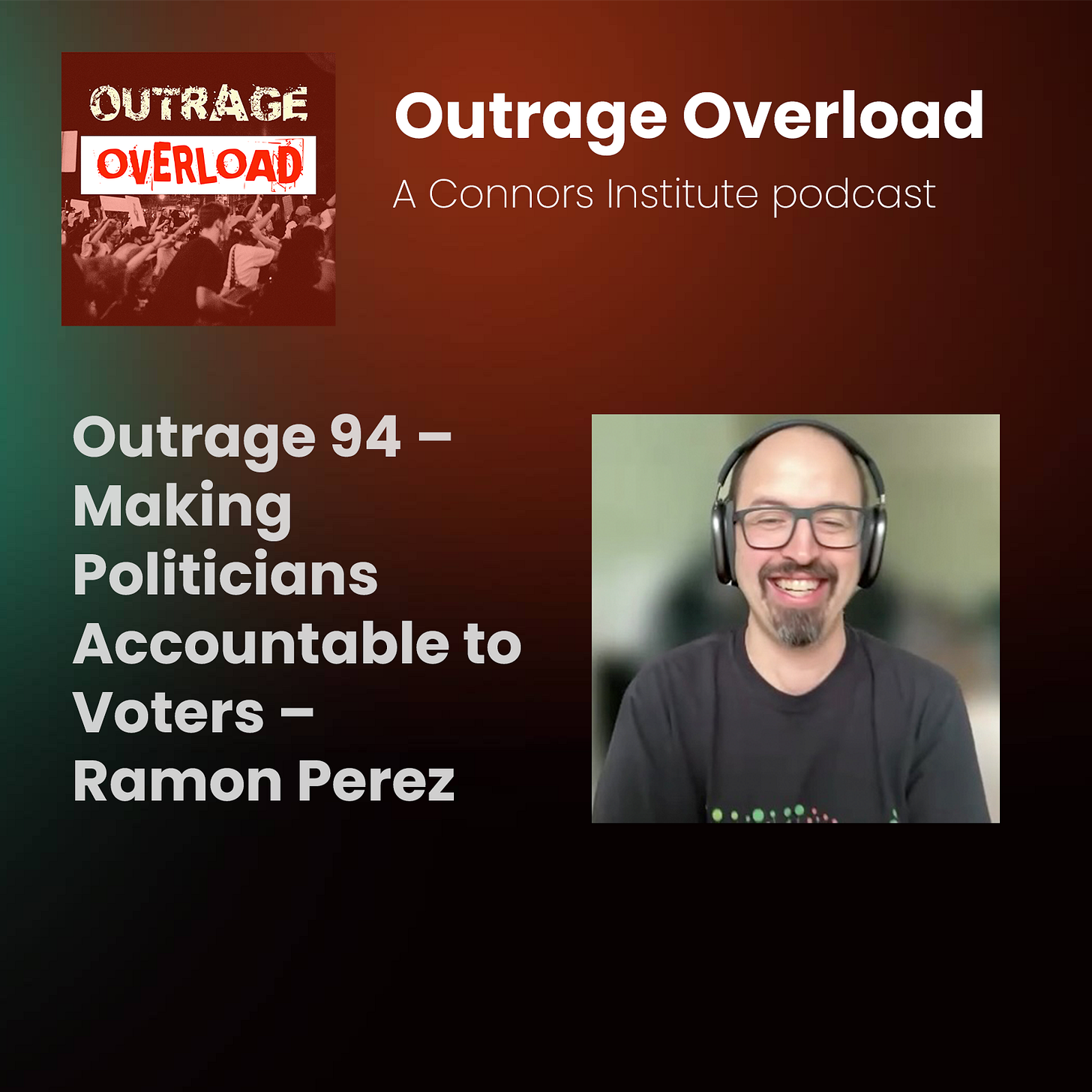
Listen to the Full Conversation: In the latest episode of Outrage Overload, I sit down with Ramon Perez, Executive Director of the Digital Democracy Project, to explore how mobile technology and AI are being used to challenge old legislative incentives. We discuss the mechanics of primary elections, how political scorecards work in practice, and why structural fixes offer a practical path out of political gridlock.
Want to go even deeper into the conversation? Watch a longer 48 minute version of this interview—including exclusive footage on local legislative maneuvering and early tech investment models—on our YouTube channel.
Join me live with Dr. Zeest Khan
📅 Date: Monday, August 17
⏰ Time: Noon PT / 3:00 PM ET
📍 Where: Substack live https://open.substack.com/live-stream/317981

The recent Executive Order on vaccine policy has generated immediate headlines, fierce debate, and understandable confusion for families and healthcare professionals alike.
Rather than leaning into the noise, we’re sitting down to examine the actual policy mechanics, the scientific context, and what this shift really means in practice.
It’s everything the Outrage Overload podcast is not. It’s not edited. It’s not scripted. It’s lightly researched. It’s David and Lisa talking about this week in outrage, what was in the news, in the memes, and maybe finding some backstory with a humorous (at least to us) twist.
No posts
Comments
Nothing yet. Say the first thing.
Sign in to join the conversation.