
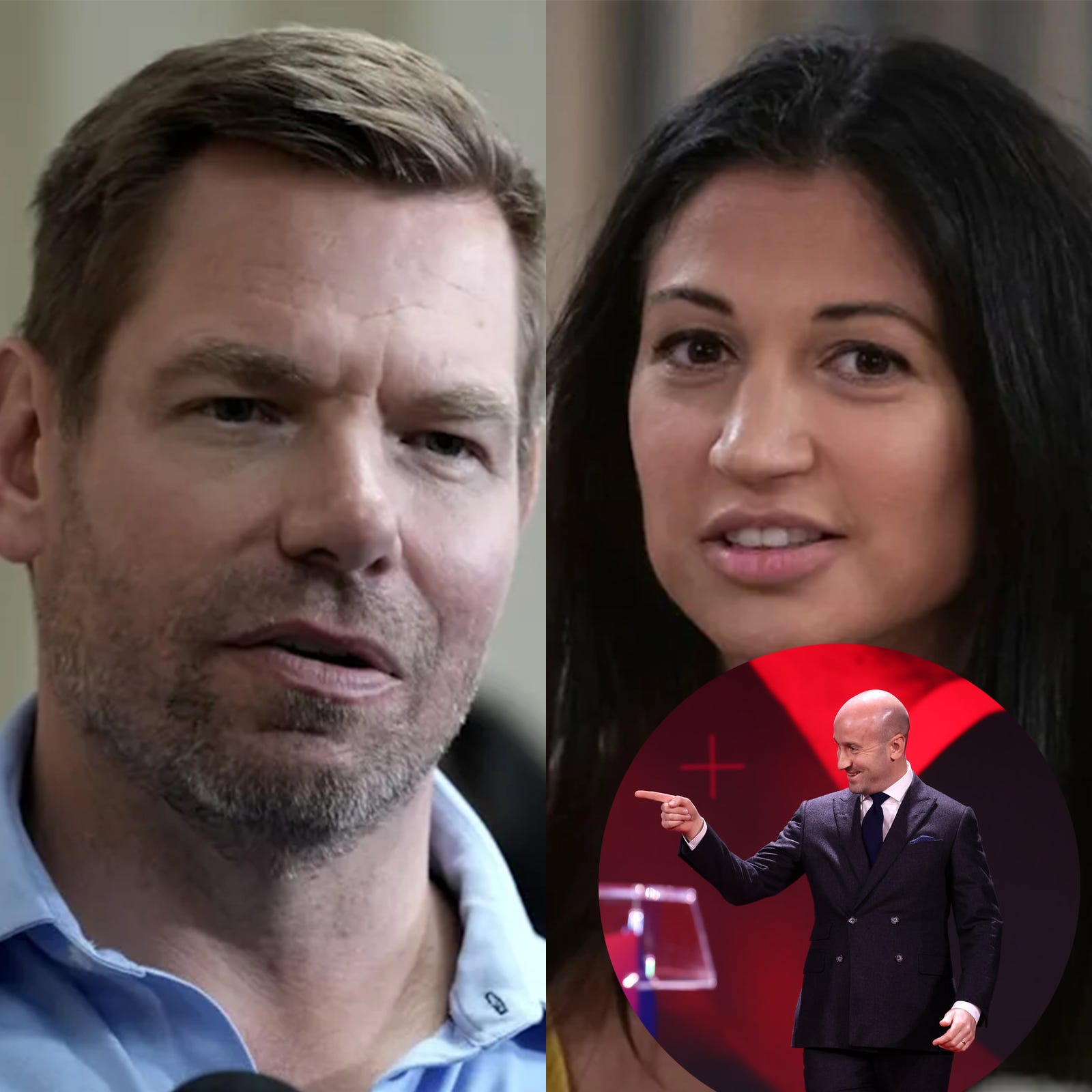
This week, Lisa and David talk about Jeanine Pirro dropping the Lincoln Memorial Reflecting Pool vandalism case is basic legal survival rather than a principled stand against Trump; DOGE cannot verify savings claims; Trump amending his case against the BCC to drop claims that the documentary harmed his businesses, brands, or financial interests, leaving only a claim for damages to his personal reputation; Judge lets DOJ dismiss J6 case against Oath Keepers; Swalwell had fling with Stephen Miller’s wife, Katie; US appeals court halts Trump ballroom project, sort of; Heritage Foundation (the originators of Project 2025) exec, Chris Wingate, busted for trying to enter Senate office building with drugs and ammo; Republican Rep. Chuck Edwards dropping out over sexual harassment allegations; UFC lost $30 million on White House fight; Hegseth kills 43-Year Blue Angels Uniform deal with black-owned local business; Republican Senator John Cornyn claimed that Congress is powerless to “rein in” President Trump, Todd Blanche approved as AG in dead of night; country songs top billboard list; DuckDuckGo offers Normal F***ing Sunglasses; attacked by a bot swarm; and more.
Politifact found that Fauci’s private COVID-era diary entries largely align with his public positions, rather than demonstrating that he privately held contrary views on the lab-leak question, school closures, or masks. It characterizes the entries as showing him working through changing and incomplete evidence.
His refusal to answer even apparently innocuous questions was likely a counsel-driven strategy: selectively answering can create disputes over whether a witness waived the privilege or invite efforts to probe contradictions.
The immediate DOJ referral is not a referral alleging that Fauci committed a COVID-era crime. It is a request from Sen. Rand Paul’s Senate committee that DOJ consider charging Fauci with criminal contempt of Congress because he declined to answer more than 100 subpoenaed questions by invoking the Fifth Amendment. DOJ confirmed that it received the document and is reviewing it.
There is also a procedural complication: ordinarily, a criminal-contempt referral has more statutory force after approval by the full Senate (or House). Paul’s committee sent its referral without a Senate floor vote, and legal observers have questioned whether that path is sufficient—though DOJ can still consider it as an ordinary criminal referral.
Experts are broadly skeptical that the criminal contempt case against Fauci has a strong legal foundation, and they frame it as a clash between Congress’s investigative power and a fairly orthodox use of the Fifth Amendment—complicated by the pardon, but not obviously overridden by it.
It’s a test of how far a partisan committee can push against established Fifth Amendment protections.
The key question for any prosecution is whether his fear of self-incrimination is “reasonable” in light of the pardon and other circumstances.
Some warn that if Congress succeeds in punishing a witness simply for asserting the Fifth, it would set a precedent discouraging cooperation or incentivizing witnesses not to appear at all, undermining oversight long term.
Todd Blanche is a strong candidate for one of the most alarming modern picks for Attorney General.
The central concern is not that Blanche lacks legal experience; it is that he was Donald Trump’s personal defense lawyer and his subsequent conduct has shown an inability or unwillingness to separate the president’s private interests from the government’s interests. The New York City Bar Association urged the Senate to reject him, alleging politically motivated prosecutions, disregard for constitutional rights and court orders, damaging personnel actions at DOJ, and conflicts arising from Trump-related matters. Those are grave allegations, though they are still allegations and assessments—not final adjudications of every claim.
Blanche was confirmed 50–49 after Republican Senators Lisa Murkowski and Susan Collins opposed him, with Murkowski specifically saying she lacked confidence that he would check the administration’s worst impulses.
Trump and Blanche argue for a strong “unitary executive” where that Article II vests executive power in the president, so the president must be able to direct executive officers, including DOJ officials. The administration is repudiating the traditional independence norm. Under Blanche’s DOJ leadership the department said it served “at the direction of the president.”
The Justice Manual expressly states that DOJ legal judgments “must be impartial and insulated from political influence” and that investigative and prosecutorial powers must be exercised free of partisan considerations. It limits White House–DOJ contacts about specific pending or contemplated cases and channels any permitted communication through senior officials.
But the Manual is generally internal executive-branch guidance, not a law conferring a private right to dismissal, damages, or judicial enforcement. DOJ leadership can waive, reinterpret, revise, or simply breach it; consequences may be internal discipline, inspector-general scrutiny, congressional oversight, whistleblowing, public exposure, resignations, and loss of institutional credibility—not necessarily a court remedy. DOJ’s own prosecution principles are likewise labeled nonbinding guidance, although deviations as a regular practice require leadership approval.
An election “mandate” does not override the Constitution or federal statutes. If government officials lack probable cause, conduct an unlawful search or seizure, deny due process, retaliate for protected speech or association, or selectively prosecute someone based on an impermissible classification or exercise of constitutional rights—including political activity—the action can be unconstitutional.
But the state can inflict severe practical harm before a court decides the merits: scrutiny, subpoenas, legal expense, reputational injury, pretrial restrictions, or arrest. Prosecutorial discretion is broad, and courts tend to defer to charging decisions; the safeguards are therefore strongest before a case begins, through ethical restraint, career-lawyer review, documented evidence standards, and institutional independence.
So if an administration rejects those internal restraints, the law is not meaningless—but enforcement becomes slower, narrower, and more dependent on evidence, judges, Congress, inspectors general, juries, elections, and officials who refuse unlawful orders. That is why these norms and rules matter. And Todd Blanche has shown that he has no intention of following them.
Links:
Yergz Radio (yergzradio.com)
Dare Talk Radio (daretalkradio.com)
This Week in Outrage Substack (outrageoverload.net/twio)
When the Bots Show Up to the Wrong Fight
Did Fauci’s private diary entries contradict his public stances on lab leak, masks, school closures? (Politifact)
Judge grants Trump’s request to delay handing financial records to BBC (BBC)
Judge reluctantly dismisses case against Oath Keepers militia group over Jan. 6 riot (NPR)
US appeals court halts Trump ballroom project paving way for Supreme Court showdown (BBC)
Heritage Foundation exec arrested on drug possession charge after accidentally bringing pistol ammo into Senate office building (The Independent)
Chuck Edwards drops reelection bid after Ethics panel calls for censure (The Hill)
UFC Lost $30 Million on White House Fight (Variety)
Navy Suddenly Ends 43-Year Blue Angels Uniform Deal with Florida Business (Military.com)
There’s Nothing We Could Do to Rein in Trump,’ GOP Senator Says (Rolling Stone)
Todd Blanche narrowly confirmed as Trump’s attorney general in overnight vote (PBS)
In a World of Smart Glasses, DuckDuckGo Made Dumb Ones on Purpose (CNet)
Woman Found Hanging in Tree Behind Vacant Home in Jackson, But Details Are Sparse (Mississippi Free Press)
What we know about the death of Tasia Fortune in Mississippi (WRAL)
Comments
Nothing yet. Say the first thing.
Sign in to join the conversation.