
Welcome to all new subscribers! If you are a new subscriber, the Getting Started article will help you answer all the common questions for new subscribers.
Subscribers to Outperforming the Market get full access to the Barbell Portfolio, all my intrinsic value, 1-year and 3-year price targets in the Price Target Report, and real-time trade alerts when I place buy and sell orders (I am fully invested in the Barbell Portfolio).
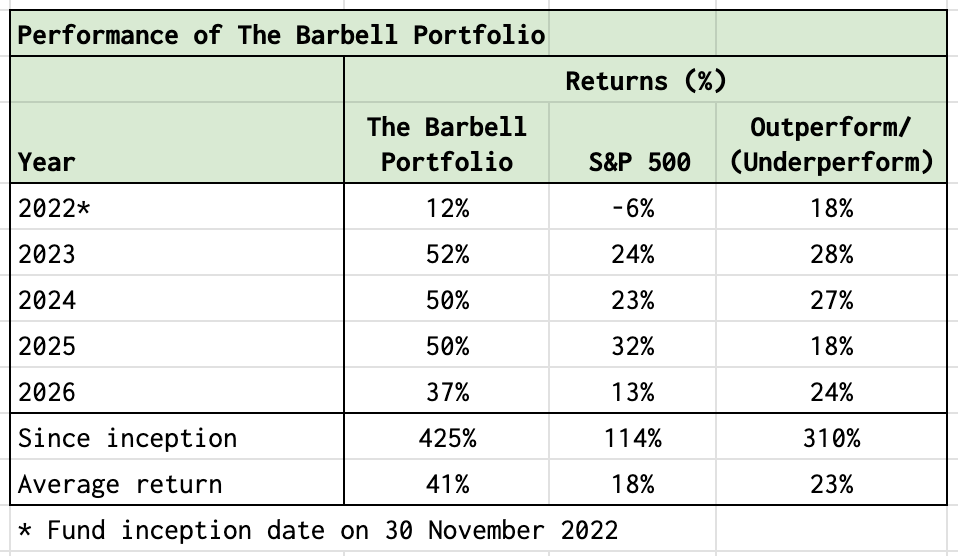
The full track record for the Barbell Portfolio from 2022 till today can be found here.
In addition, subscribers get a weekly deep dive on Fridays, a weekly newsletter on Mondays, and other earnings analysis, market review and portfolio review articles during the week. All links can be found consolidated here.
US Iran war
Iran said it reached an agreement with Oman on a proposed route for shipping through the Strait of Hormuz, a potential step toward a reopening of the critical waterway for energy supplies. A joint statement from Tehran and Muscat is under review and in the final drafting stage, with Iranian foreign ministry spokesman Esmail Baghaei saying negotiations between the two countries are “forward-moving” and a deal would be struck “if certain third parties do not obstruct this process”. Iran’s latest announcement on Hormuz comes after months of deadlock between the US and Tehran over how to conclude the war, with control over shipping through the waterway a particular sticking point.
Iran will seek to bar US and Israeli ships from the Strait of Hormuz and require compensation from hostile countries before they’re allowed to use it, according to local media reports on a proposed Iran-Oman deal. The agreement proposes a ban on cargo related to Israel, and a fee structure covering services like insurance and environmental costs, with Iranian management over the entry of vessels into Hormuz. The US has insisted on free transit through Hormuz and broadly called for a return to the pre-war status quo, with any temporary routes through the strait not subject to approvals, permissions, tolls or charges.
US President Donald Trump is pushing Iran to reach a deal with Oman on the Strait of Hormuz as soon as Tuesday, or face devastating air strikes on the country. A diplomatic resolution appears to hinge on talks between Oman and Iran to get more ships sailing through the strait, but there’s little sign of progress in those negotiations. Trump said “there’s not going to be charging” for access to the strait, something Tehran has set as a key condition of any deal.
The prospect of an interim deal focused on the Strait of Hormuz appeared to be gaining traction, with Qatar saying a proposal had been drafted and both American and Iranian officials sounding hopeful about an agreement to reopen the crucial waterway. A short-term deal could help normalize commercial shipping in the strait and prevent the resumption of fighting in the Middle East, but it might still fail to end the war conclusively or resolve Trump’s concerns about Iran’s nuclear program. Iran is considering allowing European nations to remove mines from the Strait of Hormuz, according to diplomats familiar with the matter, which is contrary to Iran’s public stance but in line with its softened position in private meetings in recent weeks.
Federal Reserve
Federal Reserve Bank of Minneapolis President Neel Kashkari said the US central bank should start to raise interest rates incrementally right now to curb inflation that remains too high. Kashkari warned that policymakers might have to raise rates more aggressively if they wait too long and high inflation becomes entrenched. Kashkari said he’s still unsure what policy action will be appropriate at the Fed’s next meeting in September, adding that he wants to see what incoming data say about the economy.
Federal Reserve Bank of New York President John Williams said interest rates remain well positioned as inflation should ease during the second half of the year. Williams said if inflation does not behave as expected, the central bank would need to act to get on a trajectory that brings inflation back to 2%. Williams added that underlying measures of inflation excluding energy and food prices should ease, and the Fed could deliver on its 2% inflation goal by 2028.
Federal Reserve Bank of Dallas President Lorie Logan said she dissented from the Fed’s decision to hold interest rates steady because she doesn’t see inflation returning to officials’ 2% target without action from the central bank. “Without any policy restraint, inflation will likely continue to trend above target until there’s an unanticipated shock,” Logan said in a statement released Friday. “Modest action in the near term would reduce the likelihood of needing to take sharper action later.”
US jobs report
US companies added fewer jobs in July than expected, with private payrolls rising 44,000. The report showed wage growth for those who switched jobs picked up to the strongest pace in nearly a year. The ADP report showed workers who changed jobs saw a 7% increase in pay from a year earlier, while wage growth for those who stayed put held at 4.4%.
Initial jobless claims
Applications for US unemployment benefits were little changed, remaining below 200,000 for a third straight week and underscoring the labor market’s resilience. Initial claims edged up to 199,000 in the week ended Aug. 1, according to Labor Department data released Thursday. The streak below 200,000 was the longest since 1969, at a time when such low levels were more common and the US workforce was about half what it is now. Meanwhile, the four-week moving average, a metric that helps smooth out volatility, fell to the lowest since September 2022.
US debt issuance
Debt issuance, signaling no change in note and bond auction sizes well into 2027. The Treasury tweaked its language to say it is evaluating potential future “changes” in coupon and floating rate note sales, rather than “increases”. The Treasury will hold refunding auctions next week, including $58 billion of 3-year notes, $42 billion of 10-year notes, and $25 billion of 30-year bonds, to raise new cash of approximately $28.7 billion.
US job openings
US job openings eased in June but hiring picked up slightly, indicating relatively steady demand for workers. The decrease in openings was driven by a pullback in healthcare, leisure and hospitality, wholesale trade and business services. The report shows a stable labor market with limited layoffs and about one vacancy per unemployed worker, which is broadly consistent with a balanced labor market.
US manufacturing activity
US manufacturing activity expanded in July at the fastest pace in more than four years as demand remained strong, production surged and firms added workers. The Institute for Supply Management’s July manufacturing gauge rose to 55.6, the highest since May 2022, with readings above 50 indicating growth. The manufacturing sector has gained momentum this year, with factories benefiting from resilient consumer demand, solid business investment and government outlays on defense.
US drafts ban on China data center components.
The Federal Communications Commission is drafting a ban on imports of some Chinese data center components to protect US data center infrastructure. The proposed ban aims to prevent Chinese firms from installing malware or stealing data from the data centers that are critical to the artificial intelligence boom. The ban would include imports of new models of optical transceivers, which help data travel through fiber optic cables inside data centers.
AMD
AMD Slides After AI Growth Outlook Underwhelms Investors. Advanced Micro Devices fell after the company gave an underwhelming sales outlook, a sign shareholders expected more of a return from the global expansion of AI data centers. Third-quarter revenue will be $13 billion, plus or minus $300 million, according to the chipmaker, though some Wall Street estimates were well north of $13 billion. AMD shares declined as much as 7.2% to $481.06 on Wednesday after trading got underway in New York, suggesting that the company needs to show more rapid growth to justify its valuation.
Anthropic
Anthropic has struck a deal for computing capacity from Volta Infra Holdings Ltd., a months-old infrastructure startup, to keep pace with demand for its products. The deal is valued at $10 billion and the agreement runs for six years, with Volta partnering with Bitdeer Technologies to deliver the computing capacity from a site in Norway. Anthropic has moved aggressively to shore up its computing resources, inking computing agreements with several companies and considering tapping the public markets for capital with a Wall Street debut as soon as this year.
Apple
Apple asked a federal judge to order OpenAI to stop using what it calls stolen trade secrets and to return any confidential information to Apple. The order would also require OpenAI to cease any efforts to acquire other private details and would stay in place while Apple’s lawsuit proceeds. OpenAI said Apple’s request is “both based on false information and completely unnecessary,” stating that it does not have, nor want, any of Apple’s trade secrets.
CoreWeave
CoreWeave is entering the Asian market with its first data centers in the region, planning three new data centers in Indonesia with a total of 360 megawatts of capacity. The company will spend billions of dollars on the project, with the data centers expected to come online in 2028, targeting labs, startups and enterprise customers in Southeast Asia. The Indonesian data centers will also target global customers, with the country’s data center market projected to more than double to $6.08 billion by 2031, according to Research and Markets data.
Caterpillar
Caterpillar posted second-quarter earnings and revenue that beat Wall Street expectations as the company’s power-generation business continued to post strong growth off the back of data center spending. Earnings excluding one-time items of $8.17 per share, compared with $4.72 a year earlier, it said in a statement, the US company said in a statement Tuesday. That compared with the $6.17 average of analysts’ estimate compiled by Bloomberg. Sales rose to $20.5 billion, exceeding the $19 billion average estimate.
CXMT
China’s CXMT is preparing to manufacture advanced low-power memory chips in small quantities around the end of the year, people familiar with the matter said. The production of sixth-generation low-power double-data-rate memory chips would allow CXMT to compete against companies like Micron, SK Hynix and Samsung Electronics Mastering the manufacture of such chips would boost revenues at CXMT and help reduce China’s reliance on foreign components, marking a breakthrough in Beijing’s pursuit of technological self-sufficiency.
Google
Google is losing prominent artificial intelligence veterans, including Jeff Dean, in a seismic overhaul that is casting doubt over leadership of a critical area of growth. Demis Hassabis, the head of Google DeepMind, is moving into a chairman role at the lab and will assume the dual titles of chairman of Google DeepMind and chief scientist of Alphabet. The changes in leadership may make it harder for Google to recruit top talent and compete with rival labs, as the company faces intensifying competition in the AI race and criticism that it has been too slow to turn its research into tangible progress.
Alphabet sold $25 billion of investment-grade bonds after generous yield payouts helped secure one of the year’s largest order books for AI-related debt. The strong investor reception for Alphabet’s notes underscores a shift in sentiment, after a flood of debt offerings and concerns about excessive spending on artificial intelligence infrastructure fueled a selloff in technology bonds last month. The company sold notes across 10 tranches, with maturities ranging from two to 40 years, and plans to issue US debt twice a year, according to people with knowledge of the matter.
McDonald
McDonald’s posted slowing growth for a second straight quarter, with sales at established US restaurants rising 0.8%. The company highlighted growth in international markets including Germany, Australia, the UK and Japan, while comparable sales were negative in China. McDonald’s is embarking on a multiyear plan to become more than just a fast, cheap meal, with the aim of being the first choice for family outings and other occasions.
Palantir
Palantir shares surged after the company boosted full-year revenue and income forecasts, describing commercial demand for its data analytics tools as “otherworldly.” Palantir Chief Executive Officer Alex Karp said US commercial sales in the second quarter were “staggering,” rising 149% from a year earlier to $764 million. The stronger outlook worked to assuage investors’ fears that Palantir’s business would suffer from AI developers selling their own software and from governments outside of the US increasingly working with tech firms at home.
Samsung
Samsung Reveals New 3D-Memory Roadmap in Bid for AI Tech Lead. Samsung Electronics is touting improved performance and power efficiency in its most advanced memory hardware to overtake rivals SK Hynix and Micron. The new system, known as zHBM, vertically stacks high-bandwidth memory on top of AI accelerators, delivering about eight times the performance of next-generation HBM5. Samsung introduced other new technologies, including zNAND-O and V10 BV-NAND architecture, as part of its efforts to position itself as an end-to-end provider of infrastructure for the AI era.
SpaceX
SpaceX stock fell after the company disclosed higher-than-expected spending on its artificial intelligence business, dampening an inaugural quarterly report that broadly surpassed Wall Street forecasts. SpaceX reported revenue of $7.8 billion, greater than the $6.81 billion analysts estimated on average, and lost 9 cents a share for the quarter, less than the 24-cent loss analysts forecast. The company’s Starlink satellite-internet service reached 12 million subscribers by the second quarter, and SpaceX intends to build out terrestrial mobile infrastructure and use Starlink to develop a direct-to-mobile service.
Spotify
Spotify shares fell in premarket trading after the company gave disappointing forecasts for active users and operating income in the third quarter. Monthly active users will rise to 788 million in the current period, missing the average analyst estimate of 793.5 million, and operating income in the third quarter will be €670 million, also missing expectations. Spotify shares fell 6.4% in early trading before markets opened in New York, with the stock down 16% so far this year, after the company reported revenue and user growth that slightly missed or exceeded expectations.
Comments
Nothing yet. Say the first thing.
Sign in to join the conversation.