
There was so much information to digest from Google’s recent 2Q26 earnings release.
Google GOOG 0.00%↑ was first of the cloud service providers to report earnings and I think its results were important for whether we see further acceleration in cloud revenue, capital expenditures trends for 2026 and 2027 and returns on investment on AI.
Here are the 4 key topics covered below:
Accelerating Google Cloud
Cash flows, capital expenditures and capital structure
AI monetization within Search and Subscriptions
AI models and products
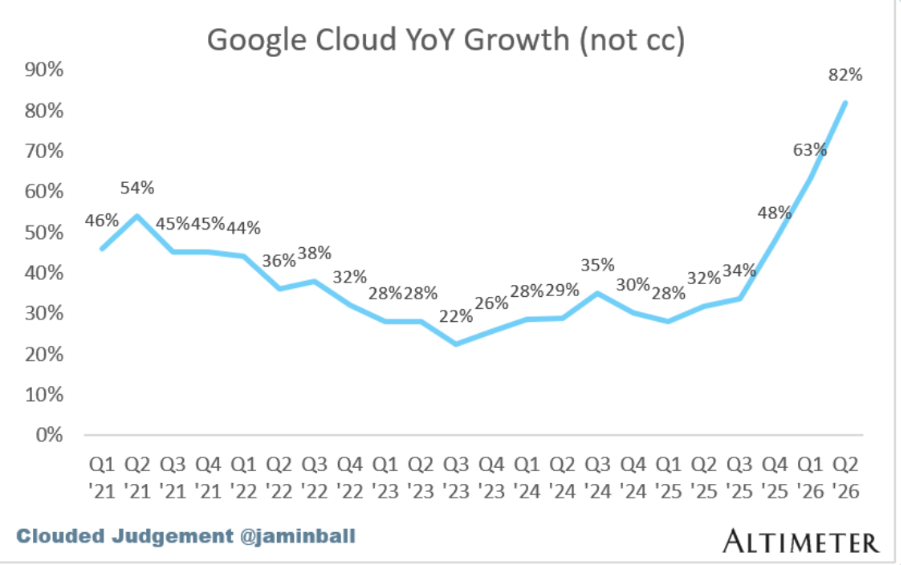
Google Cloud revenue came in at $24.8 billion, with growth accelerating to 82% in 2Q26, up from 63% in 1Q26 and 32% in 2Q25.
The strong growth was driven by Enterprise AI products and services.
In my view, Google Cloud’s stellar acceleration is largely due to a mix of vertically integrated chip platform, successful integration of Gemini across its products, strong demand for Gemini Enterprise and a leading frontier model, Gemini.
This was also the first quarter in which Google recognized revenues from TPU system sales which were delivered to customers in 2Q26.
Even without these TPU system sales, cloud revenue growth still accelerated meaningfully.
Management also stated that growth in Google Cloud was contributed by core workloads, AI solutions and AI infrastructure.
Google Cloud backlog also increased more than $50 billion sequentially to $514 billion in 2Q26, with about 50% of total backlog to be recognized as revenues in the next two years and the backlog comes from a broad mix of customers.
Firstly, Google Cloud has the best integrated AI portfolio, consisting not only of models, data, security and agent platforms, but also chips, all of which have high levels of integration.
While Google offers the best accelerators from Nvidia, one of the key drivers of differentiation and growth upside is its vertical integration and long history in developing its own chips.
This was the first quarter in which TPU systems were delivered to customer data centers and the revenues from TPU system sales agreements will be a small percentage of revenues in 2026, but Google is ramping this and the “vast majority” of revenues from these agreements will be realized in 2027.
Google continue to highlight that its TPU 8t and 8i deliver strong price performance, but further elaborated how its internally developed stack offers further differentiation.
Google’s Virgo Network was designed to meet modern large-scale AI workloads and allows customers to connect 1 million AI accelerators across multiple data center sites into a unified supercomputer.
Google’s software stack is also becoming increasingly sophisticated, with native support for JAX, PyTorch, vLLM and SGLang, enabling workload portability across GPUs and TPUs.
Google’s new agent-optimized Axion CPU delivers 30% better performance per dollar compared to its competition.
As such, due to a strong and differentiated portfolio of chips and high levels of vertical integration, Google Cloud is seeing strong growth in demand for its AI infrastructure offerings.
Secondly, Gemini Enterprise is one of the strongest growth drivers for Google Cloud.
Management highlighted that due to Gemini Enterprise differentiated and easy-to-use tools to build agents and automate processes, the company is seeing rapid adoption of Gemini Enterprise and almost 90% of Fortune 100 are using Gemini Enterprise.
Thirdly, Google is seeing diversified demand across products, customers and geographies, leading to Google winning new customers, deepening relationships with existing customers and driving growth through partners.
On new customers, Google is seeing a higher win rate of new customers and its acquisition velocity has 2x from the prior year.
As more enterprises and businesses use Gemini to build custom agents, automate processes, manage their customer relationships and more, this is also driving growth in Google’s paid token usage.
Almost 500 cloud customers have each processed more than 1 trillion tokens in the past year and over the last year, more than 2,000 enterprise customers consumed more than 100 billion tokens.
As such, Google is deepening its relationship with existing customers who are expanding their usage and exceeding their commitments by more than 50%, an acceleration from 1Q26.
Lastly, through partners, transactions on Google Cloud Marketplace is up more than 7x from the prior year, helping drive growth for Google Cloud.
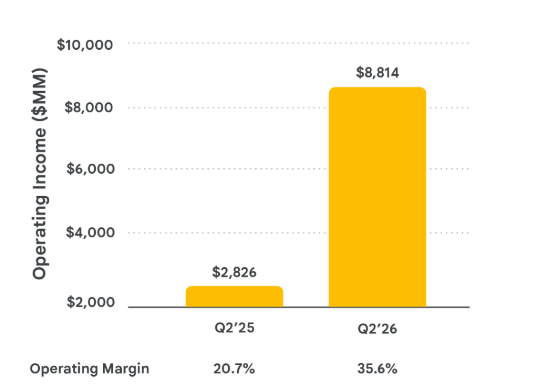
On the margin and profitability front, Google Cloud operating income more than 3x from the prior year to $8.8 billion in 2Q26.
Operating profit margin of the Google Cloud segment also increased from 20.7% in 2Q25 to 35.6% this quarter.
Comments
Nothing yet. Say the first thing.
Sign in to join the conversation.