
“When politically connected contractors receive enormous government contracts for projects of questionable need while normal environmental and oversight safeguards are waived, the public deserves answers. Border development in and around Big Bend National Park should not become a blank check for politically connected contractors. Before another dollar is spent or another acre is disturbed, the administration should explain why taxpayers are paying billions to stop illegal immigration in one of America’s least crossed, most unique landscapes.” - Tim Whitehouse, Executive Director of Public Employees for Environmental Responsibility (PEER) (August 19, 2026)

On June 16, 2015, Donald Trump descended his golden escalator at Trump Tower in New York City and officially launched his presidential campaign, changing the course of American politics forever.
Mere minutes later, the billionaire real-estate developer stood at a podium in front of hundreds of early supporters—many of whom, according to reporting by The Hollywood Reporter at the time, turned out to be paid actors who got 50 bucks to stand there—and gave the first of countless inflammatory rally speeches.
He immediately laid into Mexico and immigrants.
“Our country is in serious trouble,” Trump declared. “We don’t have victories anymore. We used to have victories, but we don’t have them.”
“When do we beat Mexico at the border?” the great orator asked the crowd. “They’re laughing at us, at our stupidity. And now they are beating us economically. They are not our friend, believe me.”
“When Mexico sends its people, they’re not sending their best. They’re not sending you. They’re not sending you. They’re sending people that have lots of problems, and they’re bringing those problems with us. They’re bringing drugs. They’re bringing crime. They’re rapists. And some, I assume, are good people.”
“But I speak to border guards and they tell us what we’re getting. And it only makes common sense. It only makes common sense. They’re sending us not the right people.”
“It’s coming from more than Mexico. It’s coming from all over South and Latin America, and it’s coming probably— probably— from the Middle East. But we don’t know.”
After about 35 minutes of complaining about massive spending on the war in Iraq, Obamacare, lobbyists, Chinese banks, oil prices, and the national debt—which was $18 trillion at the time; now it’s $40 trillion—Trump finally zoomed in on what would become one of the core messages of his campaign: the southern border wall.
“I would build a great wall, and nobody builds walls better than me, believe me, and I'll build them very inexpensively,” Trump boasted.
“I will build a great, great wall on our southern border. And I will have Mexico pay for that wall.”
Just a few months later, his supporters were shouting “build the wall,” a slogan that became an integral part of Trump’s rallies as soon as early 2016.
Boosted by his easily shoutable, crowd-rousing catchphrases, Trump was elected president on November 8, 2016, and assumed office on January 20, 2017.
When Donald Trump rode down his escalator and promised to build a wall across the southern border on that late-spring day in 2015, the construction company Southwest Valley Constructors did not exist.
That company was founded several months after President Trump entered the White House in 2017.
It was created as an affiliate of Kiewit Corporation just as the new administration began converting its defining “build that wall” campaign slogan into one of the largest federal construction programs in modern history.
Nine years later, Southwest Valley has become one of that program’s biggest financial beneficiaries.
In May of this year—as I covered in this article—Customs and Border Protection (CBP) awarded the Albuquerque-based company approximately $1.7 billion for “construction of border wall in Big Bend Texas.”
It was the largest single-project contract for border-wall construction in American history.
Southwest Valley’s parent company is hardly a fledgling business. Kiewit is a privately held, employee-owned construction and engineering giant founded in 1884. Based in Nebraska, the corporation reported $18.2 billion in revenue and 34,500 employees in 2025.
Southwest Valley, however, has developed a much narrower identity.
Its shockingly sparse, one-page website says it specializes in “large-scale construction for the federal government” and emphasizes its “history of working with the U.S. Army Corps of Engineers and U.S. Customs and Border Protection.”
In practical terms, this is a private company that relies almost exclusively on the enormous market Trump created for border construction—and survives on federal contracts paid with public money.
During Trump’s first presidency, Southwest Valley received at least $2.7 billion for approximately 100 miles of border-wall work in Arizona and Texas.
More than $2 billion came from a single Tucson-sector contract awarded in May 2019, which then expanded significantly through subsequent modifications. In 2020, ProPublica reported that no company had received more federal border-wall money since 2017.
This summer, Southwest Valley arrived at an actual National Park—a park that can’t even afford to repair the assets it already has—to build all kinds of obscure infrastructure, including roads, detention technology, and other undisclosed features.
On August 5, 2026, the company began bulldozing new roads along the Rio Grande in Big Bend National Park, clearing native vegetation and destroying wildlife habitat.
It had—and still has—free reign to do that because Homeland Security Secretary Markwayne Mullin waived 31 environmental and resource protection laws. Those laws remain waived to this day.
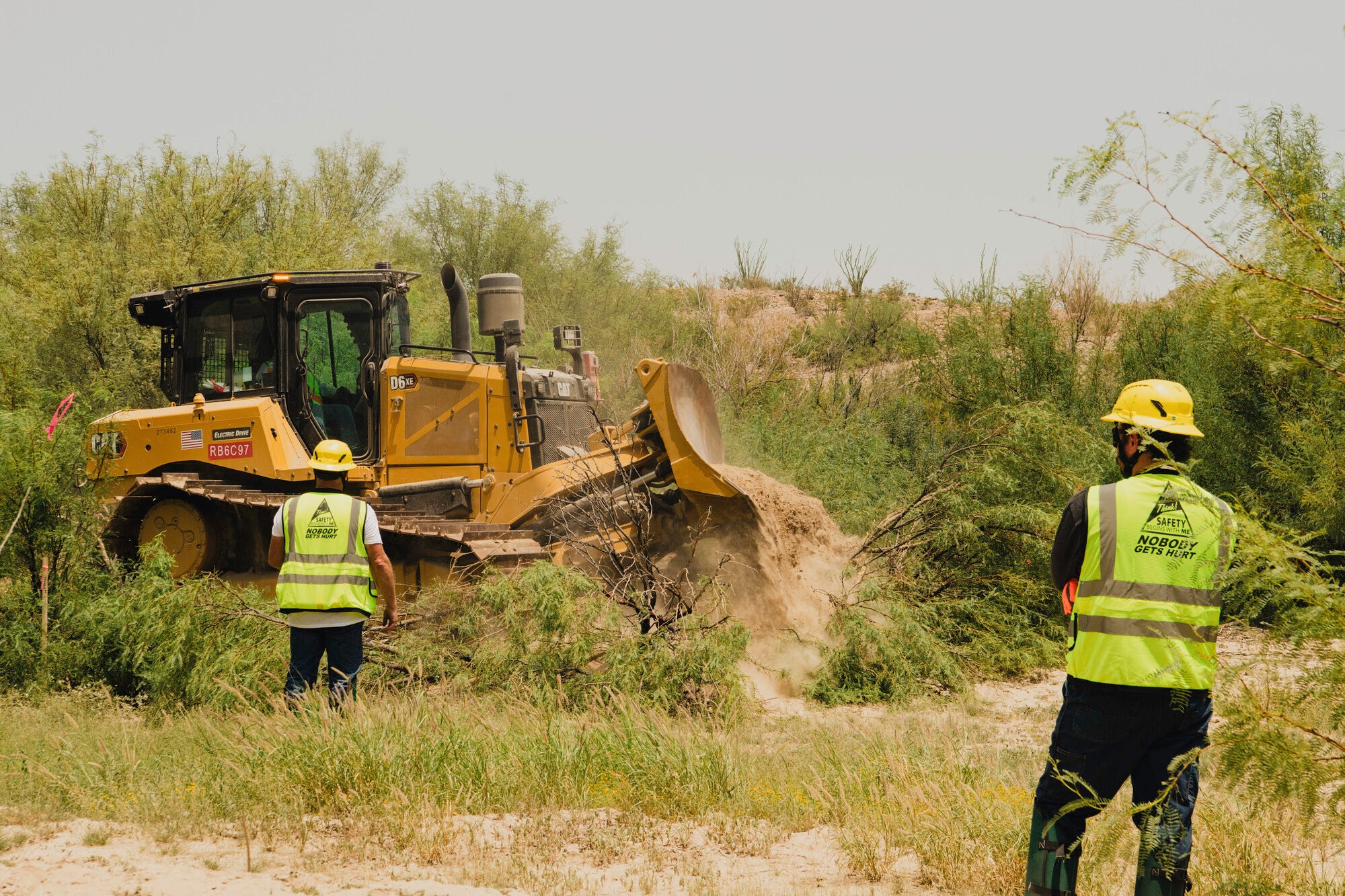
“This decision will be remembered by generations of Texans—and all Americans—as a waste of our money and an assault on not just our iconic desert but on the values that our national parks epitomize,” said Bob Krumenaker, former Big Bend National Park Superintendent and current chair of Keep Big Bend Wild.
Massive public outcry, universal bipartisan opposition, passionate protests, and widespread news coverage forced CBP to “pause” the project. Last Wednesday, August 19, the bulldozers and excavators began leaving the park.
According to Keep Big Bend Wild, the pause, as it currently stands, will be in effect through August 31. That’s only one more week from today.
“We hear the Commissioner is considering abandoning construction of all new roads in the national park, and that everything is negotiable,” the nonprofit wrote on Instagram.
In his Wes Siler’s Newsletter, outdoor journalist Wes Siler, based on an anonymous source, wrote yesterday that “[a]s for when construction might resume, expect that to take 10 days to two weeks, says my source. And, when heavy equipment does resume, expect it to be confined to existing roadways, to avoid the problematic optics of it cutting through pristine desert that occurred during the first attempt.”
“We’ll remain positive,” said Keep Big Bend Wild, “but even if they stick to existing roads, until their plans are transparent and public input is sought and considered before the dozers and excavators return, there’s still tremendous damage that can be done as long as the legal waiver remains in place.”
“We will stay vigilant, and do everything we can do to keep the light shining on Big Bend. It’s what has gotten us to this point. We are not pausing, even if the contractors are.”
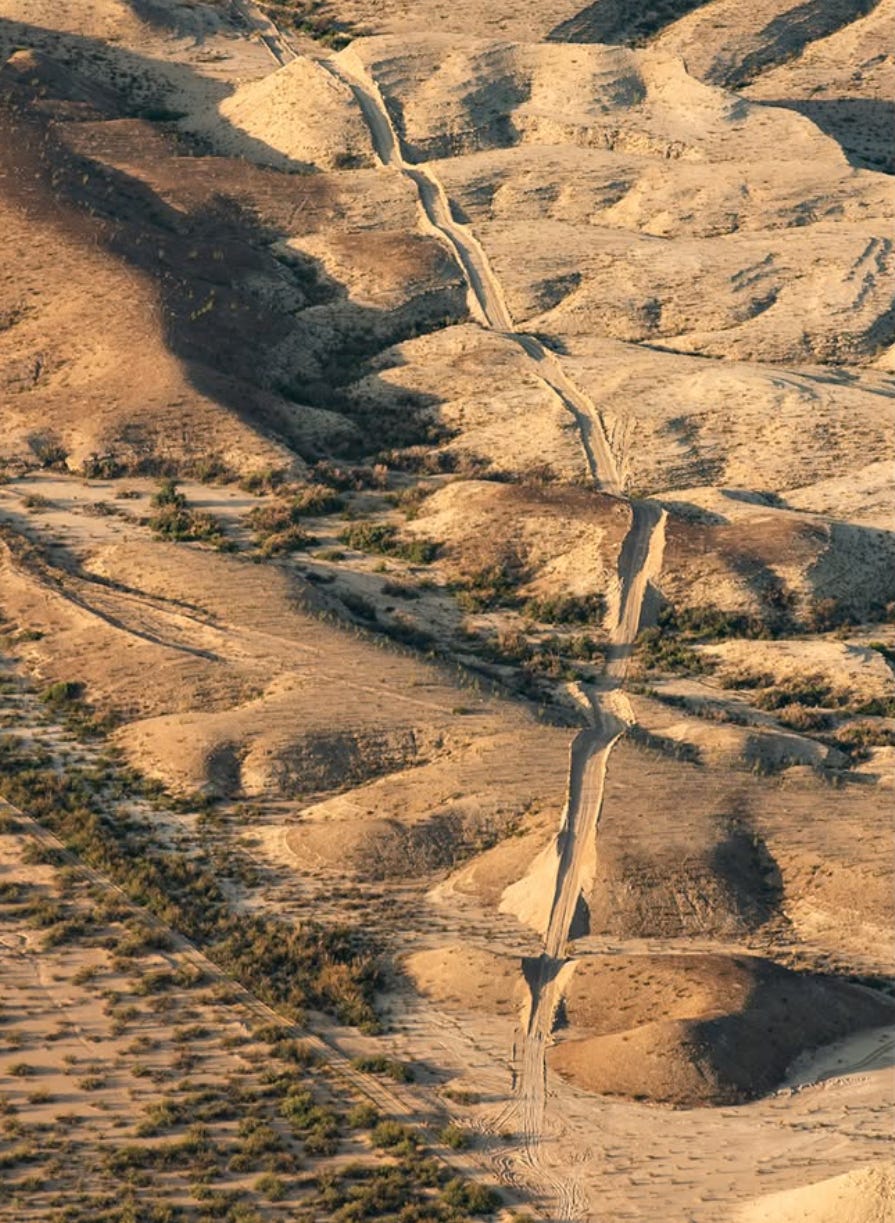
Big Bend National Park had an annual operating budget of approximately $8.2 million in 2023.
That money was responsible for running the entire 800,000-acre park: paying rangers, firefighters, emergency responders, scientists, maintenance workers, and interpreters while supporting campgrounds, roads, trails, visitor centers, employee housing, water systems, sewage systems, wildlife research, law enforcement, and search-and-rescue operations.
Southwest Valley Constructor’s $1.7 billion Big Bend border contract is equivalent to roughly 210 years of Big Bend National Park’s annual operating budget.
The park’s maintenance needs tell a similarly revealing story.
According to a National Park Service infrastructure assessment, Big Bend had accumulated approximately $197 million in deferred maintenance and repairs at the end of fiscal year 2025—that was September 30, 2025.
Paved roads account for the vast majority of that deferred maintenance backlog.
Paved roads: $121 million
Water systems: $25 million
Buildings: $21 million
Unpaved roads: $14 million
Employee housing: $8.8 million
Trails: $2.2 million
Campgrounds, wastewater systems, and other assets: millions more.
The Park Service estimates that Big Bend needs another $11 million every year simply to perform routine maintenance and keep conditions from deteriorating further.
That’s already $2.8 million more than the park’s entire 2023 operating budget—and routine maintenance does not include modernization, accessibility improvements, expanded visitor capacity, or reduction of the existing $197 million backlog.
Again, for context: Southwest Valley’s massive Big Bend National Park border infrastructure project costs $7.3 million per mile. That’s very close to the park’s entire annual budget for a single mile of paved two-lane road.
The $1.72 billion border contract could eliminate Big Bend National Park’s complete maintenance backlog nearly nine times over.
It could erase the entire $197 million backlog and leave enough money to meet the park’s modeled annual maintenance requirement for another 138 years.
Instead, however, us taxpayers are financing the paving of backcountry roads, the construction of new barriers, gates, communications systems, sensors, and other infrastructure, all of which will themselves require maintenance long after Southwest Valley leaves.
If Big Bend National Park’s annual budget does not increase, its deferred maintenance backlog is going to explode.
But what does the Trump administration want to do? You guessed it: decrease the National Park Service budget, which would also reduce Big Bend’s annual budget.
The administration has repeatedly tried to reduce the funding and workforce available to manage these public lands and assets.
Its fiscal year 2026 request proposed cutting discretionary National Park Service funding by 37 percent from the previous year. Congress rejected much of that proposal.
Its fiscal year 2027 budget included another proposed reduction of approximately $760 million— 26 percent—from park operations, along with a 44% cut to the Park Service’s “construction, improvements, repair, or replacement of physical facilities, and compliance and planning” account.
The administration calls properly staffing the Park Service and repairing public infrastructure wasteful. But it considers $1.7 billion for a private contractor to build new infrastructure inside a national park an urgent investment.
It’s worth repeating this question again: who, exactly, is paying for all these unwanted roads, barriers, obstacles, and habitat destruction in Big Bend?
It’s American taxpayers.
All of us are paying Southwest Valley Constructors.
We’re all paying for the roads, barriers, surveillance equipment, contractor camps, labor, contract modifications, and corporate profit. It’s us who will pay to maintain this new infrastructure.
And we may also end up paying for the repair of the erosion, depleted water sources, damaged habitat, and archaeological losses left behind by whatever construction ultimately occurs in Big Bend National Park when the “pause” is lifted.
Despite Trump’s original promise at Trump Tower on June 16, 2015, Mexico is not paying for any of it.
“A pause is welcome, but it does not answer the fundamental question of why billions of taxpayer dollars are being spent on these projects in the first place,” said Tim Whitehouse, Executive Director of Public Employees for Environmental Responsibility (PEER) in a statement. “When politically connected contractors receive enormous government contracts for projects of questionable need while normal environmental and oversight safeguards are waived, the public deserves answers.”
PEER is actively pursuing an investigation into how exactly the Big Bend border contracts were awarded—and if they were awarded fairly.
“Border development in and around Big Bend National Park should not become a blank check for politically connected contractors,” Whitehouse added. “Before another dollar is spent or another acre is disturbed, the administration should explain why taxpayers are paying billions to stop illegal immigration in one of America’s least crossed, most unique landscapes.”
“So let’s look beyond the pause,” wrote Keep Big Bend Wild on Instagram. “The need for legislation has never been greater, and there will be a new Congress in 2027 with a likely different dynamic.”
They called for three legislative actions once the new Congress is sworn in:
Designate most of the undeveloped areas of the park as an official “Wilderness Area,” the highest form of public land protections in the United States.
Rescind the waiver of federal environmental and resource protection laws and prohibit any new waiver of those laws in the future.
Cancel all outstanding border infrastructure contracts and require that CBP pays for the any destruction their work has caused in Big Bend National Park.
“This is not a pipe dream,” they wrote, addressing the ever-growing pro-public land and pro-conservation movement currently building in the country.
“We can do this—we urge everyone who opposes what is being done to the park, and desires that its resources, values, and opportunities be guaranteed to be preserved for our grandchildren, and theirs, please support us if you’ve not already done so, and work with us to make that a reality.”
“People, businesses, and governments are essential to show elected reps of both parties that Texans and the rest of the United States are united, and we expect them to act, not just talk, to protect Big Bend in perpetuity.”
If you’d like to support Keep Big Bend Wild, you can do so here.
In order to create more protections for our public lands, waters, and wildlife, it’s absolutely essential to vote this upcoming November. That’s when we’ll actually be able to make the biggest difference.
So make sure to register to vote. And actually vote.
You can check the environmental and public lands track record of your representatives on the comprehensive Congressional Scorecard from the League of Conservation Voters.
And if you’re in a particularly strong protect-public-lands mood and want to submit more comments, you can find all public comment periods that are currently open on the superb Public Land Comment Map created by onX.
Lastly, if you’d like to support independent public lands and conservation writing, please consider becoming a paid subscriber today. My work is made possible exclusively by paid subscribers.
Thanks for helping to protect our public lands and waters!
See you out there,
Bram
Comments
Nothing yet. Say the first thing.
Sign in to join the conversation.