
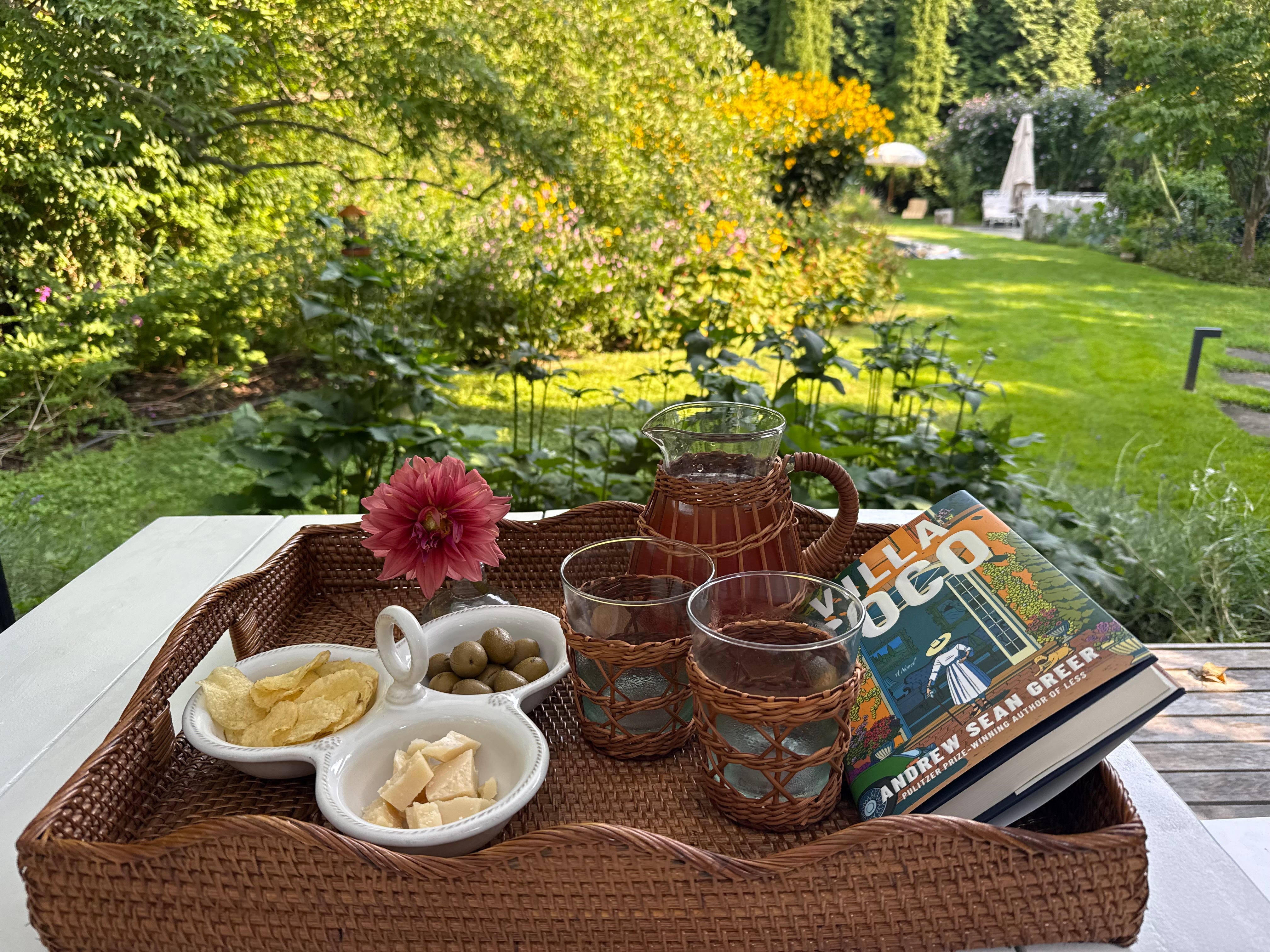
Andrew Sean Greer, author of the 2018 Pulitzer-prize winning, Less, calls his latest book, Villa Coco, a charm novel.
A charm novel takes you into a world with its own peculiar logic, populated by people who are eccentric, beguiling, witty, sometimes upper class, and almost certainly exhausting to know in real life. There is often a fish out of water: the young American in Europe, the Southerner in New York, the poor relation among the rich. You are entertained and sent home with several life lessons you didn’t know you were signing up for.
I Capture the Castle by Dodie Smith is a charm novel. The Razor’s Edge by Somerset Maugham is one of my favorites. John Berendt’s Midnight in the Garden of Good and Evil has it. Even parts of Styron’s Sophie’s Choice, despite obviously being something much darker and larger, have this quality for me: the young Southerner arriving in Brooklyn and falling into the orbit of people whose rules he doesn’t yet understand.
Villa Coco is emphatically that kind of book—and my kind of book.
The novel follows a young American archivist, “our young man,” who goes to work for ninety-two-year-old Coco, an imperious baronessa with a house full of beautiful objects and very strong ideas of what matters, based on Beatrice Monti della Corte von Rezzori, the great Italian hostess and literary patron, and the wife of Gregor von Rezzori, an Austrain novelist who wrote the book Memoirs of an Antisemite. Our hero’s job is ostensibly to sort and document a life, but inevitably he gets pulled into the life itself: its friendships, love affairs, grudges, possessions, performances and self-mythology. What began as archival work becomes something closer to an education in how a life is assembled—and how, to go about disassembling it at the end.
I have, as it happens, quite a history with imperious older ladies. Perhaps I have the face of someone who needs instruction. And I was drawn to them—they were surrogates for my imperious grandmother who died when I was eight.
When I was in my twenties, I became the pet—or, in two cases, the reluctant employee-pet—of three formidable women: a grand dame seemingly deposited directly from the Austro-Hungarian Empire, whose memoir I ghostwrote; an Italian decorator with a title acquired somewhere along the way; and an English haut-bohemian literary queen.
I spent a summer coming and going from Nantucket to interview the Grand Dame, who had a beloved poodle she once emergency-airlifted off the island when it became ill. (Coco has pugs.) She had survived the Holocaust; her mother had not. While hiding in a convent as a teenager, she had discouraged the nuns from taking her mother in too. She told me this quite matter-of-factly: “I was a teenager. I didn’t want my mother there.”
The decorator was hugely talented and bullied everyone, including her clients. She also required her assistants to join her for a glass of wine at lunch. Abstention, like most things, was apparently not an option.
The English editor, whom I was closest to, was wild and wonderful, hilarious and no-nonsense. It was me arriving in NYC and falling into the orbit of people whose rules I didn’t yet understand. After my heart was broken, she took me to her family’s camp upstate to recover and, finding recovery rather slow, prescribed: “The quickest way to get over a man is to get under another.”
All three were glamorous. All three were funny. All three possessed very definite ideas about how life should be lived and an equally definite belief that I would benefit from hearing them. And all three relationships ended, in one way or another, catastrophically.
For years I have thought of them as the three fairies in Sleeping Beauty, only darker. Three bad fairies who appeared at the christening of my adult life, leaned over the cradle and whispered their peculiar blessings:
“Unfortunately, you’re a dreamer.”
“It’s all about having children.”
“Never be boring.”
“Study how the Italians dress. They do it best.” (Advice from two of the three.)
“No one gets out of here alive.”
“Claus von Bülow was innocent.”
Then they vanished in a puff of cigarette smoke, perfume and grievance.
Which may explain why I was particularly susceptible to Villa Coco.
Michael and I actually knew Beatrice Monti, who inspired the novel. From 2016 to 2018, Greer was the executive director of Santa Maddalena, the literary retreat she founded in Tuscany.
Once, when Michael had gone to Rome to write a piece, we were sitting peacefully in our hotel when the telephone rang. Mrs. Monti had been alerted to our presence—I believe through either Graydon Carter or Michael’s agent, Andrew Wylie—and immediately took charge.
There were people we must meet. People we needn’t bother with. Places we should go. Arrangements she would make. Our independent existence in Rome was over. This was not presented as a suggestion.
We subsequently went to many parties in her extraordinary two-room pied-à-terre in New York City, where writers and artists seemed to spill from every available surface. Young writers lounged on her bed. Everyone smoked and talked and appeared to be participating in a much better novel than the one they were writing. I loved it. I also found it exhausting.
This is the difficulty with imperious women. They can make the world much more interesting while making your own life considerably less convenient.
Greer understands this. His great achievement is that the older woman isn’t merely an obstacle, a monster, or a colorful old eccentric trotted on to say outrageous things. She is the gravitational center of the book. And how rare that is.
Older people, and particularly older women, have an irritating habit of disappearing from our culture at precisely the moment they have accumulated enough material to become really interesting. Greer does the opposite. He gives his grande dame the stage.
Somewhere in reading him, I began to wonder whether I had been telling my own story incorrectly. Because there are at least two ways to remember an imperious woman. In one version, she is the villain. She uses you. She criticizes you. She demands loyalty wildly disproportionate to your salary or emotional availability. Eventually there is a rupture and you escape by the skin of your teeth.
But in the other version, she is a comic character.
She is still vain and unreasonable and occasionally monstrous. You don’t have to falsify the evidence. You simply give her her due. You remember that she was also brave, original and enormously funny, that she knew things, that she had survived a vanished world and constructed another one around herself, that she understood pleasure, and that she refused to become invisible.
And, most annoyingly, you acknowledge that some of the things she told you turned out to be true.
Which brings me to some of my favorite life lessons from Villa Coco.
Comments
Nothing yet. Say the first thing.
Sign in to join the conversation.